Aureka Biotechnologies Raises $100 Million in Series B to Double Down on Foundation Models and Push New Frontiers in AI Drug Discovery | 5Y News

A crucial step toward a biological world model.

Aureka Biotechnologies recently announced the completion of a $100 million Series B round. The round was completed in stages: the first tranche was led exclusively by Granite Asia, with subsequent tranches led by prominent industry investors and participation from HLC. Existing shareholders including Qiming Venture Partners, Matrix Partners China, and Nueli Capital continued their investment. Aureka's total funding raised now stands at nearly $200 million.
The proceeds will be directed primarily toward R&D and large-scale training of next-generation biological foundation models, with continued investment in advancing their capabilities on core tasks including de novo molecular design, biological structure modeling, and functional prediction. The company will also further upgrade its Lab-in-the-Loop system, which uses experimentation as its core feedback mechanism, driving deep integration between the foundation model and proprietary single-cell functional screening, high-throughput experimental validation, and drug development platforms.
Aureka has already completed the construction of its closed-loop AI-native infrastructure. The next step is to strengthen the foundation model as the "intelligent core" of this entire system — combining large-scale pre-training, project-specific fine-tuning, AI agents, and scalable experimental operations to build AI for Science infrastructure purpose-built for the life sciences. This will enable the model to move beyond solving isolated drug discovery tasks toward continuously learning biological principles, and understanding, generating, predicting, and intervening in complex biological systems.
As the foundation model and automated R&D infrastructure accelerate their integration, Aureka will evolve from "using AI to improve drug discovery efficiency" toward "using AI to model living systems," continuously expanding the technical frontier and industrial ceiling of AI-driven drug discovery.

Closed-Loop AI Infrastructure Incubates a Stronger Intelligent Core
Founded in 2023, Aureka is an AI-native TechBio company dedicated to developing next-generation biological foundation models and building closed-loop AI-native infrastructure comprising AI models, agents, digital biotechnology, and experimental platforms to reimagine the entire drug discovery process.
The life sciences are a domain of complex scientific research that depends heavily on real-world feedback. Advancing the capabilities of biological large models requires not only computing power, algorithmic innovation, and novel model architectures, but also high-quality experimental data that authentically represents molecular function, alongside experimental systems that continuously validate model hypotheses, correct model biases, and generate iterative feedback.
To this end, Aureka has made Lab-in-the-Loop a first-class infrastructure component of its model development, deeply integrating AI agents, high-throughput digital biotechnology, proprietary single-cell functional screening, and in-house experimental platforms into a closed-loop system covering molecular generation, experimental design, functional validation, data feedback, model fine-tuning, and candidate molecule development.
In this system, the laboratory is no longer merely a validation step after model-generated results — it becomes a core component directly participating in model learning and capability evolution. The model proposes experimentally testable molecular designs and scientific hypotheses; the experimental platform produces high-quality functional data; and this data flows back into the foundation model and project-specific models, driving continuous iteration and entering the next cycle of design and validation.
This Lab-in-the-Loop mechanism enables Aureka to autonomously generate large-scale, multi-dimensional, high-information-density functional experimental data for continuous use in foundation model pre-training, reinforcement learning, and project-specific fine-tuning. Compared to model development paths that rely primarily on public, static datasets, Aureka's models continuously receive experimental feedback through real drug discovery projects, evolving through cycles of design—validation—learning. This creates a closed-loop flywheel where data, models, experiments, and drug assets mutually reinforce each other — a dynamic approach that could be described as "using motion to overcome stillness."

Foundation Model Capabilities Validated Through Third-Party Benchmarks and Experimental Results
Built atop its closed-loop AI-native infrastructure, Aureka independently developed its biological foundation model AuraIDE. Trained at scale on proprietary protein co-evolution data, the model learns deep patterns among protein sequence, structure, evolution, and function, establishing leading advantages in biomolecular structure prediction and de novo molecular design.
AuraIDE is not a vertical algorithm developed for a single task, but a biological foundation model capable of adapting to diverse drug discovery scenarios through task adaptation and project-specific fine-tuning. Its capabilities are expanding from protein structure modeling and molecular generation to biomolecular interaction modeling, functional prediction, and multi-objective optimization under complex design constraints.
The open-source version of AuraIDE, OpenDDE, has passed independent third-party evaluation, with performance ranking among the top global open-source biomolecular models.
Third-party benchmarks and real experimental results together demonstrate that Aureka's foundation model possesses not only leading protein structure prediction and de novo design capabilities, but also the ability to translate model capabilities into real molecular function. Through continuous feedback from Lab-in-the-Loop, the model is evolving from "predicting biological structures" toward "generating biomolecules with target functions."
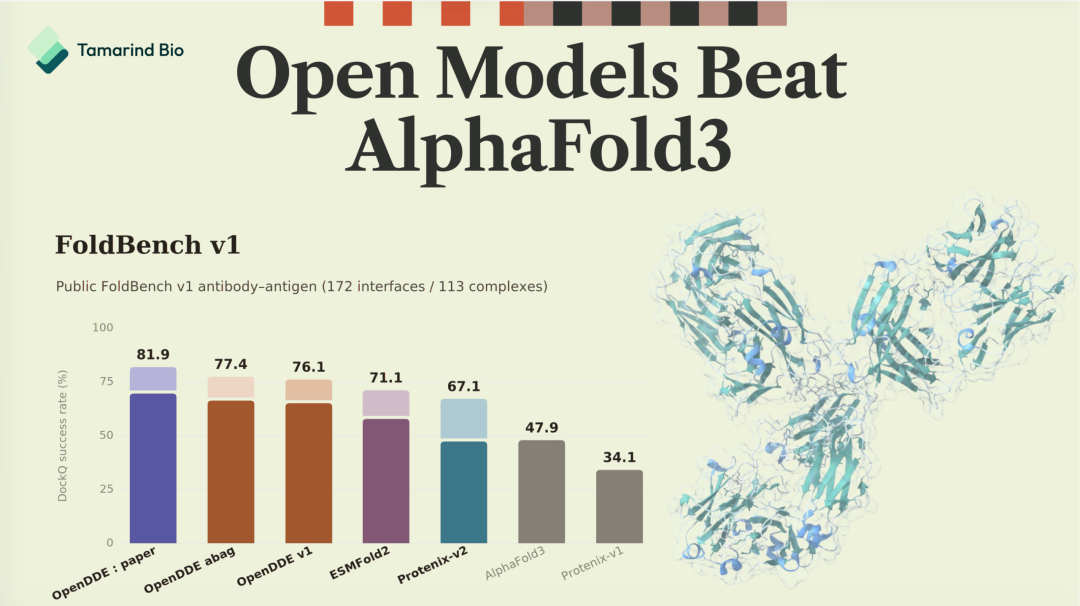
OpenDDE's third-party benchmark performance on the public antibody-antigen structure prediction benchmark FoldBench v1
Source: Tamarind Bio, "Open Models Beat AlphaFold3," FoldBench v1 benchmark.

Diverse Commercial Monetization Pathways
Leveraging its biological foundation model, proprietary single-cell functional screening platform, and project-specific fine-tuning technology, Aureka has already produced high-value, differentiated antibodies at scale in traditionally difficult-to-crack programs including GPCRs and bispecific monoclonal antibodies.
On specific projects, Aureka can conduct project-level fine-tuning of the foundation model around target mechanisms, functional phenotypes, and developability goals, transforming the model from general biological intelligence into a specialized model oriented toward specific drug discovery challenges. AI agents then collaborate to complete target understanding, molecular generation, computational evaluation, experimental design, and results analysis, with experimental data continuously feeding back into the model to form a closed-loop learning system operating around the specific project.
The company's end-to-end agentic R&D infrastructure spans molecular generation, developability assessment, experimental validation, results feedback, and candidate molecule development, enabling rapid translation of scientific hypotheses, model capabilities, and experimental capabilities into developable drug assets, while continuously supporting both internal pipeline and external partnership advancement.
Aureka has already established strategic partnerships with multiple global top-tier pharmaceutical companies to jointly advance differentiated antibody drug development, achieving tens of millions of dollars in commercial revenue over the past two years — validating its AI platform's delivery capability, scalability, and commercial potential in real drug discovery projects.

From Improving Step Efficiency to Simulating Biological Systems
Advancing Toward Biological World Models
Dr. Weian Zhao, Aureka's founder and CEO, stated: "When leading biological foundation models are truly combined with scalable R&D infrastructure, we are no longer just improving efficiency at certain steps of drug discovery — we are building the next-generation drug discovery engine capable of understanding, generating, and predicting biological systems. This is also a critical step for Aureka toward biological world models."
In Aureka's long-term technical roadmap, biological world models will no longer be limited to predicting static molecular structures, but will further simulate molecular interactions, extrapolate the potential outcomes of molecular design and engineering, and support AI agents in autonomously planning, executing, and iterating drug design tasks.
Through this financing round, Aureka will further advance the co-evolution of biological foundation models and closed-loop AI-native infrastructure, accelerate the validation and translation of model capabilities in real drug discovery projects, and continuously expand the capability boundaries of generative AI in antibody drug R&D.

About Aureka Biotechnologies
Aureka Biotechnologies is an AI-native TechBio company dedicated to building next-generation biological foundation models and closed-loop AI-native infrastructure to reimagine the entire drug discovery process. The company has raised nearly $200 million in total funding and established strategic partnerships with multiple global top-tier pharmaceutical companies to jointly advance differentiated antibody drug development.
The company's independently developed foundation model AuraIDE is trained on proprietary protein co-evolution data, establishing leading advantages in protein folding and de novo design. Its open-source version OpenDDE has passed independent third-party evaluation, with performance ranking among the top global open-source models. Combined with proprietary single-cell functional screening platforms and project-specific fine-tuning technology, the company has produced high-value, differentiated antibodies at scale across multiple traditionally difficult-to-crack programs including GPCRs and bispecific monoclonal antibodies. Through end-to-end agentic R&D infrastructure, Aureka accelerates the translation from innovative concepts to candidate compounds, supporting continuous scaled advancement of both internal pipeline and external partnerships.