Industrial Functional Coating Digital Inkjet Firm Shifang Technology Closes Nearly RMB 300 Million Funding Round | 5Y News

Bringing industrial coatings into the digital inkjet era.

Shifang Technology, a company focused on digital inkjet printing technology for functional industrial coatings, recently closed two consecutive funding rounds. From its Series B through the completion of its B+ round, the company raised nearly RMB 300 million in total. The round was led by 5Y Capital, CCV, Tongchuang Weiyue, and leading strategic investors including Hengxu Capital, Xiaomi, and NIO Capital, with several existing shareholders also increasing their stakes.
Founded in 2020, Shifang Technology provides high-precision, high-viscosity, micron-level functional coating digital inkjet printing core components and system solutions for industrial applications. The company has globally launched the first functional coating UV inkjet printing engine, which is now widely used in new energy, PCB, automotive, and other industrial sectors.
In the new energy battery sector, traditional cell insulation has relied primarily on film-wrapping processes. While mature and lightweight, this approach faces growing challenges with larger cells — declining yield rates, interface aging, and swelling failures. UV spraying processes that have emerged in recent years have addressed some pain points, but still suffer from complex masking procedures, poor edge precision, and low material utilization, resulting in high overall costs.
Against this backdrop, UV inkjet printing is becoming an important upgrade path for cell insulation coating processes. By precisely jetting materials onto workpiece surfaces through printheads and curing them with light, it enables more refined coating control. Compared to traditional processes, UV inkjet printing improves yield rates, reduces material waste, significantly lowers equipment investment costs, and enables more flexible coating processing based on performance requirements.
One of Shifang Technology's core strengths lies in its full-stack self-developed capabilities around the printing engine's core components, achieving independent control of key technologies. Through proprietary control boards, ink supply systems, software algorithms, and other modules, the company has built a complete technical stack covering hardware, software, fluid control, and material adaptation.
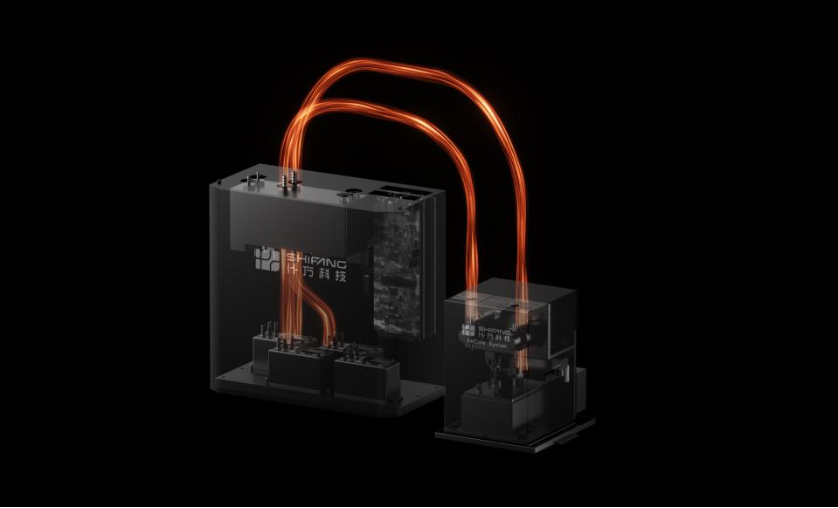
Product Overview (Source: Company)
The challenge of industrial functional coating printing goes beyond simply "spraying material out" — it lies in the systematic coordination between materials, equipment, and processes. To this end, Shifang Technology has established the Praxis Functional Coating Laboratory, focused on new process development, new material adaptation, print effect validation, and film performance testing, helping customers complete the entire journey from material validation to mass production ramp-up.
Currently, the company has partnered with over 50 domestic and international material companies, with related material systems already entering the supply chains of several leading battery manufacturers. For customers with existing ink systems, Shifang Technology can also complete adaptation validation between material properties, printing processes, coating performance, and printing systems through its laboratory. This provides customers with full-chain solutions from printing engines to process adaptation and validation, through to mass production deployment.
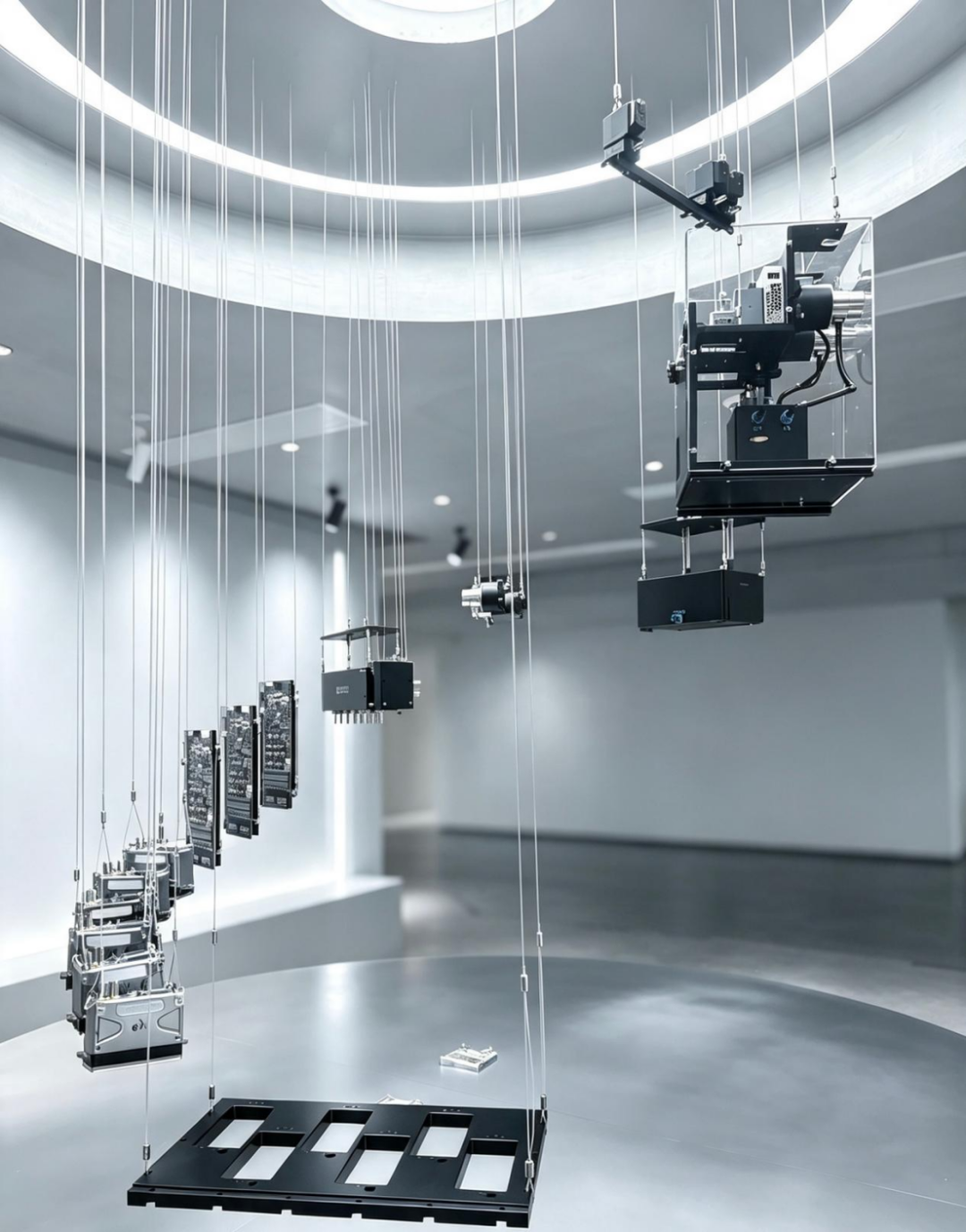
Core Component Display (Source: Company)
Addressing differentiated needs across various industrial scenarios, Shifang Technology has launched two product series — the XF series high-throughput, high-viscosity functional coating printing engines, and the P series high-precision functional coating printing engines. The XF series targets high-dose, high-speed production applications, with maximum single-dot droplet volume of 160 pL and maximum single-pass print thickness of 120μm, focusing on high-viscosity, thick-coating, high-throughput printing needs in areas such as new energy cell insulation coatings and perovskite functional layers. The P series addresses low-ink-volume, high-precision scenarios, with minimum droplet size of 3 pL and thinnest print thickness of 1μm, suitable for coating applications in PCBA conformal coating, solid-state battery adhesive frames, semiconductors, and other high-precision fields.
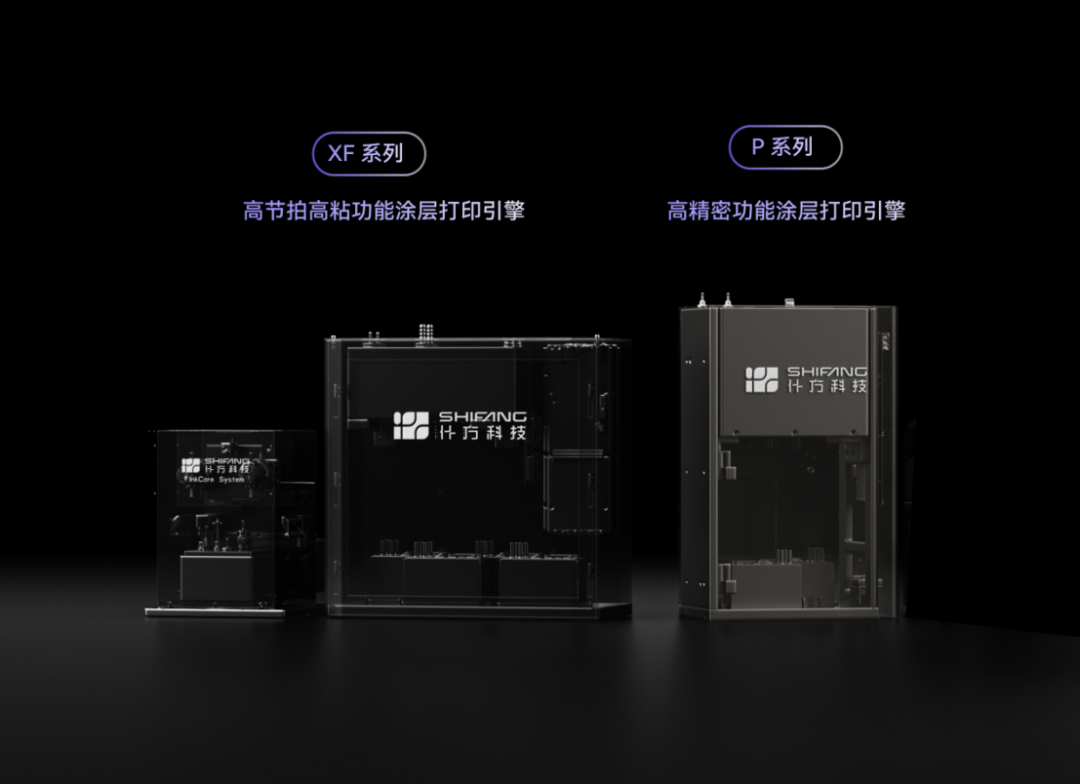
Product Series (Source: Company)
On the commercialization front, new energy batteries represent Shifang Technology's largest current application market. The company now serves over five leading battery manufacturers, with more than 5 million cells having undergone insulation coating processing using Shifang Technology's printing engines. In deployed mass production projects, the company has leveraged its self-developed hardware and software to implement top-spray, side-spray, and multi-angle spray printing methods, accommodating prismatic, cylindrical, and blade-cell formats across all categories. First-pass yield exceeds 98%, material utilization surpasses 99%, and production line throughput reaches up to 56 PPM — meeting the stringent requirements of energy storage and power battery manufacturing for coating performance, consistency, and mass production efficiency.
Furthermore, as solid-state battery commercialization accelerates, demanding higher standards for insulation and sealing structures, the value of digital inkjet printing technology extends to solid-state battery adhesive frame applications. This can address the low efficiency and poor precision control of traditional processes. Shifang is currently conducting joint process validation with several leading battery manufacturers.
Meanwhile, PCBA conformal coating is becoming the company's second growth curve. The industry still relies primarily on traditional processes such as atomized air spraying and needle dispensing, with single-dot ink volumes at the nanoliter level and requiring manual masking and path planning — unable to meet demands for higher precision and efficiency. Shifang Technology's P series printing engines, by contrast, achieve picoliter-level droplet control. This finer granularity enables more precise coating control, with thickness accuracy within ±10% of target values across the 1-50μm range, and enables different thicknesses in different regions in a single pass. Additionally, it supports importing graphic template files or generating templates from photos, enabling digital automatic avoidance of no-coating zones without masking or path planning — increasing production efficiency by more than 10x compared to traditional processes.
On the team front, over 35% of the company holds master's or doctoral degrees, and R&D accounts for over 80% of staff. The core R&D team comprises PhDs and master's graduates from Tsinghua University, Peking University, Xi'an Jiaotong University, Harbin Institute of Technology, and other leading institutions. The company has obtained over 100 independent invention patents covering key areas including inkjet printing technology, droplet observation systems, ink path control technology, and automated optimization algorithms.
Liu Kai, Partner at 5Y Capital, stated: From our first meeting through our continued investment, our assessment of Shifang has never changed: this is a team that starts from first principles, refining technical excellence at every stage into commercial moats, gradually forming a platform-type technology company. We've witnessed Shifang, in just two short years, transform UV inkjet printing from a "good idea" into a standard process on leading cell production lines, and now gradually expand into new scenarios like PCB. Teams that understand both technology and business, evolving faster than the industry itself, are extremely rare in Chinese manufacturing. 5Y is willing to continue supporting such teams as they push the boundaries in technology's uncharted territories!

The following is an excerpt from Hard Kr's conversation with Shifang Technology's founding team:
Hard Kr: Functional materials are difficult to make printable — how did Shifang Technology solve this problem?
Founding team: Actually, in the functional coatings space, if something can be solved through printing, the advantages over traditional processes are quite significant. The biggest advantage is that materials can be maximally utilized — printed on demand.
But most functional materials are difficult to print, because once functionality is involved — such as conductivity, insulation, corrosion resistance — material formulations become extremely complex. And printing itself imposes very high requirements on materials, with a very narrow process window. The material system and printing process must be highly matched, which makes things very difficult. So we chose to work with top global material companies on this. China's material supply chain has cultivated a cohort of suppliers with high-level research capabilities over the past decade, and through technical guidance and formulation adjustment recommendations, we've achieved matching between multiple materials and printing processes.
Material companies are also very willing to collaborate, because printing processes can help enhance material value. For the same material, traditional spraying may have substantial waste — perhaps 30% of material ultimately goes unused. But with printing, perhaps 99% of material lands precisely on target with minimal waste. This way, the material itself can demonstrate higher value.
Hard Kr: When different industries adopt digital inkjet printing technology — such as new energy, PCB, consumer electronics — do printheads, software, and materials require extensive customization? How do you address technology reuse?
Founding team: Different industrial printing applications do have many differences, but our understanding of reuse can be divided into technology reuse and component reuse.
Our methodology focuses more on examining experience through an engineering mindset at the underlying logic level, elevating this experience into more transferable know-how. So when facing new application scenarios and problems, technology is actually highly reusable. And the common requirements for functional coating preparation across different fields and products are actually very high. Simply put, they almost all focus on a few very straightforward requirements: uniform thickness, clean edges, and precise positioning. And these requirements, through in-depth research into various fluid characteristics, printhead control matching, and control of the landing, wetting, and spreading process from material to substrate, once thoroughly understood and mastered, can simultaneously solve problems across multiple scenarios.
For component reuse, there is cross-scenario reuse potential for printing materials across different industries. Looking at our BOM, we found the core components are all standardized hardware such as printheads, ink paths, and control boards. Because we build core functional systems, there actually aren't many customization requirements at the smallest unit level. Currently our BOM reuse rate can reach around 70%, and could even exceed 80% in the future.
Hard Kr: Why is the current focus on printing components rather than complete equipment?
Founding team: On one hand, we see enormous opportunity in printing components. Printing is a platform technology with high difficulty and large market potential, but the industry previously lacked systematic solutions. Equipment manufacturers have strong equipment control capabilities but lack printing process accumulation; material manufacturers conduct formulation R&D without clear directional guidance; supply and demand sides couldn't form effective coordination. Neither side had sufficient printing know-how, resulting in poor printing outcomes. What was missing in the middle was a company that could produce standardized printing components — we filled the industry-wide gap for system-level printing engines, with no mature deployed cases domestically or internationally.
On the other hand, it's about timing in the industry cycle. We believe we've reached a golden window for entering the printing engine segment. Entering 10 years earlier would have meant no corresponding material and equipment support, and related investment would have merely become industry cannon fodder. China's new energy equipment industry achieved global leadership in 5-10 years, and the supporting maturity of the current printing segment is now sufficient to support technology deployment. Our downstream has grown into large enough application scenarios to allow printing engine business to be tackled as independent major scenarios one by one, prioritizing coverage of precision engineering scenarios with long-term rigid demand, without needing to fragment into small-volume scenarios.