5Y News | Archon Robotics Closes Nine-Figure RMB Seed Round

What Should Robots Learn from Humans?

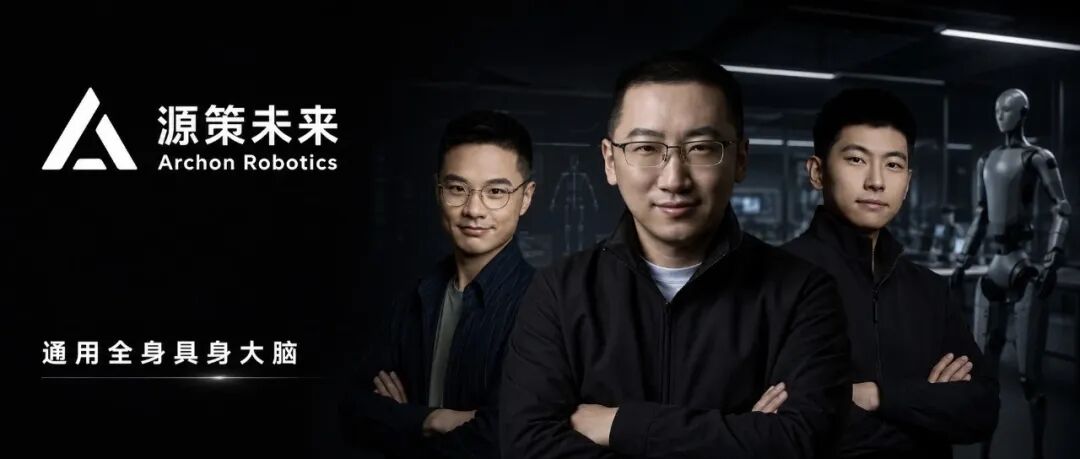
Archon Robotics, a company developing a general-purpose full-body embodied intelligence foundation model, recently completed a seed round of several hundred million yuan. The round was led by top-tier dollar-denominated funds including ZhenFund, Gaorong Ventures, IDG Capital, and 5Y Capital, as well as Gobi Partners and The University of Hong Kong's joint fund, MiraclePlus, and Shanghai Innovation Academy. Lighthouse Capital served as the exclusive financial advisor.
The proceeds will primarily fund R&D of a full-body humanoid foundation model, multi-modal whole-body motion data collection, team expansion, and the establishment of R&D centers and industrial partnerships across multiple locations — with the goal of open-sourcing a humanoid base model later this year.
Founded in April 2026 with its headquarters in Shanghai's Caohejing Development Zone in Xuhui District, Archon Robotics focuses on developing a general-purpose full-body humanoid foundation model and building Whole-body Intelligence — giving humanoid robots human-like capabilities in whole-body movement and manipulation to accelerate the arrival of embodied intelligence in everyday homes.
Founder Dr. Hongyang Li is currently an assistant professor at The University of Hong Kong, assistant dean at the School of Computing and Data Science, and a mentor at Shanghai Innovation Academy. His end-to-end autonomous driving project UniAD won the Best Paper Award at CVPR 2023 — the only such honor for a mainland Chinese academic institution in the past decade. In 2026, he received the RSS Early Career Award, becoming the first Chinese scholar in the award's 20-year history.
Co-founder and CEO Dr. Tianyu Li is among the first graduates of Shanghai Innovation Academy and holds a PhD from Fudan University. As a core developer, he was deeply involved in Huawei's mass-production autonomous driving system ADS 4.0 world engine solution. Co-founder and Head of AI Dr. Li Chen was the first author of the UniAD best paper. He graduated from Shanghai Jiao Tong University's Zhiyuan Honors Program and received the HKU Presidential PhD Scholarship.
Archon's core team comes from leading autonomous driving, robotics, and large model research groups at The University of Hong Kong, Tsinghua University, Shanghai Jiao Tong University, Fudan University, and Zhejiang University, combining original algorithmic breakthroughs with experience deploying ultra-large-scale industrial systems.

The Archon team toasts at Everest Base Camp (February 2024)
Xing Meng, partner at 5Y Capital, shared:
I met Hongyang in 2023 when I was working in autonomous driving. UniAD had just won the CVPR Best Paper, and it was the most talked-about event in the industry. What impressed me wasn't the trophy — it was how he asked questions: While everyone else was optimizing within their own modules, he started from planning, the ultimate goal, and reverse-engineered what the system should look like. He unified every module's backbone so that everything served the final planning objective.
Three years later, Archon is still the same Hongyang. While others ask "what can we train with existing data," he's asking "what should robots learn from humans." Human Body Learning for embodied intelligence is what planning-oriented design was for autonomous driving back then — both define the starting point from the endgame. Today's embodied intelligence space isn't short on money, engineers, or compute. What's missing is this kind of taste: the ability to discern what's worth doing amid all the noise. What I value most is someone's judgment that carries across two technology waves, always asking the right questions.

The embodied intelligence industry is reaching a critical inflection point. Public data from Omdia and other sources shows that in the first half of 2026 alone, China's embodied intelligence and robotics sector saw 288 financing events with disclosed totals exceeding 46 billion yuan — rapidly approaching the 55.4 billion yuan recorded for all of 2025. Yet this massive capital influx hasn't produced a corresponding convergence in technical consensus.
Most current embodied solutions carry inherent limitations. Existing training data consists primarily of desktop first-person videos and single-arm or gripper movements, lacking the native human interaction logic of whole-body center-of-mass adjustment, torso leverage, and multi-limb coordination. This means most robots can only perform fixed-point grasping; when faced with everyday tasks requiring whole-body cooperation — opening doors, making beds, or holding objects with both hands while operating a door — they struggle to adapt autonomously to variables.
The root of this limitation lies in a structural gap in data infrastructure. Archon Robotics CEO Tianyu Li told Hard Kraken that "while the available embodied datasets appear vast, the information truly effective for full-body humanoid training is extremely limited."
First-person video datasets only capture what the human eye sees, missing critical pose information beyond hand appearances — squatting, bending, leaning sideways. Annotated data for robotic arms and grippers mostly stays within a planar scope, recording only end-effector trajectories. Models can learn how the manipulator moves but not how to interact with the environment. Meanwhile, real humanoid robot data is already scarce, with collection costs running from hundreds to nearly a thousand yuan per hour. Samples of compound tasks involving whole-body multi-joint coupling have been virtually absent from past data pools.
These three data types each have their gaps, but they point to the same problem: the core information of how humans complete everyday actions — how the whole body coordinates, how center of mass shifts, how force transmits from lower to upper limbs — is barely recorded in existing data.
Take a simple everyday scenario. When a person pulls open a light door versus a heavy one, the hand trajectory looks almost identical: grab the handle and pull back. Regardless of force used, the pose remains synchronized with the door's movement. The real difference manifests at the whole-body level. For a light door, standing upright suffices. For a heavy door, the body must lean forward, shifting center of mass to use body weight against resistance.
This center-of-mass movement information only gets recorded in whole-body data — and it encodes the essential physical properties of objects. Simply put, if a model only learns single-dimension information for too long, it might perform the action of "pulling a door" without ever understanding what "how heavy the door is" means at the human level.
"The long-term absence of this information locks current robot capabilities at the level of fixed desktop grasping, with a data chasm separating them from the diverse tasks of real home environments," Li said. "To break through this ceiling, we must return to the source and redefine the logic of data collection."
The Archon team believes that migrating from wheeled chassis with dual-arm configurations to humanoid robots involves fundamental differences in structure, motion control, and perception — not a simple form factor upgrade. While overseas companies are just beginning to recognize the complexity of humanoid tasks, Archon has already locked its sights on this challenge.
Archon Robotics is targeting a nearly uncharted territory: a general-purpose full-body humanoid foundation model. Its core concept, Human Body Learning, means learning human whole-body poses and coordination patterns rather than merely tracking end-effector trajectories. By studying human whole-body movements, robots acquire "the wisdom of limb coordination" and develop complete whole-body interaction capabilities.
By embedding humanoid robot action "intelligence" at the midbrain level — as decoupled from specific hardware as possible — the midbrain learns capabilities not tied to any particular robot. It outputs whole-body motion trajectories rather than joint-angle commands for a specific model, giving the model potential to transfer across different embodiments. As data collection grows more comprehensive and covers more scenarios, the midbrain's representational capacity strengthens, and the range of body types to which Archon's embodied whole-body brain can transfer expands.
Based on this judgment, Archon Robotics will build an entirely new data collection system. Founder Hongyang Li believes that embodied data evolution is progressing from real-machine teleoperation toward handheld devices and first-person perspectives, with the ultimate destination being human-centric, full-humanoid data that includes complete human perceptual elements along with whole-body motion labels.
Archon will also introduce multi-dimensional perceptual modalities including tactile sensing, paired with higher-precision whole-body and hand capture equipment. Tianyu Li told Hard Kraken that data diversity and quality matter more than raw scale. "A single piece of whole-body data covering center-of-mass shift and torso angle change carries far higher information density than a hundred pieces of desktop data with only hand trajectories."
How data is collected determines what the model can learn; the model's capability gaps in turn define the next collection target. Once this "collect-train-feedback" loop starts running, it creates a continuously self-reinforcing data moat: with each round of collection and training, model capabilities improve, the system's understanding of "which data actually matters" sharpens, and the next round's efficiency and quality rise another notch.
This tests not only algorithmic engineering capability but also systematic understanding of the fundamental question: what exactly does the model need to learn from the physical world? And this understanding is precisely Archon Robotics's core judgment.
Hard Kraken learned that Archon Robotics plans to release its first humanoid-native foundation model in late 2026.
In the Archon team's view, bringing humanoid robots from laboratories into homes requires more than a perfect single-point demo. Robots need the ability to work continuously and reliably in complex, dynamic, unstructured home environments. The ceiling of this capability fundamentally depends on how deeply the model understands the physical world.
Archon Robotics chooses to return to the starting point of embodied intelligence and answer this question anew: what kind of body to use, and what kind of data to learn from — this determines how far robots can ultimately go.