Post-90s Quantum Computing Team "Vector Singularity" Raises Over 100 Million Yuan in Angel Round | 5Y News

The funds raised will be used for R&D of the first-generation neutral-atom general-purpose quantum computer.

Recently, Vector Singularity, a neutral-atom quantum computing company incubated by the Beijing Academy of Quantum Information Sciences, officially announced the completion of an angel funding round exceeding RMB 100 million. The round was led by IDG Capital, with participation from 5Y Capital, Yaotu Capital, Inno Angel Fund, Lingyi Venture Capital, and strategic industry partner Deepexi. The proceeds will primarily fund R&D for its first-generation neutral-atom general-purpose quantum computer, advancing key technologies toward engineering and system integration, and accelerating progress toward fault-tolerant quantum computing.
The global competition in quantum technology continues to intensify. In May 2026, the United States government announced a USD 2 billion dedicated quantum technology investment; on June 22, it signed two additional executive orders related to quantum technology. According to relevant plans, the United States aims to build a quantum computer serving scientific research by 2028, and to transition critical government information systems to post-quantum cryptographic architectures between 2030 and 2031.
On July 23, supported by the U.S. National Science Foundation (NSF), over 30 leading research institutions and quantum technology companies from the United States, Canada, Japan, Israel, Switzerland, France, and Germany jointly released the Strategic Plan for Neutral Atom Quantum Computation. The plan sets targets including 100,000 physical qubits, hundreds of long-lived logical qubits, deep quantum circuits, and MegaQUOP (million fault-tolerant quantum operations), further clarifying the technical pathway for neutral-atom quantum computing to advance toward large-scale fault-tolerant computation.
Against this backdrop, an innovation and entrepreneurship team composed of young cold-atom experimental physicists is rapidly assembling in Beijing's Haidian District. Team members graduated from leading institutions including Tsinghua University, Peking University, MIT, ETH Zurich, University of Cambridge, and University of Wisconsin–Madison, bringing long-standing research experience in cold-atom physics, neutral-atom quantum computing, precision optics, and systems engineering.
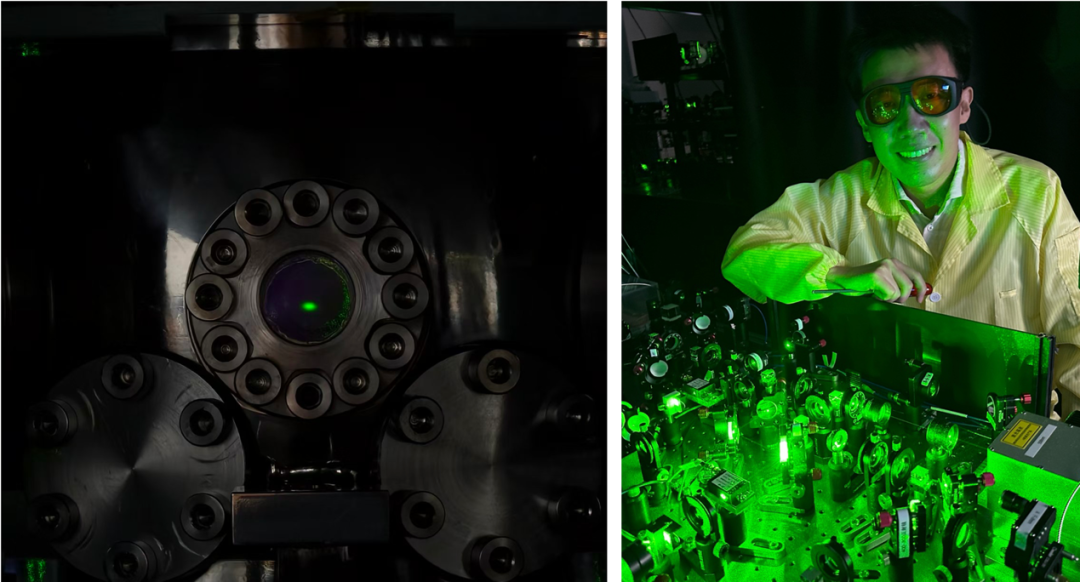
Laser-cooled and trapped Yb171 atoms (left); Xiangliang Li working on the Yb atomic quantum computing platform (right).
Project lead Dr. Xiangliang Li graduated from Tsinghua University's elite mathematics and physics undergraduate program and earned his PhD from ETH Zurich under Professor Tilman Esslinger — the first Chinese doctoral student Esslinger trained. Since late 2021, he has led construction of the Beijing Quantum Academy's Yb171 atomic quantum computing platform, with results published in top international journals including Nature, Nature Physics, and the Physical Review series. His research has received support from the Beijing Municipal Science and Technology Commission, the National Natural Science Foundation of China's major research program "Construction and Control of Second-Generation Quantum Systems," and the National Science and Technology Major Project on Quantum Communications and Quantum Computers.
As a project cultivated through the Beijing Quantum Academy's technology transfer and innovation incubation system, Vector Singularity will fully leverage the academy's industry-university-research capabilities in quantum computing hardware, quantum algorithms, cloud services, and application promotion. The project will also collaborate deeply with the State Key Laboratory of Precision Measurement Technology and Instruments, drawing on its engineering strengths in optical engineering, optoelectronic devices, and measurement and control systems to advance independent R&D of key components, complete system integration, and engineering of quantum computing platforms.
Vector Singularity's core team consists primarily of post-1990s young researchers, with most members having over ten years of cold-atom experimental research experience. They have long trained under representative scientists in neutral-atom research at home and abroad, accumulating extensive expertise in atom cooling and trapping, optical tweezer arrays, quantum state manipulation, precision optical systems, and construction of complex experimental platforms.
Going forward, Vector Singularity will pursue the development goals of large-scale, programmable, and fault-tolerant neutral-atom quantum computing, continuing to tackle core technological challenges and accelerating the formation of systematic capabilities spanning key components, quantum computing hardware, software platforms, and application ecosystems — contributing to China's quantum computing industry development.