Flying Robot Company DiffRobotics Completes Hundreds of Millions of Yuan in A2 Funding | 5Y News

Connecting flying robots to every industry, and bringing them into every home.

DiffRobotics recently closed an A2 round worth hundreds of millions of RMB.
The round was led by Puhua Capital, with participation from HLC and the Yangtze River Delta Digital Intelligence & Culture Fund. Existing shareholders 5Y Capital, Shenzhen Capital Group, Hongtai APlus, Meridian Capital, Huakong Fund, Changshi Capital, and Baidu Venture also increased their investments.
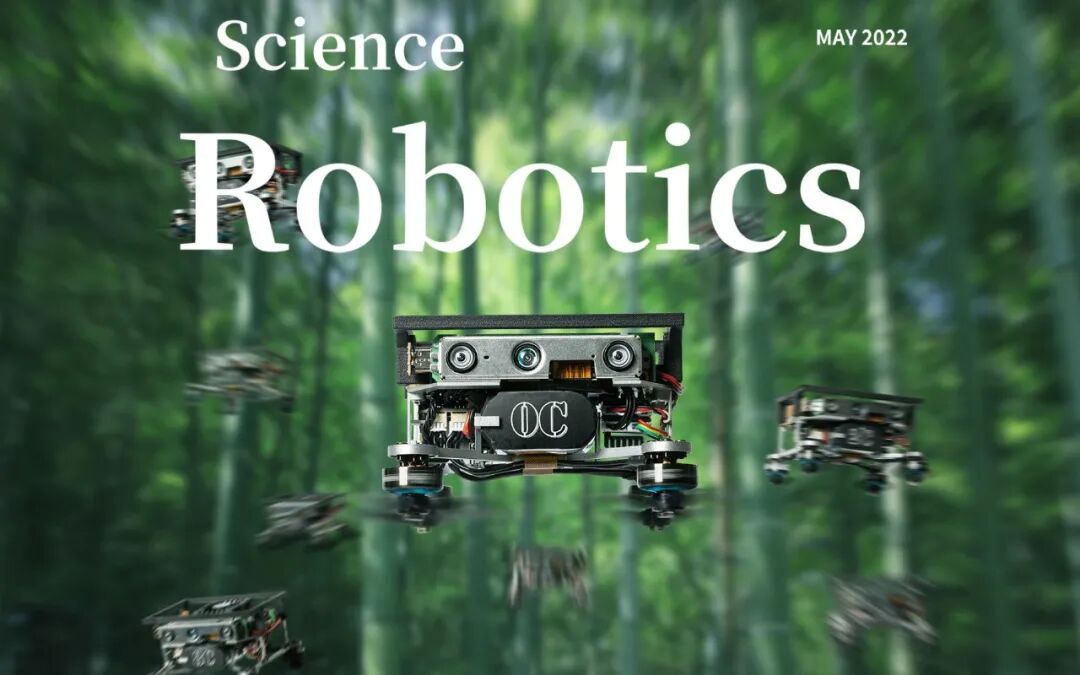
With a mission to "connect every industry through flying robots and bring them into every home," DiffRobotics is focused on building world-leading general-purpose flight AI and swarm intelligence systems. Founder Dr. Fei Gao is one of the most influential scholars in the field, and his team's work has repeatedly appeared on the cover of Science Robotics, representing the international frontier of flight intelligence. Just two years after its founding, DiffRobotics has completed multiple funding rounds, been selected as a national-level potential unicorn, and continues to earn growing recognition from investors.

Multiple technical breakthroughs, building the foundation of intelligent flight
DiffRobotics builds on extreme flight control and complex-environment perception, combining real-world flight data from actual deployments, a high-fidelity simulation data flywheel, and efficient training-and-inference infrastructure to construct foundation models for flying robots — enabling multi-task generalization from a single model and general task decision-making. The goal is to create "aerospace intelligent terminals" for homes, industry, cities, and natural environments. Core technologies include:
Extreme flight control and complex-environment perception
Fusing multimodal perception, real-time 3D mapping, and end-to-end flight control, the robots can autonomously avoid obstacles and maneuver agilely in confined spaces, low light, and GPS-denied environments — maintaining stable perception and safe flight even under degraded localization, heavy interference, and severe occlusion.
Efficient training-and-inference infrastructure and data flywheel
Connecting real-flight data, high-fidelity simulation, model training, and edge deployment: simulation generates extreme-condition and long-tail task data at scale, while real-world operational data continuously flows back to iterate the models. Combined with distributed training and efficient on-device inference, this steadily improves data utilization and model iteration speed.
Flight intelligence foundation model
Built on multimodal large models and Embodied Artificial Intelligence, it unifies task understanding, environmental perception, long-horizon planning, action decision-making, and flight control in a single model — adapting to tasks such as inspection, surveying, following, search, and manipulation, reducing the cost of developing and adapting separate solutions for each scenario, and continuously improving cross-scenario, multi-task autonomous operation.
Swarm intelligence foundation
A distributed swarm intelligence system supporting dynamic networking, collaborative perception, elastic formation, task allocation, and global scheduling. It maintains stable coordination under weak communications and decentralized conditions, with continuously scalable fleet size to meet multi-robot coordination needs such as wide-area inspection, search, and mapping.
Backed by this complete technology stack, DiffRobotics has achieved several leading breakthroughs:
General flight intelligence foundation: enabling flying robots to make the leap from flying to thinking. With just a single natural-language command, a robot can traverse indoor and outdoor environments and autonomously complete long-horizon task loops — from target search and path planning to pickup and delivery.
High-speed intelligent swarm: flight swarms moving at 10 m/s through the wild, switching seamlessly between day and night. Distributed decision-making with no centralized dispatch; dynamic self-organizing networks that connect anytime; precise navigation in unknown environments; all-weather autonomous flight.
Ultra-lightweight autonomous flying robot: a 32-gram micro flying robot that relies on limited sensor signals and a low-power on-board computer, running a self-developed end-to-end agile control neural network to achieve millisecond obstacle avoidance, continuous traversal of extremely narrow gaps, and omnidirectional perception with nimble evasion.
Rigid-flexible dual-configuration robotic arms: the flexible arm extends up to five times its length and grips softly, serving close human interaction; the rigid arm targets outdoor scenarios, enabling real-time coordinated control of flight and manipulation — precise grasping and stable transport mid-flight.

Flying into every industry, expanding new scenarios for general-purpose flight AI
Today, DiffRobotics' products are deployed in unknown, complex, signal-denied scenarios such as emergency response, mining, and power utilities, delivering complete operational capabilities including autonomous mapping, safety assessment, and routine inspection. It is one of the few teams in the industry to have delivered fully autonomous operational robots at scale in such environments. As orders grow rapidly and deployment scenarios steadily expand, the multi-task generalization and general task decision-making capabilities of aerial robots will also transform how many aerial service scenarios operate beyond industrial settings.
Following this round, DiffRobotics will continue developing its single-unit and swarm flight intelligence foundation models, accelerating product iteration and scaled delivery. The company aims to use general flight intelligence — "one brain, many bodies; one brain, many scenarios" — to move flying robots from specialized tools into broader production and everyday life.