ACE Music v1 Beats Suno to Top Artificial Analysis Rankings | 5Y News

The music of the future isn't just for listening — it's something everyone can participate in, interact with, and create themselves.
This article was originally published by Synced, with excerpts.
"AI music tools are like Semaglutide for the music industry: everyone's using them, but nobody wants to talk about it openly."
In January of this year, Suno CEO Mikey Shulman quoted this line, which had been circulating in the industry, during an interview. He believes that the music of the future won't just be something to listen to — it will be something everyone can participate in, interact with, and create themselves.
That's exactly why AI music has become one of the fastest-growing tracks in the tech industry over the past two years.
Google has embedded music generation capabilities into Gemini; Tencent Music Entertainment Group launched "VEMUS," aimed at ordinary creators, and is teasing a professional platform called MusicBuddy; ByteDance has iterated its Haimian Music to a third generation; Alibaba recently launched an AI music product called HappyShrimp; and players like Suno, Udio, Kunlun Tech, and MiniMax are all racing to keep up.
For all the bustle, Suno's dominance has remained hard to shake.
As of February 2026, more than 100 million people have used Suno, paid users have surpassed 2 million, annual revenue sits at roughly $300 million — up over 400% year-over-year. Users generate more than 7 million songs on Suno every day — the equivalent of rebuilding Spotify's entire catalog every two weeks.
That's not all. On the music leaderboard of Artificial Analysis (AA), the world's most authoritative independent AI evaluation organization, Suno's flagship model has held the top spot ever since it was listed, and has never been unseated.
Until recently, when a company called ACE broke the record.
Its self-developed model, ACE Music v1, claimed the global No. 1 spot on AA's Vocal leaderboard with an Elo score of 1160, surpassing Suno v6 (1144) — the strongest model Suno released just over a month ago.
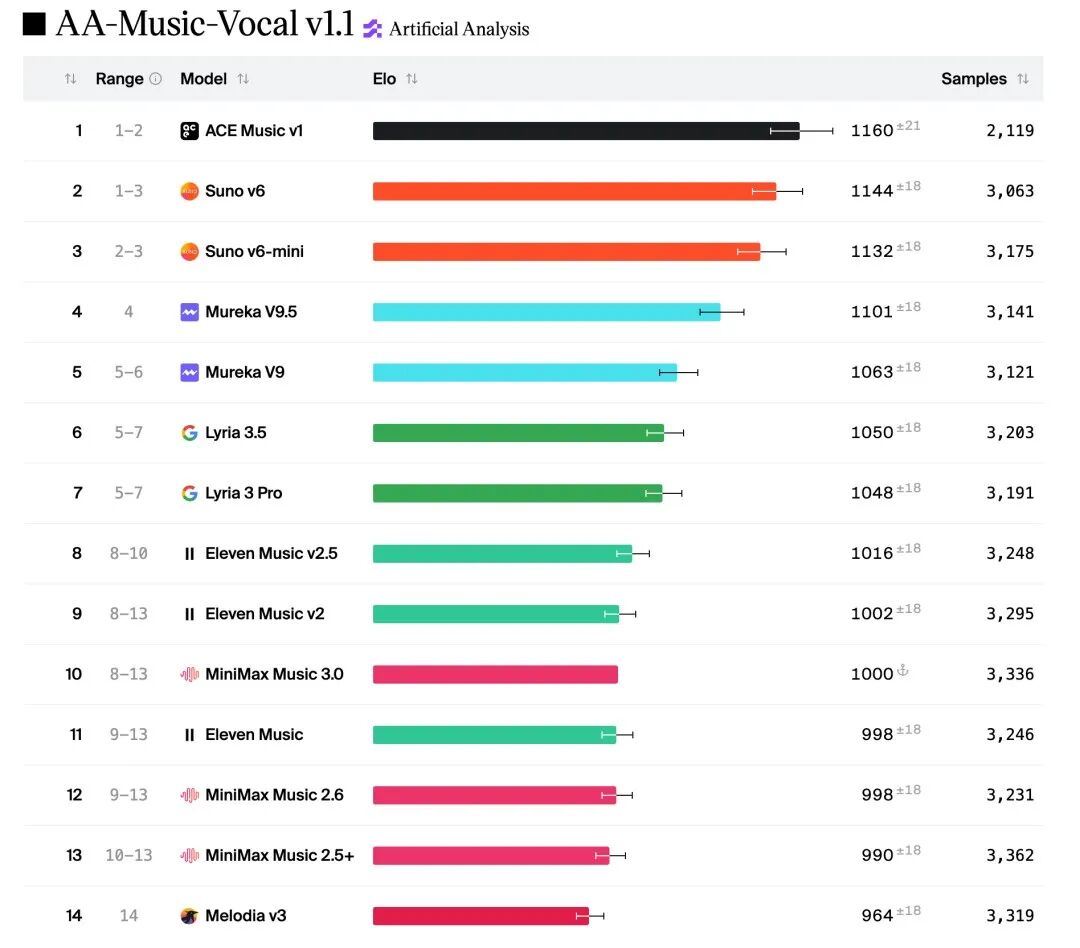
This is the first time Suno's strongest model has been defeated since the AA music leaderboard was created, and the first time ACE Music has appeared on it at all.
From launching R&D on a music foundation model in March 2025 to topping the AA leaderboard in November 2026, ACE took only about 18 months. How much does this No. 1 ranking really mean? And how did ACE pull it off?

How much weight does this leaderboard carry?
Artificial Analysis is one of the most influential independent AI evaluation organizations globally, and it has long tracked technical progress in large models, image, video, speech, and music generation.
Unlike many benchmarks that rely on automated scoring models, the AA music leaderboard uses human subjective preference evaluation. Evaluators listen to music tracks generated by two different models from the same prompt and without knowing which model produced which choose the one they prefer; the results are then statistically modeled and converted into Elo scores.
To reduce interference from irrelevant factors, AA also normalizes audio loudness and format, and requires evaluators to listen to at least 10 seconds of each of the two tracks in every comparison. Final rankings come from large-scale blind-test voting by verified independent evaluators; votes from public users in the Arena do not count toward the official leaderboard.

AA splits music generation into two separate tracks: Vocal (songs with sung vocals or speech elements) and Instrumental (purely instrumental music and backing tracks without vocals).
The Vocal leaderboard involves lyric writing, melody design, vocal performance, emotional expression, and arrangement integration — it demands more of a model's overall capabilities and is therefore more informative. Currently, ACE Music v1 ranks first with 1160 Elo, Suno v6 is second with 1144, Suno v6-mini third with 1132, and Mureka V9.5 fourth with 1101. ACE leads Suno v6 by 16 points — a wider gap than the 12 points separating second and third place.
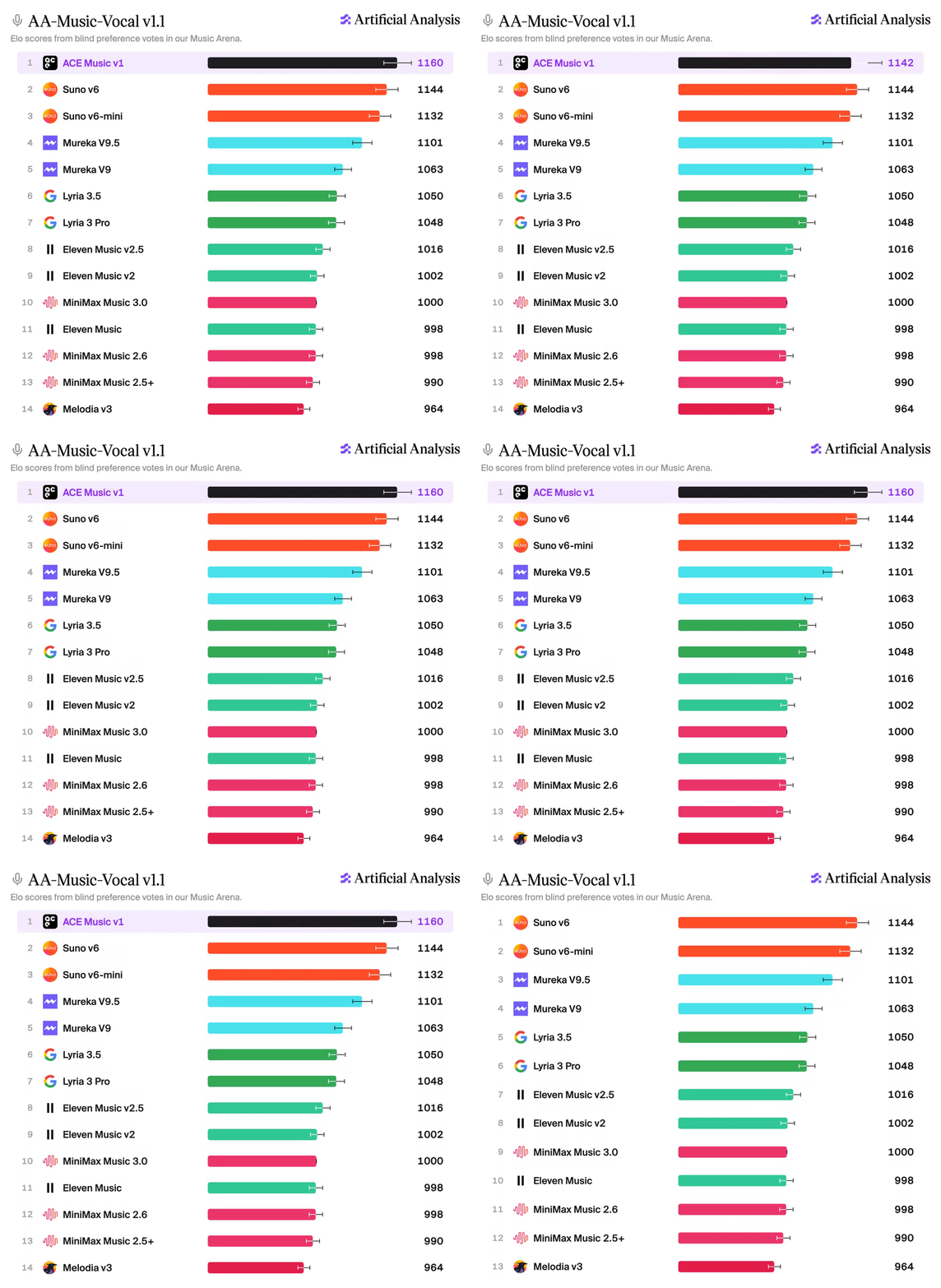
Leaderboard source: https://x.com/ArtificialAnlys/status/2120337324898992298?s=20

Hands-on testing: what can AI music models actually do?
The leaderboard gives a clear ranking, but a music model's real capabilities ultimately have to be judged by its output.
Whether a song sounds good involves vocal performance, melodic hooks, lyrical expression, arrangement completeness, and stylistic fidelity, among other dimensions. Especially when faced with complex musical instructions, whether a model can accurately grasp creative intent also needs to be tested through actual generation results.

Try it here: https://acemusic.ai/create/
Like other music generation tools, ACE Music offers two entry points: an inspiration mode and a custom mode. In inspiration mode, you simply enter a description and the model generates a complete song.
Beyond ballads, it can handle wildly different styles — funk, K-pop girl-group dance tracks, cinematic symphonic scores. It also supports cross-modal generation: writing a Cantopop song based on a movie still, expanding a casually played melody into a full song, or one-click covers that switch a track into jazz or another genre.
Overall, ACE Music performs quite consistently in stylistic fidelity and arrangement completeness, and with its rich, flexible feature set, there's plenty of room to play. It works for casual fun and personalized musical expression, satisfying hobbyists' creative urges, while also holding up to professional-grade creative attempts.

Technical breakdown: how does ACE take on Suno?
Traditional AI music generation is end-to-end: users input text or lyrics, and the model outputs complete audio. This architecture has no intermediate layer, so users can't intervene in the generation process. To modify a melody, adjust chords, or change the rhythm, the only option is to repeatedly rewrite the prompt — precise targeting and editing of specific musical elements is very difficult.
ACE Music introduces Symbolic CoT, adding a score-generation step to the music generation pipeline.
Specifically, the model first uses a language model to generate a plaintext musical score, then hands that score to a music generation model, which turns it into a complete song. The process is similar to how large language models "think first, then answer": the language model translates creative intent into structured musical expression, and the music generation model completes the sound synthesis based on the score.
This design delivers three core advantages.
First, score-level control. Tempo, groove, notes, chords, song length, and other elements can all be explicitly expressed through the score. Users can directly edit specific musical information and keep revising around an existing work, rather than regenerating the entire song every time.
Second, general language models' knowledge directly enters the music generation process. Large language models accumulate extensive music theory knowledge and analytical ability during training, but under end-to-end audio generation architectures, it's hard for them to structurally edit continuous sound signals directly. Symbolic CoT provides an intermediate interface between the language model and the music generation model, converting music into symbolic information that the language model can read and manipulate, letting its knowledge base genuinely participate in music generation.
Third, a foundation for agents to enter the creative process. A score is structured text that an agent can parse and modify, then call ACE Music to render. Natural language instructions can therefore drive the entire music creation workflow, including the arrangement, adaptation, and sequencing of multiple songs.
The ACE team ran a fairly representative test. They tried having Claude Fable 5.2 produce a millennium-era classic Chinese pop medley called The Youth of the Post-80s and 90s. Claude independently searched for the scores of eight classics — Sunny Day, Fairy Tale, Jiangnan, and others — and extracted the most memorable chorus fragments from each.
These songs differ in tempo and key, so to keep the medley coherent, Claude had to unify the tempo, readjust each section's key, and design transitions between songs. In the end, it produced a complete 88-bar score running five minutes, then handed it to ACE Music to generate a full work with vocals and arrangement.
The entire process required no human intervention in score writing — the language model independently handled everything from musical structure analysis to multi-track coordination to creative decisions.
ACE's technical footprint also extends into professional music production.
Currently, ACE has two core products: ACE Music, aimed at general users, supports multiple creative inputs including text descriptions, hummed recordings, keyboard melodies, and reference audio; ACE Studio, aimed at professional musicians, integrates AI generation capabilities into a continuously editable music production workflow.
In ACE Studio, creators can input MIDI melodies and lyrics to generate sung vocals, and adjust pitch curves, phonemes, vibrato, and singing emotion. The AI instrument feature can generate piano, strings, saxophone, and other instrument performances from MIDI notes. For existing music material, the product offers stem separation, audio-to-MIDI, and generative arrangement tools, letting creators keep editing notes, lyrics, and arrangement layers.
ACE Studio also serves to accumulate professional creative data.
Traditional music data is mostly final audio, which makes it hard to reconstruct professional musicians' specific creative decisions — why a producer changed a note, why they swapped out a chord progression, why they kept or deleted a piece of AI-generated content. These processes all contain information about musical structure and aesthetic preference. By recording creators' editing trajectories during production, and with user permission, ACE can use this data for model training.
As of September this year, ACE Studio has accumulated more than 3 million professional creative trajectories.
This forms a continuously spinning data flywheel: better models produce better professional tools; tools attract more talented musicians; musicians generate high-quality data through real creation; and that data in turn trains the models.
ACE is also further connecting agents with professional music software.
Through an MCP Server and CLI, AI assistants that support MCP — Claude, ChatGPT, Codex, and others — can connect to ACE Studio to read and edit an in-progress music project. Users can even make requests in natural language like "add a string section to the chorus," and the agent will call the appropriate tools to execute the operation.

In other words, AI's involvement is expanding from song generation into professional production, letting musicians focus more on creativity and aesthetic judgment while agents take on some of the concrete editing and execution work.
Conclusion
ACE's ability to complete R&D on a music foundation model and top a global third-party leaderboard in just 18 months has a lot to do with its team composition.
This is a team that understands AI, music, and product all at once. Founder and CEO Jing Guo was once a band's lead vocalist and has extensive product and growth experience; co-founder and CTO Wenxiao Zhao has long worked in machine learning, speech synthesis, and music technology R&D; co-founder and CPO Conger Sheng has a music industry background and was once a songwriter signed to Warner Music.
Chief scientist Ruibin Yuan's background is even more telling. He is both a veteran researcher in music AI and a lead guitarist in a band who has played guitar since childhood. A core author of the music representation model MERT, he previously participated in the development of the Qwen music model, has nearly 10,000 academic citations on Google Scholar, and ranks among the top researchers worldwide in music generation.
Bringing together technical researchers, professional musicians, and product talent lets ACE balance model capability and real creative needs from the very start.
Capital is betting on this path too. In September 2026, ACE completed a new funding round of nearly $40 million, making it the Chinese team with the highest cumulative funding in the AI music space.
ACE Music's climb to the top of the AA leaderboard sends at least one signal: the AI music market is far from settled, and latecomers still have a chance to break through via technical innovation.
In the past, everyone competed over who could generate a complete song; now, competition has extended to music understanding, fine-grained editing, and professional production. In the future, models will need to understand scores, agents will need to participate in creation, and professional tools will need to integrate into real music production workflows. Whoever can truly connect these pieces will have the best chance of building a long-term advantage.