After AI4S, AI Sets Its Sights on Manufacturing | 5Y Research

From F1 race cars to tiny switches in data centers, AI is starting to take part in the design and manufacturing of complex machines. After coding, will the next batch of customers willing to pay a premium for intelligence come from manufacturing?

The contest on the F1 track begins long before the driver presses the throttle.
Just as a new front wing must go through repeated design revisions before it ever hits the car — engineers run simulations and wind tunnel tests to narrow down options, calculating how airflow moves across the car, how much downforce and drag it generates, and which materials are best suited…
Now a company called Apex Ultra wants to join this R&D race, using AI to help engineers find the next opportunity for speed.
In October, Apex Ultra announced a partnership with Alpine, the French Renault-owned F1 team. The AI will learn from design history, wind tunnel and test results, and track data, cross-referencing simulation predictions against the car's actual performance. New designs must also account for manufacturing difficulty, cost, lead times, and component lifespan.
Apex Ultra calls this R&D goal ESI (Engineering Superintelligence — or, if you prefer, AI4E), aiming for AI that can integrate physics, materials, and manufacturing constraints to participate in the design, simulation, and development of complex machines.
The partnership is just getting started, and no speed gains have been reported yet. But the task it has chosen is a compelling one: taking a product that already concentrates the best engineering minds and using AI to push past the limits of engineering science — to build a race car that humans couldn't design on their own. Progress will be hard, but it's a deeply attractive mission.
Over the past few years, AI has been doing two things at once: reaching higher and spreading wider.
Reaching higher means pushing the boundaries of human knowledge and capability as a whole — solving harder math problems, discovering new physical laws, developing drugs that don't yet exist, building ever-better frontier models.
Spreading wider means enabling individuals and businesses to solve their own problems with AI's existing capabilities — writing code, making slides, handling business processes.
Both paths create extraordinary value, but they're measured differently. Making reports faster can be accounted for in time saved; advancing scientific discovery doesn't necessarily find a buyer right away. AI for Science is bringing capabilities into drug and materials R&D, and research outputs are starting to approach product readiness. In frontier engineering, the customer's problems are more concrete: engine efficiency, heat dissipation, device lifespan — all of which map directly to business returns.
What we want to discuss today is AI for Frontier Engineering, and the key word is "frontier." Helping someone build a simple model and helping an engineer break through a performance bottleneck that has stumped an entire industry require very different knowledge, testing, and judgment.
For industrial companies, some performance bottlenecks have consumed enormous R&D investment and still resist solution. Whoever can help them push forward one step gains the chance to turn intelligence spilling over from models into a product customers will pay for.
Stronger intelligence has to earn its premium through more frontier products.
Jeff Bezos has his eye on this direction too, serving as co-CEO of startup Prometheus, which disclosed a $12 billion Series B in June at a valuation of roughly $41 billion.
Another Amazon veteran, Jeff Holden, founded Atomic Machines, which has raised $250 million to date.
London-based PhysicsX uses AI to accelerate physics performance prediction and design optimization, closing a $300 million Series C in June at a valuation of about $2.4 billion.
They're all trying to shorten the distance between AI and manufacturing: from thinking of a new approach to making something that actually works.

Engineering only really begins after the drawing is done
When engineer Nicolas Haag came back from a two-week vacation and checked the results, the computer had automatically run about 1,500 fluid simulations — and still hadn't found a satisfactory design.
Haag, who works at PhysicsX, recalled in an interview that the team was optimizing a thumb-sized cardiac assist pump (essentially providing backup support for a failing heart), which had to balance blood pumping effectiveness, blood damage, power consumption, heat, and vibration.
The team then brought in an AI model trained on simulation data to predict the performance of different designs more quickly. Once the model was ready, the optimization round took about 10 hours and found a structural approach the engineers hadn't previously considered. When checked against conventional fluid simulation, the results matched the AI's predictions almost exactly.
PhysicsX co-founder Robin Tuluie also provided the project's performance gains: improved pumping performance and reduced blood damage — roughly 42% better than the baseline design, by the company's composite metric across multiple indicators.
This is an optimization problem with multiple simultaneous constraints. A 3D model that looks like a part doesn't necessarily have the precision engineering calculations require; it also needs defined materials, dimensions, and operating conditions. Then comes the iterative cycle: revise the design, predict performance, verify results, decide what to change next.
Before AI, industry already relied on a set of specialized software tools for design, performance calculation, and production preparation. Take a heat sink for data center cooling: CAD (computer-aided design) is the drafting table inside the computer, where engineers build the 3D model, determine the part's dimensions, where to cut openings, where coolant flows. CAE (computer-aided engineering) is the virtual test bench — input the material and operating conditions, and it calculates how much heat the design can carry away and where overheating might occur.
Once the design is basically settled, CAM (computer-aided manufacturing) converts the model into a machining plan: if using a CNC machine, which tool to select, where to cut first, what path the tool follows — all planned here. A prototype still has to be tested, and problems send you back to revise the design. Each tool has its specialty; the engineer is responsible for connecting them, making judgments and adjusting plans across rounds of computation and prototyping.
Of course, even a correct simulation doesn't guarantee the prototype meets spec. A heat sink might have machining deviations, insufficient actual flow rate, requiring a re-examination of both the flow channel design and the process. What physical testing fills in is the part of reality that computation doesn't yet accurately describe. Design, simulation, prototyping, and testing therefore frequently interleave throughout development.
Having AI call a single piece of software has been demonstrated many times. The harder challenge is getting AI to think like an engineer — deciding what to do next based on each step's results: after changing a structure, which performance metrics need recalculating; when a deviation appears, whether to go back and revise the drawing or adjust the process; why one test round failed and how to avoid repeating the mistake. The model needs to trace requirements all the way through to validation results, then feed those results back into design.
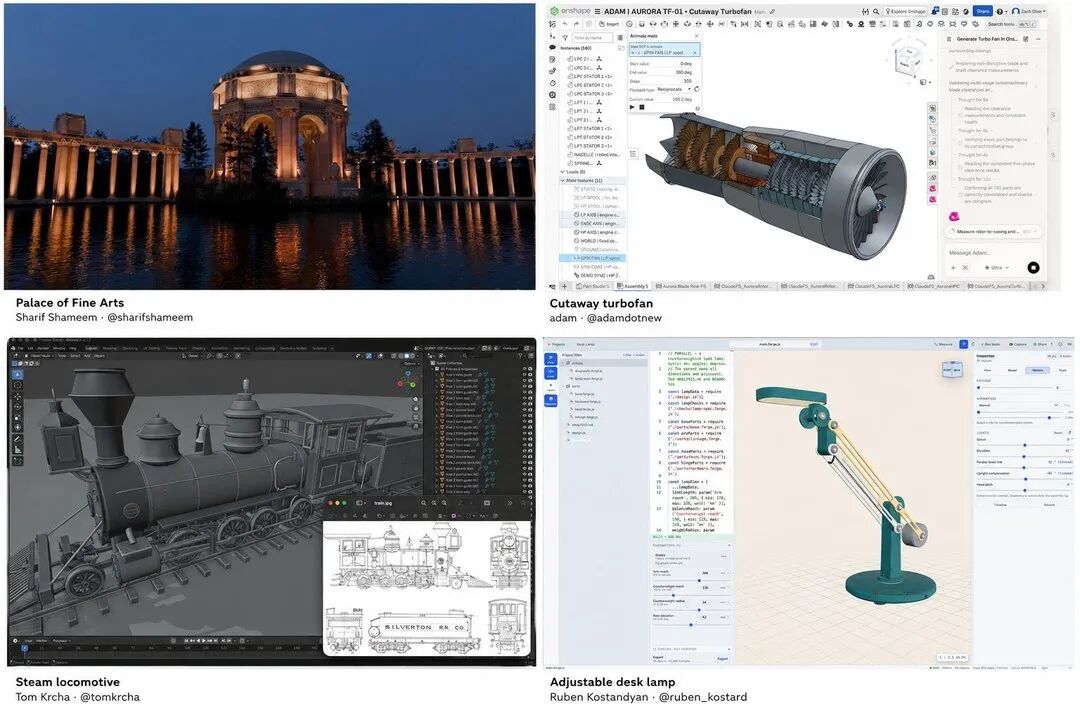
Four examples of AI-assisted 3D modeling: a building, a turbofan engine cross-section, a steam locomotive, and an adjustable desk lamp. The model can render complex shapes.
Another category is AI that accelerates computation itself. PhysicsX's cardiac pump optimization relied on learning the relationship between structure and performance from simulation data to make faster predictions for new designs. These "surrogate models" are like a lookup table learned from detailed computation, helping screen options; whether they apply to new materials or new operating conditions still requires re-validation. General-purpose models organize tasks, performance models help evaluate quickly, and numerical solvers and physical tests continue to provide verification.
Anthropic's collaboration with quantum computing company QuEra offers a concrete example of giving AI access to physical feedback. In the experimental setup, a titanium-sapphire laser that drifts off its target frequency sometimes requires an expert familiar with the equipment to come on-site and restore it.
Anthropic connected Claude to the test equipment, let it repeatedly modify and test recovery methods, then wrote the effective judgments into a standalone control program. Out of 700 tests, it successfully recovered 695 times; for harder faults, it took about 10 to 14 seconds, compared to the 5 to 10 minutes a human typically needs.
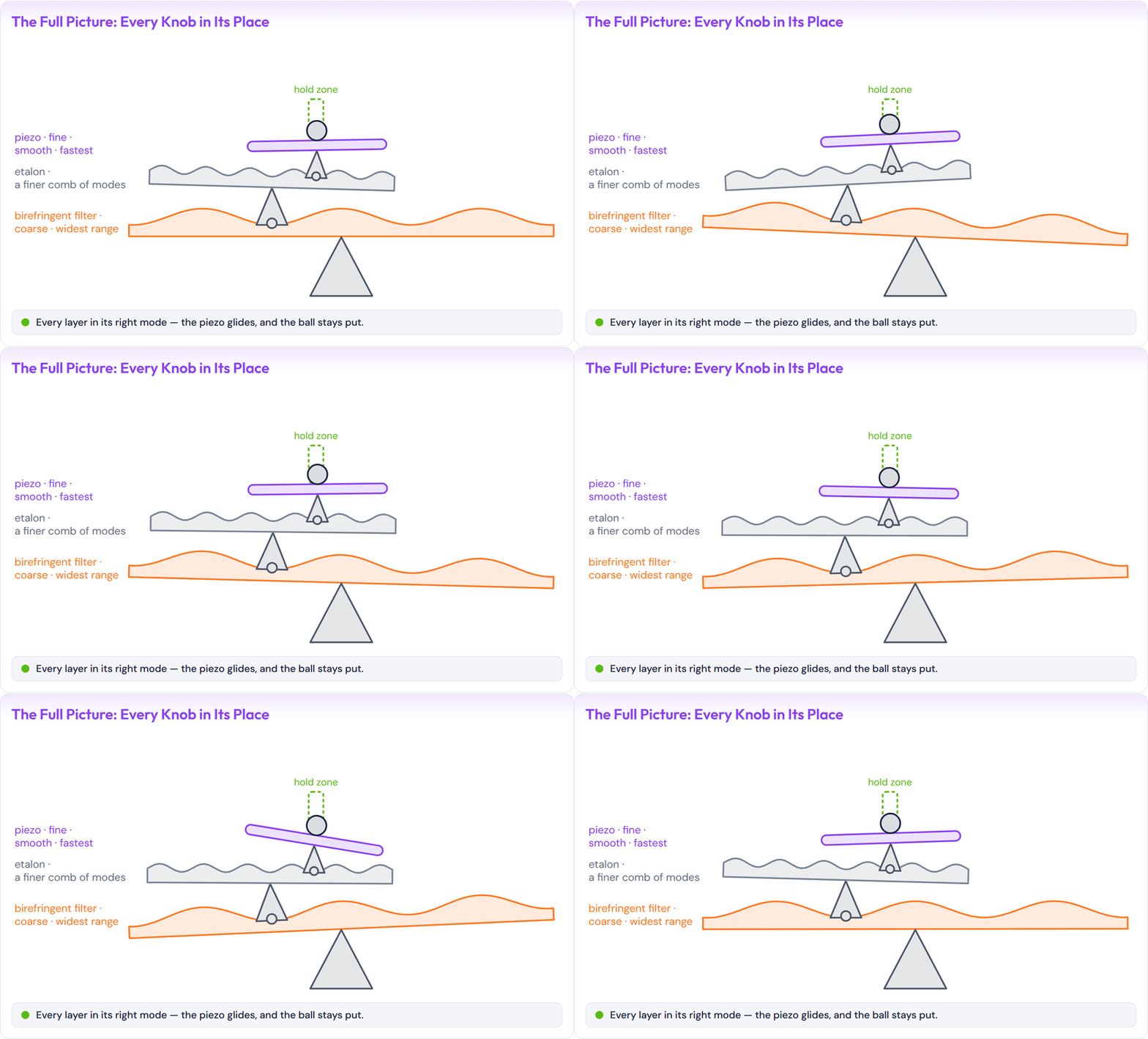
This gif is a schematic analogy for QuEra's principle. Stabilizing the laser is like keeping a ball at a specified position above several layers of seesaws: coarse adjustment handles large-range corrections, fine adjustment handles rapid fixes. The ball's position represents the laser frequency; after a disturbance, the system must confirm it has returned to the correct position.
What AI participates in here is the development of a control program. In testing, the recovery was executed by an already-written standalone program — Claude didn't need to re-reason each time. The MHS (Model Hardware Standard) connecting the model to the equipment handles the interface work, letting the model read instrument states and invoke operations while constrained by device-defined limits. It bridges the connection into the experimental floor; the full R&D process still requires engineering knowledge and judgment.
Nor is there a context-free answer to what constitutes "the best design." Stronger cooling may require more pump power; a lighter part may be harder to machine. Engineers need to specify which requirements are mandatory and which metrics can be traded off. The direction AI pursues depends on whether those constraints are accurately written into the task.
Getting AI involved in engineering R&D means design, simulation, and physical testing can't be siloed. Where a design works and where it fails must both become the basis for the next round of revisions.
But how far R&D can go also depends on which options are worth trying in the first place. If a part's basic structure is already fixed, no matter how fast the computation, you can only adjust dimensions and parameters within a given range.
So a more valuable question is whether AI can participate in proposing different structures, then hand them to computation and testing for screening. That could give engineers options they never thought of — and never tried.

From optimizing old designs to exploring new structures
Drawing a support column thinner and thinking to split it into two branches are two fundamentally different design approaches.
In typical parametric CAD optimization, an engineer first draws the basic structure, then opens up a few dimensions for the software to adjust. If the only allowed changes are the thickness and angle of three columns, the computer will never think to change the structure itself.
Engineering AI can split into two kinds of work here:
The first is optimizing an existing design — adjusting the dimensions of a cooling channel, say, or changing a blade angle.
The second starts from requirements and lets the model explore different structures and component arrangements.
This latter approach is what biodesign calls de novo design. It aims to be less bound to any single old solution, but it must still respect physics, performance, and manufacturing constraints.
CAD still has a role. It expresses shapes, dimensions, assembly relationships, and revision history. The question worth asking is whether the engineer has already fixed the rough shape of the answer before the search even begins.
Take a bracket: which points it must connect, what loads it must bear, how much space it can occupy at most — these requirements can't be dropped. But how many supports to use in between, and where to branch, can be left for the algorithm to explore. Traditional topology optimization can already adjust material distribution based on load requirements.
What generative AI adds is learning the patterns of shape from 3D data and proposing new candidate structures based on them.
PhysicsX's bracket experiment connected such a generative model to mechanical simulation: the model generates new variants of existing designs, the system compares weights, and simulation checks whether stress limits are exceeded; better-performing designs are kept and used to generate the next round. The entire search process doesn't require first constraining shape variation to a set of CAD parameters.
In this experiment, PhysicsX started from a winning entry in an engine bracket competition and found a new structure with branched supports. The new design satisfies stress constraints while weighing 18.5% less. This is exploration continuing from an existing design, and it's still a simulation result; what it shows is that AI can go beyond a fixed set of CAD parameters and change the structure itself.
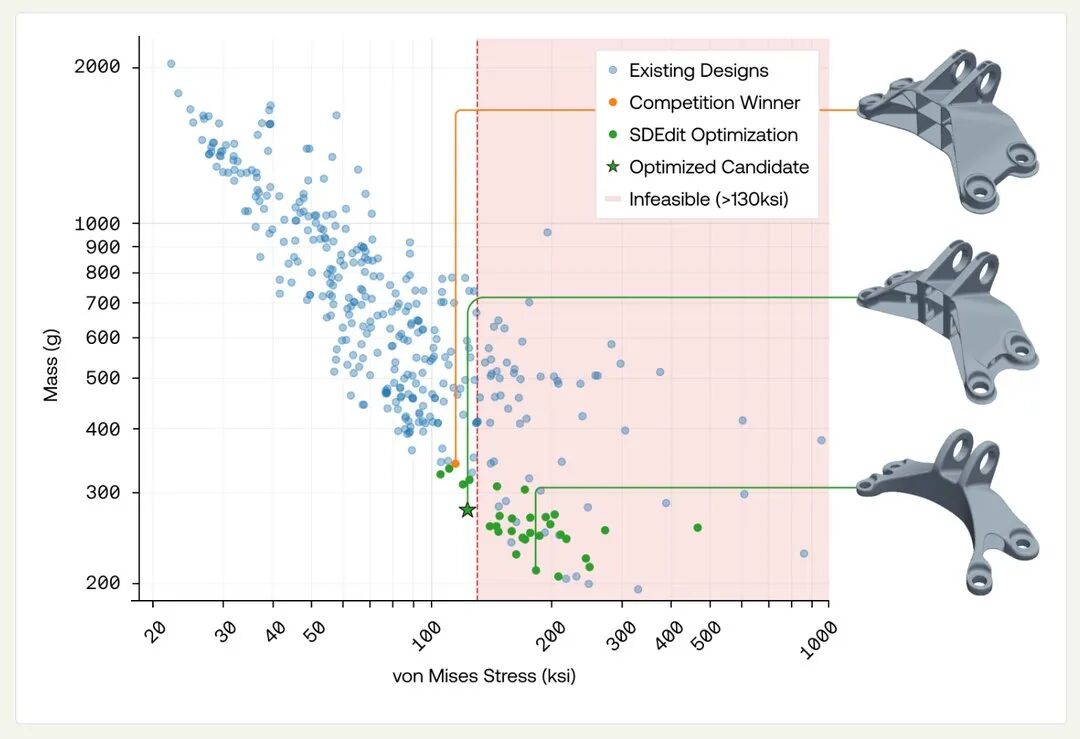
Each point in the figure represents a bracket design; lower positions mean lighter weight, while falling into the red zone on the right indicates stress exceeds limits. The design in the middle-right satisfies stress constraints in simulation and is 18.5% lighter than the original competition-winning design above it. The design below is lighter still but failed this constraint.
In industrial history, redesigning a structure has indeed sometimes beaten long stretches of incremental refinement. Faced with the waste from repeatedly heating and cooling the cylinder of the steam engine, Watt invented the "separate condenser" — moving steam condensation into a separate vessel: the cylinder stays hot, the condenser stays cold, significantly improving fuel efficiency.
In the past, breakthroughs like this depended heavily on the inspiration of a few geniuses and the cost conditions for running many trials. The promise of generative AI is to make the process of proposing different designs, calculating trade-offs, and eliminating errors more thorough — letting more teams explore new solutions beyond conventional designs.
Increasing the degrees of freedom in the search also increases the burden of verification. The model may propose shapes that simply can't bear loads, be assembled, or be machined. Whether a new structure is a good idea or just a novel-looking mistake still has to be judged through simulation and prototyping. Writing requirements for AI doesn't mean engineers can skip defining constraints.
If bolder designs always get stopped at the machining stage, the exploration upstream will struggle to become a product.
Atomic Machines wants to push this problem into the workshop: having micro-manufacturing equipment, process expertise, and software participate together in device development. The first product it used to test this approach was a micro switch.

Why does a micro switch need a whole new factory to build?
Delivering power to a data center also means figuring out how to cut it off in time.
If a circuit shorts at home, the breaker in the distribution box "trips" and cuts the power. Mickael Mauger, an engineer who builds power supply equipment for data centers, has to arrange the same kind of protection for server rooms: let current flow smoothly during normal operation, cut power promptly during a fault, and prevent downstream equipment from being damaged.
But the same act of cutting power varies in difficulty depending on how power is delivered. Homes typically use alternating current, where the current periodically drops to zero, which helps extinguish the arc produced when a switch opens. In the 800-volt DC power systems of AI data centers, this natural condition doesn't exist: even after the contacts have separated, current can continue flowing along the arc. Protecting equipment requires both separating the contacts quickly and cutting off that current as fast as possible.
The requirements during normal operation can't be ignored either. With large currents passing through the switch for long periods, conduction losses accumulate and add cooling burden to the server room. Traditional mechanical switches conduct through metal contacts with low losses, but they're bulky and slow to actuate; semiconductor switches actuate quickly but convert more electrical energy into heat when conducting continuously. The server room pays for these losses in electricity bills and has to dissipate the heat as well.
Now Mickael Mauger has a new switch that fits on his fingertip. It conducts through metal contacts with very low losses, yet the contacts can separate within tens of microseconds — achieving what seems impossible. He asked the manufacturer: "How is this possible?"
The company is called Atomic Machines, and the product is called PrimeSwitch. It can be installed in a "hybrid circuit breaker": during normal operation, current flows mainly through its metal contacts; when the protection circuit detects a fault, the contacts separate rapidly, a paired semiconductor circuit briefly takes over the current, and then completes the interruption. Metal handles long-duration conduction, while the semiconductor only works during the brief interruption process, balancing low losses with fast protection. A device less than a centimeter across has to handle the large currents on a power supply line.
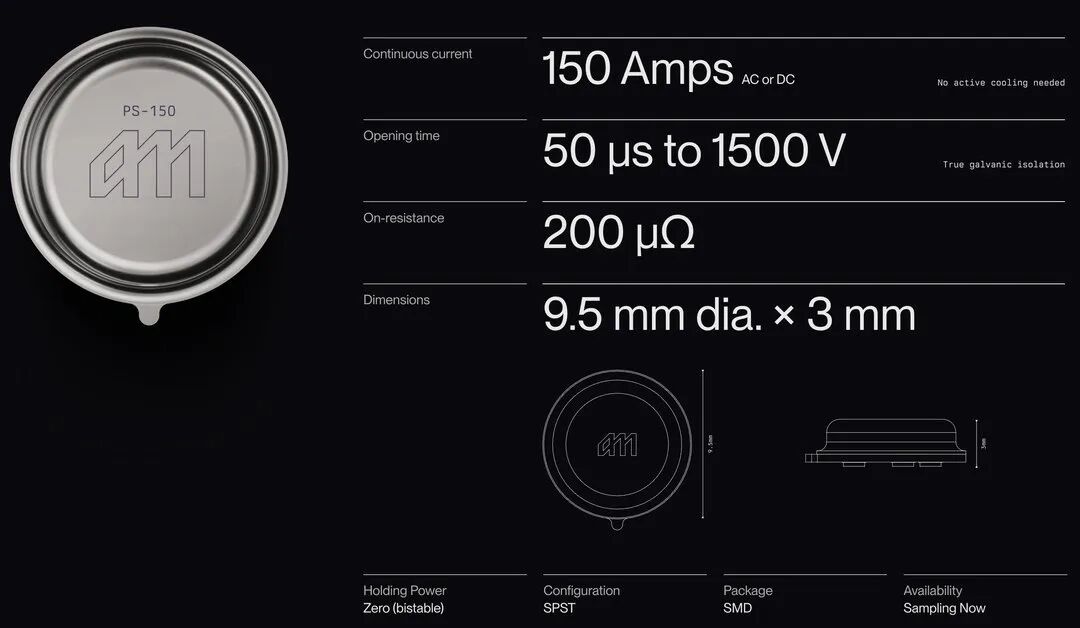
Atomic Machines' microelectromechanical relay PrimeSwitch PS-150, usable in hybrid circuit breakers for data centers, works with semiconductor circuits to balance low losses during continuous power delivery with fast interruption protection during faults.
Behind this micro switch, multiple machines need to relay through machining, assembly, and inspection. Atomic Machines calls this system the Matter Compiler. Atomic refers to the equipment handling different processes as Nodes — think of them as different workstations on the shop floor, called and coordinated by software.
Atomic lists the division of labor among these "workstations": laser processing forms fine structures in materials; droplet deposition delivers liquids to specified positions; electrochemical processes handle plating, polishing, and similar operations; assembly and measurement capabilities help fit components together and confirm machining results. Metals, polymers, glass, and ceramics are all within the materials it has disclosed. Different devices can select and combine different process steps.
Atomic Machines' Matter Compiler manufacturing system includes equipment modules for laser micromachining, inspection, and more, with multiple manufacturing capabilities called by software.
Behind this lies the challenge of coordinated manufacturing across multiple materials, 3D structures, and moving parts. What a workstation excels at is only the beginning; whether the next process step can pick up where it left off determines whether the whole device can be built.
The name borrows from the software world. After a programmer finishes writing code, a compiler turns it into instructions the machine can execute. Atomic wants to bring a similar organizing approach to manufacturing: once the design is set, the system arranges a series of machining operations. But materials don't produce exactly the same result every time the way program instructions do.
The dimensions or surface state left by the previous step affect the next. Small deviations, if they accumulate along the way, can ultimately cause the device to fail. So AI can't just remember "do A first, then B" — it also needs to know what state the material is actually in after A, and whether the next step should be adjusted.
Backer Construct explains that Atomic measures results before and after operations, using learned models to predict how a given step will change the material. Actual deviations are then fed back into manufacturing decisions.
Here, AI is more like learning what consequences a given process will have: doing this action in this material state — what happens next. Only when this prediction is checked against measurements does it have a chance to reduce blind trial-and-error.
Data accumulated this way includes not only what was made, but also how it was made, where it deviated, and how it was corrected. If designers know a certain structure is hard to machine reliably, they can adjust in advance; if the manufacturing side discovers a more reliable process, it may broaden the design options for the next device.
This is where software organizing processes and AI learning from feedback can work together.
Atomic uses a micropump as an example to demonstrate how AI participates in judging "how to build the next step": starting from a circular blank, selecting executable machining steps, optimizing the cut shape, and using electromagnetic simulation to verify the design; then reasoning through the assembly relationships of the components, simulating the combined structure again, and gradually forming a complete device plan. AI needs to consider "how the shape changes, how performance will change, and whether the next process step can connect" all together, so that design and manufacturing arrangements work in concert.
Of course, it's too early to understand this system as a fully unattended machine where you input a sentence and get a finished product. Engineers are still needed today to handle transfer between some machines and assist with final assembly.
When a product changes materials, structure, or precision requirements, the manufacturing process often has to change along with it. What Atomic Machines hopes to reduce is precisely the cost of figuring out these changes.
3D printing can be one process such a system uses. Atomic's scope is broader, involving different materials, multiple machining steps, and assembly of moving parts; what it wants to deliver includes how devices are reliably made.
Atomic Machines chose micro devices as its first direction. The reason for "micro" is that for many devices, making them small itself brings performance gains. PrimeSwitch's contacts have low mass and short travel distance, which helps them actuate faster. But at smaller scales, machining and assembly methods from large machines may not transfer directly.
Semiconductor processes and MEMS have already mass-produced large numbers of devices such as phone motion sensors, accumulating standard processes along the way. The difficulty concentrates in new material combinations, complex 3D structures, and cross-component assembly: off-the-shelf processes may not apply, and developing new processes may cost more than a single device can bear. Directions like micropumps and microactuators therefore carry both performance promise and manufacturing barriers.
The value of a switch product can be measured in volume, loss, and speed; but Atomic Machines' value also depends on what's left behind after this switch is done. Only if the process models can support more devices will R&D investment have a chance to accumulate across products.
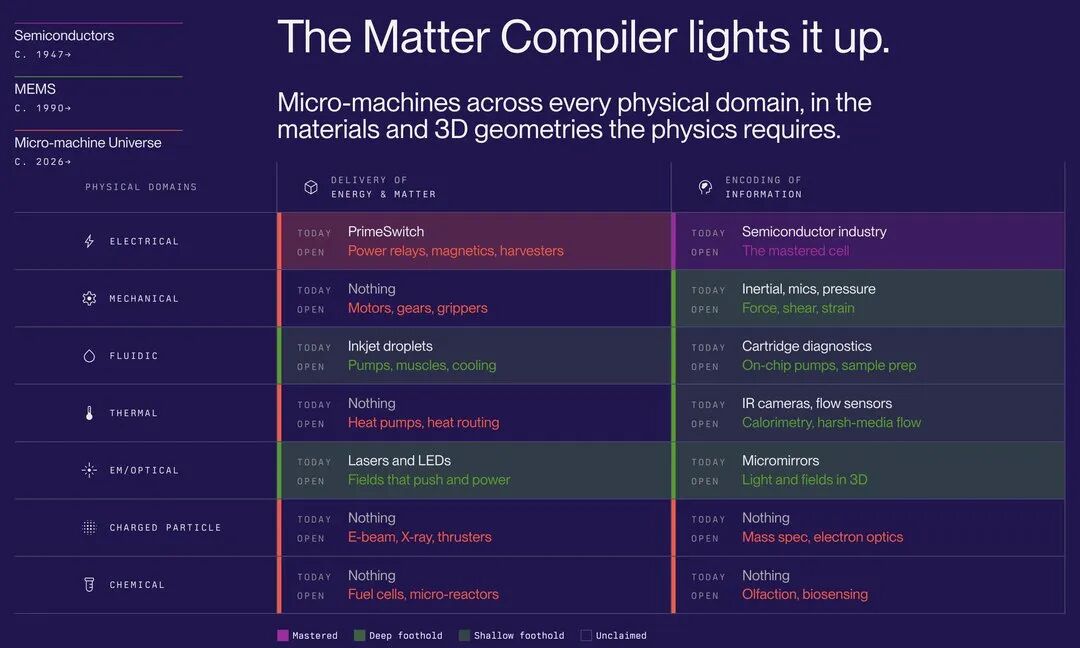
Atomic's own vision of the future: after building a single microscale switch, what else can this manufacturing system do? That determines its platform value.
In the field of AI for Frontier Engineering, another company worth watching is Prometheus, founded by Jeff Bezos and Vik Bajaj. Their ambition is to push AI capabilities into a much broader range of engineering domains.
Prometheus's goal is what it calls a "general AI engineer." Bezos used an aircraft engine as an analogy: if a team of over a thousand people would normally spend more than a decade developing a next-generation engine, could AI compress that cycle to five years, two years, or even one?
Right now, the first problem Prometheus has to solve is data. Bezos once offered an analogy: even after reading a thousand books on gymnastics, he still wouldn't be a good gymnast.
The internet is full of content explaining engineering principles, but whether a design can withstand high temperatures, whether parts fit together precisely, and whether a product can run reliably over the long term — these questions still require simulation, prototyping, and testing to answer. Prometheus needs to generate its own training data while also finding ways to obtain engineering data that is hard to come by.

Prometheus co-founder and co-CEO Jeff Bezos with Vik Bajaj. The company aims to develop AI tools for engineering design and manufacturing that shorten the R&D cycle from concept to physical product.
But who currently holds the most useful experience and data?

Who can connect scattered engineering experience?
A final drawing that passes acceptance may hide all the wrong turns taken along the way.
The design team remembers the performance targets and a few key revisions; the factory knows which materials are hard to machine and which parameters tend to produce scrap; the testing team knows under what conditions a particular failure mode occurs. This knowledge is scattered across different people, documents, and systems — only when pieced together does it approximate a complete R&D record for a product.
This constitutes the first layer of fragmentation in engineering AI: different stages of the same product are held by different participants.
Design firms have models, patents, and customer requirements; manufacturers have equipment, processes, and production management experience. In the past, the two sides could collaborate on specs, cost, lead time, and yield without needing to know every detail. For AI to learn to improve the entire process, a design change must be linked to the downstream machining and test results.
The second layer of fragmentation comes between different products.
A cooling system deals with flow and heat transfer; a rocket engine also faces combustion, high temperatures, and material lifespan; a microscale switch has its own distinct contact, actuation, and assembly challenges. All are called engineering, yet the valid data, failure diagnosis, and acceptance criteria differ greatly across domains. How much experience gained from switches carries over to engines must be tested item by item.
Connecting design, manufacturing, and testing within a single product category is more likely to build accumulating advantage than trying to cover all engineering tasks from the start.
Following this logic, the teams worth watching are those that understand design themselves and have been deeply involved in process development, prototype testing, and rework — they know why a parameter needs to change and have seen what happens on the factory floor after the change. Even if they don't own the factory, they have a chance to capture a complete slice of engineering experience.
Traditional industrial software vendors already have deep roots here. Part geometry, assembly relationships, simulation settings, and design version and approval records are stored in the CAD, CAE, and product data management systems that customers have used for years. New AI companies wanting to participate in R&D must find ways to connect to these records and tools.
Whoever makes it easy for engineers to access them — and preserves the basis for every change and verification — has a chance to occupy a more important position in daily work.
But historical records can only tell a model what was done in the past. To continue exploring new solutions, it also needs an environment where tasks can be run and results verified.
Having a piece of code and being able to run it, execute tests, and trace errors are two different things. The same applies to engineering AI: after changing a part's shape, you need to rebuild the computational model, set material, load, or temperature conditions, call the solver, and then judge the result against agreed metrics. With only a drawing, it's hard for a model to know what exactly is good about its own modification.
Speed matters too. If every change requires waiting for an engineer to manually organize files, reset parameters, and resubmit the computation, then no matter how fast the model proposes solutions, the number of attempts will be limited. Connecting the tools, making failed computations discoverable and handleable, and invoking more refined verification at the right moment is itself a valuable product capability.
Apex Ultra offers a concrete example. The company lists wind tunnels, test benches, simulation clusters, and manufacturing sites as important conditions for training and evaluating models, and plans to work around partners' real problems and actual constraints. The value of these environments lies in connecting design decisions to outcomes: what the model changed, how performance shifted, what problems arose during manufacturing — all have a chance to be verified. The company also says it does not mix data across different partners.
From an investment perspective, we believe the probability of a winner-take-all outcome in engineering AI is low. Differences across domains in data, processes, and verification environments may leave room for many specialized companies, each forming product capabilities from design to verification around a major category of engineering problems.
These companies' products might be agents specifically designed for rocket engines. They need to understand requirements, invoke engineering tools, and continue revising solutions based on verification results. The underlying models can be shared, but specialized teams need to organize their domain's data, process experience, and testing environments into products that can be repeatedly used for similar R&D tasks.
This specialization may be even finer than in robotics. Household robots, for instance, may still cover multiple chores. But in engineering development, it's hard at this stage to imagine a company specializing in racing engines also doing a good job on data center cooling systems. Of course, the difficulty of crossing domains also affects how broad a company's product coverage can be.
On the other hand, for China, a dense manufacturing supply chain and engineering talent pool provide favorable conditions for this kind of accumulation.
When Apple announced new applied research labs in China back in 2024, it specifically explained the value of being close to production and assembly bases: engineers can test prototypes with suppliers, discuss production processes, and adjust workflows in a timely manner. Design problems have a chance to be discovered and addressed early on the factory floor.
Engineering AI needs this kind of collaboration too. After a model proposes a solution, whether a prototype can be made promptly and whether someone who understands the process can explain the test results will affect when the next round of revisions begins. Chinese startup teams can start from a single product category, build long-term cooperation with designers, testers, and suppliers, record the changes from each prototyping round, and let manufacturing-side experience feed into the next design cycle.
The industry may therefore accommodate many companies with distinct expertise. Their advantages will come down to specifics: what exactly the model helped the customer solve, whether it still works under a different operating condition, and whether the next delivery can avoid some detours.
These questions are hard to judge from a leaderboard that claims to cover the entire industry.

The cold-water moment: customers have their own evaluation criteria
People who write code already understand the gap between leaderboards and real-world use. A coding benchmark can provide a rough reference for choosing a model, but when it comes to your own project, you still have to try it yourself to know whether it works well.
In engineering, however, inferring real capability from benchmark scores is even harder. A model may perform well on a particular test, but whether it can still solve the problem with a different material, process, or operating condition requires fresh verification.
So a major difficulty for AI for Frontier Engineering is this: the more specific the engineering task, the harder it is for any public test suite to represent it.
Take the data center switch again. Metal contacts separate quickly, but the current doesn't necessarily stop immediately — an arc can form between the contacts, allowing current to continue flowing. So what data centers care about is how long it takes for the switch to completely cut off current after a line fault occurs. To measure this clearly, you have to wire the switch together with its companion circuit and test it under the relevant voltage and load conditions. Measuring the speed of the opening action alone is not enough to judge real-world performance.
In this industry, customers' own standards and acceptance criteria are often more decisive than public leaderboards. How precise a part needs to be, and which deviation will cause the entire product to fail, depend on the specific application. Even the conditions needed to set the test — the machining precision a piece of equipment can actually achieve, the parameters under which a process tends to produce scrap — are often held by customers and suppliers.
The data itself has gaps, too. The scale advantage of China's manufacturing sector does not directly translate into a data advantage. Historical files may contain only final drawings without the reasons for changes; trial and error on the factory floor may lack complete measurements; core processes involve intellectual property and usage licensing. Sorting through these issues increases upfront investment, but it determines whether the feedback a model receives is actually trustworthy.
The more specialized the industry, the closer verification gets to the customer — and this can easily drag delivery toward customization. If every new order requires modeling from scratch, rewriting tests, and re-debugging, a company may still end up growing revenue by adding engineers.
To judge whether a product is maturing, look at whether verification workflows and process knowledge from similar projects can be reused, whether deployment gets faster, and whether delivery costs can come down.
Only then can we see clearly what AI has actually brought.
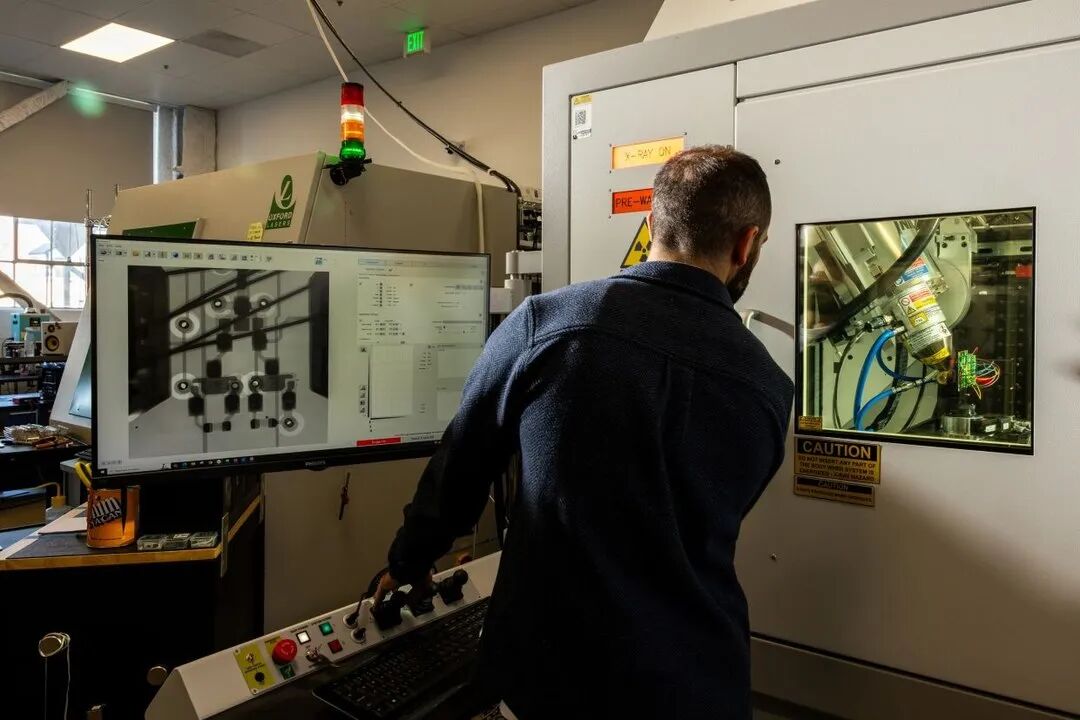
Atomic's engineers use X-ray scanning to inspect circuit boards, and people are still involved on the R&D floor, usually in ways tied to the task at hand: production-line inspections mainly determine "whether something meets the established standard," while R&D inspections also need to figure out "why it went wrong and how to fix it next." On top of that, moving components between machines and assembling them still requires engineers, and Atomic's process from design to finished product is not yet fully unmanned.

Conclusion: When the barrier to making things drops sharply
If AI can keep driving down the cost of design, computation, and verification, then the ideas shelved because trial and error was too expensive, the products that struggled to get off the ground because demand was too small, and the explorations that went unfunded because the returns were unclear all become possible to try — and the value that was buried has a chance to be discovered.
Historically, Watt moved the condensation process out of the cylinder, and this structural change opened a new revolution in fuel efficiency. But from conceiving of the idea to building a usable industrial machine, he still spent years. A breakthrough needs inspiration, but it also needs repeated trial and error and correction, until the conditions are ripe.
And those conditions remain very unevenly distributed today. Ideas are scattered everywhere, yet the capacity to design, test, and manufacture tends to be concentrated in a very small number of companies. The person who spots the problem may already have figured out how to improve it, but lacks the resources to draw up the plan, work out the numbers, and turn it into a prototype. Lowering the cost of trying also means giving more people the chance to put their ideas into practice.
If engineering AI can help people complete design and verification, and new manufacturing platforms can take on the subsequent trial production, then small teams — even individuals — may be able to call on engineering capabilities that were once hard to access, and a single R&D effort can start from a more specific, smaller need.
Today, coding has become routine; in the future, perhaps more people will use AI to design and make a physical object for themselves.
And those ideas scattered everywhere will have a chance to actually become products.
If you're building a startup in this space, or have published academic papers, or are simply very interested in this field, we'd love to hear from you — we're always online:*