Tsinghua AIR's First PhD Graduate Li Jianxiong Found BASAL Intelligence, Completes Seed Round Led by 5Y Capital

Enable robots to learn on the fly in new environments through a handful of demonstrations and self-directed trial and error — no retraining required.

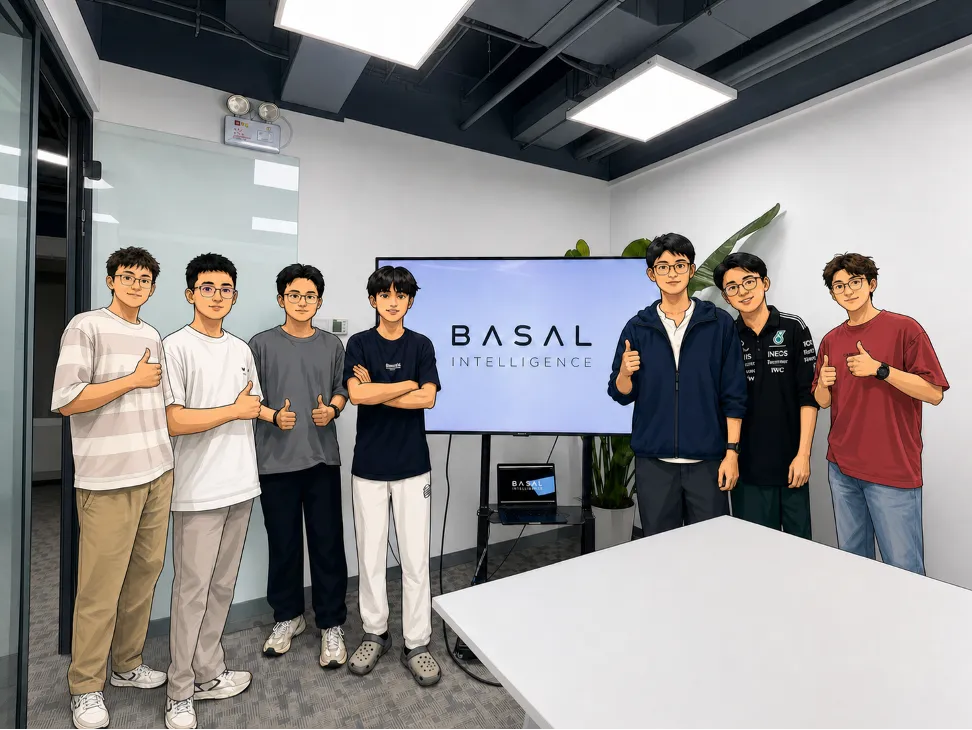
Jianxiong Li, the first PhD graduate from the Institute for AI Industry Research (AIR) at Tsinghua University, has founded BASAL Intelligence (BASAL), an embodied AI company.
BASAL has raised a funding round led by 5Y Capital, with participation from Ivy Capital, Linear Capital, and Huashan Capital WestSummit Capital. The core team includes chief scientist Xianyuan Zhan, an associate professor at AIR, Tsinghua, and seven young researchers who have collaborated long-term.
According to BASAL, before assembling the founding team, core members had received high-paying offers from ByteDance Top Seed, NVIDIA, and Xiaomi, as well as PhD admission offers from overseas universities.
BASAL's official materials state that the company will not follow the mainstream "pre-train base model + post-train deployment" paradigm. Instead, it is betting on an action-native In-Context embodied foundation model, aiming to enable robots to learn and adapt on-site when moved to new environments — without retraining.

Change the environment, and everything starts from scratch
The dominant approach in embodied AI today is to pre-train a foundation model, then do post-training deployment for each specific task. This paradigm works in standardized factory settings, but once the environment, objects, or workflow changes, robots typically need to recollect data and retrain. Faced with the endless long-tail scenarios and tasks of the real world, this path has an obvious scaling ceiling.
BASAL's blunt assessment: this is essentially an extension of industrial automation, not truly embodied AI in a meaningful sense.
The team believes that action information from physical world interaction cannot be fully or accurately described through language; the existing language-centric VLA approach therefore has inherent limitations in fine-grained manipulation and cross-scenario generalization.
BASAL's goal is to give robots the ability to learn on-site: when confronted with new scenarios, tasks, or robot embodiments never seen during training, the model should not need retraining — just a few human demonstrations and autonomous attempts to achieve rapid learning and adaptation within minutes.

Abandoning language, betting on action: an off-mainstream embodied route
BASAL frames its methodology as first principles of intelligent decision-making, proposing an "action-native In-Context embodied foundation model" technical approach.
Unlike existing solutions that center on language, BASAL treats action as the core expressive modality of the model, having it directly learn the relationships between actions that interact with the world, task feedback, failure correction, and human demonstration. Most of the model's capacity goes to action generation, organizing continuous physical interaction through long context — enabling the robot to continually adjust subsequent decisions based on prior actions, outcomes, failures, and feedback.
BASAL argues that action is closer than language to the essence of how robots interact with the physical world, while In-Context Learning gives the model the ability to keep learning after deployment.
Taking a barely-trodden path means confronting the industry's dominant narrative head-on. The VLA route centered on multimodal large models and natural language instructions remains the most familiar context for capital and industry; customers are also more accustomed to products whose robots can "understand human speech." Abandoning the language-centric approach and emphasizing action nativism will significantly raise communication costs for commercialization in the near term. BASAL will need to clearly explain to customers that integrating action-native model interaction into existing production lines is no more difficult than language commands.
Supporting this approach are two core technologies the team has been developing since 2024: the cross-embodiment model X-VLA and the efficient latent-space world model ODEWorld.
X-VLA focuses on cross-embodiment action expression. Using less than 1,000 hours of pre-training data, it has achieved leading results in multiple third-party evaluations; based on this model, the team emerged victorious from over 400 competing teams to win the championship at the AgiBot Challenge at IROS 2025.
ODEWorld, meanwhile, provides a more efficient technical foundation for long-horizon physical information expression and robotic In-Context Learning through latent-space modeling of continuous physical time.
According to publicly available information, BASAL is among the earliest teams in China to systematically explore cross-embodiment rapid adaptation and In-Context embodied learning.

From pre-programming to on-site learning: a solution awaiting validation
BASAL is focused on a key cost contradiction in scaling embodied AI: more and more enterprises are willing to adopt robots, but cannot bear the high cost of recollecting data and retraining for every new scenario.
If In-Context embodied learning truly works, deployment costs would decline as robots accumulate learning experience, rather than rising linearly with the number of scenarios — the most tantalizing aspect of this business.
From X-VLA's championship performance at the IROS competition to ODEWorld's technical accumulation in long-horizon physical modeling, BASAL has already demonstrated considerable technical depth at the academic level.
The key challenge the team now faces is validating this minutes-long on-site learning capability across more real-world scenarios, more robot embodiments, and more task types.