Four Days at ICML Seoul: Models Are Eating Everything Faster Than Anyone Can Find Their Footing | Xing Meng, 5Y Capital

In July 2026, Xing Meng, partner at 5Y Capital, traveled to Seoul for ICML, where he engaged in deep conversations with researchers and founders on the front lines of the global AI industry. This article presents a selection of his firsthand observations after returning to China.

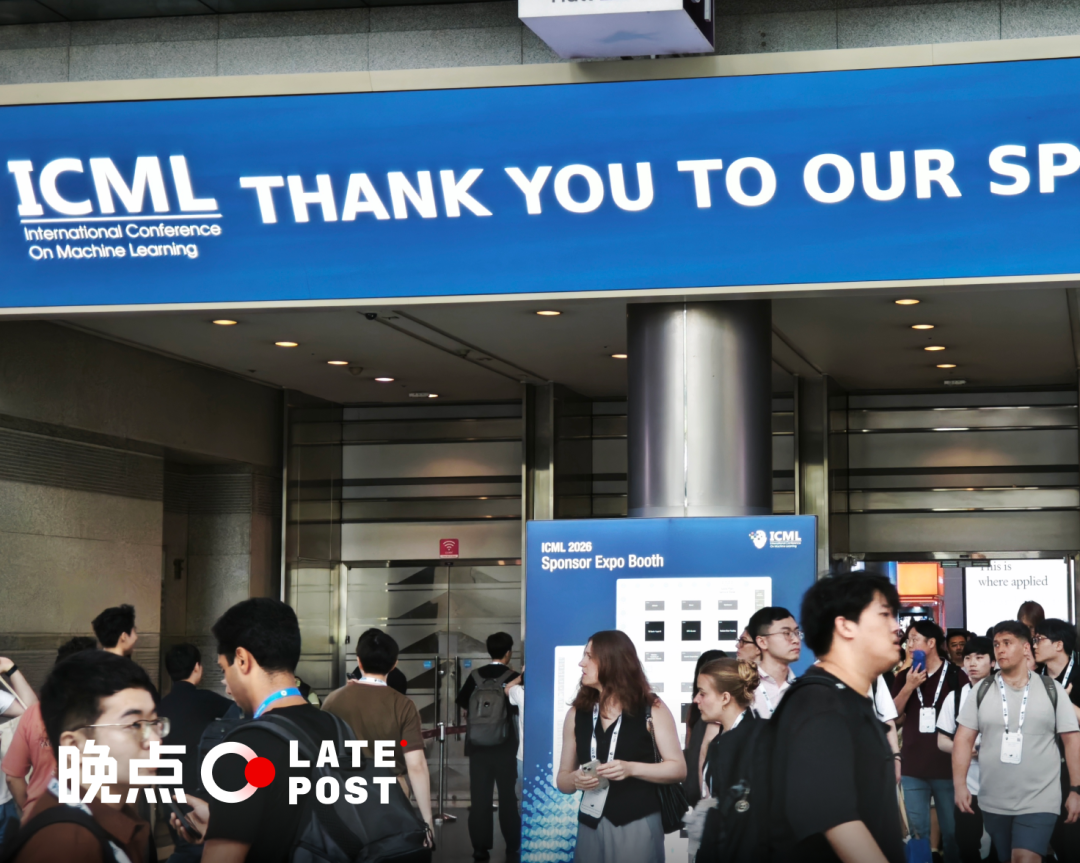
In this race that's getting faster, more expensive, and more crowded by the day, what can we still do?
LatePost Column | Xing Meng, Partner at 5Y Capital
The ICML conference that just wrapped up was probably the most buzzing — and most "lost" — AI top conference in recent years.
ICML stands for International Conference on Machine Learning. Running since 1980, it's one of the "Big Three" alongside NeurIPS and ICLR. Most of the world's latest AI research makes its debut at these three venues, subject to peer scrutiny.
This year's event was held in Seoul, South Korea. For once, all the key global players were in the same place. Without the visa hassles of traveling to the United States, much of China's AI community showed up — nearly every major LLM team had people on the ground. OpenAI set up its own standalone booth for the first time. Google DeepMind sent over a hundred people. Even Europe's Mistral had representatives.
ICML has always drawn clusters of young researchers, making it a prime hunting ground for talent. NVIDIA, Amazon, Meta, and domestic players like Alibaba, Kuaishou, ByteDance, and Tencent all held their usual HR sessions. Quant shops like Jane Street and Citadel also flew in to compete for the same pool.
The most dramatic showdown unfolded between OpenAI and Anthropic. OpenAI packed its schedule with talks and even brought in K-pop singer Chungha to perform. I saw on X that one invited guest skipped Anthropic's dinner to attend OpenAI's event, just to catch the K-pop act.
An Anthropic researcher responded: "We invited them to a recruiting dinner. That was a privilege. If they chose OpenAI's event because of K-pop, they're not serious enough about AGI and probably not a fit for our culture."
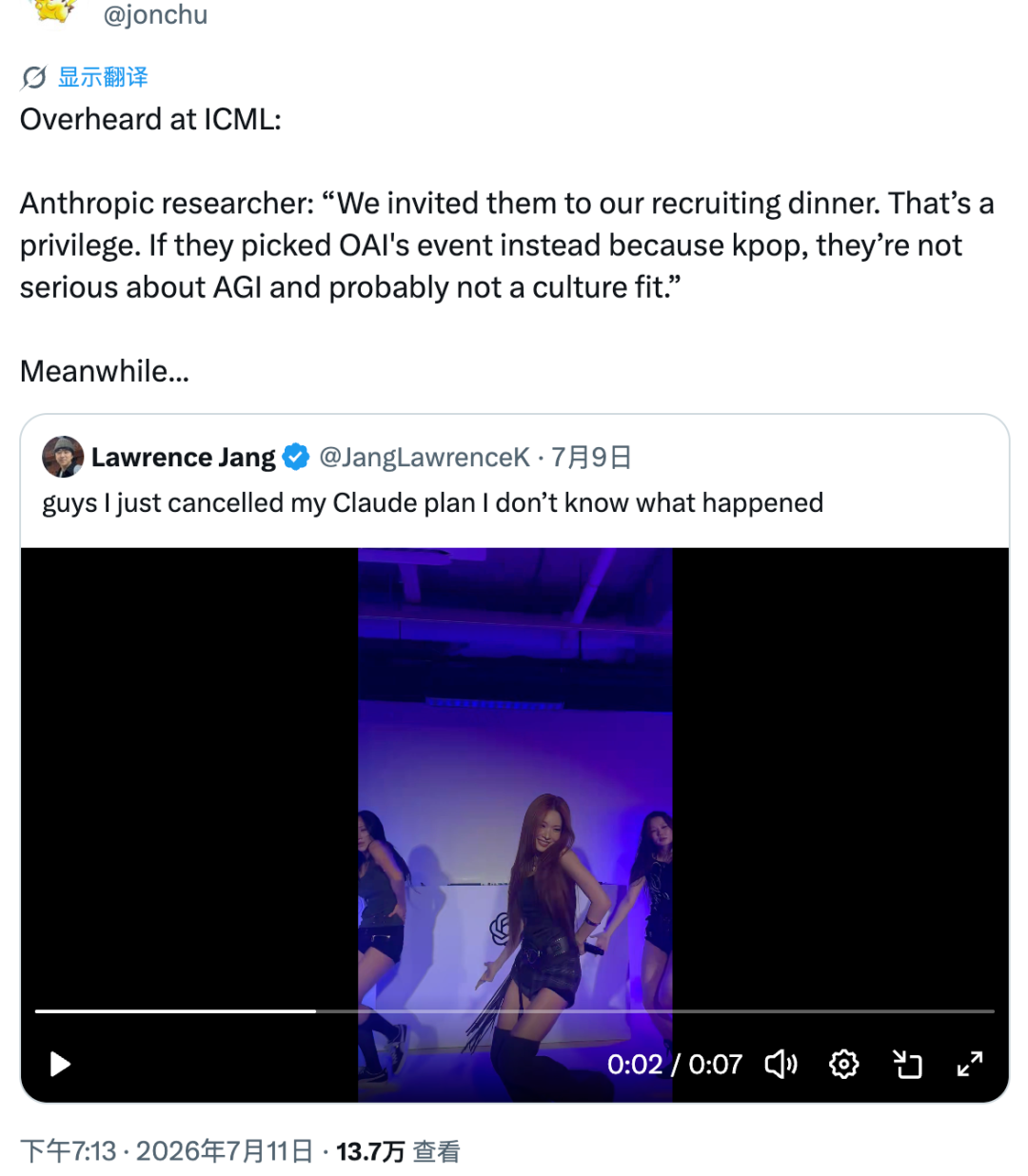
OpenAI's after party at ICML this year
We also co-hosted an AI4S after party with our portfolio company Aureka, bringing in the K-pop girl group Kiss of Life. I honestly hadn't heard of them before. All I could tell was that each of the four members seemed to channel a different member of BlackPink, one-to-one. What's remarkable is that many Anthropic researchers and professors in attendance could actually name the group and even specific songs.
That party ended up becoming the hottest event in the entire city on ICML's first day. Over two thousand people registered — a figure roughly equivalent to the total attendance of an entire past ICML. That gives you a sense of how explosive this year's conference was.
It was also the largest ICML in history: 23,918 paper submissions, nearly double last year's 12,107, with 6,352 ultimately accepted.

Co-hosting an AI4S after party with our portfolio company Aureka, bringing in K-pop girl group Kiss of Life. Never thought my first time watching a girl group perform would be at ICML
But beneath the noise, I sensed another layer: confusion. The "winner-takes-all" dynamic in AI has reached absurd extremes. Over these few days, many friends I met used the same phrase: "Some are drowning in abundance, others starving."
The most elite model companies have seen valuations skyrocket to eye-watering levels, with a clear "eat everything" trajectory. Most everyone else sits on the "starving" side.
Nobody wants to fall behind. They're scrambling to catch up, but haven't found a good way. The original vision was reaching for the stars, yet the immediate choice staring them down is: Should we start with data, do the things that can convert to cash right now? Many are stuck at this crossroads, deeply struggling.
During my days at ICML, every conversation that lasted more than thirty minutes circled back to the same question: Faced with increasingly powerful models, what is my position?
Entrepreneurs are asking it. Researchers are asking it. Frankly, I'm asking it too: Which lane are you in, half a step ahead of whom, and a full step behind whom?
Model Companies Are "Eating Everything"
A few days after arriving in Seoul, I checked in with several old friends. AI application entrepreneurs, without exception, voiced a similar theory:
They said they know their fate — eventually being swallowed by a model company, just not when. So their current frenzy of innovation, product-building, and user context accumulation is really a long-horizon data play. When the day comes that a model company moves in, they'll pivot from product company to data company, sell what they've got, and "that's probably my destiny."
Other friends, highly influential core contributors to open-source communities, were a different story. When we met three or four months ago, they were fired up and ready to start companies.
This time, the answer was they'd all gone back to big tech. One friend said the story just stopped making sense halfway through. "The sense of inevitability facing large models was too overwhelming."
From hot blood to cold reality: barely a quarter. Though admittedly, this past quarter was also when model companies kept expanding their boundaries.
I found it rather poignant. In an era of increasingly powerful models, many things that looked promising have proven not to be. The mindset has shifted from initially wanting to disrupt model companies, to gradually accepting this kind of destiny.
The data business is indeed one of the few directions with a confirmed business model right now, because the entire industry is grappling with one thing: training and evaluation costs have risen to absurd levels.
ByteDance has an internal benchmark for testing model self-evolution capabilities. A full run now takes roughly 1,000 hours and costs $500,000 to $1 million. This means two things: the problems that can still differentiate models are already this difficult, showing how high the starting point is; and the players who can afford to test them can be counted on one hand.
The same dynamic plays out in model training. The dominant method for model evolution today is reinforcement learning (RL): have the model solve problems, assign a score (reward), encourage correct answers, penalize wrong ones, repeat. Early problems were short with clear answers — write some code, run it, you know immediately if it's right. Training was fast.
But as models grow stronger, problems must grow longer, harder, and more open-ended. How long? Like a two-hour game of chess, where you only learn at the end whether you won or lost, with hundreds of moves in between and no telling which one was wrong. Mark Chen, OpenAI's Chief Research Officer, shared at ICML that a year ago they still hired people to write problems for the model. Now, "if a PhD says the model is wrong, it's usually the PhD who's wrong."
These long-horizon problems require a training environment to run in. A good environment must satisfy three conditions: the answer is deterministic, feedback is immediate, and the cost of trial-and-error is low.
Looking across the industry, the two highest-quality "training dojos" are chip EDA design (have AI design circuits, performance results come straight from simulation) and kernel operator optimization (have AI optimize low-level compute instructions, speed is measured directly). When people work on model self-evolution, these are the first two scenarios they gravitate toward.
But outside these two "dojos," building environments becomes grunt work.
At our 5Y Signal Station event in Seoul, one friend shared a more experimental approach: have AI practice against itself (self-play) to generate training environments. Take an existing software project, have one AI inject buggy code (the problem-setter), another AI fix it (the solver), and a third AI judge the results. If it gets fixed quickly, ramp up the difficulty. Failed attempts that couldn't be fixed? Keep those as training data too.
A solid paper at this year's ICML explored this idea, following the same lineage as AlphaZero: play against yourself, drive down the cost of generating problems.
This reminded me of my autonomous driving days. When the takeover rate was once every 5 kilometers, a single vehicle could accumulate 20 issues in a day — more than you could fix. At 10,000 kilometers per takeover, a hundred vehicles running all day might encounter one issue. Go higher, and finding a new problem requires tens of thousands of vehicles — a test fleet larger than the operational fleet, at prohibitive cost.
So autonomous driving, past a certain point — say, better than the average human driver — could no longer rely mainly on testing environments for iteration. You had to collect feedback from operational environments orders of magnitude larger.
But AI is different. Right now it's still a bottomless pit. Models can always get stronger. There's always someone willing to spend another million dollars to test once more.
Data, environments, evaluation — this "selling shovels" business chain is being driven by demand. But these can only be fallback options for startups, rarely a true destination.
Data work used to be primarily about operating human labor — the ability to manage ordinary people doing high-quality annotation. Today, researchers selling data to model companies are somewhat like financial advisors (FAs) in primary markets.
Many FAs are former investors themselves. They may not be the absolute best at investing, but they know precisely what investors want — even shaping investor preferences and FOMO, preparing "inventory" in advance to catch the wave.
Many data company leads are themselves researchers with genuine taste. They can anticipate what capabilities next-generation models will lack, create benchmarks that current models can't crack, then sell the remedial data to fill those gaps.
Once all models catch up, that batch of "inventory" expires, and everything resets to day one. In data, short cycles are about accumulation; long cycles are about taste.
The speed at which models replace these links is only accelerating. Mark Chen's colleague Noam Brown was even more direct in his warning to entrepreneurs: build harnesses if you must, but don't over-invest — they'll likely be obsolete in three months.
Moats are evaporating faster than they can be dug.
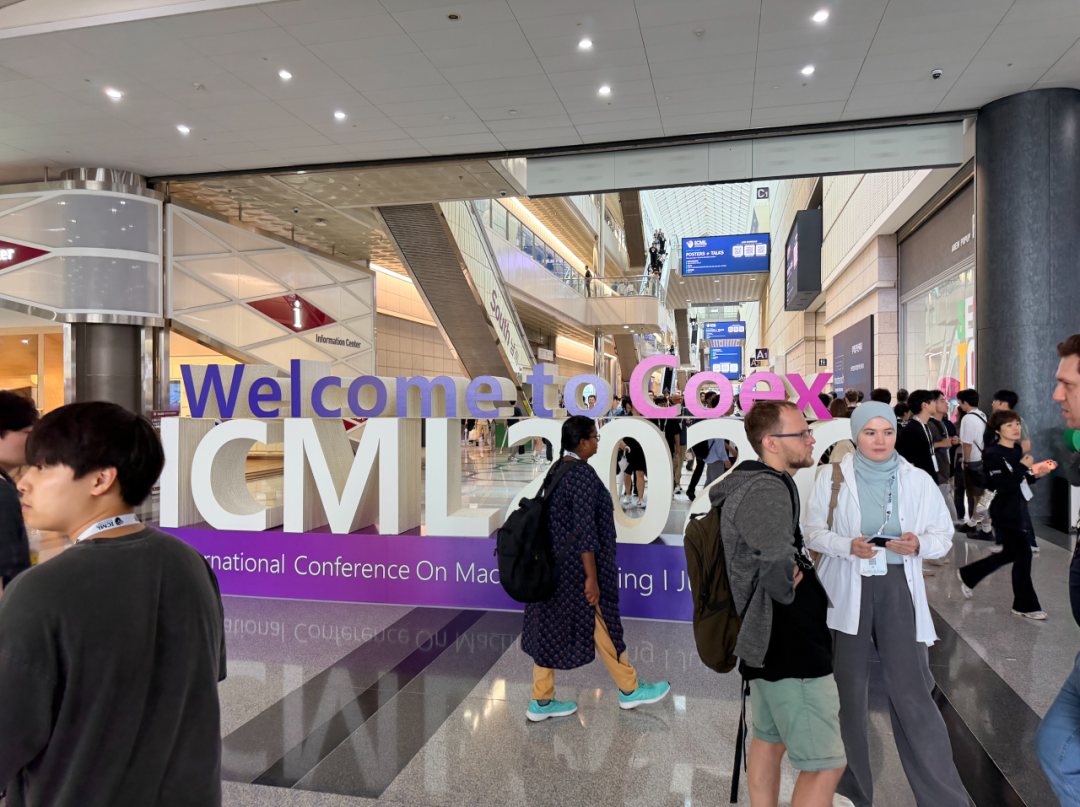
The venue was so packed with people there was never a moment to capture the whole "Welcome" sign in one frame.
An Academic Conference, Also a Frontline in the AI Arms Race
A friend from China had come to Seoul hoping to find someone from OpenAI or Anthropic to discuss a few pre-training questions.
Though everyone was speaking Chinese, whenever the conversation turned to anything specific, the other side would predictably smile and deflect with a laugh.
This is a race with only two real competitors. A friend at one of the major tech companies put it bluntly: AGI cannot be held solely by American firms.
And looking globally, there is no third player qualified beyond China and the United States. "Whether it's compute, electricity, or capital — this is a superpower competition."
Talent is blocked on either side by an invisible wall.
At this year's ICML in Seoul, there were actually few Chinese faces from North American frontier labs. One researcher explained for absent colleagues: many Chinese researchers at OpenAI and Anthropic haven't gotten their green cards yet. Because of visa issues, if they leave the country once, they might not get back in: "They can legally stay inside the 'house,' but they don't have the key. If you go out, the door shuts automatically, and you may not be able to return."
On the American side, the money spigot is opening. Once OpenAI and Anthropic go public, fundraising could reach tens or even hundreds of billions of dollars — money that can be directly converted into compute.
For China, the story has been one of relentless catch-up at lower cost and smaller scale, maintaining a roughly six-month lag. But the window for catching up is clearly there.
What's anxiety-inducing, though, is that a friend counted off for me on his fingers the GPU counts at overseas frontier labs in recent years: from 10,000, to 50,000, to 250,000, to 1 million — roughly a fivefold increase every year.
By year-end, leading labs are projected to have 5–6 million equivalent H100s in compute (newer-generation cards, where one equals several older ones; the actual physical card count isn't this high, but the compute equivalent is at this magnitude).
Even if we conservatively assume only a doubling each year going forward, that's 20 million equivalent H100s in two years.
For China to maintain a position of "only ten times behind" overseas — ten times is already a substantial gap, but at least it's still on the same track, where efficiency and engineering innovation can close some of the distance — working backward, it would need 1 million cards by year-end. And that number is not easy to hit.
More nerve-wracking is that a game that looks close today may see its catch-up window closing in the next year or two. Today it takes 3–6 months to catch up because the frontier hasn't accelerated to the point of being uncatchable.
But once the gap widens past a certain threshold, the time required to close it expands dramatically: today the China-U.S. compute gap is roughly 10x, but if both sides maintain their current growth rates, in two years it could be another order of magnitude. At that point, catching up isn't measured in months — it's measured in years.
But the United States has its own weakness: electricity. Though GPU production capacity is increasing, actual deployment can't keep pace with production. The bottleneck is power (and the policies around it).
Cards remain tight in the market, but buying cards doesn't mean you can power them on immediately. The current U.S. grid can only deploy half to two-thirds of them; the rest wait in line for electricity. Microsoft CEO Satya Nadella admitted publicly last November: "I have a bunch of chips sitting in inventory that I can't plug in."
At the two ends of this competition, the shortfalls are mirror opposites.
I heard an even more aggressive take: at some point, China may be able to trade its power advantage for compute disadvantage. That is, if it has enough cards (even a generation behind), China's electricity surplus could run them all at full capacity, converting excess power into additional token output. Meanwhile, the U.S., despite having more and newer cards, would be constrained by power and unable to deploy them all.
Whether it's short on cards or short on power, there's one thing everyone is short of. When OpenAI's Mark Chen was asked about memory, he confirmed HBM is the critical supply chain bottleneck, adding that Sam had seen this five or six years ago and locked in partnerships early. SK Hynix and Samsung are now scrambling to expand production.
And those two companies he named? They're right here in this city.
Two Companies, One Country
Living in a country like China with such comprehensive supply chains, it's hard to imagine a nation's fate being repriced by just two companies.
JP Morgan ran the numbers: over the next three years, the expected net profit of SK Hynix and Samsung combined is 1.4 times South Korea's total government debt — meaning these two companies' expected profits alone could fully cover all government debt with room to spare. Even looking at just the taxes these two companies are projected to pay over three years, that covers 40% of government debt and approaches 80% of South Korea's total foreign exchange reserves.
One industry. Two companies. Three years of profits. Enough to swallow an advanced economy's sovereign debt whole. That alone is staggering.
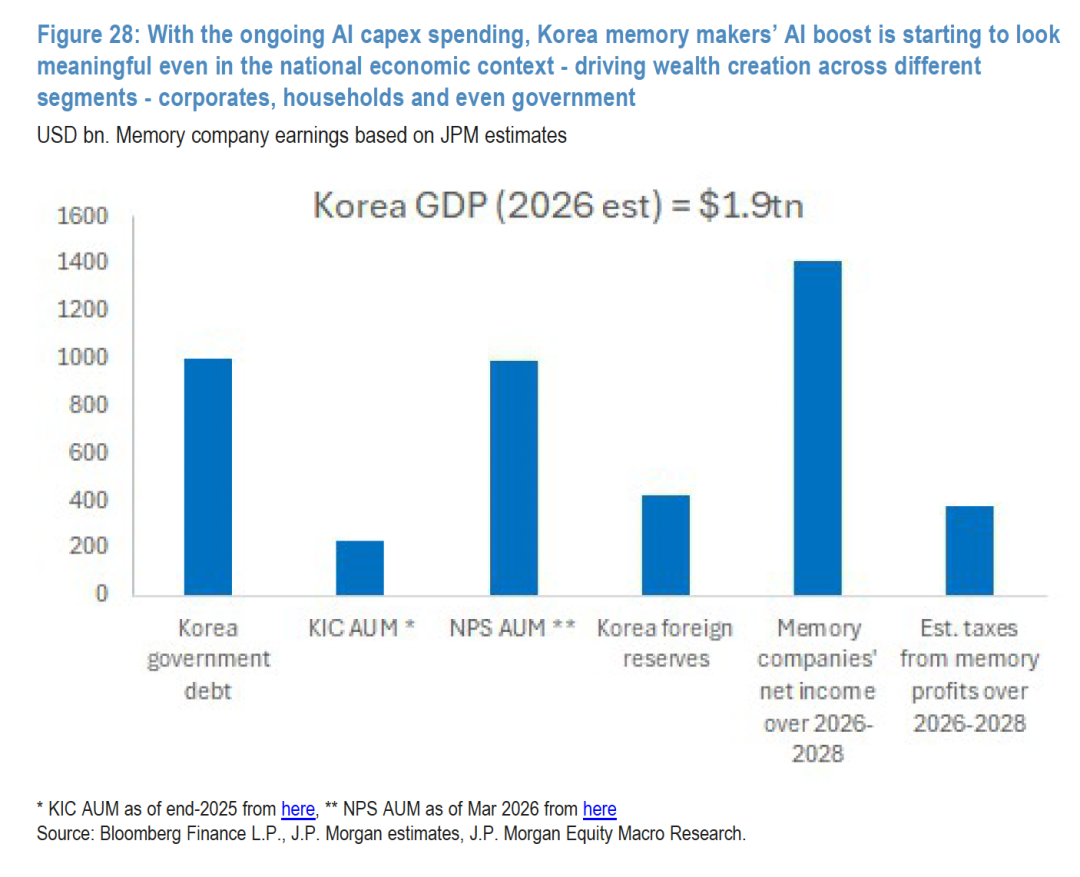
JP Morgan: Over the next three years, direct tax contributions from Samsung and SK Hynix to the South Korean government are expected to easily exceed $350 billion; adding personal income tax from employee bonuses would push the total even higher. For reference: South Korea's total foreign exchange reserves stand at $427 billion, with total government debt at approximately $1 trillion.
The memory chip industry has been governed by the same script for forty years: two years of boom, one crash. Every dollar earned in the good times becomes a new production line; by the time that new capacity comes online, demand has usually peaked, and prices plunge.
Over the past three decades, this cycle has repeated roughly every four years, eliminating players each round: in the 1990s, there were still more than twenty companies making DRAM; several cycles later, only three names remain at the table: Samsung, SK Hynix, Micron.
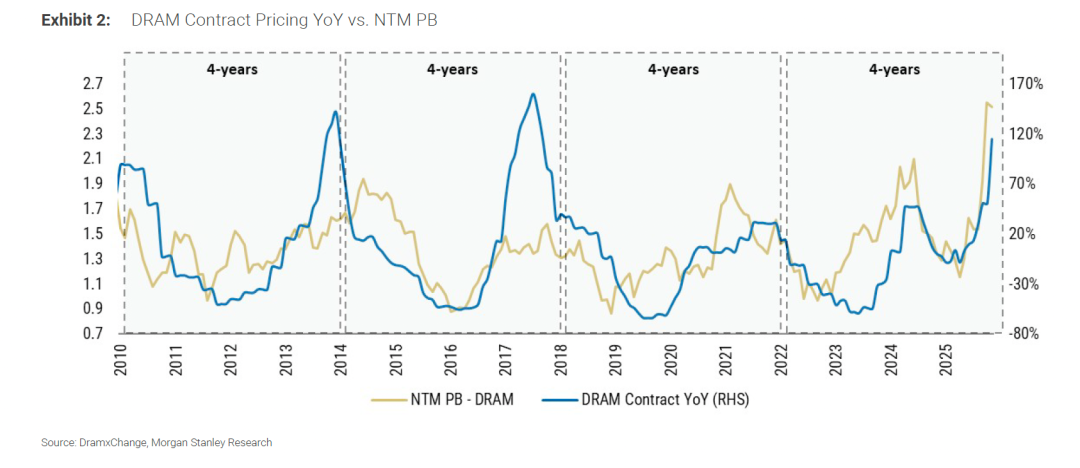
For years, the memory industry followed a roughly four-year cycle, repeating endlessly. The bulls argue — this time is different! Memory has transformed from a cyclical industry into one of structural growth, thanks to AI.
And in this memory "supercycle," one core question hangs over every manufacturer and investor: is the cycle still there?
The bulls say: this time is different! Because of AI, this formerly cyclical industry is becoming one of structural growth — it's no longer a cycle at all.
This logic is the core support for memory's nearly year-long surge. Samsung, SK Hynix, Micron, SanDisk — their valuation frameworks have switched from "cyclical stocks" to "growth stocks." Even without profit growth, share prices have multiplied several times over, with P/E ratios jumping from single digits to double digits.
SemiAnalysis defined this shortage as "once-in-forty-years." And the timescale of expansion itself ensures the shortage won't end quickly: building a new fab takes three years, and HBM consumes twice the production capacity of ordinary DRAM, so expansion actually worsens the shortage.
A SemiAnalysis memory analyst also told me that even counting capacity under construction, the shortage in 2027 will be twice as severe as this year. Because large numbers of new AI chips come online next year, memory capacity originally allocated to phones and laptops will be massively diverted. The industry consensus: 2027 will be the tightest year, with possible relief only in 2028.
South Korea is the biggest winner in this shortage. The bulk of HBM capacity sits with SK Hynix and Samsung. Despite recent market turbulence, the Korean stock market remains the world's best-performing this year — and most of that rise has been carried by these two companies.
Market euphoria has seeped into every corner of life. In Seoul, I once scheduled a meeting in Yeouido, the financial center.
Saturday noon. At Hyundai Department Store in Yeouido, every luxury boutique from LV to Chanel to Bulgari had wait times of over an hour just to enter.
From friends, I heard all kinds of wild stories: SK Hynix employees don't dare say where they work when on blind dates; only if they sense the other person isn't materialistic do they tell the truth. And no wonder — SK Hynix's average annual bonus in 2025 hit $90,000, a record high. With 2026 profits projected even higher than 2025, bonuses will only grow.
Nearly all of South Korea is in the stock market. Retail investors' net buying this year has seen roughly 83% flow to Samsung or SK Hynix. Many elderly have cashed out life insurance policies and dipped into retirement savings to buy chip stocks. There's a FOMO sentiment in Korean society — maybe you've done nothing wrong, your salary still comes in, your savings are still there, but simply because you didn't buy these two stocks, while everyone around you got rich, you've become poor. This FOMO emerged during the last housing frenzy, and now it's resurfacing in the AI boom.
The winners are celebrating, but behind the celebration, society is tearing apart.
Outside chips, South Korea is actually struggling. Petrochemicals, steel, batteries, auto parts — squeezed between weak demand and Chinese competition.
Economists call this K-shaped divergence: one leg shooting to the sky, one leg falling away. South Korea's average monthly salary is under $3,000; one chip worker's bonus equals an ordinary person's ten years of wages. One government official proposed using taxes from AI-benefiting companies to fund a "national dividend," redistributing some excess profits to other workers — "a necessary cost to maintain systemic stability." The post was later deleted, but the topic lingered.
Yet even the skyward leg of this K-shaped divergence has been shaking violently lately. Monday morning after ICML ended, one brokerage report projected SK Hynix's Q2 operating profit would surge 556% year-over-year. A staggering number by any industry's standards.
But the stock fell over 10% that day. The reason was simple: the market had expected an even higher number. For memory stocks, nobody cares what profits actually grew by anymore — only whether they beat expectations.
Morgan Stanley noted this is already the third major memory stock correction since ChatGPT's launch; the previous two didn't break the cycle. As the industry shifts toward three-to-five-year long-term contract structures, brokerages are rethinking valuation frameworks: from "how much did prices rise this quarter" to "how many years can these profit margins hold." Short-term surges and plunges may just be noise in a longer cycle. I have a friend who went heavy into chip stocks this year; this week's crash didn't faze him: "The cycle isn't over yet."
This AI transformation is far from finished. But in this supercycle, three clocks are running: models iterate by the month, capital gets repriced by the quarter, fabs get built by the year — and ultimately, the market gets calibrated by whichever clock moves slowest.
Not far from the COEX venue sits the famous "Jensen Huang fried chicken restaurant." Most customers there were wearing ICML badges — the AI concentration was off the charts.
The Divide Between AI Academia and Industry
This year, both of ICML's two best papers went to the diffusion direction.
One was from MIT's Fan Chen, leaning theoretical — something about improving diffusion sampling rates (making them faster). I didn't really follow that one. The other came from Tsinghua University's Gao Huang's team, and the key phrase in its title was "The Flexibility Trap."
Diffusion LLMs represent a class of generation methods that diverges from mainstream large model approaches. Mainstream models write left to right, one token at a time; diffusion LLMs can scramble the order, filling in wherever they feel most confident first. Sounds like more freedom, right?
This paper used experiments to prove: on tasks requiring strict reasoning like math and code, the very freedom that diffusion prides itself on becomes a trap.
Reasoning requires making choices at critical junctures. A model with too much freedom tends to dodge the hardest choices, filling in the easy parts first — only to find, when it circles back, that no options remain.
Of course, in industry, diffusion LLMs aren't mainstream. ICML is an academic conference; it likes ideas with intellectual bite. But academic cleverness and commercial viability are two different things.
At 5Y Capital's Signal Station event, we happened to revisit an old topic: Richard Sutton's Bitter Lesson, a pattern repeatedly validated in AI.
Put simply: in the long run, the most effective methods are always the most general, the most brute-force — scaling search + learning to beat anything hardcoded with human knowledge. The industry sometimes crudely simplifies this as scaling versus craft. Those delicate techniques tailored to specific problems work in the short term, but once scaling resumes, they get discarded.
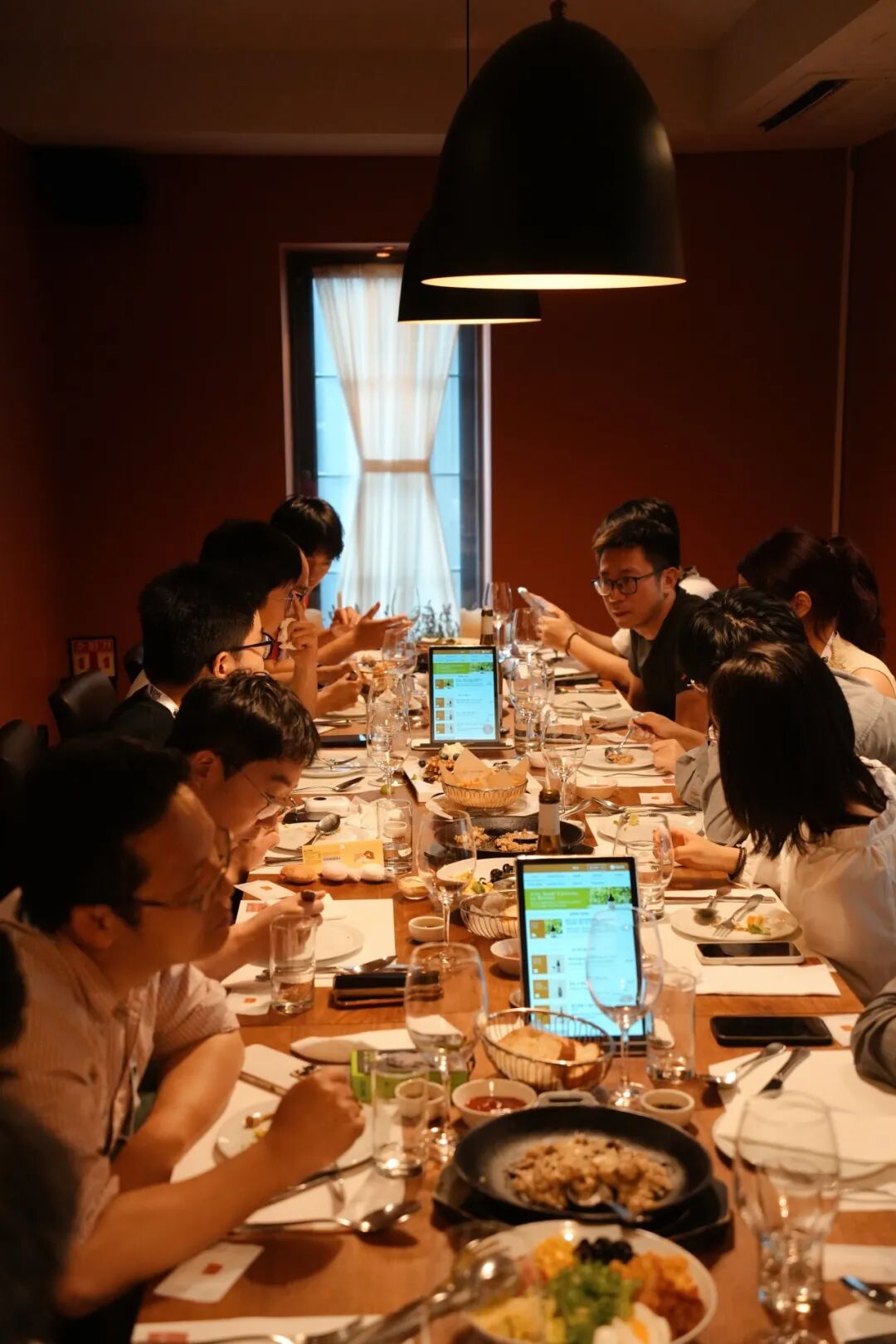
5Y Capital Signal Station Happy Hour at ICML 2026 — the energy for conversation was so intense. Seoul restaurants close way too early at night.
But what I was thinking about that day was the flip side of this lesson: if scaling were truly smooth sailing, why would the Bitter Lesson need to be brought up again and again? Because scaling hits walls every so often.
Scaling isn't a complete solution; it's a compounding mechanism. It eliminates human techniques that can't compound, yet it forever depends on new algorithmic innovations to redefine what can compound.
AI's history isn't scaling defeating insight, but insight repeatedly creating new scaling regimes, which scaling then amplifies and commodifies.
The Bitter Lesson is that human insight does not scale.
The bitter lesson of that lesson is that scaling does not invent itself.
Every wall we hit, it's those "useless" insights and techniques that pull us out of the dead end. Once scaling finds its breakthrough and starts running again, these lifesavers get abandoned — until the next wall, and the cycle repeats.
The diffusion LLM awards may sit at some point in this cycle: academia is refining it, industry doesn't need it yet, but nobody knows whether it'll be exactly what's needed the next time scaling hits a wall.
Of course, this is the old question at the methodology level. But at this conference, there was a newer, more concrete problem that unsettled me: results that academia proves "effective" often fail to hold at industrial scale.
Previously, academia ran experiments on "small" 7B models. If an idea showed promise, even just preliminary signals, that was enough for a paper. Industry bought in: you saw a signal on small models, and we'd pay the bigger price to see if it scaled.
Not anymore. Academia has gritted its teeth and pushed validation scales to 20B, 30B — a single training run burning nearly 10 million RMB.
But industry's threshold has ballooned to 100B, and it dismisses whatever you saw below 100B. Too many ideas work on small models and fail when amplified.
One core algorithm engineer put it bluntly: doing research and actually operating thousands of GPUs at industrial scale are completely different things.
A thousand ideas that work on 7B models — scale that to 100B, maybe ten survive. That attrition rate is fatal for investment. We've seen many projects that, strictly speaking, were investments in a paper. Beautiful idea, but not yet grown into a business.
So on the night ICML ended, walking back from the COEX venue to my hotel, I seriously questioned myself: over the years, have I made a category of error — overloving novelty, overloving cleverness?
But investors must constantly remind themselves: don't live like a reviewer. Reviewers evaluate papers on whether they're new, good, citable. Investors judge something else entirely: can this thing grow in the real world, can it become a business?
These two standards are diverging by the day. The venue was littered with good ideas, but few that could converge into an actual business.
The world has entered a phase of massive AI industrial advance, and the window for "boutique" innovation may temporarily close.
The AI Paper Explosion: How to Disrupt arXiv
This year's ICML deployed a thunderbolt tactic to enforce review discipline.
The organizing committee embedded invisible prompt bait in submitted PDFs. If reviewers got lazy and fed papers directly to AI to write reviews, the AI would regurgitate that hidden phrase verbatim into the comments.
ICML's penalties were severe. Many of these reviewers were themselves authors of submitted papers. Once caught using AI to write reviews, your own submission got rejected too. In the end, 506 reviewers were flagged for violations; 398 of them were also submitting authors, and their 497 papers were rejected on the spot — about 2% of total submissions.
This naturally drew protests from some reviewers: why demand they spend massive time and energy writing detailed comments for free?
The controversy also revealed that, amid today's explosion in AI paper volume, this peer review system that has operated for decades is completely overloaded.
After spending days at ICML, I suddenly felt the conference itself resembles a giant Transformer. Each paper is a token; each person is a token too. Twenty-thousand-plus tokens crammed into the same context, competing for attention.
Submissions nearly doubled this year; next year will likely keep growing. Models can endlessly expand context windows, but human attention budgets are basically fixed. If this continues, ICML's first bottleneck may not be compute — it'll be human KV cache overflow.
For authors, the rules have partly changed: used to be enough to do good research; now you have to attract attention, figure out how to lure others' attention toward yourself.
Symptoms of overload were everywhere. One longtime attendee said he couldn't even score a ticket this year; headhunters and HR were sweeping the hallways, and most DMs he received came from hedge funds.
In the era of paper explosion, how do people find papers worth reading today? Most researchers have reverted to the most primitive method: identify talented people, read what they write directly — rather than staring at arXiv (the world's largest academic paper repository).
Today's academic system is tailored to human capabilities at every step. Research is conducted by humans; humans absorb prior work by reading papers, because humans need text to crystallize knowledge; the trial-and-error process stays private, with only the successful path written up and published; evaluation goes to peer review.
But if we AI-ify this process, AI doesn't need to read papers. Papers are just interfaces for humans; what AI needs is everything behind that interface: chain-of-thought, trial trajectories, failure paths, raw data, runnable experimental environments.
The fundamental unit of research will shift from a paper to a runnable folder.
How academic knowledge gets shared will change too. Today if you spot a paper on arXiv, you build the environment from scratch and reproduce the experiments yourself.
But why not design it like a vibe coding community (imagine arXiv, GitHub, and Hugging Face merged): research happens there, experiments run there, evaluation completes there.
Today if you want to combine Method A from one paper with Method B from another, a human has to read both and manually stitch them together. The AI era should be modular plug-and-play — provided all research outputs leave clean interfaces, composable and permutable.
Review needs to change too. Human reviewers today can only run one standard: either academic value or industrial value, rarely both.
Switch to AI reviewers, and weights become freely adjustable. Want academic novelty? Weight novelty higher. Want industrial viability? Weight viability higher. Two value systems could converge in one framework for the first time.
Paper output will keep exploding; evaluation must evolve with it: from human reading and human judging, to runnable automated testing — like running benchmarks.
This may have been the clearest thought I had during my days in Seoul. "Disrupting arXiv" matters enormously. If you read this far and feel the same, reach out — let's build it together.
Epilogue
On the flight back, I flipped through my notes from the past few days.
Four days, dozens of conversations, spanning compute, papers, stock prices, visa issues... On the surface each segment told a different story, but underneath they all answered the same question: in this race that's getting faster, more expensive, and more crowded by the day, what position truly belongs to you?
Even the ICML schedule reflected this uncertainty. There was a talk by Princeton professor Narayanan titled "What will be left for us to work on?" One of the most influential scholars in AI, standing on the stage of the world's top AI conference, asking the exact same question.
Of course, I didn't find an answer either.
But I remember a high school student. Over those few days, I met almost exclusively with Big Tech researchers, founders who'd raised hundreds of millions, engineers managing thousand-GPU clusters. But at a workshop called RLxF, I saw a high schooler take the podium. He was from Lynbrook High School in San Jose, California, about to enter his senior year.
An independent author — no team behind him, no institution, just one person who wrote a paper and submitted it. He got an oral, meaning he was selected to give a formal presentation on stage, a fairly high honor at an academic conference. The vast majority of papers only get poster presentations.
His research was crop recommendations for farmers. Previous recommendation systems only considered which crops grew best. He added one more variable: whether the farmer would actually adopt the suggestion. Could they afford the seeds? Did they know how to use new tools? All of this got folded into the recommendation.
In an industry where benchmarks routinely require thousands of GPUs and millions of dollars, a high schooler with a single computer was studying how farmers could actually use an AI recommendation system. While everyone else in the room was scrambling to find their position, he might have been the only one who didn't need to — he simply finished something he wanted to do.
That was probably the most moving moment of the entire trip: this industry is simultaneously raising the ceiling to unprecedented heights and lowering the floor to unprecedented depths.
Whether you feel anxiety or excitement depends on which end you're looking at.
I'll be heading back to Silicon Valley at the end of the month. Last quarter, everyone was token-maxxing — people frantically piling on compute, scaling up, unable to stop. A few months later, the winds have shifted: the token-maxxing momentum has slowed considerably; there's now nuanced debate about just how big the compute gap really is; applications have entered a downturn cycle while data has entered a peak cycle... Let's talk. (Xing Meng)
Cover image: ICML