Startups Without a Defined Finish Line: Growth Is Just Self-Indulgence | 5Y Capital × Zhejiang University Meetup

Large language models have given the tech industry an irresistible narrative: as model capabilities keep improving, demand will naturally follow.
In recent years, large language models have offered the tech industry an irresistibly compelling narrative: as model capabilities keep growing, demand will naturally follow. As long as the capability curve keeps climbing, the investment is worth it.
But when AI moves into applications like robotics and drug design, that curve starts to break down. More advanced algorithms don't necessarily mean better usability. More data isn't always obtainable. Whether a "Scaling Law" even exists becomes questionable itself. The real world doesn't hand technology a universal ruler, nor does it hand entrepreneurs a ready-made answer. After leaving school, no one sets the problems for you anymore; after starting a company, no one tells you where the finish line is.
"When a Young Person Decides to Start a Company" is a series of events that 5Y Capital launched for university students, hoping to discuss with young people the problems truly worth solving before they make the entrepreneurial leap. On September 21, together with Zhejiang University's Delta Space, we invited Xing Meng, partner at 5Y Capital, and two founders from 5Y's portfolio — Fei Gao, founder of DiffRobotics, and Odin, founder of Valhalla Tech — to share their frontline experiences from investing, flying robots, and AI for Biology, and to discuss technological progress, entrepreneurial choices, and personal growth in the real world.

September 21: 5Y Capital × Zhejiang University Delta Space, "When a Young Person Decides to Start a Company"
Highlights
- Large language models are one of the rare technologies where you can focus purely on capability growth and let the world fill in the demand. In the physical world, most technologies need to work backwards from the end goal;
- The most generalizable thing in robotics may not be the scaling of some algorithm, but scientists' mathematical abstraction of a problem's essence;
- "When you stop chasing physics, physics appears." The breakthrough in protein design came precisely when we stopped requiring models to follow human-derived physical formulas;
- There is no universal solution for real-world data flywheels: industrial drones lose both users and data when they crash; AI drug discovery lacks experimental data that can provide rapid feedback;
- "Without a primary goal, you can't choose what to give up." The hardest part of tech entrepreneurship is balancing long-term technical accumulation with rapid commercial deployment;
- After leaving school, the problems disappear. Passion isn't the default option; finding your own problem is itself the most important capability;
- Taste can be cultivated: read ten thousand papers and you'll naturally know what good research is; look at ten thousand products and you'll develop commercial judgment.
Panelists | Xing Meng, Fei Gao, Odin
Edited by | Musen Zhou

Physical AI: Where Scaling Law No Longer Holds Automatically
Language models are built on massive amounts of readily available text and can improve continuously through scale. But robots and AI for Science face the physical world: tasks are specific, data is scarce, and failure has consequences. Here, "more advanced," "more data," and "larger scale" are no longer automatically valid answers. Each domain must answer two questions anew: What counts as progress? And where does the fuel for progress come from?
1. Large Models' Success Is "An Exception"
In tech entrepreneurship over the past two decades, language models represent a very rare type of technology: it has a grand but coarse-grained AGI goal, and everyone only cares about how fast intelligence rises and how fast it can be distributed, letting the world fill in the demand. Encountering a technological wave like this once in a lifetime is a kind of luck. But it also has a side effect: people easily come to believe that all tech entrepreneurship should work this way — only looking at growth speed, never asking about the destination.
Autonomous driving provides another reference point. From 2016 to 2020, the industry's KPIs were basically "self-assigned: 200% annual improvement in disengagement miles gets an S, 100% gets an A, 50% gets a B." But the finish line might be one step away, or several orders of magnitude away — no one had measured it. It wasn't until around 2020 that the industry, referencing Waymo's practice of removing safety drivers, back-calculated a threshold: approximately 20,000 kilometers without critical disengagements before you dare remove the safety driver from the vehicle. With this number, there was finally a basis for deciding which paths to abandon and whether to add an expensive sensor. Once disengagement miles became sufficiently high, the focus shifted to cost reduction, and scaling began to converge.
Most technologies that enter the real world look more like the latter than the former.
2. What Truly Matters Is Mathematical Abstraction of a Problem's Essence
Ten years ago, people expected reinforcement learning to enable robots to make autonomous decisions and learn many things from failure. A decade later, reinforcement learning has finally proven capable of solving control problems — but control is precisely the most fundamental and most mathematically characterizable problem in robotics; true autonomous decision-making remains unsolved.
In complex environments without signals, what enables a drone to complete its mission? Fei Gao's answer is that it relies not merely on some more advanced paradigm of intelligence, but on extensive foundational work: modeling, low-level operators, engineering design, and scientists' mathematical abstraction of a problem's essence.
This is also what he understands by generalization: the same set of models, algorithms, and software can enter different scenarios and complete tasks. Stitching together several strategies tailored to specific scenarios does not constitute generalization. Take "spatial understanding" as an example: understanding a room doesn't equal understanding underground spaces; what truly transfers is abstraction of a problem's essence — a mathematical theorem can describe a vast range of phenomena. This cannot be achieved by scaling some algorithm alone; it also requires reality-facing methods that stack into a deliverable solution.
3. AI for Science: Turning Luck into Engineering
Pharmaceutical history offers a good illustration. The discovery of penicillin came from an accident: a petri dish was unexpectedly contaminated by mold, and the bacteria around it died. Without this accident, penicillin might not have been discovered for many more years.
Later, with the emergence of structural biology and molecular biology, "rational drug design" was born, and random luck was transformed into an engineering process for the first time. The 2024 Nobel Prize in Chemistry, recognizing protein structure prediction and computational design, also honored the transformation of a problem dependent on chance into one that can be solved through engineering.
Odin summarized this transformation in one sentence: "When you stop chasing physics, physics appears."
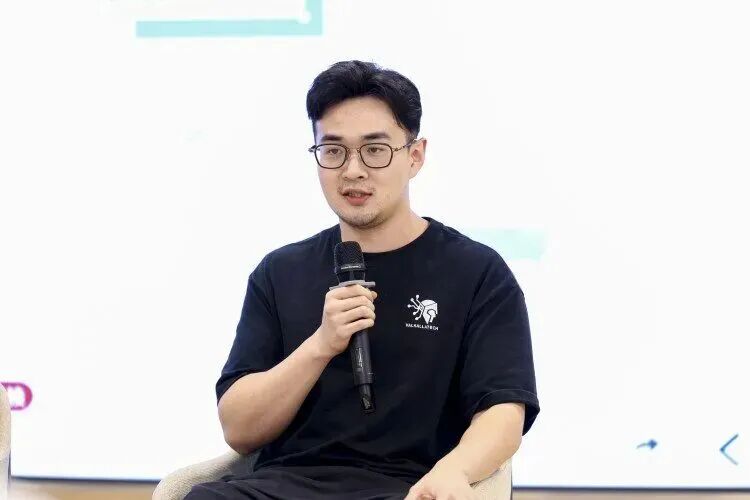
Odin, founder of Valhalla Tech
Has the model learned the most fundamental physical laws? One perspective is that human-written physical theories themselves are merely effective descriptions at different scales: Newtonian mechanics fails at microscopic scales, and in quantum regimes we need another language entirely. For AI for Science, whether a model reproduces some existing equation may not be the most important question. What matters more is whether the patterns it learns can continue to predict and generalize in new systems, and guide next-step design.
Two examples illustrate this: A counterexample is that machine learning force fields can achieve very low errors in energy and force, but this doesn't automatically mean that free energy, dynamics, or other ultimately relevant physical quantities will be correct. Fitting some underlying metric more accurately doesn't equal having captured the truly useful physics of the entire system.
Protein design offers another path: rather than being required to first write out a perfect, solvable explicit energy function, the model directly learns patterns between sequence, geometry, and interactions from large numbers of structures, and further answers "given a target, what protein might bind to it?"
In AI for Science, what is more worth looking forward to is physics emerging from the model, rather than constraining it with existing physics.
4. Real-World Data Flywheels Have No Universal Solution
Systems that enter the real world must first answer where data comes from, and different domains get stuck in completely different places.
Industrial drones often go precisely where users are unwilling to go: high-risk areas without GPS. Expecting users to enter first, map the area, and demonstrate once is unrealistic. And if any hardware component fails, the drone crashes with no second chance. The crash costs more than just equipment. Once users lose trust, they stop using the product; real data flow is interrupted, and the product can no longer iterate. DiffRobotics's answer is: before having real aircraft data, first use simulation, publicly available first-person-view (FPV) data, and underlying mathematical models to give the product initial capability to enter scenarios, then iterate through use.
AI drug discovery faces a different dilemma: a lack of data that can be obtained at low cost and scale, with rapid feedback loops. Drug development is a very long chain. If you only look at whether any drug ultimately reaches clinical trials or market approval, the feedback cycle is too long to guide how the model itself should improve. But reframed through an AI logic, the problem becomes generalization: faced with a new target, can you design an antibody that actually binds? This can be tested experimentally, verified repeatedly, and advanced as target numbers and success rates grow. For AI for Science, such verifiable, accumulable goals may be more suitable as a metric for model progress than "whether any drug ultimately reaches market."
In the physical world, data strategy depends on the product: first clarify what task the product needs to accomplish, then you know what data you need and where to get it.

Taste Determines What You Give Up
Technology doesn't automatically converge into a product; the destination must be defined by the entrepreneur themselves. And defining the destination, deciding what to abandon, and maintaining independent judgment in the face of hot trends — all depend on the founder's taste. As AI makes writing code and generating content increasingly cheap, the judgment of "what to build and what it should look like" becomes more scarce instead.
1. Taste First Means What Not to Do
Academia is an open-ended goal; no one requires you to back-calculate how far you are from the answer. But when building a product, goal definition is as important as demand discovery. Perfectly solving a problem might require ten thousand units of resources, while your team only has one hundred. The core question is which nine thousand nine hundred to abandon, "imperfectly completing the goal." Without a primary goal, there is no basis for choosing what to give up; and what you choose to give up most reveals a founder's taste.
2. Research Taste Doesn't Equal Business Taste, But Both Come from Massive Input
The hardest part of tech entrepreneurship is balancing long-term technical accumulation with rapid commercial deployment — they require different kinds of taste. Technical accumulation is like climbing a mountain: no cable car to ride, any unsteady step leaves hidden risks. Business requires judging which way the market currents flow, and going with them.
But if you only follow the current downstream, a tech company loses the moat built by technical accumulation, and also loses the reason it was founded by a scientist in the first place: why should I be the one to build this company, rather than someone a hundred times better at business than me? Founders need one eye on the long-term direction of technology and another on where the market is flowing. Fei Gao also admitted that his past research taste was quite good, but his business taste needed to be learned anew.
Research taste comes from reading papers day after day, from mentors and peers with good taste. Having read ten thousand good, mediocre, and bad papers, you naturally know what good research is. Business taste works the same way: having seen ten thousand products and scanned enough industries, judgment begins to form. The prerequisite is to first enter the market, accumulate through practice, rather than waiting until everything is figured out before setting out.
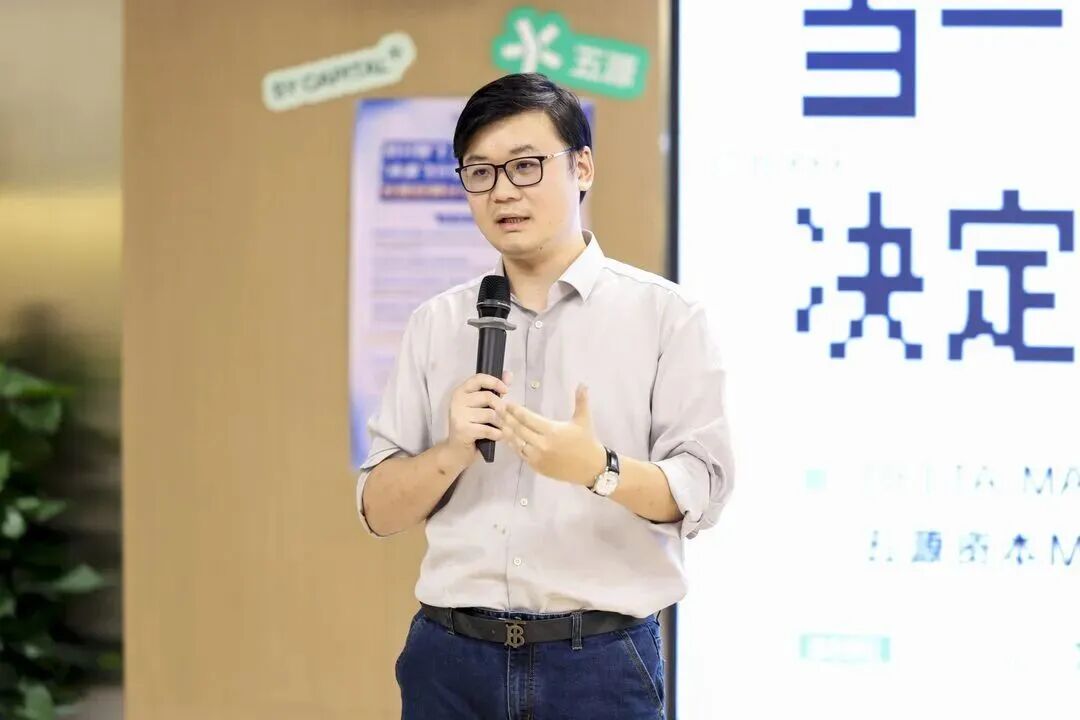
Fei Gao, founder of DiffRobotics
3. The Biggest Enemy of Good Taste Is Following the Crowd
Many scholars have excellent taste in research, yet abandon their unique judgment when starting companies, chasing hot directions instead. Part of the reason is that academic decisions can be made independently, while entrepreneurship faces continuous influence from capital, markets, and public opinion. Precisely because of this, founders who persist in independent judgment are more easily identified in homogeneous races, and more scarce.
Persisting in taste means enduring noise. Odin divides noise into two kinds: one comes from the outside — the world often judges an emerging direction without consensus through frameworks from other fields, such as repeatedly asking whether AI4S has a Scaling Law; the other comes from within — under massive questioning, will your own judgment waver? His experience is that rather than repeatedly arguing the correctness of a technical path, it's better to first produce results.

Answers Are Cheap, Questions Are Scarce
From childhood, we've solved problems set by others. After leaving school and entering open space, the problems suddenly disappear — you have to set them for yourself. As AI makes answers increasingly cheap, proposing a question worth solving becomes more scarce instead. Finding such a question, and confirming that you are the person to solve it, matters more than any methodology.
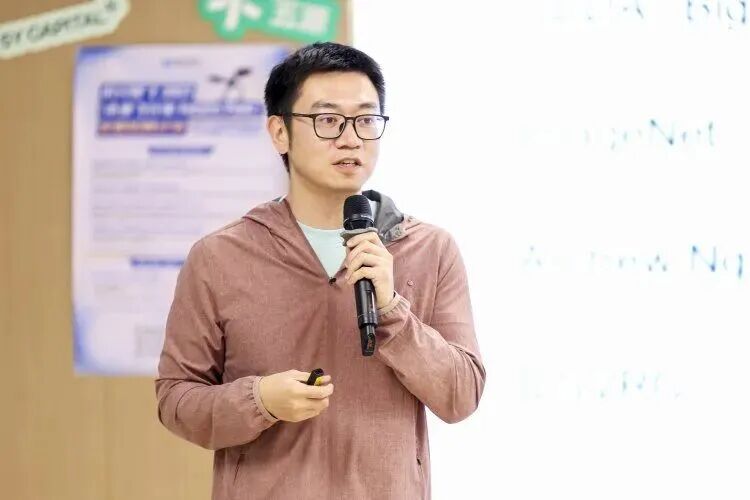
Xing Meng, Partner at 5Y Capital
1. Look for Problems Where Variables Have Just Emerged and Uses Haven't Yet Become Consensus
When Xing Meng was about to graduate in 2011, SoLoMo — the convergence of social, location, and mobile — was the hottest direction in tech, and the best graduates were flooding into Facebook and Twitter. But in his view, when everyone sees a trend, it's already mainstream; latecomers can only divert a small tributary from the flood.
He noticed another set of variables that hadn't yet caught mainstream attention: CUDA unlocked GPU parallel computing power, Andrew Ng demonstrated that neural networks might be able to scale, and ImageNet provided data. These variables pointed to the most direct application: image recognition. Looking back today, this was an "early version of the GPT moment." At the time, the most advanced face recognition accuracy was only around 70%; beyond being a toy, it was almost useless. Xing Meng's first startup began here: could visual recognition be made into a cloud service? As for how to make money, he hadn't thought that far ahead. This company was acquired by Amazon three years later.
When you've discovered the variables but others don't yet know what they can do — that's often the window when individuals can spot opportunities first.
2. Passion Isn't the Default Option; It's Often Encountered Through Action
Is passion a gift? There's no universal answer, but there are at least several real paths.
The first is encounter. It requires luck, and also giving yourself chances to try. In a room where everyone sits at roughly the same height, if Yao Ming is sitting there, you can tell at a glance that he's different.
The second is "refusal to accept." Believing your idea is right, wanting to prove it, and in the process of proving it, discovering that you quite like it.
If you haven't found it yet, don't be anxious. Clearly knowing what you don't want, and having the courage to give it up, already puts you ahead of most people. Finding a direction worth devoting your life to is a privilege, not a default option that everyone has.
3. Judging Whether You're the Person to Solve It: Obsession, Independence, Action
For the same problem, there may be dozens or even thousands of people thinking about it. How do you know you're the right person to solve it:
- Obsession. Before officially starting, how much time, money, and failure have you already invested in this thing.
- Independent world model. The same information input into your brain produces judgments that diverge from the mainstream yet remain internally consistent — the more orthogonal you are to others, the more likely you are among the few best suited to solve this problem.
- Action. When you only have 2% of the information, have you already started moving? Only by moving does new information enter your world model, enabling subsequent judgments.
4. Questions Grow More Precious, Answers Grow Cheaper
After AI permeates every industry, asking the right questions, knowing which direction to ask in, will become increasingly valuable. In the past we spent 80% of our energy learning how to give answers; this proportion needs to change.
Two other capabilities are equally important: one is the ability to build trust between people — it's hard for humans to trust an AI the way they trust a person; the other is the ability to iterate oneself. Going to university isn't about becoming a "tool person" in the industrial system, but learning how to learn: when you're genuinely interested in something, go read a dozen books to figure it out, rather than just waiting for class.
Final Words: Half Science, Half Faith
After stepping out of a world with standard answers, technology, companies, and individuals must all define their own problems, set their own destinations, and continuously calibrate with reality. And before anything is proven, the same question must first be answered: when something is still hazy, how do you get others to believe?
Founders, business leaders, and investors are all answering this question. Founders must generate faith, and get more people to believe in what you believe. Business leaders must solidify faith into concrete goals, making reasonable and scientific compromises. Investors must leverage faith. Late-stage investing can be calculated; early-stage investing has no numbers to calculate, requiring half scientific judgment and half faith.
The model curves will continue to rise, but they won't answer where the finish line is for you. What 5Y hopes to do is, before consensus forms, find those who have already found their own problems, generated their faith, and can make others generate faith too — and then lend them a little extra belief.