Nature's Will Unveils Natura-1: A General-Purpose Foundation Model for the Physical World

Zero-shot language-instruction following for long-horizon dexterous tasks in unfamiliar scenarios, including folding, calligraphy, and tool switching.

Natura-1 is the first general-purpose foundation model for the physical world from Natura. It follows language instructions zero-shot and performs dexterous manipulation that generalizes to open-ended scenarios.
Natura's goal is general physical intelligence. We are committed to building foundation models that learn directly from human experience, master general-purpose dexterous manipulation, and generalize across the physical world. The physical world is shaped by human hands, for human hands.
People make tools with their hands, and through tools have shaped the world we live in today. In such a world, a truly general-purpose robot must possess dexterity.
Yet incorporating high-DoF dexterous manipulation into a general foundation model has remained a frontier that physical intelligence has struggled to reach: contact dynamics offer vanishingly small margins for error, while the high degrees of freedom in dexterous hands create an enormous action space. The model must fully understand instructions while executing precisely amid complex contact.
We officially release Natura-1: Natura's first general-purpose foundation model for the physical world.
Natura-1 is a 50-billion-parameter Mixture-of-Experts (MoE) model, pretrained on 1 million hours of first-person human experience data. It takes language and vision as input and drives a 20-DoF dexterous hand within a 100-millisecond control loop.
Natura-1 follows complex natural language instructions zero-shot, generalizing to unseen scenarios and tasks. It autonomously completes long, continuous workflows — folding thin, easily deformed materials, writing calligraphy with compliant brushstrokes, or switching tools mid-stream in multi-stage tasks.
How general a model is depends on the breadth of its experience. The physical world is infinitely varied; it cannot be covered by human-designed tasks.
Our approach is clear: train larger models at scale, and let data cover as many environments and tasks as possible.
Model capacity and compute can be built or bought; but data of such breadth can only come from the real world itself. The diverse activities humans perform with their hands are everywhere, and constitute the essential source of scalable physical experience.
To this end, we developed full-stack infrastructure: a data lakehouse that efficiently manages tens of petabytes. Data pipelines cover the full flow of cleaning, annotation, and distribution control. Custom low-level operators and a distributed training engine jointly optimize sample dispatch, cache prefetching, and GPU computation.
Natura-1 is the first model trained on this stack, and every component of this system is designed for further scaling.

Real-World Performance
We evaluate Natura-1's capabilities in the real world. Our self-built benchmark spans twelve dimensions across three groups. "Dexterous Control" covers pose control and contact, bimanual coordination, in-hand manipulation, and tool use.
"Instruction Following" tests the model's reasoning toward goal achievement, and its generalization to novel scene and spatial layouts, tools and objects, actions, and task combinations.
"Long-Horizon Execution" evaluates the model's planning, memory, and recovery across extended workflows. The entire benchmark is evaluated by a single base model, and this model was never exposed to these evaluation tasks, scenes, objects, or action combinations during robot training.
Since no strong general-purpose dexterous manipulation model existed before, finding fair baselines was difficult. We selected π0.5 and GPT-6-Astra.
Yet even after fine-tuning π0.5 on identical robot data and giving GPT-6-Astra 60 minutes of execution time, neither produced scorable results on the same dexterous hand platform.
To enable a relatively fairer comparison, we used the ARX AC One dual-arm gripper body — a platform more familiar to both — with π0.5 fine-tuned on a gripper-manipulation version using the same real-world training data.
Ultimately, π0.5 and GPT-6-Astra scored 13.5% and 16.7% on the gripper, respectively. Natura-1 achieved 53.4% (Base) and 59.1% (Agentic) on this 20-DoF dexterous hand.
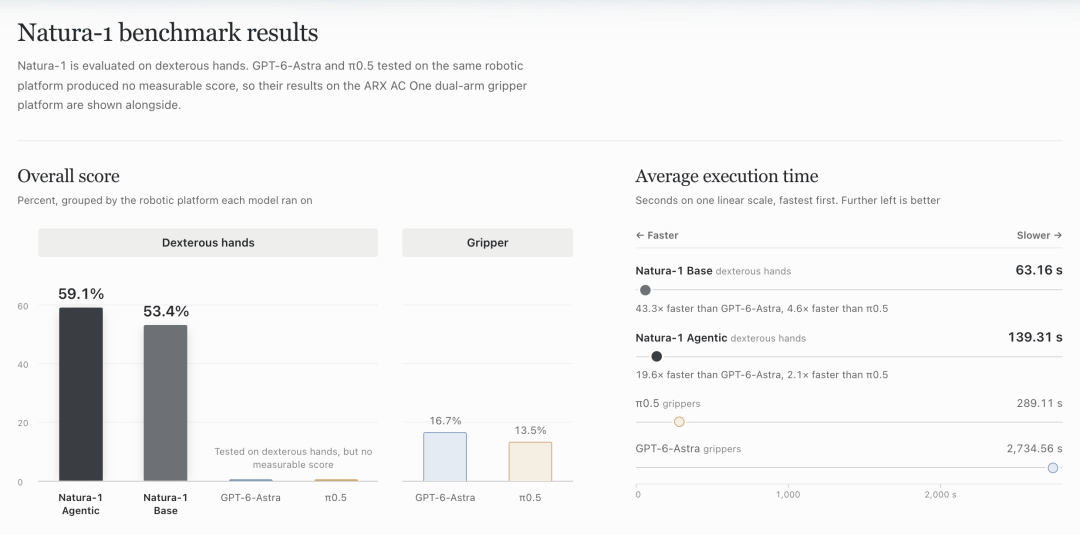
Natura-1 (Agentic) achieved the highest or tied-highest score across all 12 dimensions.
1.1 Long-Horizon Dexterous Tasks
With additional fine-tuning, Natura-1 demonstrates autonomous execution spanning several minutes without human intervention. Within a single workflow, it handles different materials and contact conditions, links multiple steps, and steadily advances the task.
Natura-1 adjusts grasp and motion based on continuously updated observations, executing fine manipulation with new tools, objects, and scenes. The high-DoF hands and the model's generalization capabilities work together in actual action.
1.2 Zero-Shot Instruction Following
Language defines the global goal; real-world feedback guides action. Natura-1 can follow unfamiliar instructions zero-shot. New instructions typically bring unfamiliar spatial relationships, object combinations, and manipulation objectives. The model must understand the constraints in the instruction, map them to the scene before it, and then drive the dexterous hand to complete the corresponding action.
Faced with actions, objects, and scenes never seen in training data, Natura-1 organizes both hands to execute steadily; when objects move, contact conditions change, or execution is disrupted, it adapts its manipulation to faithfully complete the user's instruction.
1.3 The Beginning of Emergence
In everyday interaction, Natura-1 has also demonstrated behaviors beyond our expectations.
During a playing-card grasping test, the cards were extremely thin. Drawing on physical intuition, the model employed a novel grasping strategy: it pushed the card past the edge of the box to create an overhang that fingers could slip under, then coordinated both hands to lift it.
Confronted with an out-of-reach ball of yarn, the model was asked to figure out how to retrieve it. It used a pole already threaded through a basket to pull the basket closer, then took the object.
In the task below, Natura-1 completed something never present in training: pressing the spacebar on a laptop to wake it up.
The instructions never specified these intermediate steps, and real-world demonstrations never provided such operation paths. The model organized new solutions toward the goal based on the physical regularities before it.
We view such emergent behavior as early signs of more general physical intelligence: large-scale human experience may enable the model to learn implicit understanding of physical mechanisms, and form novel action strategies in unfamiliar situations.

Scaling, Scaling, Scaling
2.1 Data
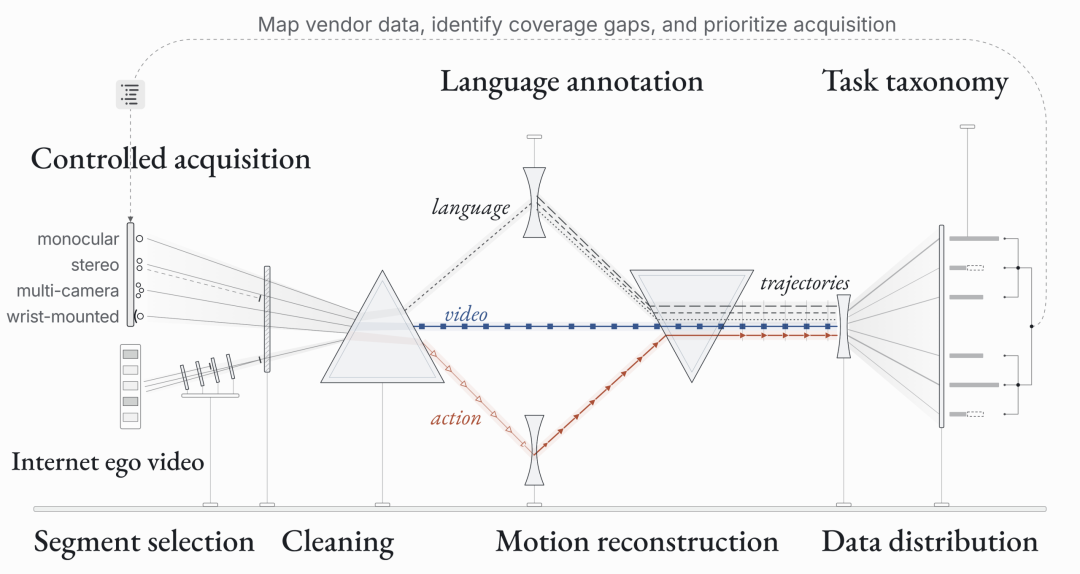
The value of human experience lies in both scale and span. Natura-1's 1 million hours of first-person data covers the vast majority of daily life and production scenarios. Directionally collected data covers mainstream tasks and scenes; internet video adds diversity — the accumulation of experience continuously broadens the world the model sees.
In our data pipeline, over 20 low-level operators continuously perform deduplication, quality screening, and distribution control; recover hand and full-body motion from monocular and binocular video; and decompose global goals into subtasks and atomic steps, forming video-language-action multi-level trajectories.
A tens-of-PB data lakehouse carries the entire process. The pipeline can produce 350,000 hours of training data per week, scaling linearly with compute resources, allowing real-world experience to continuously flow into the training process.
2.2 Infrastructure
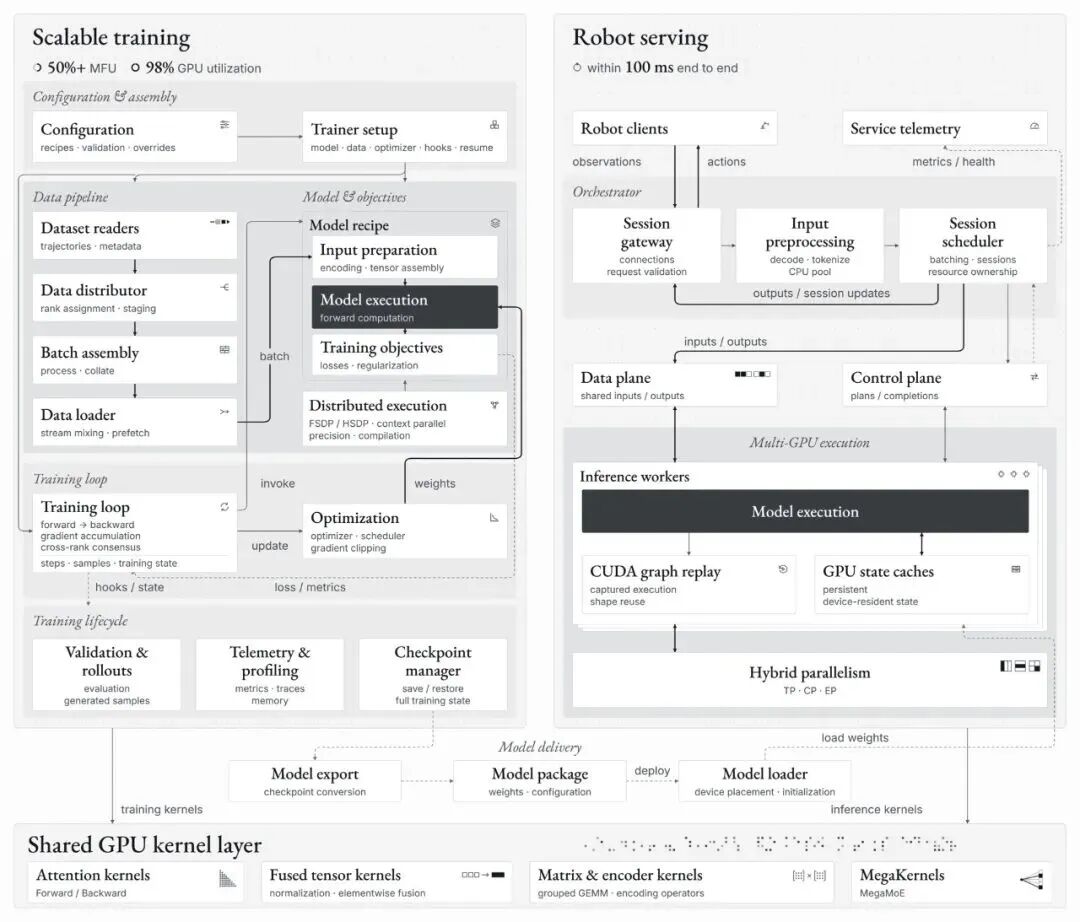
Scalable infrastructure must satisfy two requirements simultaneously: during training, let the model continuously consume multi-modal trajectories at high throughput; during inference, respond to the real world within 100 milliseconds. The former requires sustained efficiency in distributed computation; the latter demands precise control of latency across the entire execution path.
To this end, we rebuilt the training and inference stack through software-hardware co-design, from data organization and distributed execution to GPU computation.
On the training side, sample dispatch and cache prefetching reduce padding waste and idle waiting; under measured production configurations, model FLOPs utilization (MFU) exceeds 50% and GPU utilization reaches 98%. On the inference side, Rust coordinates scheduling and sessions, reusing resident GPU state caches.
Our self-developed attention operator achieves approximately 1,200 TFLOP/s throughput on average in forward and backward benchmarks, exceeding the performance of a tuned FlexAttention baseline by 6x. End-to-end inference latency from observation to action is strictly controlled within 100 milliseconds.
2.3 Model Architecture
Natura-1's architecture revolves around one question: how to extract more intelligence from every segment of experience? Language, images, video, and action are placed into the same 50-billion-parameter MoE model; instruction understanding, world modeling, and action generation are jointly learned by the same sequence model.
In its architectural design, Natura-1 follows the first principle of scaling potential: its architecture closely approximates a standard end-to-end MoE Transformer, restricting all inductive biases to the organization of multi-modal data within sequences and the causal structure of attention mechanisms.
This allows the model's optimization potential for training and inference efficiency to rival frontier LLMs and video generation models.
We treat video frames and action poses at the same timestep as two different projections of the same physical state. Though high-quality action labels are scarce, video runs through every trajectory.
Natura-1 uses past video as memory and future frames as world-modeling targets, learning video and action through joint denoising and flow matching — gaining supervision beyond action labels from abundant video.
Predicting the next step also requires understanding human intent. Fitting the joint distribution of vision and action poses does not necessarily produce this capability.
We use fine-grained language supervision so that different intentions correspond to different video and action predictions, making "what to do next" entirely dependent on the goal proposed by the human. A small amount of robot data is then used for post-training to adapt capabilities learned from human experience to specific robot platforms.
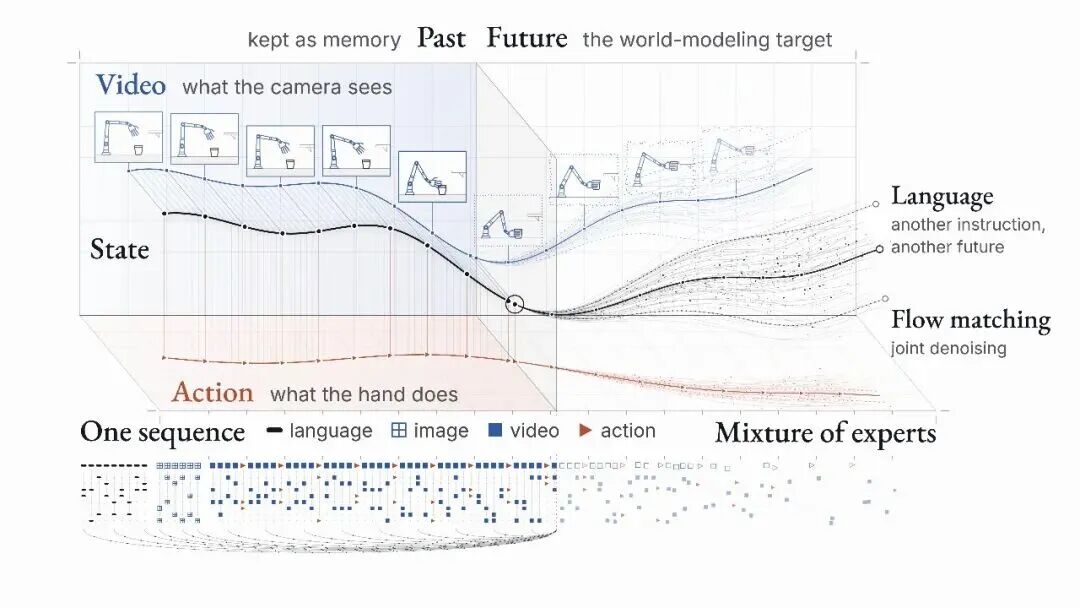
We design the data pipeline, model architecture, and infrastructure as an integrated system, aiming to convert more human experience into more precise action predictions.
The scaling curves below illustrate Natura-1's progress toward this goal. As training advances from approximately 44,000 hours of experience to 1 million hours, prediction error decreases clearly on both held-out human data and robot validation data.
These curves provide empirical validation for our integrated scaling strategy. With continued investment in data and compute, we aim to expand the scale and breadth of its capabilities, advancing toward general-purpose physical foundation models.
About Natura
Natura is a research company dedicated to achieving general intelligence in the physical world. We focus on training general-purpose foundation models capable of closed-loop perception, prediction, reasoning, and action in the real world, and exploring self-awareness and continuous learning for physical systems.
Natura's R&D system spans data collection and governance, foundation model pre-training, training and inference infrastructure, simulation and real-world evaluation, and post-training and reinforcement learning — forming a complete closed loop from research methodology to real-world validation.
The team possesses a full-stack talent array in embodied AI. Core members come from top global universities and leading technology enterprises, including frontier industry researchers, core contributors to flagship large models, world university supercomputing champions, and senior robotics hardware researchers — with integrated capabilities from algorithmic innovation to real-world system validation.