Inverse Matrix Technology Unveils PhysisServe, First Physical AI Inference System to Balance Intelligence and High-Frequency Throughput

Achieved real-time output at kilohertz frequencies for the first time with a world model at the scale of tens of billions of parameters.


Inverse Matrix Technology, in collaboration with BAAI, vLLM, and Peking University, has officially released PhysisServe — the first physical AI inference system that delivers both intelligence and high-frequency throughput. PhysisServe achieves, for the first time, real-time output at kilohertz frequencies for 10-billion-parameter world models, outpacing existing state-of-the-art solutions by one to two orders of magnitude. This demonstrates that with sufficient compute, even as physical intelligence foundation models scale to tens of billions, hundreds of billions, or even trillions of parameters, model inference can sustain real-time outputs at task-required frequencies — parameter count and output frequency can be achieved simultaneously.
The next frontier for artificial intelligence is the physical world. Today, physical AI can execute actions in controlled environments, but the journey from relatively stable laboratories to real-world scenes full of noise, interference, and continuous change remains long. Inverse Matrix Technology is committed to building a "general world foundation model" for the real physical world, exploring general physical intelligence capable of understanding, predicting, and acting across diverse scenarios, empowering applications ranging from embodied AI and industrial simulation to scientific forecasting.
Intelligence in the real physical world requires understanding how environments change, predicting the consequences of different interventions, and applying these capabilities to new conditions and tasks.
In physical simulation, this means predicting the evolution of complex systems to inform design, validation, and decision-making;
In embodied interaction, this means adjusting actions based on continuously changing observations;
In industrial production, this means adapting to variations in materials, equipment, and operating conditions.
When physical AI tackles thousands of tasks, we cannot expect every task to be covered by training data. Physical AI systems must continuously update memory, switch tasks, predict environments, adapt to variable bodies, and evolve the model itself in dynamic environments with malleable embodiments.
We frame this as a foundational problem:
How do we build a physical intelligence foundation that can accumulate and reuse experience across scenarios, and operate at the speed and precision required by real-world tasks to understand, predict, and influence the physical world?
Over the coming months, we will release our thinking and technical results on this problem in a series, systematically presenting our exploration and practice in building general physical intelligence.
This article is the first in Inverse Matrix Technology's technical series. It starts from infrastructure, examining how to enable larger-scale models to sustain high-frequency outputs and serve more interactive tasks within limited compute budgets.

The Infrastructure for Next-Generation Physical AI
Rather than comparing architectural merits, this article starts from the input-output patterns during interaction to discuss two implementation approaches directly relevant to the serving systems covered here. Both Action-Conditioned World Model (ACWM) and World Action Model (WAM) can employ autoregressive denoising for generation.
Autoregressive denoising shares the autoregressive property with large language models' token-by-token generation, with the key difference being whether subsequent outputs must wait for previous ones to complete. In LLMs, each token is generated sequentially — the next token cannot begin computation until the previous token has passed through all Transformer blocks (Figure 1, left).
Autoregressive denoising generates continuous frames in chunks: each chunk starts from pure noise and progressively clarifies through multiple denoising steps. The next chunk need not wait for the previous chunk to fully denoise; after each denoising step of the preceding chunk, the next chunk can read its still-noisy KV cache at that step and execute its corresponding denoising step. The denoising of adjacent chunks thus staggers and overlaps, enabling chunks to complete in rapid succession (Figure 1, right).
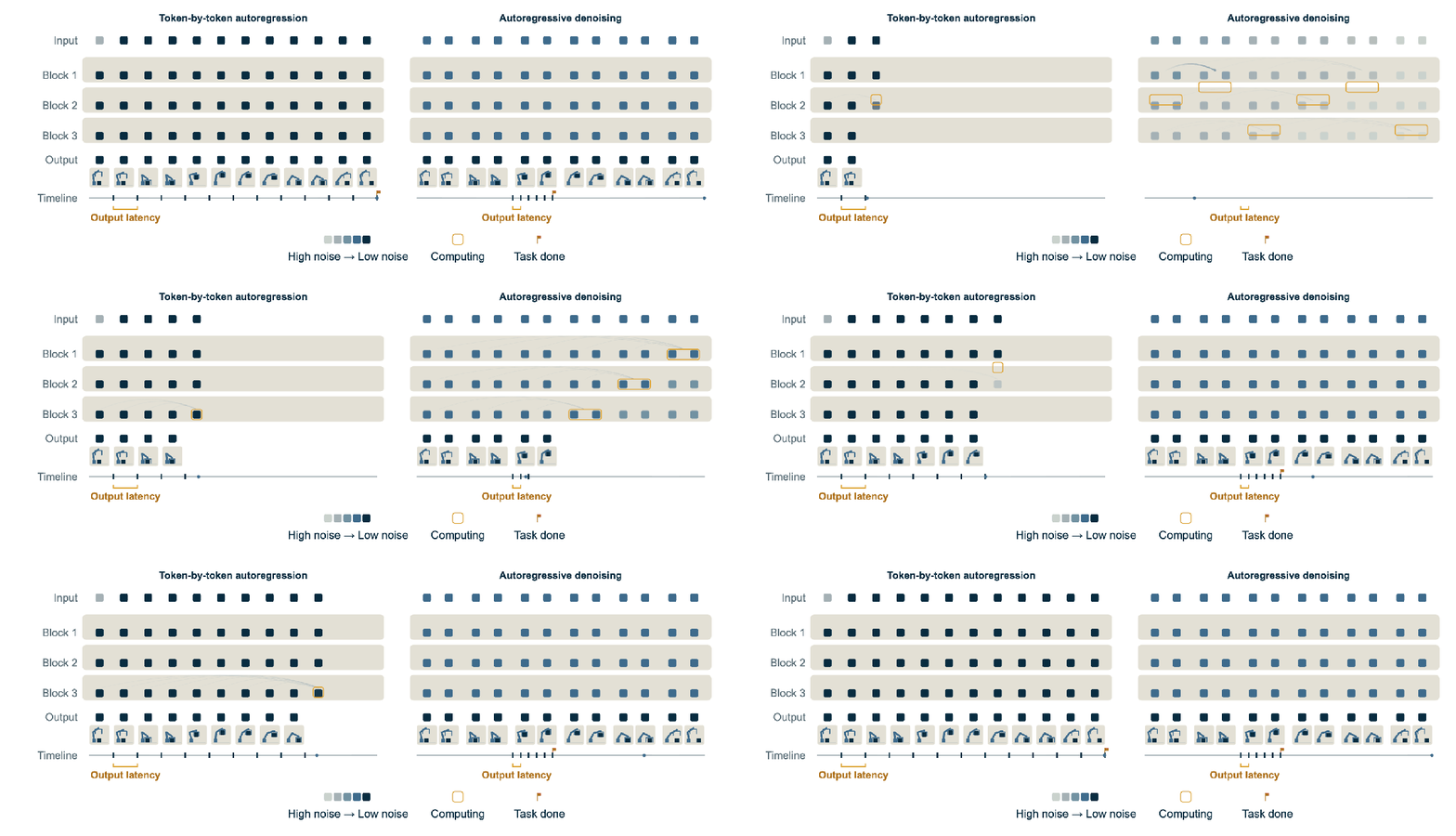
This difference in generation paradigms ultimately manifests in output frequency: token-by-token autoregression is strictly serial, with each token waiting for the previous one to traverse all Transformer blocks, locking output frequency to the computation latency of a single token — throwing more compute at it provides no direct speedup.
Autoregressive denoising is inherently parallelizable: all tokens within the same denoising step advance simultaneously, while adjacent chunks' denoising steps stagger and overlap. Parallelism scales freely with available compute — more compute directly enables higher output frequency.
The physical world changes at millisecond timescales, demanding that models refresh predictions of environment and action at sufficiently high frequencies. The parallel, compute-scalable structure of autoregressive denoising aligns naturally with this rapidly changing physical world, providing the structural starting point for PhysisServe's parallel design.

PhysisServe: Scaling Model Size and Output Frequency Together
We designed and implemented PhysisServe, an inference system for physical AI: with sufficient compute, even as models scale to tens of billions, hundreds of billions, or trillions of parameters, the system sustains task-required output frequencies — parameter count and output frequency become simultaneously achievable. PhysisServe partitions models into multiple stages, with each stage corresponding to a specific Transformer block at a specific denoising step, using stages as the fundamental unit for compute allocation and scheduling. The system design unfolds across three layers: single-stream acceleration, compute sharing, and multi-stream scaling:
Stage-wise pipelining. Pipelining across both denoising steps and Transformer blocks extends the GPUs usable by a single stream to the product of the two quantities. In steady-state operation, output latency is determined by the slowest stage's computation time; increasing denoising steps or model depth primarily adds pipeline depth and required GPU count, without directly reducing output frequency.
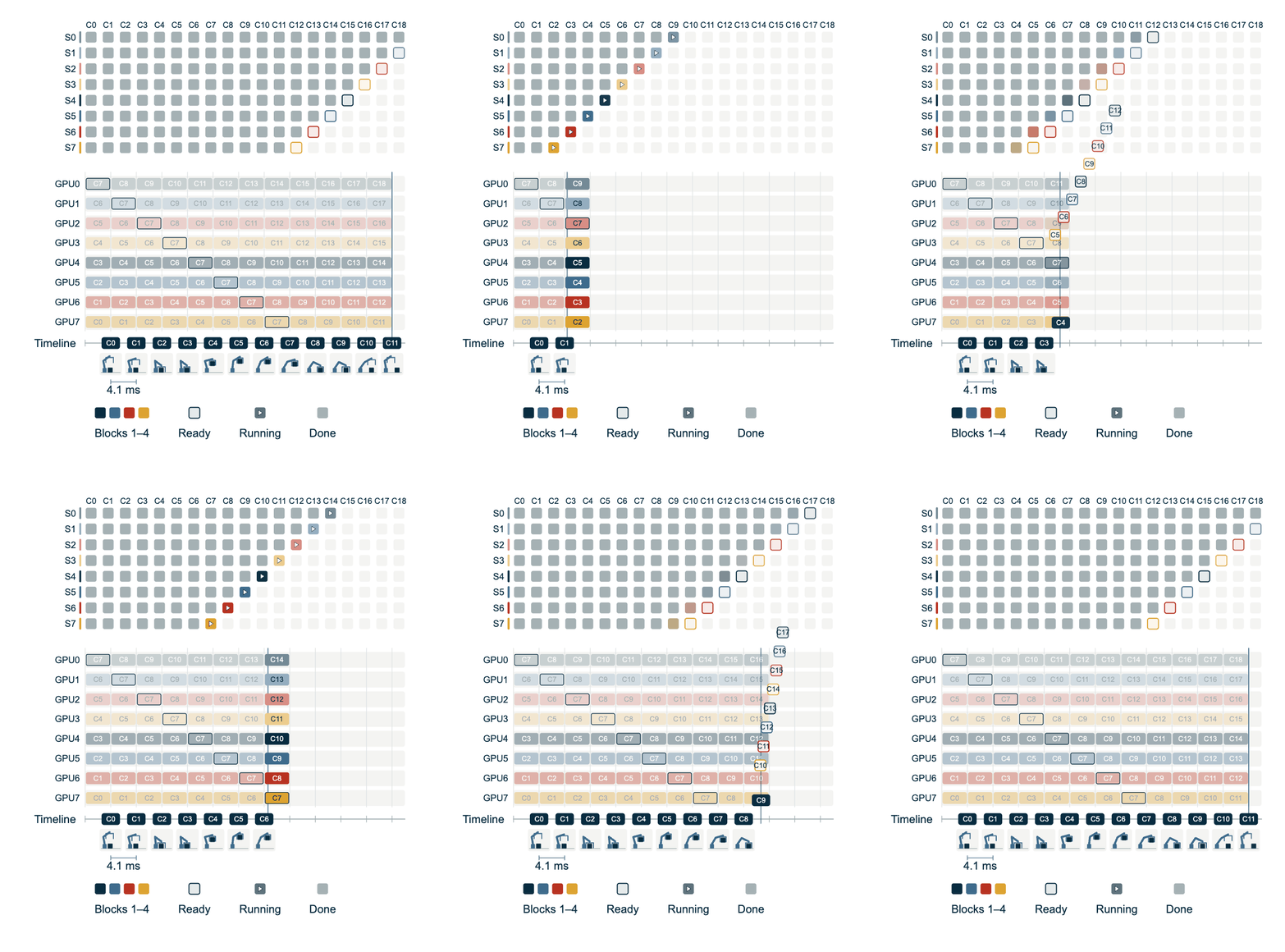
Time-division multiplexing. Decoupling stages from physical GPUs allows a single GPU to execute multiple stage tasks in rotating time slices. For tasks from different chunks on the same block, the scheduler merges them into batches for consolidated execution, amortizing weight loading and kernel scheduling overhead. GPU idle time is thus occupied by computation from other chunks, eliminating the requirement for each stage to monopolize a dedicated card; when extreme output latency is not required, a single stream can operate with fewer GPUs while still meeting target SLOs.
Dynamic virtual rank placement. Each stream's computation tasks and runtime states across stages are encapsulated as virtual ranks, which are then mapped to physical GPUs. Upon new stream arrival, the scheduler selects placement based on remaining capacity across cards; admission occurs only when all stages of the entire stream can be accommodated, with no migration of already-running streams. This preserves service stability for existing workloads while balancing inter-card load and utilizing fragmented idle capacity.
We evaluate PhysisServe on five backbones commonly used in ACWM and WAM: Wan2.1 1.3B, Wan2.2 TI2V 5B, Wan2.1 14B, LTX-2.5 22B, and MiniMax H3 33B — all weights unpruned, uncompressed, and unquantized. With each stage on a dedicated card, the 33B MiniMax H3 achieves measured single-stream minimum output latency of 4.1 milliseconds. This translates to approximately 245 chunks per second, equivalent to roughly 1,000 frames per second as an ACWM, and up to 3,900 Hz as a WAM.

Keeping Intelligence in Step with the Physical World
Larger world models promise more accurate understanding and prediction of the physical world; but the physical world demands real-time responsiveness — if a model's output frequency cannot keep pace with environmental changes, even perfect predictions lose their value. For autoregressive denoising-based world models, model scale and output frequency have long been difficult to reconcile. A key reason for this tension is that existing inference solutions pipeline at overly coarse granularity, limiting parallelism and constraining output frequency, preventing world model real-time performance from scaling with increased compute. This has become the primary bottleneck for deploying world models in real-world scenarios.
PhysisServe addresses this through stage-wise pipelining to boost single-stream output frequency, time-division multiplexing to improve single-stream compute utilization, and virtual ranks with joint scheduling to support multi-stream sharing — providing a new systems path for co-scaling model size and serving capacity.
Enabling sufficiently large models to keep intelligence in step with the physical world's rhythm, PhysisServe takes an exploratory step toward this goal.