Why Are Half of Today's Large Model Builders Studying Physics?

From Hopfield and Hinton's Nobel Prize to Anthropic's CEO, xAI's pre-training lead, and He Kaiming's latest physical world model: the through-line of physics has persisted for four decades. This is no coincidence — it's a particular "taste" that happened to collide with the right era.
Over the past six months, I've had serious conversations with more than 200 AI researchers. I've discovered that the people who gave me the most startling insights — the majority of them — never formally studied AI. They studied physics. I asked my colleagues at 5Y Capital to check my work, and it wasn't sampling bias. This pattern seems to hold globally. Let's look at three résumés.
First: Stanford physics undergrad, Princeton biophysics PhD. Second: Harvard theoretical physics PhD, fifteen years in academic theoretical physics. Third: Stanford theoretical physics PhD, worked on quantum gravity and the holographic principle.
The three of them later got together and trained a rather weak chatbot.
The first is Dario Amodei, CEO of Anthropic. The second is Jared Kaplan, Anthropic's Chief Science Officer and lead author of the Scaling Laws — the curve that gives everyone the confidence to pour hundreds of millions of dollars into a single model today. The third is Sam McCandlish, Anthropic's Chief Architect, now running pretraining.
That weak chatbot was called Claude.
This isn't one company's quirk. Fei-Fei Li, who built ImageNet, was a Princeton physics undergrad. John Schulman, who created PPO, was a Caltech physics undergrad. The dominant approach in image generation today, diffusion models, was cribbed by Jascha Sohl-Dickstein from nonequilibrium thermodynamics.
The 2024 Nobel Prize in Physics went to neural networks. That same year, half the Chemistry Prize went to AlphaFold.
This reads less like an AI hall of fame and more like a physics department's employment report.
The easiest explanation is talent flow — physics is hard to find jobs in, smart people go where the money is. I thought this too, at first. Then I changed my mind.
Because during this same period, something even stranger happened.
For the first time, humans built something they could construct but couldn't explain.
Every line of code in a large model was written by humans. Every operator can be taken apart and inspected. Yet no one can clearly explain why, when hundreds of billions of parameters are stacked together, grammar, knowledge, reasoning, even personality emerge from the pile.
So the only way to study it is the same way we study rocks, stars, proteins: observe, measure, induct, guess a theory, then go back and verify.
An engineering discipline is becoming a natural science.
So it's not that physicists crowded into AI. It's that AI walked onto physics territory.
This has a forty-year prehistory.
When the Nobel went to neural networks, many thought the committee was chasing trends, padding the roster. Not so.
Imagine a magnet. Inside are countless tiny compass needles, each quite dumb, only jostling with its immediate neighbors. Physicists define an "energy" for the whole magnet, and the system rolls toward lower energy on its own. The remarkable thing is that from such simple rules, magnetism emerges at the macro scale — a property invisible in any single needle.
In 1982, Hopfield discovered that neural networks could use the same mathematics. Neurons are the needles, connection weights are the interactions, and "remembering" something is the whole system rolling into an energy valley.
So the earliest mathematics of neural networks was copied from magnets, not grown from computer science.
Forty years, from energy functions to Scaling Laws — that thread barely breaks.
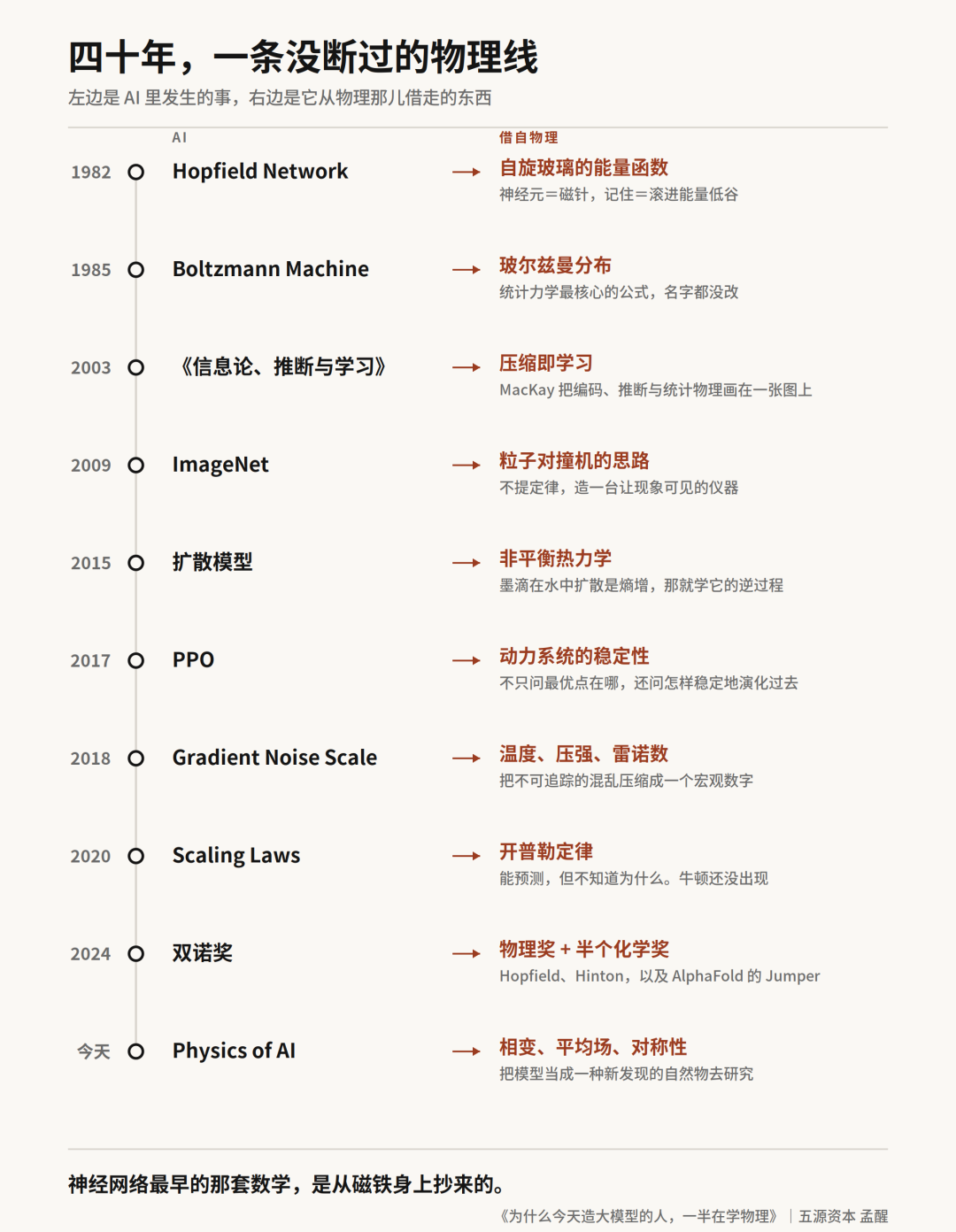
What this article wants to trace is the other end of that thread: why it suddenly became so visible today.

We built it, yet can only study it as we study nature
Not long ago I spoke with Juntang Zhuang, previously head of pretraining at xAI, PhD in biomedical engineering from Yale — not a physics background, so what follows isn't self-flattery. He said large models resemble physics because they're stuck between theoretical and experimental science.
Place several disciplines on the same axis.
Pure mathematics sits at the theoretical end. Truth is determined by whether a theorem can be proved — it must be universal, must hold even in the worst case. Engineering sits at the other end, with a plain standard: can you build it, can it run stably, can it beat the benchmark.
Physics sits dead center. It has a particularly pragmatic tradition called effective theory.
The idea is: I don't need to know what's at the very bottom, I just need a theory that's accurate enough at a particular scale. Nineteenth-century thermodynamics had no idea what molecules looked like, yet it calculated steam engine efficiency to several decimal places. Fluid mechanics ignores quantum mechanics, yet airplanes are built from it. And physicists actively mark their own boundaries of applicability — "this theory works within this scale, beyond that I make no guarantees."
This is the opposite of mathematics' attitude. Mathematics demands "always true"; physics accepts "good enough here." This distinction matters, and we'll keep returning to it.
So where does training large models fall?
It certainly has theoretical intuition: architecture, optimization, representation space, Scaling Laws. But the final arbiter is experiment: run loss, measure scaling, do ablations, see if capabilities emerge. You're not proving theorems, nor are you merely assembling a system to run. You're using theory to guide experiments, then using experiments to calibrate theory.
This is what physics has been doing for three hundred years.
Back to the paradox at the beginning.
It sounds mystical, but it's actually quite plain. Faced with a rock, you can only observe, measure, induct, guess a theory, then verify — because you don't have the rock's source code. A large model's source code is right there, every line intact, yet it's no more explainable than a rock. We know what each step computes, but not why hundreds of billions of parameters stacked together grow a personality. So researchers fall back to the rock-studying approach.
This is literally what happens today. People doing interpretability treat models like brain slices. People doing eval treat them like experimental subjects. People doing scaling treat them like thermodynamic systems where you can adjust temperature and pressure.
When an engineered system grows so complex that even its builders can't explain it from the inside, engineering starts growing into physics.
Following this logic, three subsequent events shouldn't surprise us. Their radicalism increases: first, predicting it with physics methods; then building instruments to force it to speak; finally treating it as a newly discovered species in nature.

Step one: compressing chaos into a few numbers
Physics doesn't live on proving theorems; it lives on empirical laws that can predict. To understand this, we need to go back four hundred years. In the late sixteenth century, Tycho Brahe observed planets with the naked eye, recording data for over twenty years. He proposed his own cosmological model too, which later proved wrong; his true legacy was the most precise observational dataset in the world at that time. After his death, his assistant Kepler got this data and began hard fitting, eventually extracting three laws: planets move in ellipses; equal areas swept in equal times; the square of the period proportional to the cube of the semi-major axis.
These three laws remain precise enough for use today.
The key point: Kepler had no idea why. He didn't have the concept of gravity — Newton wouldn't use universal gravitation to explain these empirical laws for another seventy years or so. What Kepler did was purely fit extrapolatable patterns from a pile of data, then boldly declare this is how planets behave.
Kaplan's group did the same thing.
They found that a model's loss drops along a remarkably clean power law with parameters, data, and compute. The significance of this curve: you can run a few points on small models, fit the curve, then predict how good a model that hasn't been built yet will be. Before it, "will bigger be better?" relied on intuition; with it, people dared to spend hundreds of millions of dollars training something that could only be trained once. Later, DeepMind's Chinchilla refined it further — previously people had made parameters too large and fed too little data; the two should scale proportionally together.
Notice the shape of this craft. Run experiments at several scales, fit a curve, then extrapolate to an experiment so expensive it can only be done once.
This isn't mathematics, because no one has proved these laws hold forever. It isn't pure engineering either, because the goal isn't to get one system running, but to find something that predicts across scales. It's Kepler's craft.
An early work by McCandlish illustrates even better where this intuition comes from. At Stanford, he studied the holographic principle — a seemingly crazy conjecture: all information in a three-dimensional space can be completely encoded on its two-dimensional boundary. You don't need to grasp its physics content; what you need to get is this habit of thought: a system that looks extraordinarily complex may have a low-dimensional, concise description.
What he later did at OpenAI was the direct application of this intuition. He faced a very practical problem: how large should batch size be during training? Too small wastes GPUs; too large wastes them too, because returns saturate. Previously people relied on trial and error, and on asking whoever nearby seemed most experienced. He distilled a number from the noise in each step's gradient, called Gradient Noise Scale, and used it to directly predict the batch ceiling for a given task.
This is deeply physical. A cup of water contains 10²³ molecules colliding chaotically — you have absolutely no way to track each one. But measure just two numbers, temperature and pressure, and the whole cup becomes predictable. The core craft of a physicist's entire life is this: compress untraceable chaos into three to five macroscopic numbers. McCandlish did exactly the same thing to the gradients of hundreds of billions of parameters.
Shunyu Yao (Tsinghua physics, condensed matter, nine years in theoretical physics) has an analogy I particularly like. He says today's Scaling Laws are like early thermodynamics: usable, predictive, but the microscopic mechanism isn't explained at all. In the first half of the nineteenth century, people could already calculate heat engine efficiency, knew entropy would increase, yet had no idea what molecules were — statistical mechanics wouldn't arrive for several more decades.
The entire AI industry rests on a stack of empirical laws that "we still don't know why, but it works." Microscopically incomprehensible, macroscopically highly predictable.
In other words, Scaling Laws are still standing where Kepler stood. AI's Newton hasn't arrived yet.

Step Two: Build an Instrument, Let the Phenomenon Speak
If we only talk about Scaling Laws and energy functions, "physical taste" risks becoming an aesthetic of theoretical physics. But physics has another equally hard tradition — one severely underrated in AI circles: building instruments. Progress in physics is often instrument-first. No astronomy before the telescope, no cell biology before the microscope. The Large Hadron Collider itself produces no theory; it does only one thing — pile energy high enough for something like the Higgs boson to have a chance of being seen. Without it, Higgs theory would have remained forever a guess on paper.
Fei-Fei Li's ImageNet was such an instrument.
It proposed no new neural network law. Before it, unified benchmarks existed, but at far smaller scale — each algorithm showcased a few cherry-picked results, no one convincing anyone else. ImageNet pushed scale to another order of magnitude. Its competition ILSVRC used millions of labeled images across thousands of categories, forcing all algorithms into the same scale, the same data, the same measurement regime — and then the shift represented by AlexNet became visible for the first time, and irrefutable.
The more I think about it, ImageNet is more like a particle collider for computer vision. It didn't "prove" deep learning was better; it just set up the measurement conditions, then let the results speak for themselves.
The difference lies in cost structure. The Europeans spent billions of dollars and over a decade on their collider. Fei-Fei Li built hers mainly through Amazon Mechanical Turk, using nearly fifty thousand strangers from 167 countries, paid per image, clicking away one by one. Whether an instrument is expensive and whether it works are two different questions.
This fills in the half of physical taste most often overlooked: proposing good theories isn't enough — you also need to know how to make nature answer your questions.
Today's AI benchmarks, evals, arenas, red-teaming — all play the role of instruments. There's an industry truism: getting an eval right is harder than training a model. The truly hard thing is often not building another model, but building a measurement that makes some capability visible for the first time.

Step Three: Treat the Model as a Newly Discovered Species
Step three is the most radical. Since we've built something we don't understand, stop treating it as a product. Treat it as a newly discovered natural object — remeasure, classify, build theory. First, a phenomenon that serves as this step's starting point.
Take a small network learning some mathematical task. After training for a while, it enters a state that looks like total failure: training set perfect, test set completely wrong. It's just memorized answers, understood nothing. This state persists for a very long time — long enough that any normal engineer would have killed this run and gone back to tune hyperparameters.
Then at some moment, test accuracy suddenly jumps from random guessing to near perfect.
It suddenly, truly understands. This phenomenon has a name: grokking.
An engineer's first reaction is "black magic" or "maybe there's a bug." A physicist's first reaction is completely different: water heated to 100 degrees doesn't slowly become steam; at some critical point it suddenly changes state. A magnet heated to some temperature instantly loses its magnetism. Such abrupt changes are called phase transitions. Physics spent over a century studying them; there's a whole mature toolkit.
So a physicist seeing grokking would say: this has the shape of a phase transition, and phase transitions I know.
Not panicking at emergence but getting excited — this may be the most valuable instinct left by physics training.
This now has its own name. A group of physics-trained researchers call it "Physics of AI," and Ziming Liu (Peking University physics undergrad, MIT physics PhD, now teaching at Tsinghua University) is among its most systematic advocates. The meaning: no longer treat neural networks as products to be optimized, but as natural objects worthy of having their laws discovered.
Another default move in physics: when encountering a new problem, first look for symmetry. Physics contains an extraordinarily beautiful result called Noether's theorem: continuous symmetries in physical laws often correspond to conserved quantities. Spatial translation symmetry corresponds to conservation of momentum; temporal translation symmetry corresponds to conservation of energy.
Max Welling took this path: bake symmetry directly into network architecture. To identify a molecule, if you rotate it in space the result should be completely unchanged — so why make the network painstakingly learn this from data? Such equivariant networks have shown significant results in chemistry, materials, and protein domains. And Welling was also co-author of VAE — another main thread of generative models, which he also initiated.
By the way, he finished his PhD in quantum gravity in 1998; his advisor was Gerard 't Hooft, who won the Nobel Prize in Physics the following year, while Welling himself switched to studying how to make neural networks recognize molecules.
Diffusion models connect from another direction.
Drop ink into a glass of clear water. The ink irreversibly diffuses until uniform, and never spontaneously gathers back. This is entropy increase, the second law of thermodynamics, the most non-negotiable law in all of physics.
In 2015, Jascha Sohl-Dickstein (UC Berkeley biophysics PhD, theoretical neuroscience background, whose pre-PhD work involved sending rovers to Mars) asked a strange question: if I could learn the reverse of this process step by step, could I reconstruct structure from chaos? Forward: progressively add noise. Reverse: learn to denoise. The title of his paper literally said "Deep Unsupervised Learning Using Non-Equilibrium Thermodynamics."
Today's most mainstream image models, plus a considerable portion of video models — Midjourney, Sora, Keling AI among them — have diffusion models as their base, or sit on adjacent continuous generation paths. A skeleton copied from the second law of thermodynamics, not grown out of computer vision. A person who worked on Mars rovers happened to lay the foundation for today's AI image generation.
But here we must guard against romanticization.
Phase transitions, symmetry, minimal models — these things don't automatically explain today's large models. Far from it. The power of effective theory comes precisely from honestly admitting its scale of applicability — it never claims "I explain everything"; what it does is, in a system that cannot be fully solved, first grab the parts most useful for prediction and least sensitive to details.
This self-limitation is what makes it trustworthy.

Now, Tear Everything Above Apart
Up to here, a nice story has been told. Now I need to tear it apart — without tearing it apart, it's just a likable article. This observation has three pitfalls.
One: survivorship bias. Half the landscape of deep learning has nothing to do with physics: Yann LeCun is from electrical engineering, Bengio and Sutskever from computer science. The Transformer authors were mainly from computer science and engineering. Aren't backpropagation and attention mechanisms fundamental enough?
Two: "fundamental" was never defined. The word is an empty basket — anyone can draw a line by their own standard, circling in whoever they want. I was doing exactly this while writing this article.
Three: confounding variables, and this is the deadliest. Physics is already a strongly selective discipline; it first siphons off a cohort of young people with extremely strong mathematical and abstract abilities at age twenty. What we see may just be the shadow left by ability selection, with no causal relationship to physics training itself.
There's also a counterexample I ran into myself. Andrej Karpathy did a double major in computer science and physics at Toronto — by my classification he should count as on the physics track, yet in his most influential work, it's hard to point to any place that genuinely depended on physics training. Fits the category, doesn't support the explanation. I haven't counted such examples, but I'd guess there are many.
So what remains?
I never intended to argue physicists are smarter — that claim is wrong. The question worth asking is another one: what set of default moves does physics training leave people with?
Preference for first principles, preference for minimal models, preference for measurable variables. Not panicking at emergence; first reaction is "could this be a phase transition." Knowing any theory has its scale of applicability, so daring to use approximations, and willing to concede defeat.
Physics doesn't give higher intelligence; it gives a feel for finding order in a complex world.
Then the real question becomes: why is this feel suddenly valuable now?

AI Is Becoming a Science of "Artificial Nature"
Models grow larger, single experiments grow more expensive, microscopic mechanisms grow harder to explain. Meanwhile, macroscopic laws grow more stable. Researchers begin measuring scale, phase transitions, emergence, critical points, training noise, capability boundaries. Models are human-made, yet must be observed, experimented on, and inductively reasoned about like nature. AI is shifting from an engineering discipline that builds algorithms to an experimental science that discovers laws of artificial nature.
Today's AI is stuck precisely between theory and experiment — and that has always been physics' home turf. The influx of physicists is just footprints left by this transformation, not its cause.
But physics isn't the endpoint, and this must be clear. Transformer was mainly an engineering victory. Backpropagation is inseparable from mathematics. Actually training models out depends on systems, chips, data, and organization. Physics is just a particularly useful default entry point for this era.
The ultimate breakthroughs belong to those who can freely switch between three tastes. Mathematics demands you clarify what necessarily holds. Physics demands you find what works at real scales. Engineering demands you actually build it.
Today's large models happen to need all three kinds of honesty at once.

Easter egg: physics sneaks in one more thing
After writing that last line I thought the article was finished. Then I remembered something Shunyu Yao said on Xiaojun Zhang's podcast — and realized there was still one thing left unwritten. It doesn't go on a résumé, but it may matter just as much as all six tools covered above.
Shunyu Yao came up through Tsinghua University's physics department, won the university's highest undergraduate honor, and spent nine years immersed in theoretical physics. After his PhD, he pivoted straight into AI, contributing to the training of both Claude and Gemini. He put it bluntly on the podcast:
"I don't have any mentors in this industry, no old friends. Of course I can call out whoever I want."
He also joked that one reason he left physics was not wanting to waste time "serving old geezers" anymore.
Beneath the joke lies a real mechanism. People who cross over from physics into AI often arrive without the field's lineages, factions, and vested interests. No academic bloodline to protect, no authoritative consensus to honor. So they're more willing to ask naive but fundamental questions, more willing to take apart practices that everyone else treats as settled.
This has actually happened before.
In the 1980s, symbolism ruled and neural networks were dismissed by the mainstream as a dead end. The people who pulled them out of the cold storage were physicists like John Hopfield (Princeton physics professor, working in condensed matter) and Terrence Sejnowski (physics from undergrad through PhD, later switched to neurobiology). They had no ties to the AI establishment of that era, so they didn't know this path was "against the rules."
Christopher Bishop (Oxford physics undergrad, Edinburgh PhD in quantum field theory) was the same — driven into neural networks, then decidedly "improper," after being cornered by the complexity of plasmas at a fusion lab. Fei-Fei Li challenged computer vision's long reliance on small samples and hand-crafted features by scaling up data.
The crosser's advantage has never been knowing more. It's not knowing which questions are against the rules.
So physics actually gives two things. A set of ready tools, plus an outsider's passport. The tools give you the ability to ask that kind of question; the passport gives you the nerve to actually ask it.
This is probably the discipline's best state right now: it's complex enough that no one can claim to fully understand it, so none of the rules are set in stone yet. Someone who doesn't know the rules walking in — that's exactly the right fit.

Appendix: The physics line in AI (AI-summarized)
The main text stayed lean by cutting most names and explanations. This roster fills the gaps, grouped by how they entered.
I. The generation that carried neural networks out of physics
John Hopfield (physicist) The energy function in Hopfield Networks came straight from statistical mechanics. Spins in a magnet and neurons in a network ask the same question: why do large numbers of simple interacting units give rise to complex collective behavior? 2024 Nobel Prize in Physics.
Geoffrey Hinton (experimental psychology background) The one who connected cognition to statistical physics. Co-recipient of the same 2024 Nobel.
Terrence Sejnowski (physics undergrad and PhD, later neurobiology) The third person eclipsed in the 2024 Nobel narrative. The Boltzmann Machine was his work with Hinton — taking Hopfield's deterministic energy network and making it stochastic, letting neurons flip states probabilistically according to the Boltzmann distribution. That's the central formula of statistical mechanics, name unchanged. These were the first genuinely "learning" energy models in history, ancestors in some sense to all generative models today. He also built NETtalk (1987): fed the network only English text and corresponding pronunciation, no grammar or phonetic rules, and let it learn to pronounce on its own. Sounds mundane now; heresy forty years ago.
David MacKay (Cambridge natural sciences, then computation and neural systems in Hopfield's group at Caltech, later back to Cavendish physics) His significance was wiring four strands into one. In Information Theory, Inference, and Learning Algorithms, compression, coding, probabilistic inference, statistical physics, and neural networks are different facets of the same thing. That insight is especially valuable today because large models are fundamentally compression: how tightly a model can compress the internet is how deeply it understands. People now casually say "compression is intelligence"; MacKay had drawn that picture by 2003. He later wrote a popular book on energy, served as chief scientific advisor to the UK Department of Energy, and died in 2016.
The early vitality of neural networks came precisely from lacking a pure disciplinary pedigree. It wasn't a neat orthodox line inside computer science, but something physicists, psychologists, brain scientists, and engineers built together in the borderlands.
II. The core layer of today's large models
Dario Amodei Stanford physics BA, Princeton biophysics PhD. CEO of Anthropic.
Jared Kaplan Harvard physics PhD, Anthropic co-founder. Lead author of the 2020 Scaling Laws paper. Without it, no one would have dared to spend hundreds of millions training a single model at once.
Sam McCandlish Stanford theoretical physics PhD, worked on quantum gravity and holographic principle, Anthropic co-founder. Author of Gradient Noise Scale.
Shunyu Yao Tsinghua physics department, Tsinghua's top undergraduate award, nine years in theoretical physics. Contributed to training Claude and Gemini. The "Scaling Laws as early thermodynamics" analogy comes from him.
John Schulman Caltech physics undergrad, originally chose physics to "understand the universe." After several physics research stints found he wasn't excited by them, switched to neuroscience at Berkeley. Only after seeing helicopter control and robot towel-folding in Pieter Abbeel's lab did he turn to AI. Later created TRPO and PPO, key to modern deep reinforcement learning and RLHF. Calling PPO derived from some physical law would be a stretch, but its temperament is physical: not just asking where the objective function's optimum is, but how the system can evolve toward it stably, without allowing any single update to go so far that the whole policy suddenly destabilizes.
Alex Graves Theoretical physics undergrad, later at DeepMind. CTC (2006) solved a very practical problem: in speech recognition, audio has tens of thousands of frames while text has maybe a dozen characters, and they don't align. Previously you had to manually label which audio segment corresponded to which character. CTC let the network align itself — the key step that got deep learning into speech recognition. His later Neural Turing Machine and DNC were attempts to give networks external read-write memory; heavily anticipated at the time, ultimately bypassed by Transformer in a completely different way. Today it looks like a dead branch, but the problem consciousness — that memory, state, and temporal evolution should be core variables of the system — has a physical flavor.
III. The school that studies networks as natural objects
Surya Ganguli (studied physics, math, and computer science simultaneously at MIT, Berkeley string theory PhD, now at Stanford) The most "physical" tier of deep learning theory. Questions he works on: in a randomly initialized deep network, how does signal attenuate or explode as it propagates forward, and is there a critical initialization where signal just barely makes it to the bottom. This stuff is literally called edge of chaos. He studies real brains and artificial networks as the same class of system.
Yasaman Bahri (quantum condensed matter physics PhD, Google DeepMind) Core author of the "infinitely wide neural networks are equivalent to Gaussian processes" line of work. The move is deeply physical: take a limit where the system becomes exactly solvable, like assuming infinite volume or infinite particle number in statistical physics. Real networks are of course finite-width, but the infinite-width analytical solution gives you a reliable reference frame.
Lenka Zdeborová (EPFL, statistical physics background) Her lab is literally named Statistical Physics of Computation. Three tools worth knowing. Mean-field: instead of calculating every particle's interaction with every other particle, assume each particle only feels an "average environment" — crude but extremely useful. Message passing: draw the system as a graph, nodes repeatedly pass messages of "I think your state should be X" until convergence. Replica method: the system you want to calculate is too hard, so pretend you have n identical copies of it side by side, calculate, then let n go to zero — n is a positive integer, making it zero makes no mathematical sense, but the answer is right. Giorgio Parisi deployed this method in 1979; mathematicians didn't rigorously prove it until 2006, and Parisi himself won the Nobel Prize in Physics in 2021. More than forty years in between, and no one stopped using it for lack of rigor. Physics's "use first, prove later" ethos — this is the definitive specimen.
Ziming Liu (Peking University physics undergrad, MIT physics PhD, advisor Max Tegmark, now teaches at Tsinghua) In recent years, one of the leading voices systematically advocating for the "Physics of AI" research program. Uses minimal models to study grokking, emergence, and interpretability. His KAN (2024) moved learnable functions from nodes to edges; the practical results are debated, but the intention is physical: make the network output human-readable functional forms, so you can directly see what规律 it has discovered, instead of facing a pile of weights.
Max Welling (Utrecht University theoretical high-energy physics PhD, advisor Nobel laureate Gerard 't Hooft) Equivariant networks: taking the physical methodology of "first find the symmetry, then bake it into the system" and turning it into an architectural constraint. Also co-author of VAE.
Jascha Sohl-Dickstein (UC Berkeley biophysics PhD, Redwood Center for Theoretical Neuroscience) worked on Mars rover projects before grad school. In 2015, he borrowed the framework of diffusion models from non-equilibrium thermodynamics, which became the foundation for today's mainstream image generation. He's now at Anthropic.
IV. The Instrument Builders, and Those Who Returned from AI to Science
Fei-Fei Li did her undergraduate degree in physics at Princeton. ImageNet's significance wasn't in proposing laws — it was in building an experimental apparatus that made a transformation visible and undeniable for the first time.
Christopher Bishop studied physics at Oxford and did his PhD in quantum field theory at Edinburgh, then joined Culham Laboratory to work on magnetic confinement nuclear fusion. His pivot is worth noting: plasma behavior was so complex that no analytical solutions were available — he was pushed toward machine learning by the physics problem itself, not by any interest in AI. He later wrote Pattern Recognition and Machine Learning, which remains one of the standard textbooks for machine learning graduate students worldwide, twenty years on. Today he leads the AI for Science team at Microsoft — essentially circling back from physics to do physics with AI.
John Jumper came from theoretical chemistry and physics. Early in his career, he did molecular dynamics simulations at D.E. Shaw Research — essentially using physical laws to calculate step-by-step how atoms move. What he really brought was knowing where pure physics simulation hits a wall (too slow, not precise enough) and where pure learning hits a wall (too little data). By combining physical constraints, geometric structure, evolutionary information, and large-scale learning, he made AlphaFold. He shared half of the 2024 Nobel Prize in Chemistry with Demis Hassabis; the other half went to David Baker.