Gen Z, UC Berkeley Dropout, Backed by Hillhouse, BAI, and MiraclePlus: Li Wenxuan's Escape Route and AI Gamble
Can't someone born after 2000 be obsessed with cash flow?

By Antony | Produced by AI Nao
01
Li Wenxuan, Peter, born in 2003 in Beijing. He came of age in an era when the "elite track" still seemed like a safe bet.
Before turning 20, nothing in Peter's life suggested he would stray from that path. He got into AI early, working on image and speech recognition. Won a gold medal in physics competitions. Did an algorithm recommendation internship at Tencent in high school, and tried a few small startup projects on the side. Then college at UC Berkeley, double-majoring in computer science and statistics — round after round of standardized filtering, and he was always the one confirmed, the one selected.
In the second half of 2023, a full year after GPT-3.5 entered public consciousness, 20-year-old Peter made a decision that seemed abrupt to outsiders but felt utterly rational to him: drop out.
It wasn't impulse. It was an escape curve he had stress-tested repeatedly.
02
In Peter's view, after GPT-3.5 dropped, new models, tools, and applications started updating on a weekly cadence. The knowledge that actually mattered no longer sat stably inside any syllabus — it was emerging from code repositories, experiment logs, and half-formed ideas.
"At the rate model capabilities improve by an order of magnitude each year, by the time I graduate, AI intelligence will have far surpassed PhD-level."
The human learning curve was being ruthlessly overtaken by AI's evolution curve. The classic elite script — "graduate from a top school, join a Silicon Valley giant" — suddenly looked like a slow detour.
He quickly convinced his professors and parents on the logic. Dropping out wasn't an ending. It was the start of a more radical kind of learning: in the feedback loop of the real world, fighting obsolescence by building.
Now, ThetaWave.AI, the AI-native knowledge content platform Peter founded, has secured investment from BAI Capital, Hillhouse, and MiraclePlus. Co-founder Zhong Ziqiu, also born in 2003, dropped out of New York University's Stern School of Business to join the venture. To date, ThetaWave has nearly a million users globally, with ARR exceeding $1 million in the second half of 2025.
ThetaWave's entry point is ruthlessly practical: cramming for exams.
Peter believes that in an age of information overload, humans shouldn't waste cognitive bandwidth digesting inefficient raw materials. When users dump all their multimedia materials and lecture notes into the model, ThetaWave uses AI intelligence to deeply restructure them — folding and compressing lengthy information, dynamically generating adapted content based on the user's learning goals and existing knowledge, including flashcards, outlines, videos, and other formats more aligned with how the human brain actually works.
The vision behind this is clear and uncompromising: In the AI era, knowledge should adapt to people, not the other way around.
The exam-cramming scenario is just a sufficiently realistic starting point for now. At its core, Peter is using AI to redefine the slope at which humans internalize knowledge.
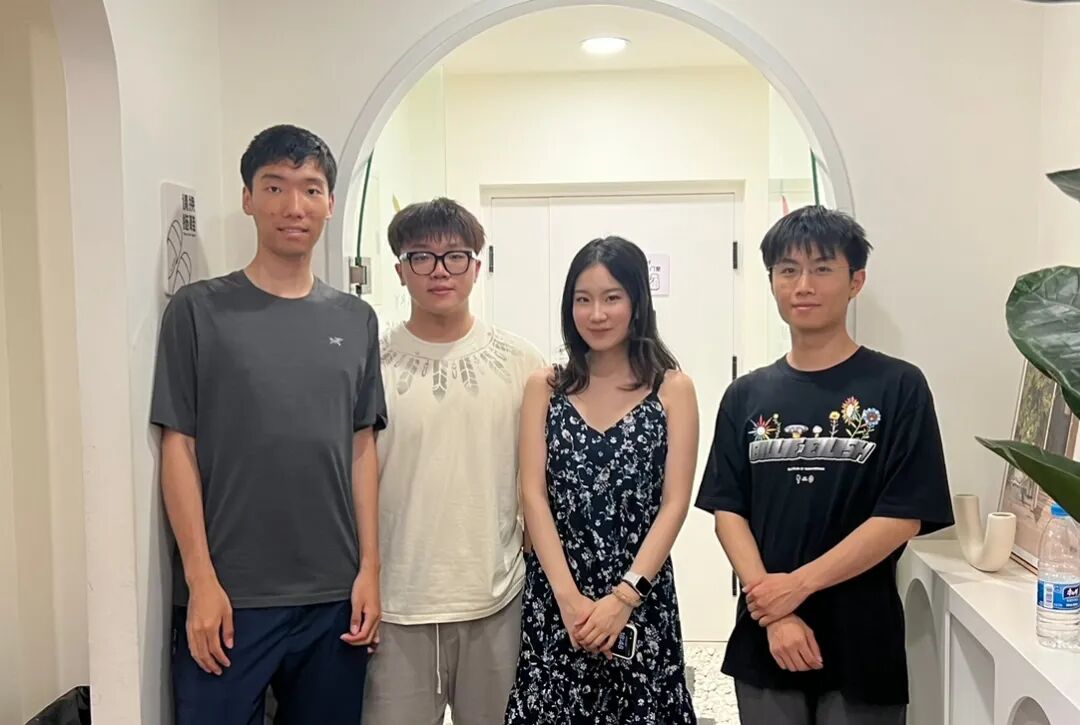
ThetaWave founding team, 2023. Peter and Zhong Ziqiu are second and third from left.
ASK Me<10
AI Nao: Before the current version of ThetaWave, you tried many directions. What made you decide this was the path?
Peter: The big opportunity we've always wanted to capture hasn't changed — making knowledge content adapt to human characteristics, rather than forcing people to adapt to knowledge.
People need knowledge at different life stages: exams as students, career advancement as adults, hobbies in old age — some utilitarian, some not. But the current ways of acquiring it are terribly inefficient. Take a non-economics major opening an economics textbook to self-study — it's hard because that thick, specialized book isn't friendly to beginners.
I believe AI applications are essentially the distribution of model capabilities to different user groups. So we initially tried two directions:
First, AI spoken language practice. The demand was obvious, the business model worked — AI could cut costs by 10x. But the problem was incumbents like New Oriental and Youdao already dominated, with existing channels and content. We couldn't differentiate. The ecological niche was too crowded.
Second, AI education for schools — using AI to help teachers generate more absorbable lesson plans and materials. This was viable, we had the capability, but it was sales-driven at its core, essentially B2B SaaS. Our team wanted to be product-driven, to do something cutting-edge and cool. We didn't have that passion.
Those two attempts: one where we wanted to do it, could do it, but shouldn't — too competitive. Another where we could do it, had the ability, but didn't want to — not our model.
Our current direction — personalized content generation around the college exam-cramming scenario — was the first time we found the intersection of want-to-do, can-do, and should-do.
We want to do it because it directly serves the vision of knowledge adapting to people. We can do it because we are the target users, deeply understand the pain points, and have the technical capability. It should be done because it's a real, urgent need in a massive market that existing solutions like ChatGPT haven't solved well.
So choosing this path was a process of continuous elimination and calibration, until we found the resonance point where our vision, capabilities, and market opportunity intersected.
AI Nao: Knowledge management is also a crowded space, with giants like Notion. Is ThetaWave's exam scenario just a subset of Notion?
Peter: No. We're not in the same race as Notion. Our long-term vision is to be the Taobao of knowledge.
Early on we considered an AI note-organizing direction, even registered an ambitiously named domain. But then we got clear: we're not building a recording tool, we're building a content generation platform. Users' real need isn't "how do I take notes" — it's "when I have all this stuff I can't get through, who can explain it to me in a way I'll actually understand?"
So Notion and other knowledge management platforms are recording-driven — they require you to have the motivation, ability, and habit to organize. It's a long-term, disciplined process. The bar for users is high, and the aha moment takes a while. We think that's actually a niche market.
We're creation-driven. You need something, I generate it on the spot. Learn 10x faster. Before exams, you'd borrow notes from a top student friend. We're making AI that friend — notes always available, and organized to your level.
So notes are just one carrier we chose for this exam need. Definitely not the only one. In the future, if you want to learn tennis, what I generate might be a mini-game; if you want to learn history, maybe a podcast with Q&A. We won't box ourselves into note software. That's too narrow.
So I say we're building the Taobao of knowledge. ThetaWave is an entry point where you can learn everything. Through AI, we're moving knowledge from static, one-way, homogenized containers to dynamic, interactive, personalized AI-native content.
AI Nao: You keep mentioning knowledge adapting to people. What does that look like concretely for individuals? If Person A and Person B have different levels but need to pass the same exam, or both want to learn tennis, will ThetaWave give them markedly different learning experiences? Or is there a relatively optimal way to learn any given type of knowledge?
Peter: Good question. But there's no fixed answer — internally we frame it as a ratio problem.
Any learning process contains two kinds of information: baseline information everyone needs to see, call it N percent. And the personalized, interactive portion based on individual circumstances, making up 100 minus N percent.
What N is depends on what you're learning.
Take tennis — it has some universality. For a beginner, N might be as high as 70% — rules, basic movements, footwork, these are the same for everyone. But the remaining 30% adjusts based on your past athletic experience, physical coordination, even your preferred teaching style.
But if you're learning semiconductors, it's completely different. An experienced engineer and a complete novice should see fundamentally different content. Here N might be only 10% or even 5% — just the most core, foundational concepts. The remaining 95% needs to be reconstructed in language and examples you can understand, based on your existing knowledge background.
So to achieve knowledge adapting to people, two things are key:
First, having enough high-quality raw content on our platform as a foundation.
Second, having sufficient context about the user — who they are, what they know, what they're trying to achieve.
With these two, we can provide personalized interaction on top of a baseline version, ultimately completing the learning flow.
AI Nao: How did you get your first 100, and then first 1,000 users? What does marketing mean for AI companies today?
Peter: ThetaWave's first 100 users were basically our classmates. The earliest version — about 80% of the code was written in school libraries. We'd finish a feature and just grab someone in the library: try this, does it work? What do you think?
Our first users came from this face-to-face, zero-distance feedback loop.
The path to 1,000 was more interesting. We had a friend, a small KOL on Xiaohongshu, who found our product genuinely helpful and started sharing daily how he used ThetaWave to study. A very plain video — unexpectedly got hundreds of thousands of views and thousands of likes that day, directly bringing us several thousand users and hundreds of paying users.
This made us, at a very early stage, firmly believe that social media marketing, especially UGC, is extremely effective for this category of product — incredibly high value. From then on we committed to social media as our most important growth channel.
To your question — what does marketing mean for AI companies today?
I believe the essence of this generation of AI applications is the distribution channel of model capabilities to different user groups. This means two things must be done well:
First, at the product level, let users intuitively and easily feel the benefits that model capabilities bring.
Second, you must deliver the product to users' eyes through effective marketing channels.
So for our users — young people who spend at least five or six hours on social media daily — I think marketing will be even more important than for the previous generation of mobile internet products. Because their attention is there. Their decisions are driven by emotion and authentic peer sharing. The energy we spend on marketing is essentially building a cyber channel that reaches users' emotions and needs directly. Like opening a shop at the school gate — you know your customers pass by every day.
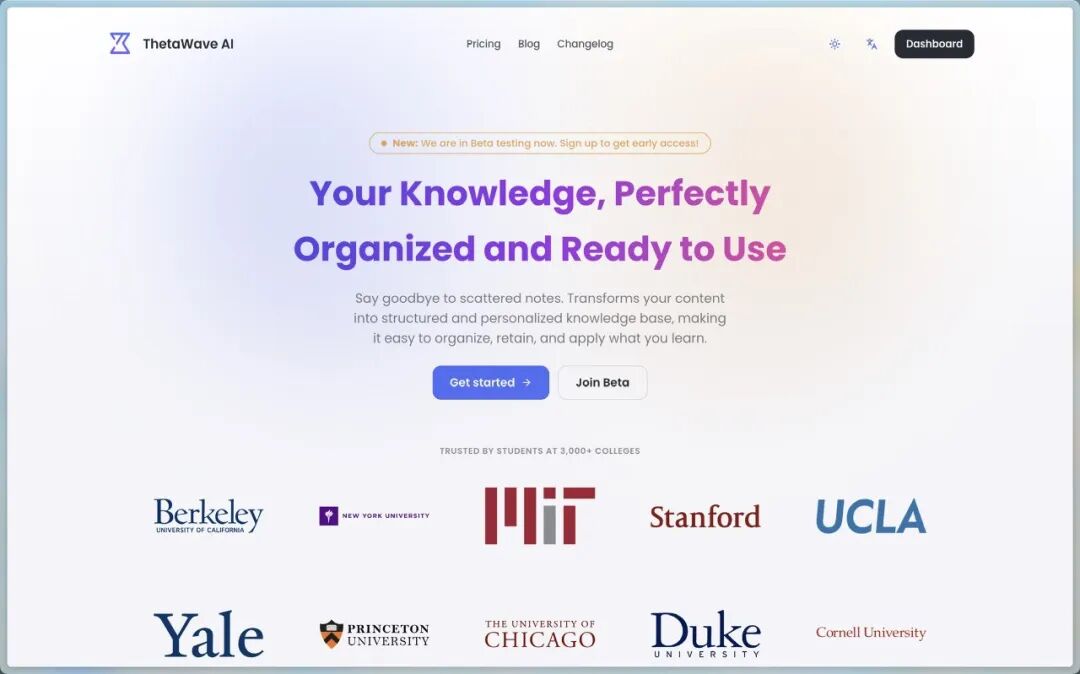
ThetaWave's earliest product homepage
AI Nao: There are now many specialized AI marketing companies. Would you use them, or do it yourselves? (As an AI-native company, if marketing still mainly relies on humans, isn't that a bit embarrassing?)
Peter:
Our AI involvement in marketing is quite high, but mainly internal. We don't work much with external AI marketing companies because we haven't seen solutions that really hit our pain points. Maybe our current approach is too specialized, not yet common enough to become a standardized product.
Internally we've mapped the entire marketing workflow — AI involvement is about 60-70%. Personnel management, asset generation, data analysis — these are basically AI-participated. For example, when we need Spanish-speaking KOLs, from screening, outreach to preliminary negotiation, AI is involved throughout.
But honestly, I don't really believe a giant "end-to-end marketing" AI company will emerge. Marketing is somewhat like arbitrage in quantitative trading. Say a model works in English markets but nobody's done it in Spanish — you localize it and capture the alpha. But if an AI tool could do that localization in one second, the first user gets quick arbitrage, but for later users there's no alpha left. Once a strategy is public, the alpha disappears.
So I think there will be opportunities for point-solution companies — an Agent specialized in KOL outreach, or one for ad data analysis. But solving all companies' marketing problems with one product is very hard. Because the core of marketing is often case-by-case details, capturing specific user emotions, even an ineffable "internet sense."
This also answers why we emphasize marketing's importance. The essence of AI applications is distribution channels for model capabilities. So you need to build that channel yourself. If you don't take it seriously, don't build it as a core capability, you won't succeed. You've handed the hardest technical part to model companies — then efficiently, precisely, and scalably delivering product value becomes the hard bone you must chew yourself.
AI Nao: Manus-style event marketing, rapidly capturing mindshare through one big moment, has been extremely closely watched among AI application companies this past year. What do you think of this approach?
Peter: We definitely study event marketing, but it's highly contingent — the preconditions are very demanding.
Different products face users at different levels of cognitive maturity. Manus targets highly educated, high-value white-collar workers who already understand AI, who habitually look for advanced tools and efficiency signals on social media. In that user layer, completing mindshare capture through a sharp enough event works.
But ThetaWave's current users are the majority of college students. Many of them, beyond ChatGPT, don't really know what other AI products exist. For this group, marketing first isn't about capturing mindshare — it's using very concrete, very practical details to prove "this thing can actually help me."
Of course ultimately, we want mindshare too. But mindshare isn't claimed through one event — it's accumulated bit by bit through the product itself staying one step ahead.
We've already run a replicable growth method, but the metric we always care about most is paid conversion rate. For us, if AI's essence is improving productivity, saving people time, then how much users are willing to pay to "buy back" their time is the ultimate measure of our value.
AI Nao: You have over 10,000 paying users and have basically achieved revenue balance — uncommon in AI application startups. What gave you this obsession with cash flow? Is making money very important to you? Could this make some investors think you're not aggressive enough?
Peter: We're indeed a team that cares more about cash flow.
Probably related to the survival period we went through. When we started, especially 2023 to 2024, not many people were investing in AI applications — attention was all on models. After our seed round, we went a long time without raising more. Survival was the first priority, so we did many practical things to create cash flow. For example, we even opened an AI coding tutoring institution for kids, taught over a hundred children in total.
But looking back, that experience helped us enormously.
First, it let us truly run through a complete business cycle. From single-store model, to expansion, to staffing and cost structure — it's a very朴素 but very solid business. Much of our intuition about product and commercial judgment today comes from that period.
Second, and more importantly, it deepened our understanding of "how people learn" immensely. Spending every day face-to-face with kids, watching how they understand knowledge, interact with AI, where they get stuck, where they suddenly light up — this was extremely high-density real feedback.
If I had one month now, and had to choose between two things to invest time in — improving paid conversion rate, or making the product look cooler — I'd probably choose the former. Paid conversion rate is a good market barometer. If it suddenly drops, we immediately investigate: new competitor? Leap in underlying model capabilities? This lets us respond quickly.
Also, I believe AI entrepreneurship will return more to business fundamentals. Unlike internet-era entrepreneurship that required massive capital to rapidly change production relations and become an industry entry point before monetizing, AI's essence is productivity improvement — so if you get it right, you should naturally be able to collect money.
AI Nao: "Post-00s entrepreneurship" is seen as having huge dividend right now. Do you think you've captured this dividend?
Peter: I think we have. The dividend manifests in our ability, empowered by AI at a young enough age, to assemble world-class teams and build world-class products — and because we're young, we're closer to future users.
This is what I see as the most essential advantage of the post-00s generation, not the surface-level labels in communications.
If the stereotype is that post-00s teams are wildly imaginative and dream big — we're not really like that. But we believe in doing things well according to our own philosophy and values. I believe we'll have our place.
AI Nao: What made you decide to leave Silicon Valley and base your company in Beijing? If you had one piece of advice for a friend going to Silicon Valley to start up, what would it be? And for a friend returning from the US to start up in Beijing?
Peter: The reason for returning was we always wanted and were better suited to do ToC products.
Silicon Valley overall is a highly ToB-oriented entrepreneurship environment. Investors clearly prefer founders using AI to solve enterprise problems. The US market has long lacked confidence in ToC — historically, truly successful ToC products built by local teams with massive returns are actually few and far between. This makes doing ToC in Silicon Valley relatively hard to get support for.
Investing in a ToB company might have 30% win rate, and if it wins, $1 billion return. Investing in ToC might have 0.1% win rate, but if it wins, $100 billion return. Most investors would definitely see the former as the better choice.
By comparison, domestically we have a massive user base, and more investors who understand ToC and are willing to grind out the product with you.
One piece of advice for a friend going to Silicon Valley? — Definitely build something Silicon Valley people themselves would use. Not saying it can only be ToB, but you need to be either very geeky or very imaginative, targeting the most cutting-edge global needs. Those are Silicon Valley's rules.
Advice for a friend returning to start up is the opposite: be pragmatic, get the business running. Don't spend every day immersed in Silicon Valley narratives daydreaming. Instead, quickly validate whether the product can make money, whether it can generate basic cash flow, stand firm in real feedback, then talk about long-term ideals and bigger stories.
Join Our Community