100 Hardware Fanatics, 48 Hours, Something Electric Happened in Zhangjiang | Someone's Always Out There Doing Something New

Can Be Abstract, Can't Be Mediocre
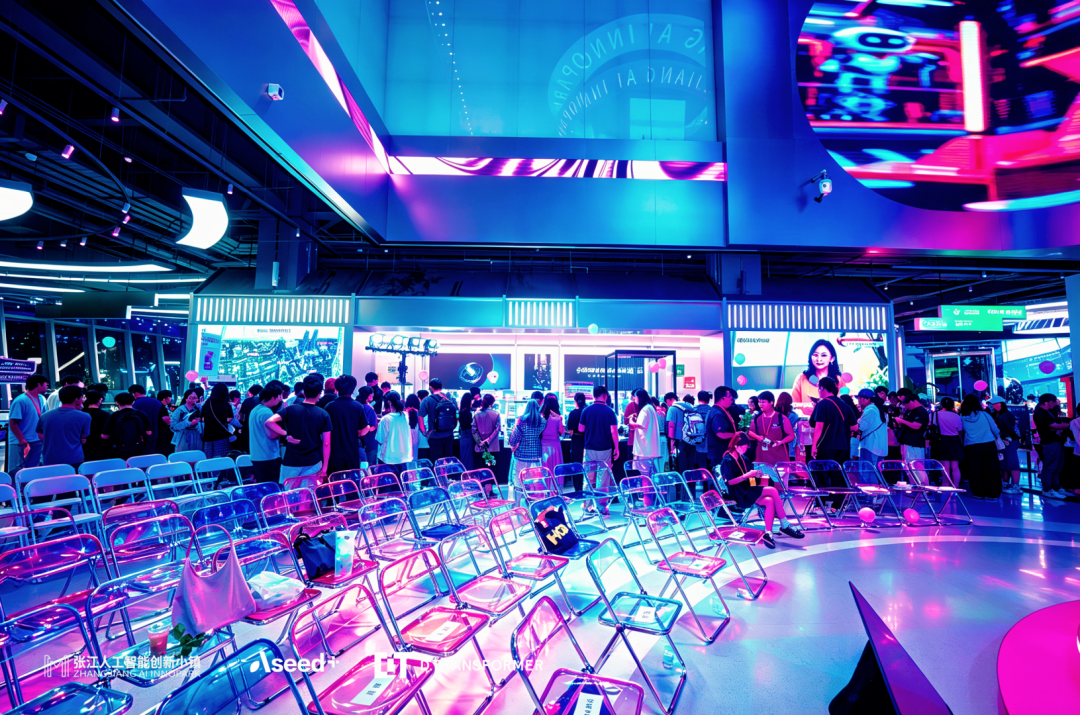
48 hours.
100 hardware builders.
100 hardware observers.
160 fresh roses and PCB talismans.
One AI hardware creation challenge.
At the end of July, it happened in Zhangjiang — a heartbeat moment.
There are always people doing something new: it can be abstract, but never mediocre.
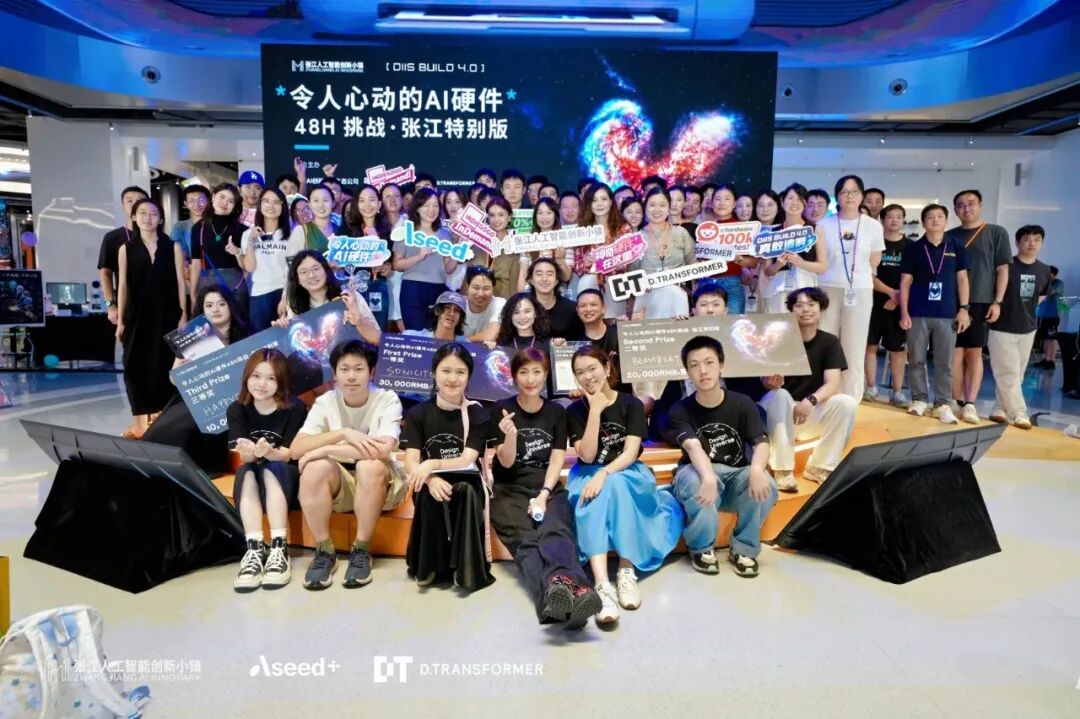
On the evenings of July 24–26, the Heart-Pounding AI Hardware 48H Challenge · Zhangjiang Special Edition took place at Zhangjiang AI Innovation Town. The event was co-hosted by the Zhangjiang AI Innovation Town ecosystem company, Hillhouse Aseed+, and D.Transformer.
From over 100 registered teams, 20 were selected to compete on-site.
Among them were hardware structure prodigies, designers, architects, and students from universities at home and abroad — backgrounds spanning engineering, design, art, medicine, and music.
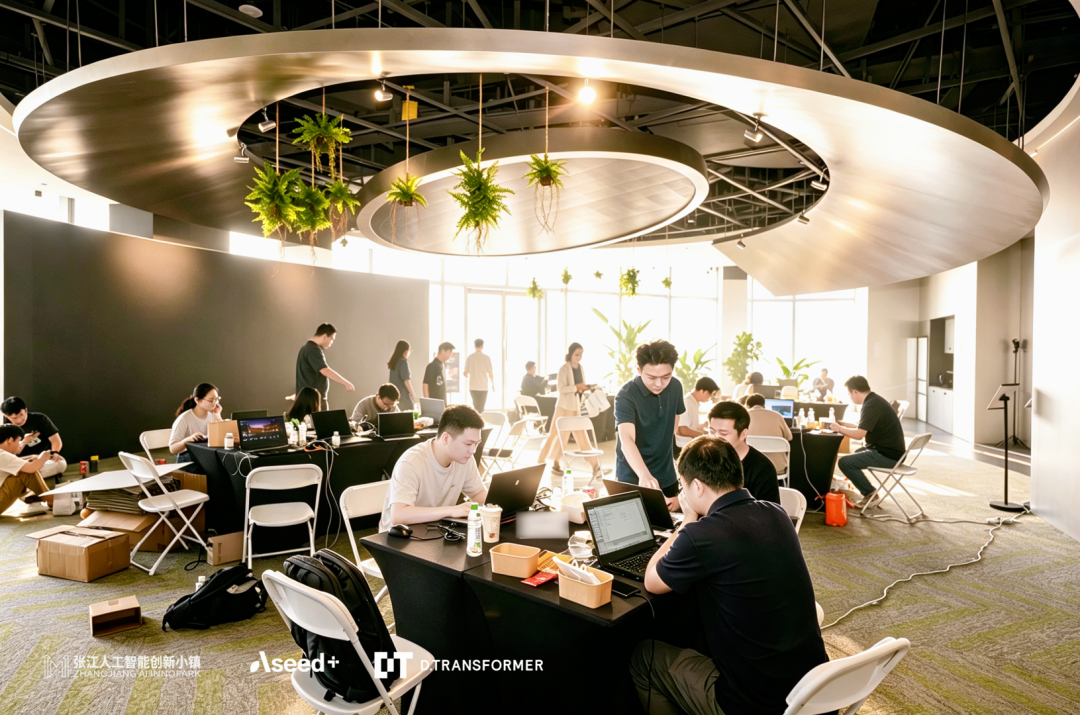
On the evening of July 25, 3D printers ran nonstop, soldering stations steamed, pizza boxes stacked high, and everyone worked while getting to know each other in the sunset.
Eighty percent of teams produced playable, functional demos within 48 hours — even if the 3D-printed shells still radiated warmth, even if tape was temporarily holding together components mid-debug, even if some were still assembling minutes before the finals began.
Some teams met in person for the first time yet collaborated like old partners; others scrambled to find teammates on-site and still got it done.
That's probably how originality happens: a group of people thinks something is cool, then seriously makes it happen.
One participant said before leaving: someone has to build hardware that stands out, and it starts right here.
Sow the world with intelligence and imagination.
Great products and great users are a natural match
On finals night, 100 AI hardware observers arrived, selected based on real AI hardware purchase records and in-depth product review content. Among them were software developers, designers, IP creators, self-media operators, and hardware bloggers.
They would vote with roses and leave on-the-spot feedback for each product.
Together with 10 judges, the observers selected the top 8 teams by total rose count to advance to the final pitch round — works that illuminated the boundless possibilities of AI + hardware from different angles.
Meanwhile, each of the Top 8 teams also selected, from the observers they spoke with, the user who offered the most valuable product insights as their "Most Heart-Pounding Observer."
BEAMBEAT: "I don't want to charge ten thousand yuan — my product sells for $199!"
BEAMBEAT aims to build the audiovisual operating system for the AI era. They zeroed in on an industry pain point: professional lighting equipment is expensive and operationally demanding. Traditional event lighting systems require specialists trained over 1–2 months, with single-event costs routinely exceeding 10,000 yuan.
BEAMBEAT's AI lighting robot, by contrast, uses AI algorithms to auto-generate and intelligently match lighting effects. The hardware sells for just $199–599, paired with a lighting design template community where users can download and share personalized schemes.
Moliban (莫离) & Kiwi
In the AI era, context is your most important personal asset. Kiwi gives everyone's context ears, a brain, a mouth, eyes, and a body that can move.
"We want to record users' casual thoughts anytime, anywhere in the most convenient way — capturing ideas and emotions in the moment, giving context a pair of ears. We want AI to help analyze and review context, capture and resonate with emotions, giving context a thinking brain. We want to make context visible through mobile apps, desktop agents, and desktop AI hardware — letting the 'you' deep inside emerge, giving 'them' a cute IP form: a soft yet spiky little hedgehog, giving context a mouth to speak and a body that moves."
Kiwi targets those in the AI era who want to record personal context, emotions, and planning reflections — mental healing and self-growth, exploring AI-era personal data memory companionship.
Portable Modular AI DJ Machine — Flux
Flux uses a magnetic modular design that fits easily in a backpack, satisfying creation, party, and event scenarios — letting anyone experience DJ performance anywhere, anytime.
Users simply describe a scene, mood, or style to complete intelligent track selection, auto-mixing, and seamless transitions. They can freely combine scratch turntable, gesture-controlled effects, and stereo speaker modules to match different scenarios, learning through an interactive tutorial mode. The team has laid out three copyright paths: proprietary music library, AI-generated music, and independent label licensing. Future additions will include audience requests, spatial intelligence, and real-time music generation, continuously expanding the boundaries of AI music performance.
Happy Power (游乐能): "Miracle Blooms" — Converting Joy into Clean Energy
The "Miracle Blooms" project originated from a romantic yet hardcore story: after a Category 17 typhoon, the team used kinetic energy from amusement park rides to power 500 households, sparking the idea of "converting joy into clean energy."
This wind power generation device for cycling scenarios can be installed on bicycles and e-bikes. Wind energy during riding is converted on one hand into electricity for wireless charging of phones, watches, and other devices; on the other hand, optical projection casts a "flower path" on the road surface, with multiple riders creating a flowing urban landscape.
Liaoban (疗伴): Don't Make Elders Adapt to Hardware — Make Hardware Adapt to Elders
The Liaoban team addressed three pain points for seniors: difficulty using mini-programs, poor adherence to home treatment, and disconnected patient-doctor data.
They designed a "plug-and-play" hardware solution: doctors write treatment plans onto smart cards, and patients simply insert the card into bedside lamps, portable power banks, or other terminal devices at home to receive reminders and logging for medication, exercise, and daily routines — with data transmitted back to hospitals for follow-up assessment. The product supports offline operation, with the basic version costing under 100 yuan.
Duomi (多眯): Let Users Catch a Few More Winks in Daily Life
The Duomi team brought an AI sleep agent terminal for bedroom scenarios.
Compared to the burdensome wearables of smartwatches and the passive interaction of smart speakers, Duomi uses millimeter-wave bio-radar as its core sensing technology, enabling zero-wearable, zero-contact monitoring of sleep states, vital signs, and health data. The AI agent actively adjusts the sleep environment based on monitoring data: automatically tuning temperature and lighting, playing sleep-aid content before bed, lowering disruptive volume during sleep, and waking users comfortably with sound and light in the morning — while providing daily routine and lifestyle recommendations based on health data analysis.
Zizi (嗞嗞): Keep Cyclists' Eyes on the Road
The Zizi team focused on cycling safety pain points, creating a navigation handlebar based on haptic feedback. They found that looking down at phone navigation for 2 seconds while cycling creates a 10-meter blind spot, with traffic accidents caused by distracted cycling numbering in the tens of thousands annually. Voice navigation is easily drowned out by environmental noise, while wearing earphones blocks out road sounds — both safety hazards.
This product conveys left turn, right turn, and warning information through differentiated vibration patterns, letting users stay focused on road conditions throughout — becoming a new interaction entry point that doesn't occupy visual attention.
You Shou Jiu Xing (有手就行): Make 3D Creation "Just Use Your Hands"
"You Shou Jiu Xing" (literally "if you have hands, you can do it") brought an EMG-interactive 3D sculpting system, dedicated to lowering the barrier to 3D creation. Traditional 3D modeling software has steep learning curves and professional equipment is expensive, making it hard for practitioners to get started.
The team combines wearable wristband EMG signal collection with hand pose data and AI models to achieve gesture and force recognition. Users simply use natural gestures like grabbing, pinching, and pulling to edit and create 3D models in virtual space. The project applies to interactive education and gaming, 3D print pre-design, cultural tourism digital assets, and data collection scenarios.
In the end, the Duomi team's AI sleep terminal took home the "Most Heart-Pounding AI Hardware Award." This bedroom terminal based on millimeter-wave radar, with its precise scenario targeting and privacy-friendly technical approach, received the most roses and highest heart-pounding score from observers and judges alike.
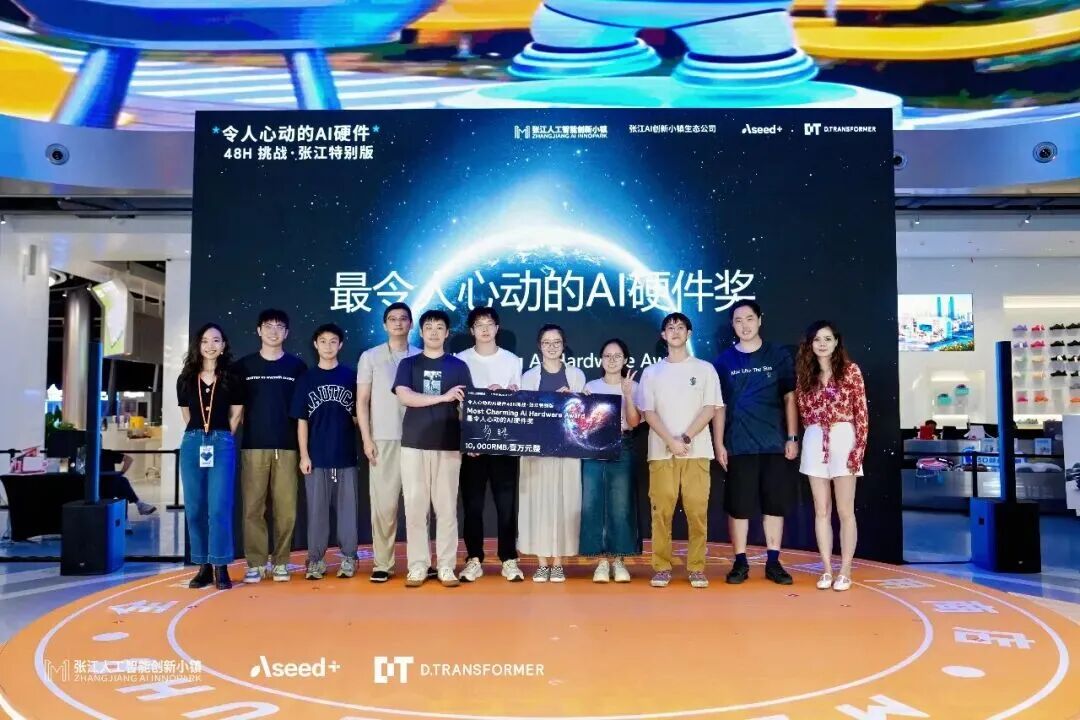
First prize went to SONICITE's portable AI DJ machine. BEAMBEAT's AI lighting robot and Happy Power's cycling power generation device took second and third place respectively.
The Best Social Media Share Award went to creator Doria, who generated the highest on-site social platform engagement.
Redefining Hardware Value for a New Era
This event was jointly initiated by Zhangjiang AI Innovation Town, Hillhouse Aseed+, and D.Transformer incubator. Zhangjiang AI Innovation Town provided space and industrial resources; Aseed+, as Hillhouse's platform for early-stage AI entrepreneurs and young founders; and D.Transformer handled hardware incubation and acceleration — the three parties built a fast lane from idea to product launch.
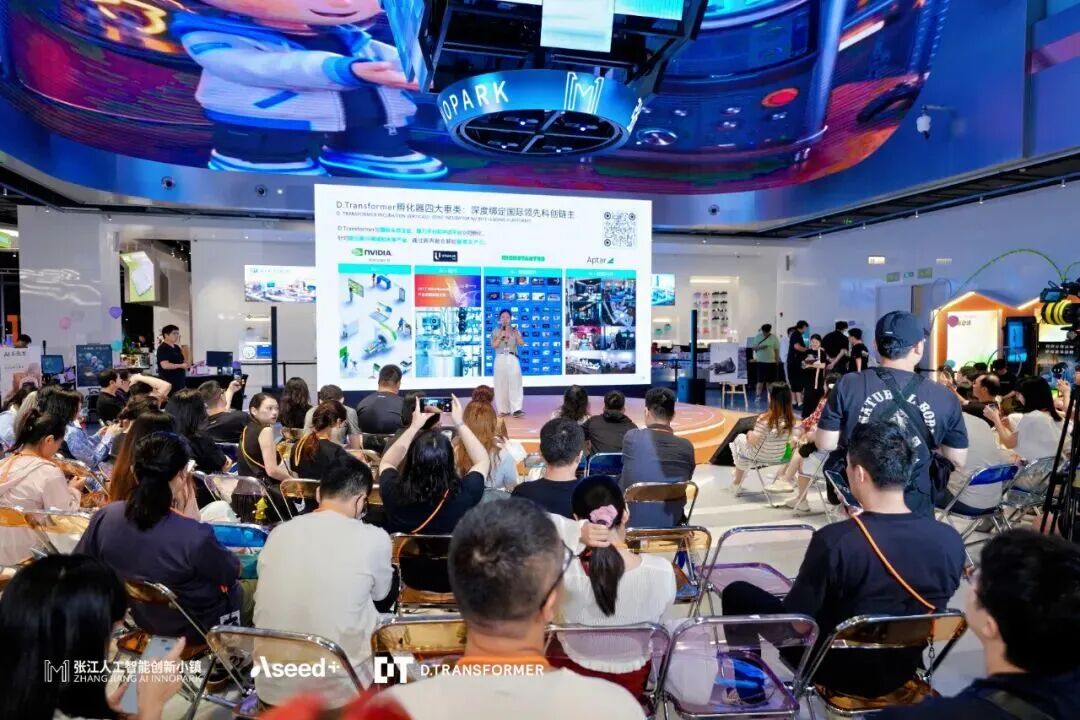
"We connected with Zhangjiang last September — this time it's not just a venue change, it's a playbook change," said Zhang Jie, executive director of D.Transformer. The core shift: putting real user judgment directly at the first stage of evaluation.
Across the previous three hardware maker sprints, over 410 projects and 250 developers participated, with more than 75% of projects still iterating and 63% securing funding or new orders. One team hit 1,933% of their crowdfunding target; others took their demos to CES and VIVATECH.
In the view of Wang Bei, partner at Hillhouse and judge at this maker sprint, hardware is a unique opportunity for Chinese entrepreneurs in the AI era — the supply chain is here, the engineering talent is here. Hardware value is no longer about cost-performance ratio, but the integration of software and hardware, experience-driven.
The challenge is over. Some plan to keep refining their products; others are preparing to take their prototypes to international exhibitions.
The story isn't over.
Looking forward to more builders and great products getting that push from real markets, getting seen by a bigger world.
- One-click recap of the heart-pounding 48H
Join the Community