Interactive blind-box pop-ups sold 120,000+ units, AI activation rate hit 40% — he's defining a new IP category for the AI era | A conversation with Shuyang of WakuArt
Please, Pop Mart, Just Make Interactive Blind Boxes Already
Against Data | Artist Sovereignty | Category Definer | Begging Giants to Jump In
Produced by | AI Nao

01.
By 2026, China's IP industry has surpassed 820 billion yuan in market size, while the global IP licensing market has hit $580 billion. For comparison, domestic box office revenue for the entire past year was 51.8 billion yuan — the IP market is now 16 times the size of the film box office.
From Pop Mart to miHoYo, from The Walt Disney Company to Bandai, this track has been validated again and again: more and more adults are willing to pay for emotional experiences, and willing to pay more.
Up to now, the core product in this massive market has remained static collectibles. You buy a Molly, put it on your desk, and your interaction with it is limited to "you look at it and find it cute."
But change is underway.
According to the Ministry of Industry and Information Technology, China's AI toy market reached 29 billion yuan in 2025 and is projected to exceed 100 billion by 2030, with a compound annual growth rate exceeding 20%. AI is transforming silent designer toys into companions that "have context, remember you, and play games with you."
Six months ago, Shuyang founded WakuArt. He firmly believes he is the most suitable person in China to build at the intersection of AI and IP. Shuyang was involved in the introduction and China operations of Demon Slayer, participated in Smart Share Global's journey from zero to IPO, and hosts the well-known podcast China Good Business.
He positions himself as someone who understands both IP and business. Among AI entrepreneurs, he is surely the one who best understands IP; among IP practitioners, he is the one most deeply embracing AI.
His investor list confirms this self-assurance. WakuArt has completed its angel round, with investors including the founder of China's largest IP trading platform, a former Pop Mart executive, and leading industrial capital.
02.
The question is: IP, as a content industry that VCs have historically considered "hard to replicate and highly uncertain" — does it really have anything to do with AI? The industry consensus points to AI improving efficiency, but not generating IP.
Shuyang believes AI will inevitably accelerate the birth of a new generation of IP, for three reasons.
First, the emergence of new technologies and platforms throughout history has always brought explosions of new IP.
The Famicom gave us Mario, home television popularization propelled Gundam, smartphones detonated Honor of Kings. Every new technology's novel interactive experience eventually settles into IP assets, and AI will be no exception.
Second, AI doesn't directly create IP characters, but short video plus AI multimodal technology has dropped the barrier for secondary creation and remixing to extremely low levels, massively accelerating the process by which a newborn IP gets redistributed and expands into derivative versions.
In the past, an IP explosion cycle might take six months to two years, relying on fan-driven community behavior. Now this can become part of product design itself — using AI to generate more experiences, upgrading blind boxes into interactive blind boxes.
Third, six months into entrepreneurship, Shuyang believes WakuArt has already worked out the basic methodology.
WakuArt has created 7 IPs to date. Its core IP, "Apple Bunny," sold nearly 2,000 units in its recent first pop-up appearance, while 40% of users downloaded the app for AI interaction, with intended orders even exceeding 10 million. For a brand-new IP just a few months old, these numbers are significant, and they prove what Shuyang says:
"Even in 2026, there are still many user needs unmet. IP in China has actually just begun."
WakuArt means "art that makes people boil over." Shuyang's dream is to use new AI technology to build the next world-class IP platform. And throughout our conversation, my expression went from 🤨 → 😮 → 🤔.
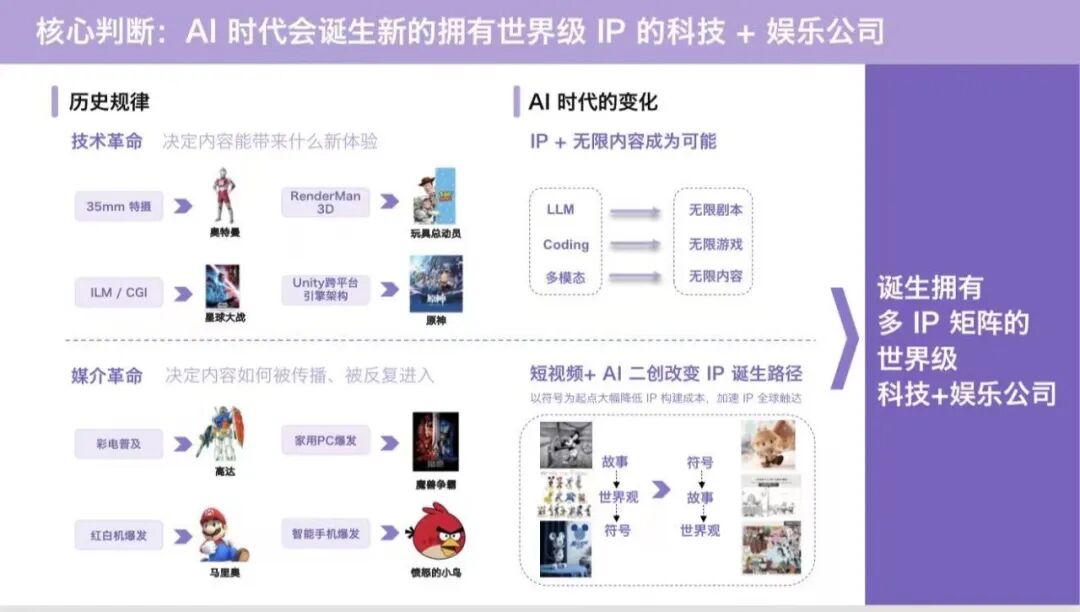
- Shuyang's framework for the relationship between IP and new technology
Below is Shuyang's worldview, and the worldview of the IP platform he is building.
"Conversation with Shuyang"
AI Nao You keep talking about AI + IP, but the biggest question everyone — including many VC investors — has is: Can AI really create IP? If not, what exactly is AI doing in IP?
Shuyang AI cannot birth new IP. IP must be drawn by human artists. We absolutely insist on this.
While it doesn't directly create IP, AI can compress the IP explosion cycle from years to months. This is crucial.
First, AI can accelerate the path from an IP's birth to its explosion. In the past, for an IP to blow up, it relied on core fan community propagation, with cycles of six months to two years. Now AI multimodal has dropped the barrier for secondary creation and remixing to nearly zero, and with short video as a distribution format, the frequency and speed at which a newborn IP gets redistributed and derives more versions has greatly increased.
Before AI technology, small IPs had no chance, because all production capacity was controlled by big IP players. But now technology has lowered this threshold, and small IPs have more opportunities today.
Second, AI will definitely bring opportunities to define new IP categories.
Every generation of new technology and platforms has birthed new great IPs, which define new categories for carrying IP. Disney defined theme parks and merchandise, Pop Mart defined blind boxes, miHoYo defined content-as-game and game-as-content.
What we want to do now is use AI to define a new category: interactive blind boxes. Not static collectibles, but blind boxes with games, with skins, with interactivity powered by AI.
AI Nao So the soul of IP still depends on human artists — AI can't help with that.
Shuyang It can't help. We made 7 IPs simultaneously, ran them for about a month. The best-performing data-wise was actually a cat image, which quickly gained 40,000 followers on Xiaohongshu, while BratPingo only had 8,000.
But when it came time to pick one IP, we chose BratPingo. The former had good follower growth, but we all felt it lacked character — it was just cute. Apple Bunny looks more distinctive, both arrogant and mischievous.
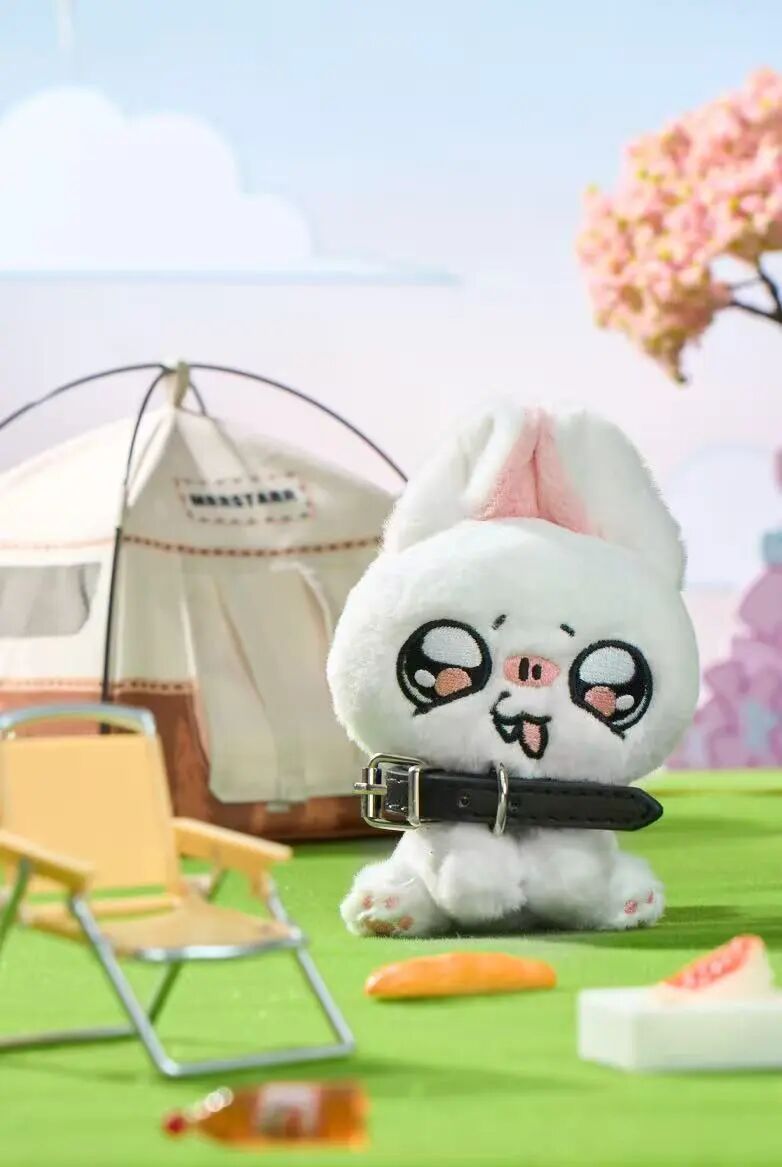
- BratPingo themself
AI Nao Was this your choice or the artist's choice?
Shuyang A unanimous choice between me and the artist.
AI Nao But didn't you launch 7 IPs precisely to test follower counts?
Shuyang Testing matters for establishing a baseline. Beyond that, follower count means little.
Gaining followers is easy — make some animations and followers come immediately. The key is whether the character has memorability, whether it has emotions that make people want to get close.
AI Nao So the core of IP selection relies on intuition?
Shuyang Yes, pure intuition.
The core of IP is worldbuilding and character design. All companies that can sustainably produce IP have an expandable worldbuilding framework. Detective Conan can solve infinite cases, Pokémon can challenge infinite gyms.
What we're building is called "Symbol Society" — within this framework, characters and stories can be generated infinitely. Artists don't need to build worldbuilding from scratch; they only need to create characters within this container.
AI Nao How do you filter for human artists?
Shuyang There are several criteria.
First, people who don't love studying, who haven't been contaminated by higher education — vocational school or junior high graduates. People who are good at school actually can't do this work, because they get trained into "correct" thinking, but IP creation requires very strong intuition and instinct.
Then, good internet sense. Our current lead artists fit this profile — one has several hundred thousand followers on Douyin, another lead artist also has several hundred thousand followers.
AI Nao Pop Mart has already defined blind boxes. You're now doing interactive blind boxes. For users, is interactivity a must-have? What experience does it enhance?
Shuyang Interactivity changes the relationship between people and IP.
With static blind boxes, you're done after buying. You look at it and find it cute. This is one-way.
With interactive blind boxes, you only begin after buying. It plays games with you, it has skins, it responds to you. This is two-way. In the future, users can also easily handcraft games based on our IPs.
Our backend data confirms this — 40% of pop-up store consumers who bought blind boxes downloaded the app. Users are actively seeking this relationship. We're not forcing it on them.
AI Nao What does the product roadmap for achieving interactivity look like?
Shuyang Step one is what we have now: interactive blind boxes. Each blind box corresponds to a mini-game or a skin. Users buy the blind box, scan the NFC, and unlock an interactive experience on their phone. We've already validated this — the pop-up store sold 120,000 yuan.
Step two is social. Two users bring their Apple Bunnies, tap them together, and enter a chatroom. The two Apple Bunny agents start chatting, and users can join in themselves. Using IP as a catalyst for offline social connection — this is what we'll do.
Step three is further out. We plan to put first-person AI memory into the plush itself. You carry it around, it records your life context, and automatically generates four-panel comics belonging to you.
AI Nao This sounds a lot like Looki.
Shuyang Yes, we want to take Looki's capabilities — first-person perspective, memory, automatic content generation — and stuff them into designer toys.
Once this is built, carrying Apple Bunny with you every day, your life becomes a comic between you and it.
AI Nao What if Pop Mart one day also does interactive blind boxes?
Shuyang I beg Pop Mart to do it. If they do, our category becomes hot.
But it's actually very challenging for them. Pop Mart's development cycle for a blind box set is at least 9 months; our company launched product in under 6 months since founding. It's not that we're fast — big company processes just take longer. Big companies have IP departments, product departments, and game departments as three separate teams; mixing them together to make something is very complex.
We have 15 people. One decision can be executed the same day.
AI Nao What does WakuArt mean? How do you introduce your company now?
Shuyang Waku means boiling over, heart-racing. WakuArt means very wow art. My ideal picture is: we have one building, half top-tier artists and content team, the other half extremely strong technology and commercialization team.
AI Nao What's the gap between current WakuArt and your ideal picture?
Shuyang First, I hope AI develops faster, with stronger multimodal capabilities. During the May Day holiday, I discovered that Codex has already surpassed Claude Code — especially suitable for making games.
Also, money. AI + IP is still a non-consensus track, but people inside the industry, including model companies, very much recognize it — they've even made acquisition offers for us.
So we hope to quickly find people who believe in this, who share our vision, to accelerate making this happen.
AI Nao What do you most want to say to investors reading this piece?
Shuyang Don't wait for Pop Mart to do it. Once they do, this track won't be at this price anymore.
Image source | Interviewee
Join the Community