14.9 Grams of Obsession and Six "Anti-Consensus" Views

"First, a pair of glasses"

AI Glasses | Light | Recording | Traditional Industry

1
About four months ago, AI Nao first heard of Moonix. The company had just launched its new product in Silicon Valley.
A pair of AI glasses weighing 14.9 grams. Most AI glasses on the market weigh between 30 and 80 grams — the human face is one of the most nerve-dense areas of the body, and wearing glasses over 50 grams creates noticeable pressure. At 14.9 grams, Moonix was lighter than many regular glasses, pushing toward the physical limit of "unnoticeable wear."
At the time, Moonix hadn't begun mass production — only basic prototypes and concept videos existed. After chatting with friends in Shenzhen working on AI glasses, the general feedback was: 14.9 grams is the biggest highlight, the design looks good too, and it's one of the more innovative products to emerge recently.
But lightness comes at a cost: no display, no teleprompter, battery compressed to the limit, long battery life actively sacrificed. In its official video, Moonix emphasized its core function: recording.
This sparked our curiosity. When every player in the AI glasses race is adding features — translation, teleprompter, music, everything thrown in — why would a startup choose subtraction?
At July's WAIC in Shanghai, we met Moonix founder Yuchen Guo. What surprised us was how rarely we'd heard a single word so densely from an AI hardware entrepreneur lately: good-looking.
"First, you need to give users a good-looking pair of glasses."
"Comfortable wear is the prerequisite for AI glasses to work."
"If users don't want to wear them, all technology becomes irrelevant."
Guo is a serial entrepreneur. Before Moonix, he spent four years on an AR startup. The biggest lesson from that experience: "Augmented tech is cool, but divorced from user needs, it's zero." This time around, he says, a sword of Damocles hangs over him: don't let technological advancement override user needs.
This means that while most industry players chose technology first, letting the body adapt, Moonix took another path: first a pair of glasses, then a computing device. Under this product principle, large numbers of non-essential technical options get cut.
This doesn't seem like a new insight — more like common sense restated.
Braun's chief design officer Dieter Rams proposed in the 1970s: less, but better. Steve Jobs inherited this legacy, leaving Apple's design principle: I'm as proud of what we didn't do as what we did.
"Restraint" is the watershed between product taste and engineering bloat.

- Yuchen Guo, wearing Moonix
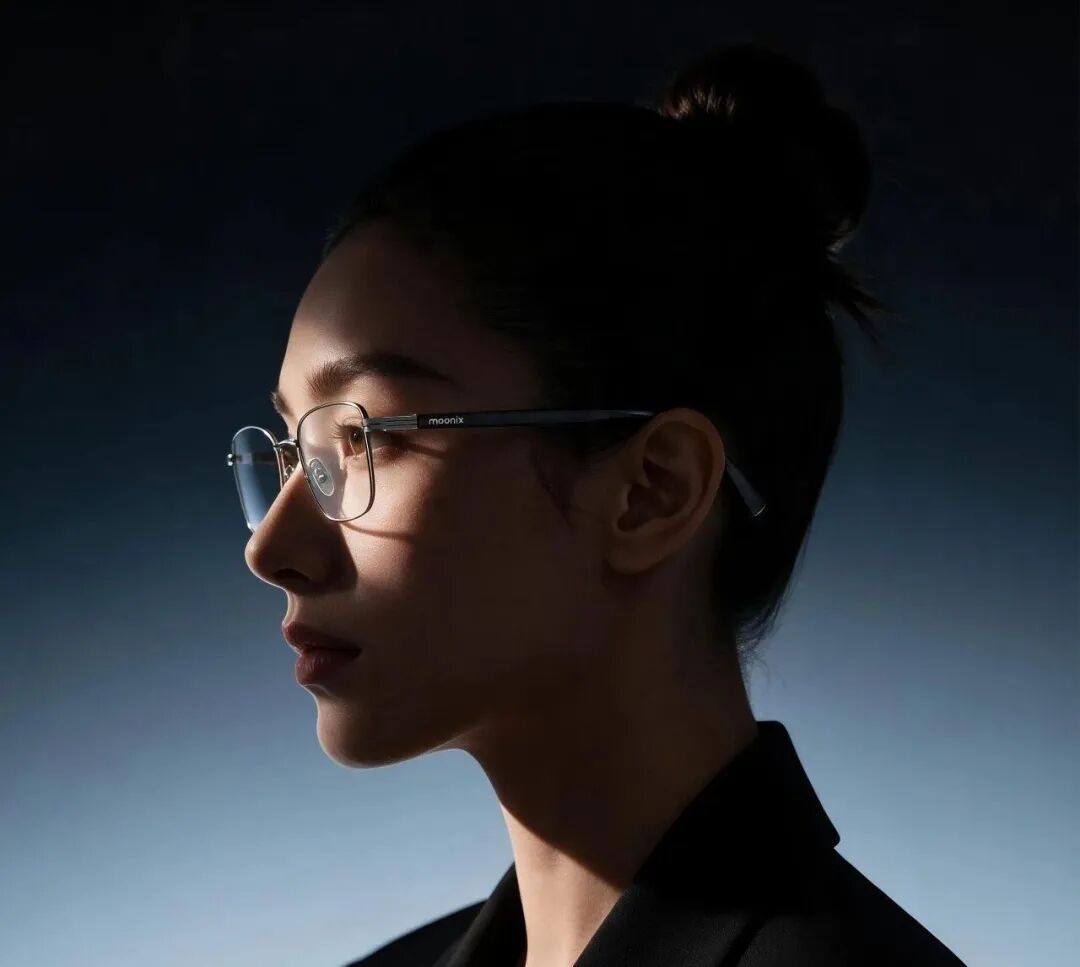
- Moonix product concept render
2
AI glasses have been the hottest track for two years. 2025 is also the year when major tech companies fight over them as an entry-level product. (This kind of talk is cliché by now.)
Rumor has it ByteDance currently has two teams racing to build AI glasses — one with a display, one without. Originally scheduled for July launch, now pushed to November.
From shipment numbers, this remains a blue ocean: global AI glasses shipments around 8.46 million, with Meta's Ray-Ban capturing over 60% share. The best-selling domestic brands are Xiaomi and Huawei, each with under 200,000 units — far from the 1 million threshold that marks consumer electronics legitimacy.
The competition, to some extent, still lives at the level of faith.
Another set of numbers is more interesting: global glasses sales are 1.5 billion pairs; AI glasses account for less than 1%. From a target market perspective, Moonix clearly wants to enter the traditional glasses market.
"A good-looking pair of glasses, plus AI features — consumers are willing to pay for that," Guo says. Their sales channels are primarily offline, and choosing glasses as the hardware entry point is based on their everyday nature, their closeness to ordinary people. "Glasses also have jewelry attributes — a person can own several pairs." Plus, "AI glasses are too homogenized now. I want to offer a different answer."
Our conversation with Guo also started with his desire to make a good pair of glasses.
From a product perspective, whether Moonix succeeds needs market validation. But from an industry angle, Moonix raises a valuable question: is subtraction actually the more aggressive strategy?
Below is Guo's account, from two conversations, edited into his six "counter-consensus" points.
"In Conversation with Yuchen Guo"
AI Glasses Are Still Glasses
Most people making AI glasses aren't treating them as glasses. This is a massive pitfall.
For example, most smart glasses have flat lenses because optical displays need flat surfaces — so engineers designed them that way.
But human eyes naturally have some curvature. Good glasses always have some arc to them. The more they conform to the eye area, the better the wearing experience. Then there's center of gravity, balance of fulcrum points — these make them comfortable to wear.
These details, someone from the traditional glasses industry can spot at a glance.
So I decided early on: first make a good pair of glasses. That means bringing in people from the traditional glasses industry. Tech companies have their know-how; the glasses industry has its own.
Also, the industry is all doing single-SKU. I think this is wrong too.
Glasses is an extremely long-tail market — phones can win with one model, but glasses are accessories. Even the world's largest eyewear group has over a hundred sub-brands serving different demographics.
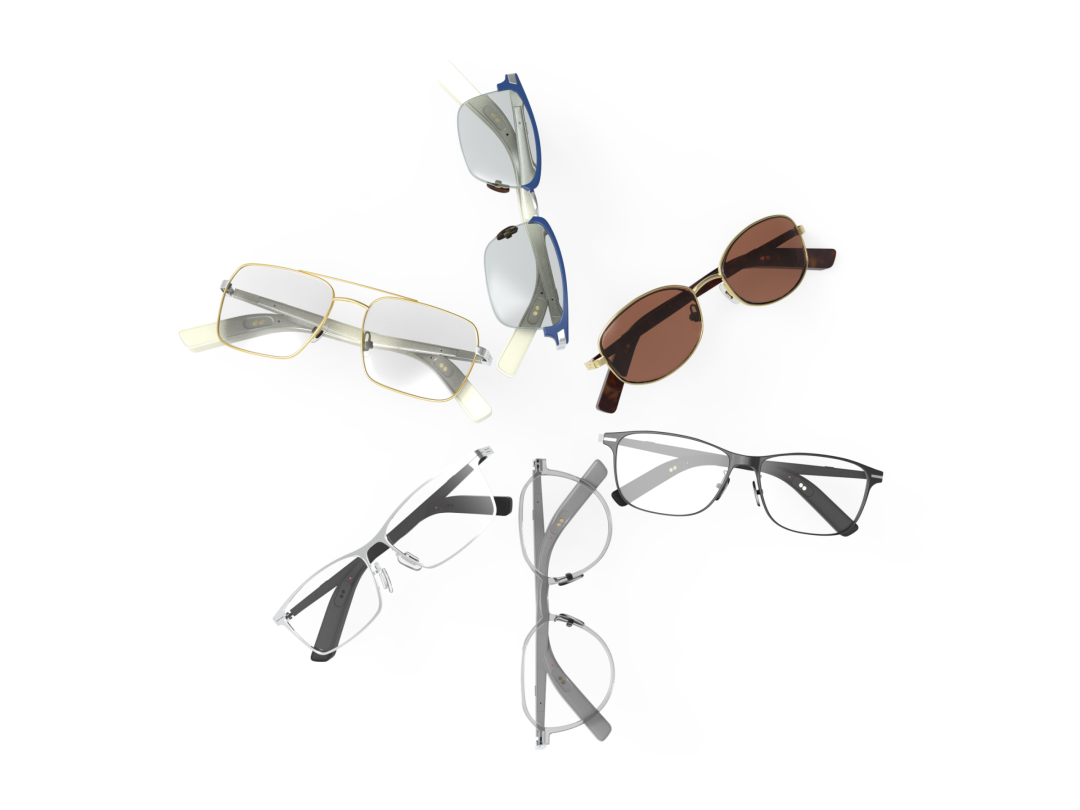
We're using a "modular design" — 39 front frames, 7 temple arms, combining into over a hundred SKUs. Temple arms quick-swap, lenses interchangeable.
Because consumers need different looks for different occasions.
There's another pitfall detail. Many AI glasses directly use molds designed for Western faces. Asians wear them and feel the temples pinching their head, the frame pressing against their face, overall proportions off — in short: ugly.
We referenced numerous East Asian handmade eyewear brands, re-adapting frame shapes, temple curvature, nose pad height.
Everything returns to the product's origin point: making a pair of glasses "people want to wear."
Cutting the Screen
Why cut the display function from AI glasses? For me, this too is returning to origin.
From the day glasses were invented, their primary function has been to help people see the world clearly. Together with the ears, they're a crucial source of human information input — this is the biggest differentiation of this product form from all other smart hardware: input. But display? That's output.
Our team debated this extensively — whether to do output. The final conclusion was: first get input right.
Because input is what AI glasses are best at right now.
Here's a judgment worth expanding on: the value of input and output is asymmetric in the AI era.
Training large models requires massive data, but public datasets — Romance of the Three Kingdoms, Wikipedia, Common Crawl — have been largely exhausted. What's truly scarce is personal data: daily conversations, walking routes, etc. This data has never been systematically collected before.
Glasses are the most natural vehicle for collecting this kind of data. My understanding is: glasses are essentially an extension of human organs.
Also, "presentation" — phones do this far better than glasses. Why should we compete with phones for this job?
I used to work in augmented reality. I know too well the engineering challenges here. The tech is cool, but not ready for consumer markets.
Navigation, teleprompter — these industry-default features. My logic is: adding features naturally appeals to human instincts, but doesn't necessarily follow product logic. Every added feature, seemingly giving users more, actually adds another layer of distraction.
Focus on recording, just record. Making it also navigate and also be a teleprompter — that backfires on the core experience. Once you understand this, there's not much to agonize over.
In the end, we only focused on recording. We were simply holding to our basic product definition.
14.9 Grams
During development, weight was my biggest concern — because it relates to wearing comfort.
Why? Because building a data moat only works under the condition of "continuous wear." So "light" is mandatory.
Early on, I tracked two metrics for "wearing comfort": daily wear duration, and how often core features were activated — if users buy but don't wear, or wear but don't use, sales numbers mean little to us.
The initial goal was 50% of users using AI features daily in the first month.
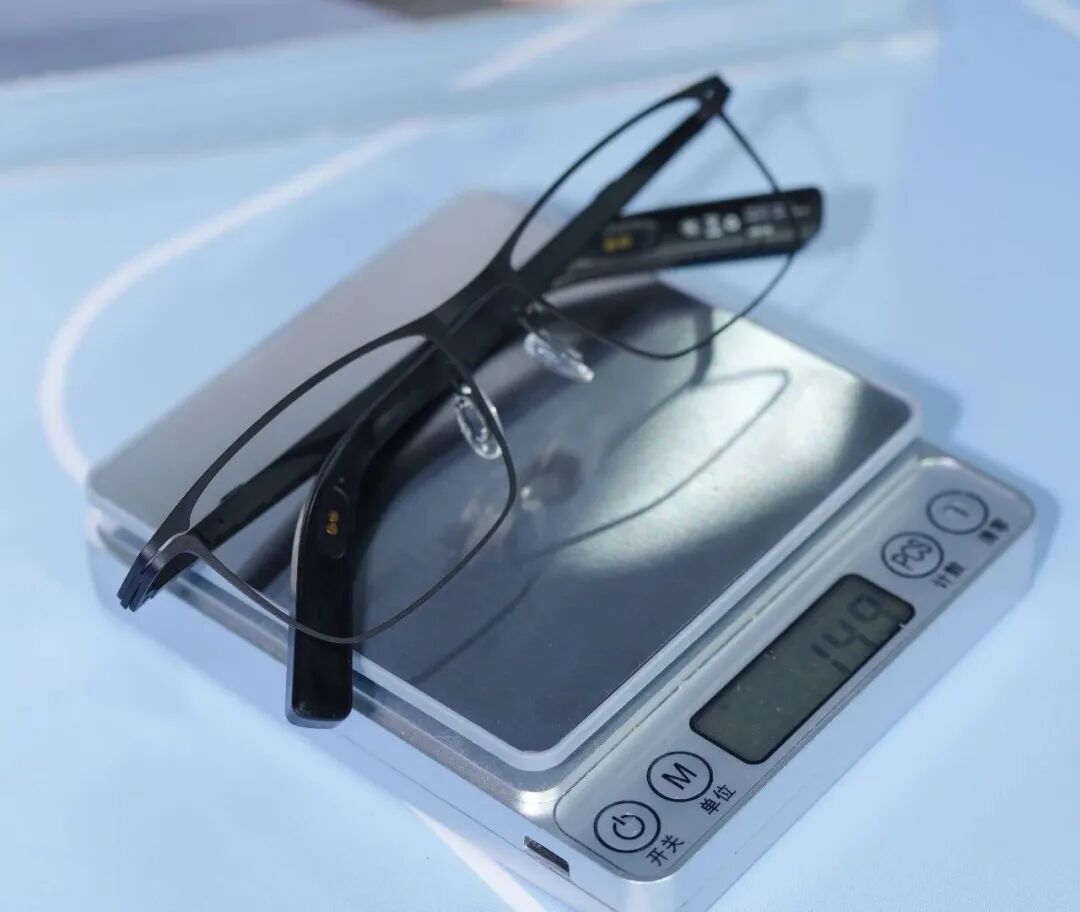
Achieving 14.9 grams was a natural outcome, more like a reward from heaven (laughs), not an initial target we set.
In our office, we still have a scale. At first it was genuinely used to weigh glasses. Now the symbolic meaning outweighs the practical — a bit like the empty chair Amazon places in meetings, representing the user perspective, constantly reminding us to stay sensitive to weight.
14.9 could theoretically go lower. The pursuit of wearing experience has no endpoint.
Not Planning the Next-Gen Entry Point
This time we're not doing a product launch. This decision wasn't difficult at all.
Launches solve attention problems; products solve trust problems. We're in an era of extreme attention fragmentation and extreme trust dilution. In this context, letting products be products matters far more than adding noisy concepts to the industry.
I even wrote an article titled "The Product Is the Best Launch Event."
Moonix also won't claim to be building "the next-generation entry point."
I've never fully understood this "entry point" concept — not whether it's right or wrong, but when you先天性地 assign a product such massive historical responsibility, saying it's here to replace phones, tactical execution inevitably distorts.
Because all your decisions, resource allocation, will unconsciously lean toward "must replace phones," and the result is: farther from users, farther from real needs.
Objectively speaking, glasses' current relationship with phones is more like TWS earbuds' relationship with phones — an accessory.
Internally we've discussed: do we want to build an iPod-level product, or an iPhone-level product?
My answer: the iPod was already an incredibly great product. You can't say it's not era-defining just because of its scenario limitations.
Every product has its own mission — maybe 20 years, 30 years, maybe shorter. It doesn't matter. What matters is whether it serves users well in its own time.
We should focus more on what value the product actually creates.
Objectively, glasses are currently phone accessories. Then first do what an accessory should do, to the extreme.
Whether it grows into an entry point, or some other form, in the future — that emerges, it's not planned.
Selling AI Glasses at Traditional Optical Shops
The glasses form factor is fundamentally different from traditional digital products, where purchase decisions come from repeated comparison and review.
The glasses consumption logic is: users are first attracted by appearance, then combine with some AI features to complete the purchase.
So we must go offline. Offline shipment volume is an important near-term metric.
Currently partnering offline with Dr. Glasses and Wujie, about 100+ stores, covering tier-one cities, priced around 2,000 RMB.
2,000 RMB offline for a good-looking pair of glasses with AI features — that's a relatively acceptable price for consumers. Since launching in July, natural sales have been surprisingly good.
We won't compete on low prices. The essence is错位竞争 with major tech companies. Big companies treat glasses as entry points, using subsidies to drive prices extremely low — that's how smart speakers were fought. But strictly speaking, our users aren't the same demographic. We're targeting general consumers, especially women, who see glasses' first attribute as wearability, as accessory.
Also, just making a good-looking pair of glasses — this wouldn't pass review at a big company. Big companies must do full AI office suites, next-gen computing platforms, entry points. It's in their DNA.
Our short-term moat is definitely appearance and technology, roughly an 8 to 10 month window. Long-term moat is definitely the data itself.
"Recording" Is Undervalued
I left NetEase in 2020 and started my first company doing AR. The biggest learning from those four years: augmented reality has tremendous technical imagination, but divorced from user needs, it's zero.
This time, the sword of Damocles hanging over me is: don't let technological advancement override user needs. Choosing glasses was also about choosing something everyday, naturally sitting on your face, ordinary enough that technology could enter life.
The stronger AI gets, the more it forces us to think one step further when building products — technology doesn't directly determine human happiness. It has to answer a simpler question: what do people actually need?
Especially with hardware, many things can't be expressed as data — non-objective indicators, just intuitive judgment.
This is also why we had to focus on "recording" early on. A prevalent bias in AI: recording is too simple, not worth doing directly. But precisely because it's simple, it's important.
For example, my father is a very scattered thinker. He has many ideas daily and wants to record them — Moonix can do this. Or there's a particularly niche track now called "writing memoirs for elderly people" — Moonix can help organize and summarize.
AI makes recording no longer a privilege of the few — previously only writers, journalists could systematically organize their lives. Now Moonix can help you record, help you better understand yourself. This is how I define a good product.
I still want to make products that bring people happiness.
Image source | Provided by interviewee
AI Nao is looking for independent contributors
If you're curious about people and stories in the AI wave, and skilled at writing
Please contact: shizao1123@hotmail.com
Email should include: 1. Personal introduction; 2. Relevant articles; 3. Your favorite AI Nao article
Competitive compensation, professional editorial guidance
Looking forward to making noise with you