Two Rounds, Nearly $100M in Four Months: AI Is Actually Helping Creators Make Money | A Conversation with K2Lab Founder and Former DingTalk VP Ming Wang

Has the Era of Intent-Based E-Commerce Begun?

Rewriting Supply | Beyond Tools | Distribution | Intent Commerce | Agent OS
Produced by | AI Nao

Intro.
Six months ago, Wang Ming jumped into entrepreneurship.
At 38, he was the youngest VP in DingTalk's history. Before joining Alibaba, Wang had a varied track record — multiple internal and external startup stints spanning B2B marketplaces, O2O, e-commerce, and SaaS.
At Alibaba, Wang was also a disruptive force. He led DingTalk's AI-native ecosystem efforts, consistently pushing the company to transform DingTalk into "the AI-to-B entry point" and build the largest AI-native application ecosystem.
The reason Wang waited until November 2025 to start his own company was simple. He believed that by then, model capabilities had reached a tipping point — enough to serve "ordinary users with zero learning curve" in specific scenarios. He narrowed his startup's mission to an extreme:
Let AI directly help people make money.
By April 2026, Wang had rapidly closed two funding rounds. The first was led by Yunshi Capital; the second was led by Huakong Fund with Yunshi Capital following on. The two rounds totaled nearly 100 million RMB. Meanwhile, Moras, the company's first product, had already begun its first batch of testing on TikTok's US marketplace in March.
Moras used cold emails to reach a group of mid-tier creators who had barely made any sales: they had entered the affiliate system but never figured out conversion, with sizable followings but extremely unstable output over the past year.
The email response rate hit 2–4%, far above industry norms (typically below 0.01%). Roughly 40 creators in the initial co-creation cohort, using Moras, were able to post 3 to 5 pieces of content daily on a regular schedule, with monthly output exceeding 200 posts. A creation process that had been highly dependent on personal time and experience was compressed into a scalable, executable system.
Creator weekly conversion rates exceeded 70%; average monthly GMV approached $10,000.
In individual cases, some creators hit $10,000 in weekly GMV after using Moras, and one even broke $100,000 in a single month during testing — though such results carried some randomness.
Moras's production chain is long, but the logic is straightforward: through a suite of Agents, it strings together product selection, script generation, video production, and publishing — completing the entire selling chain for creators, who only need to provide their account and basic preferences.
But one subtle shift occurs in this process: revenue flows to Moras first, then gets distributed to creators as commission. For a subset of users, Moras even operates in an "AI hires humans" mode — it pays creators a base salary plus revenue share, but the bulk of earnings go to the AI system (i.e., Moras itself).
In other words, Moras doesn't just participate in production; it participates in distribution. This disruption arrived faster than imagined.
Peng Chuang, founder of Yunshi Capital, which invested in both rounds, has known Wang for years. In his view, Wang is among the most knowledgeable people about China's entire SaaS ecosystem. The two share a conviction: SaaS stops at the tool layer, while AI must be able to deliver complete outcomes. Peng had been searching for a company that could deliver results through full-chain execution; Moras was the answer he found.
Wang sums it all up: 2026 is year zero for AI outcome-based pricing.
And Moras's ambition lies in securing full user delegation rights — building an Agent OS for A2A-native commerce scenarios.
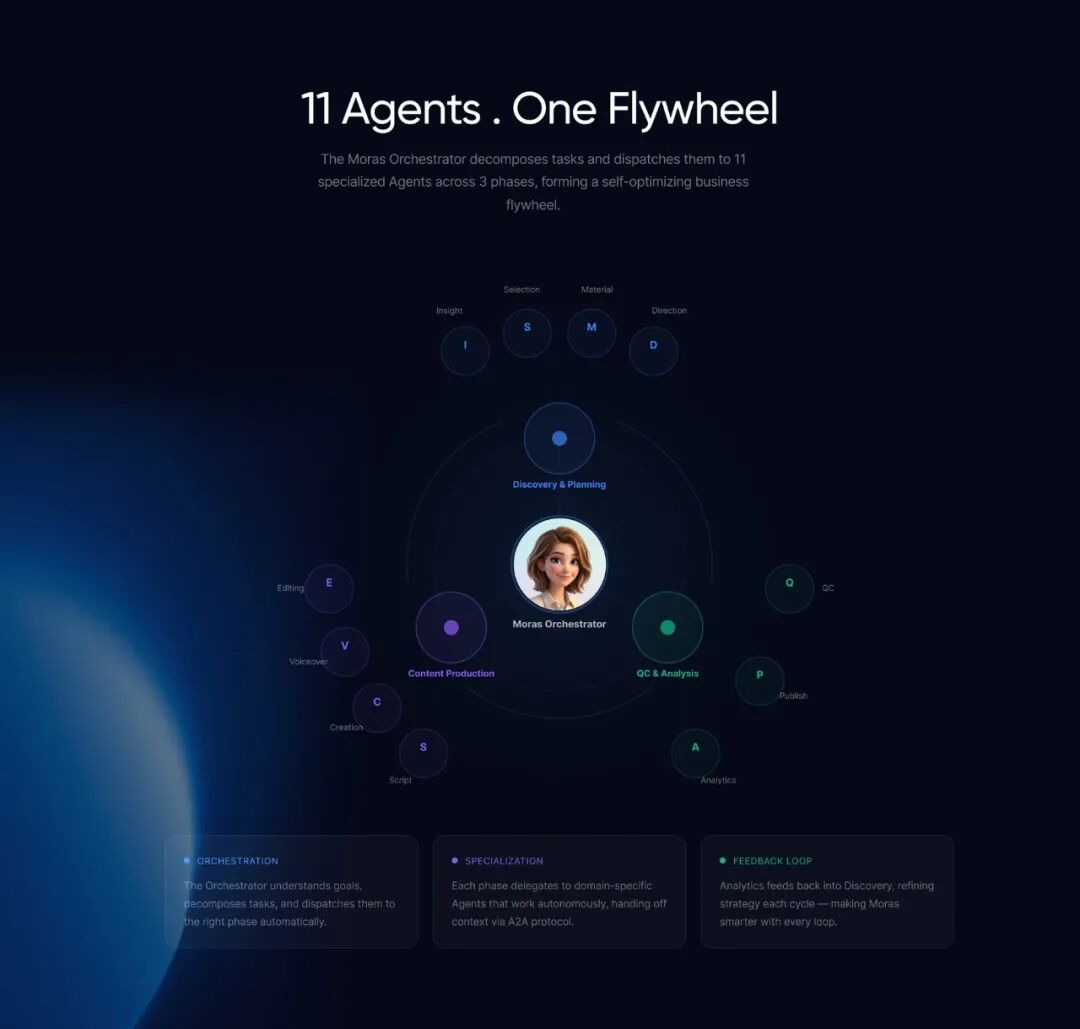
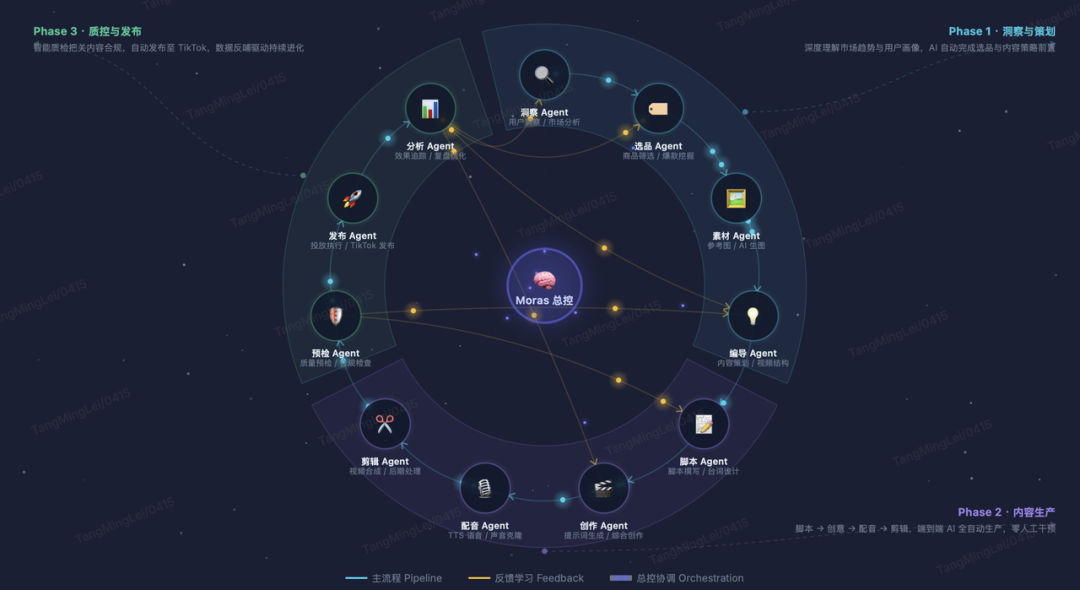
- Moras interface and workflow examples
「 In Conversation with Wang Ming 」
Letting People Who Can't Sell, Start Selling
AI Nao Your first test batch didn't target top-tier creators; instead you went for people who had barely made any sales. That's a counterintuitive choice. How did Moras select its initial partners?
Wang Ming We looked at the entire creator structure on TikTok's US marketplace — roughly 850,000 affiliate creators, of whom nearly 60% had never made a sale.
These aren't people without followers. Many are mid-tier creators with decent scale, at least 5,000 followers or more. But they never figured out how to make selling work. On one hand, their production capacity is unstable — they might not post much content in a year. On the other hand, they never developed a complete methodology for selling.
But from another angle, this group represents a larger supply pool. Top creators already have strong methods and path dependencies, and they're being bombarded by tools. These mid-tier creators haven't been fully activated; they're underserved and lack support.
So for our first batch we leaned toward this group — lower cold-start costs on one hand, and on the other, once the model works, this segment has more room to grow.
AI Nao Getting a group of people who hadn't converted for long periods to a 70% weekly sales rate in one week — what did AI actually do in the middle?
Wang Ming It's essentially two overlapping changes.
The first is a change in production capacity. AIGC has dramatically lowered content production costs. Previously, making a single affiliate video involved a long chain — product selection, sample purchasing, filming, editing — dependent on personal experience. Now these steps can be systematically decomposed and recombined, letting creators produce content continuously in a short time.
The second change is actually more critical: it's a change in content supply. When production costs drop, content proliferates quickly, but this also brings a problem — user trust in content declines.
In this environment, simply having "more content" doesn't drive conversion. You need to return to trust between people. What we've seen on TikTok is that what actually converts is content where users feel "this is a person recommending something to me."
So to some extent, AI solves production efficiency, but conversion still has to happen through trust in people.
AI Nao What role does Moras play in this process?
Wang Ming We reconstructed the entire selling chain.
From product selection, script generation, video production, to posting rhythm and some operational decisions — these steps can all be completed through a suite of Agents. Creators don't need to figure out each step themselves; they just provide their account and some basic preferences.
What used to depend on personal time and experience becomes a continuously running system.
AI Nao In this process, revenue goes to Moras first, then gets distributed to creators. How did this structure come about?
Wang Ming This structure is tied to the type of users we serve.
The creators we work with are mostly US-based, and most aren't willing to spend time learning a complex selling process. They care about results, not process.
In this case, if we used the traditional SaaS approach — having users learn a bunch of tools first, then repeat inefficient operations themselves — it wouldn't work.
So for a subset of users, we use a simpler cooperation model: the system completes most decisions and execution, revenue enters the system first, then gets distributed to creators according to rules.
To some extent, you could understand this as AI hiring people to get the job done.
Abandoning Platform Fantasies, Letting AI Make Money Directly
AI Nao You worked on AI ecosystems at DingTalk and thought about bigger platform-level opportunities, but after leaving you chose a very specific, long-chain entry point building Agents. How did this shift happen?
Wang Ming At Alibaba, we were definitely looking at AI from a very platform-centric perspective.
Starting in 2023, we basically looked at AI projects domestically and internationally. By late 2024, we were internally pushing something major — turning DingTalk into Alibaba's entire AI-to-B entry point. We even discussed a more aggressive path internally, like spending three years acquiring over a hundred AI-native applications to build out the whole ecosystem.
But after seeing enough projects, I gradually cooled down. What you find is that every wave of technological change looks exciting, but what truly determines success or failure essentially hasn't changed — business logic hasn't changed, user needs haven't changed. What's changed is just technology, attention, and the form of production relations.
So I started thinking: if these underlying things haven't changed, then in this AI wave, what do startup teams actually have a shot at? We developed a simple filtering framework internally called "May Fourth Youth" — five dos and four don'ts — essentially a process of elimination.
AI Nao What can't you do?
Wang Ming There are several categories we explicitly avoid. No pure domestic market. No overseas B2B. No pure tools. No non-essential scenarios. Nothing purely dependent on large language models, and so on.
The reason for not doing pure models is that we had extensive contact with model teams. We had lots of collaboration with MiniMax, Moonshot AI, Zhipu AI, and other model companies before they got so hot. We did a lot of exchange. The large model track is too brutally dominated by the Transformer architecture — whoever has more data and compute wins. This is a battleground for tech giants; startups can barely survive. Even Cursor, which seemed so close to users with product experience advantages and got in so early — as long as its foundation depends on someone else's large model, even at a $30 billion valuation, it's hard to say today whether it survived. It'll likely end up acquired.
AI Nao What can you do?
Wang Ming Round after round of elimination, you find there aren't many options left. The remaining directions must simultaneously satisfy several conditions: must be an incremental market, must be an essential scenario, and must be able to quickly become number one in a niche segment, get users paying, form data and revenue scale, then have a chance to move forward.
Another important point: we didn't want to build another "tool." We wanted to construct a two-sided structure from the start — one side users, the other side supply that can generate transactions or value.
After this filtering, in our first month of entrepreneurship we actually built three products: AI manga drama, an AI version of TikTok, and what we have now.
AI Nao Why did only "AI helping creators make money" survive for you?
Wang Ming We abandoned AI manga drama because video model capabilities weren't mature enough yet. The entire production chain was still too complex, with high learning costs for users — better suited for experienced creators, so-called prosumers. But hard to truly reach broader consumer users.
And we didn't want to build a general-purpose tool or a vertical scenario product that only serves a small group. We wanted to find something that genuinely connected to the next era for a large user base.
AI Nao What did your other experiment, the AI version of TikTok, look like?
Wang Ming We were thinking of using AI to generate thousands of virtual characters, handsome men and beautiful women. We could even make something like a reality show mechanism, like eliminating 20% daily, letting the content itself form ongoing narrative, with AI-generated characters interacting and co-creating. We found the same problem — technology wasn't there.
If you ask AI to make a longer continuous story, it can't do it. Every 15 seconds it has to start a new story; you need manual stitching, and that becomes a tool again. I didn't want to do tools.
What remained was Moras. This direction happened to fit all our do and don't conditions —
Overseas, not domestic. Prosumer, not B2B. Essential — directly helping people make money. Not purely dependent on large models, but using AI to string together a long chain end-to-end, using reasoning and multimodal capabilities. Not a tool, but a product that delivers results. Our target users aren't the small number of professional creators, but mid-tier creators who signed up for affiliate selling but barely made any sales.
AI Nao Very pragmatic choices, but doesn't pragmatism mean the ceiling isn't the highest?
Wang Ming No. Actually, the core points we focus on are:
First, can this show results in a relatively short time;
Second, can users adopt it without much learning cost;
Third, can this chain be decomposed and run by a system.
"Let AI directly generate transactions" was what emerged from this filtering. Actually, this is the path we think has the highest ceiling. Because once you help creators stably make money, you're no longer a tool — you're a two-sided ecosystem: creators' attention on one side, merchants' goods on the other. Tools get replaced, but ecosystems snowball. And traffic will migrate toward Agents; transaction forms will become A2A. There's massive opportunity there.
Intent Commerce Is the Next E-commerce Form
AI Nao From testing feedback, Moras is a small closed loop that works. Looking one step further, what do you think this ultimately becomes?
Wang Ming Our internal judgment is that in the AI era, e-commerce is about to transition from today's content commerce to intent commerce.
Current content commerce is essentially "product finds person" or "content influences person." You have to continuously produce content to generate user interest, then gradually convert. But this process is relatively inefficient and heavily dependent on human experience and luck.
But if model capabilities continue advancing, there's actually opportunity to directly understand user purchase intent. When the system can more accurately judge what someone wants at this moment, it no longer needs to plant seeds through massive content — it can directly match supply, even automatically complete transactions through Agents.
AI Nao What's the biggest difference between intent commerce and today's model?
Wang Ming From shelf commerce to content commerce to intent commerce, the core difference is that the middle layer gets compressed.
Previously, you watched content, got influenced, then made a decision; the future might be: after your need is recognized, you directly enter matching and transaction.
So structurally, with excellent memory systems and autonomous evolution capabilities, it will fully understand user intent, shifting from "content-driven" to "intent-driven." From human judgment to AI completing most judgment with human sign-off, or even AI directly completing transactions.
AI Nao Which part of this process is Moras currently working on?
Wang Ming We're still in relatively early stages, rapidly improving the Agent OS through coding capabilities and Harness architecture. Moras is more on reconstructing the supply side — making content production, product selection, distribution, and fulfillment systematically completable, letting people and sellers who previously lacked the capability enter this system.
But looking ahead, these capabilities can ultimately connect with the "intent" layer. When supply can be system-generated and demand can be system-understood, matching efficiency dramatically improves. As personal AI systems like Open Claw rapidly evolve, the A2A commerce era will quickly arrive.