Some Observed Parallel Worlds, Others Wrote a Life Manual for Humanity | 6 Projects at an AI Night on the High Seas

6 Ideas That Rocked the A-Island Sailing Night

The only WAIC event with a dress code — blue and white. Luckily, everyone who showed up followed it.
Hot.
Shanghai nights were still pushing 40°C. The bar owner had to throw open the terrace doors. Ice melted by the minute. They eventually panic-ordered a bunch of ice cream so nobody passed out on the floor.
First up was Creator Lele, who brought a "Parallel World Observer." Before he even finished, both mics died. Every Creator after him had to rely on lung capacity — shouting themselves hoarse, the audience shouting back just as loud.
The night's projects spanned parallel-world exploration, expert information aggregation, AI influencer matchmaking for going global, genomic foundation models, open-source AI products, and AI-powered workout recommendations. Diverse directions, bold imagination. Here's our best shot at explaining them all in 300 words.
You Who Came From the Stars
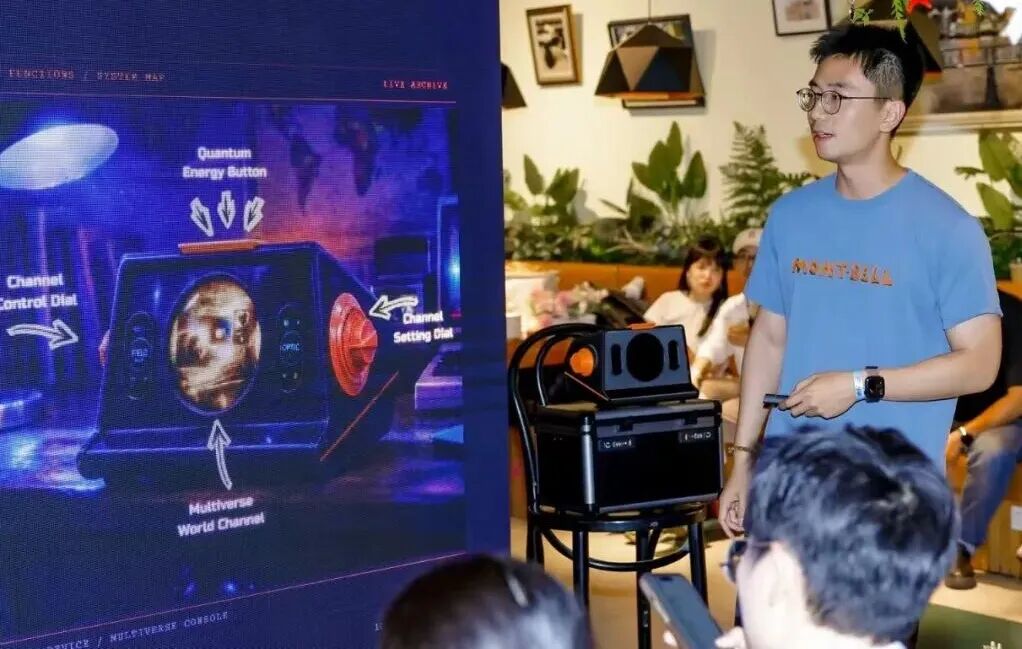
First up, Lele. Two years ago, he claims, he met an elegant Mexican woman named Cruz on a dating app. She "summoned" him into something called the Multiverse Collective, an organization devoted to exploring parallel worlds.
"At first I thought these people might be insane." Until he saw the device — the Parallel World Observer.
Lele brought it to the event. It looks like an old radio. Twist the tuning knob and you don't find traffic reports — you get live broadcasts from parallel worlds. "Maybe an alternate history at some fork in the road. Maybe a bestseller a writer only wrote because of a dream they had — that dream, it's in here."
Even weirder: the machine can transmit signals to parallel worlds. Hit the orange "quantum energy button," record a message, fire it off. If that world happens to host life, your voice might suddenly flash through their mind.
Someone asked: Is this hardware for sale? Lele said no, not yet — they charge subscription fees.
His real purpose here was recruiting more voyagers. Apparently 20,000-plus Parallel World Observers exist globally, most still undiscovered. "Maybe at a flea market, maybe in some forest."
Believe it or not, they've already secured investment from a well-known angel firm and are about to launch in North America.
An Investor Forced Money on Him
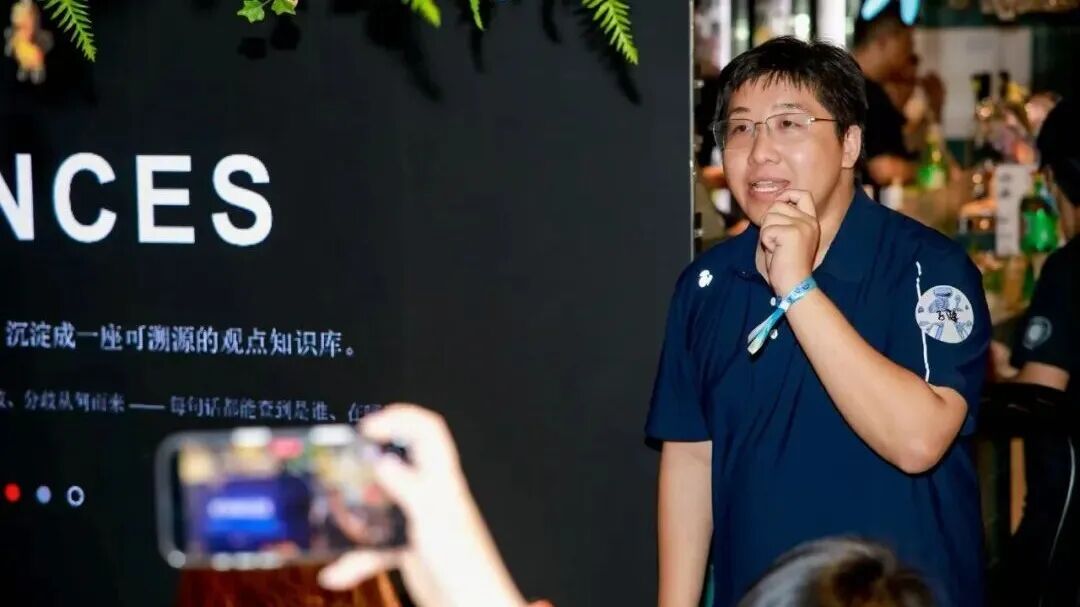
Second up: Zijian, a well-known founder with plenty of fans in the room. He's built two products with over 100 million DAU. More than 3 million users globally. Topped Apple's education charts. Spoke with an investor for ten minutes — the investor tried to force money on him.
His new product asks a simple question: Can you trust what large models tell you?
He posed three questions to the room: When you chat with a large model, do you know if its answers are reliable? Do you know where its information comes from? After you ask something, do you know what follow-up questions you should be asking?
Built on over 100 million data points, the core logic is this: aggregate first-hand expert information from around the world. When you ask a question, it tells you which expert discussed relevant views on which program, laying out consensus, dissent, and multi-angle perspectives on a timeline.
An audience member got abstract: How do you see the world developing in 5 to 10 years?
Zijian's answer was restrained, roughly: Don't follow the noise.
Oh — this product launches at month-end. AI Nao will get early access codes first. 😄
The Most Controversial Project

Third up: Casey, co-founder of Aha.
The most controversial project of 2025, bar none. Good news: they survived the controversy, and came back this year with something new.
AI Nao previously covered this ⬇️ No college, no code, $2.5M ARR in under a year — Head AI founder Kay responds to all doubts
The new product's positioning is clear: matchmaking brands with AI influencers for going global. Casey shared three case studies.
First, a Chengdu-based AI creation platform. Six months of partnership, several hundred creators matched. "The founder told me, I just want my ops team doing product and growth — not spending time sending emails and chasing replies."
Second was the most interesting — a competitor's big boss and Aha's founder were in the same WeChat group. The boss kept praising his own ops person there, "doing great lately." But secretly, that ops person had been a heavy Aha user for over half a year.
Third, even more direct. A customer kept asking "does your product actually work?" The Aha team had no patience left, told him to try the $2,000 minimum package first. Two days later, he dropped $20,000.
AI marketing is no longer about "can we do this" — now it's about "who can do it faster."
Audience members were all adding Casey on WeChat, asking about discounts.
Human Genome Passport

Fourth project: θGenome, a whole-genome foundation model.
Let me try to explain this in plain terms. How different are people, really? If you look at SNPs alone — 99.9% sequence identity. It's that 0.1% that makes us who we are.
Current genetic testing companies have only decoded 1% of the "words," recognized 10% of the "signposts." The remaining 89% awaits cracking. Why do so many genetic tests say "for reference only"? Because science still can't read most of it.
Take schizophrenia: theoretical heritability of 80%, yet traditional tests predict only 8%. θGenome's goal is to find causal loci directly — pinpoint exactly which disease variant you carry.
Co-founder Situ Lu demonstrated a feature on stage: whole-genome sequencing from a drop of blood or saliva. Feed the data into the model, and θGenome can predict your appearance — with skeletal reconstruction accurate enough to 3D-print.
θGenome's 1.0 base model is complete; 2.0 goes straight to commercialization. First target for going global: the Middle East. The reason is practical: consanguinity rates near 50% in some Gulf states, genetic disease incidence extremely high. In the UAE, genetic testing is mandatory for marriage licenses.
A woman in the audience asked a sharp question: "In the end, are you just doing prediction, or could this lead to designer babies?"
The answer was equally direct: "We only focus on disease and health. We won't participate in anything unrelated to disease and health, like baby customization."
AI Rights Declaration

Fifth up: Deng Xiaoxian Koki, a well-known AI KOL. She opened with a bomb. "How many of you genuinely believe that leading AI company is a good company? That you agree with its values?"
Few hands went up.
She continued: "Twenty years ago, people lined up at 3 a.m. for the latest iPhone. If you love a company's product, you should love the company too. So why has it flipped in the AI era?"
She named the phenomenon: AI tyranny.
Then she formally launched the AI Rights Declaration on the spot, proposing four rights:
First, the right to freely choose and switch models
Second, the right to refuse planned obsolescence
Third, the right to have personal memories recorded
Fourth, the right to freely use third-party accessories and modifications
Behind the declaration sits a fully open-source AI product: 80,000 likes in two months since launch, millions of downloads, covering 50 countries. Capable of long-term user memory recording.
An audience member added: "That leading company doesn't just discriminate against Chinese people — it excludes non-American employees too."
Whether or not you agree this counts as "tyranny," when one company controls most of the world's compute and talent, they are indeed reshaping countless people's work and lives.
Mysticism + Exercise?
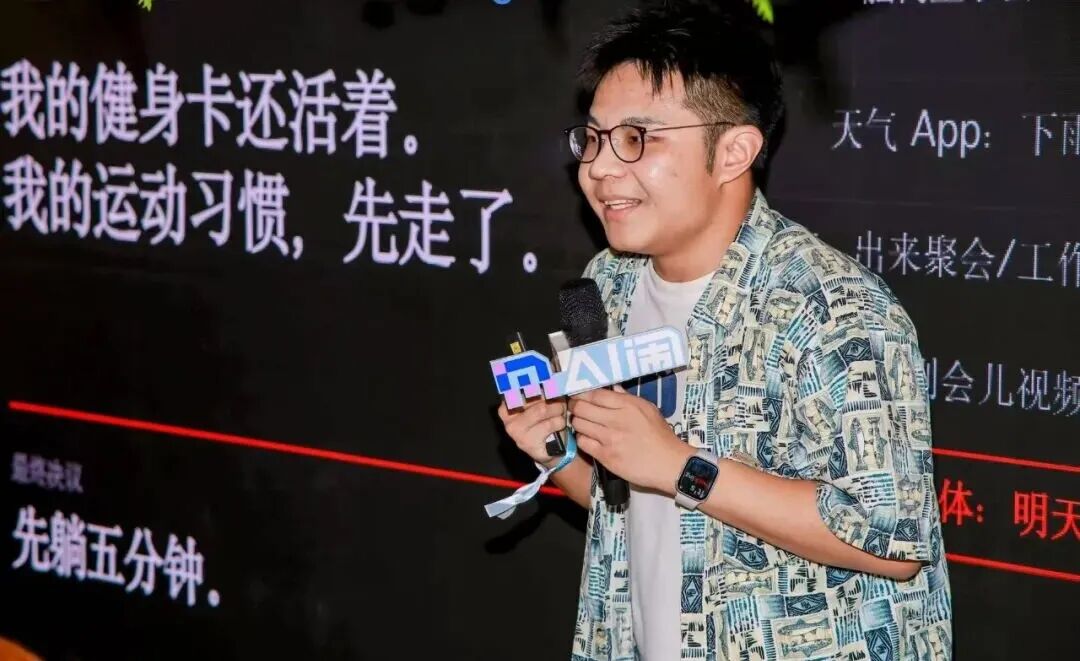
Eddie wasn't here to pitch. He was here to confess.
Three charges: using AI for fortune-telling, teaching exercise through five-element rhythms, and telling people not to drink — in a Shanghai bar.
Eddie first asked the room: Who's bought a gym membership? Keep your hand up if you actually kept going.
Then he named the pain point: Tomorrow and tomorrow and tomorrow.
The product logic is simple: combine user birth information, daily status, and traditional five-element monthly and daily cycles. The AI tells you whether today's good for exercise, and what kind. It respects scene boundaries — won't recommend climbing a snowy mountain right now. Respects ability boundaries — won't recommend basketball if you can't play.
Core proposition, one sentence: Start moving today.
Someone asked: What's your basis for exercise recommendations?
"Annual cycles, monthly cycles, daily cycles." Believe it or not. Fine. When everyone in AI is building foundation models and agents, someone actually combined fortune-telling with fitness. That's differentiation, I guess 😼
The Winner

After intense voting
First place: Zijian 👏👏👏
Can't rule out that his victory came from adopting Norway's World Cup celebration during the on-stage vote pull: the Viking clap 🚣
Shanghai Is Hardcore
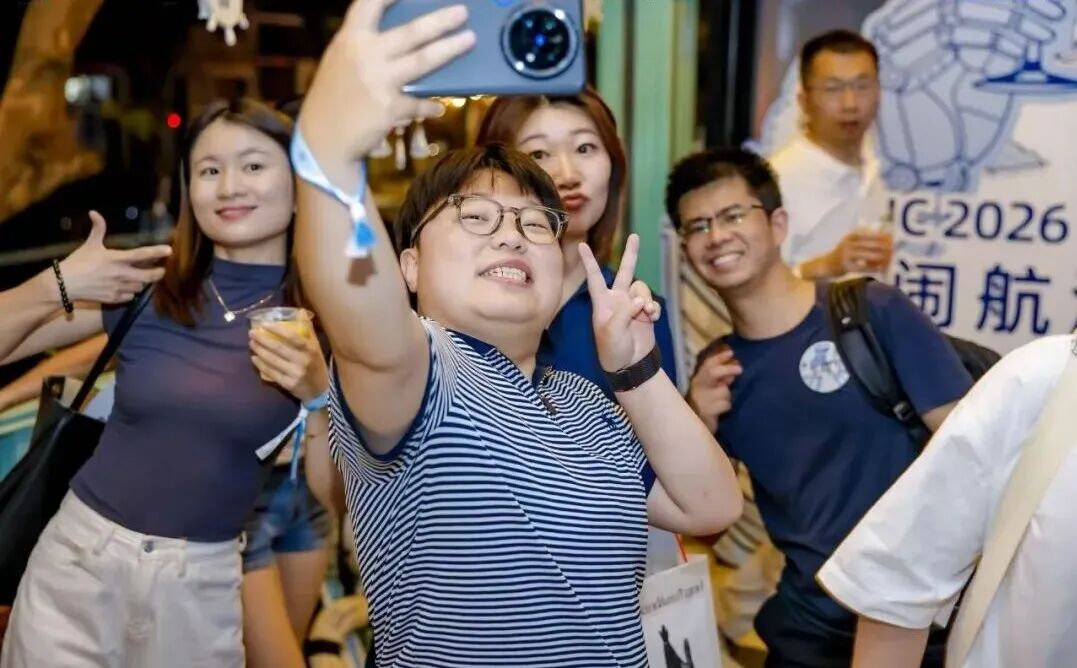
- 300+ hunter applications, 40+ Creator applications backstage — basically every AI founder in China descended on Shanghai. 100 made it through — the acceptance rate slightly gentler than a license plate lottery;
- 61% women, 39% men. 70 founders total, 20 of them women — putting to rest complaints that AI events don't show enough female founders;
- Youngest: an 18-year-old entrepreneur recommended by MiraclePlus. Oldest: a 56-year-old CTO. Over half were 30 or under;
- AI hardcore off the charts: 43% from AI / hard tech, with Galaxy Universal, Lovart, and Looki in attendance. But also sneaking in: lawyers, a Roland Berger consultant, and a music hardware oddball;
- Going global was the night's theme. North America the undisputed top destination, Europe and Southeast Asia trailing;
- Finally, thanks to WebEye and Google Cloud for their support. We recommend Google Cloud's "Google for Startups" program for early-stage companies. WebEye can help fast-track applications through the green channel, with up to $100,000 in first-year credits — great for post-seed companies. Scan below ⬇️⬇️

- Lastly, don't miss the video recap ⬇️⬇️
Join the Community