In-home lobster installation, waiting in line for lobster installation — that's way too janky. He built a desktop lobster that installs in 60 seconds | A conversation with Song Jian, founder of DeskClaw
The Shrimp Myth Lives On
1 minute | OpenClaw | Gateway-level | Extreme pivot | Non-zero-sum
Produced by | AI Nao

01.
OpenClaw spread like wildfire, sparking a "FOMO-driven startup wave" among China's developer community — from startup teams to cloud providers to model companies, nearly the entire industry began experimenting with products or infrastructure built around Claw.
For this edition of AI Practitioners, we selected Jian Song, founder of DeskClaw, and his startup as our case study. Over the past 14 days, they pulled off an extreme pivot.
Song decided to go all-in on OpenClaw just 48 hours after it launched. He judged it to be the "iPhone 4 moment" of the AI era — a gateway-level opportunity was certain to emerge.
The project kicked off on February 4; ten days later, DeskClaw (https://deskclaw.me/) shipped its first version.
Since then, through the Lunar New Year and beyond, Song and his colleagues have barely rested, iterating at near-daily velocity, burning through 150 million tokens per day — equivalent to roughly 10,000 lines of code per person daily.
The second reason we chose Song: DeskClaw has the lowest barrier to entry among this wave of Claw products. Visit the DeskClaw website, download and register, and within one minute, a little crab appears on your desktop.
It's also the most accessible "shrimp" for ordinary people.
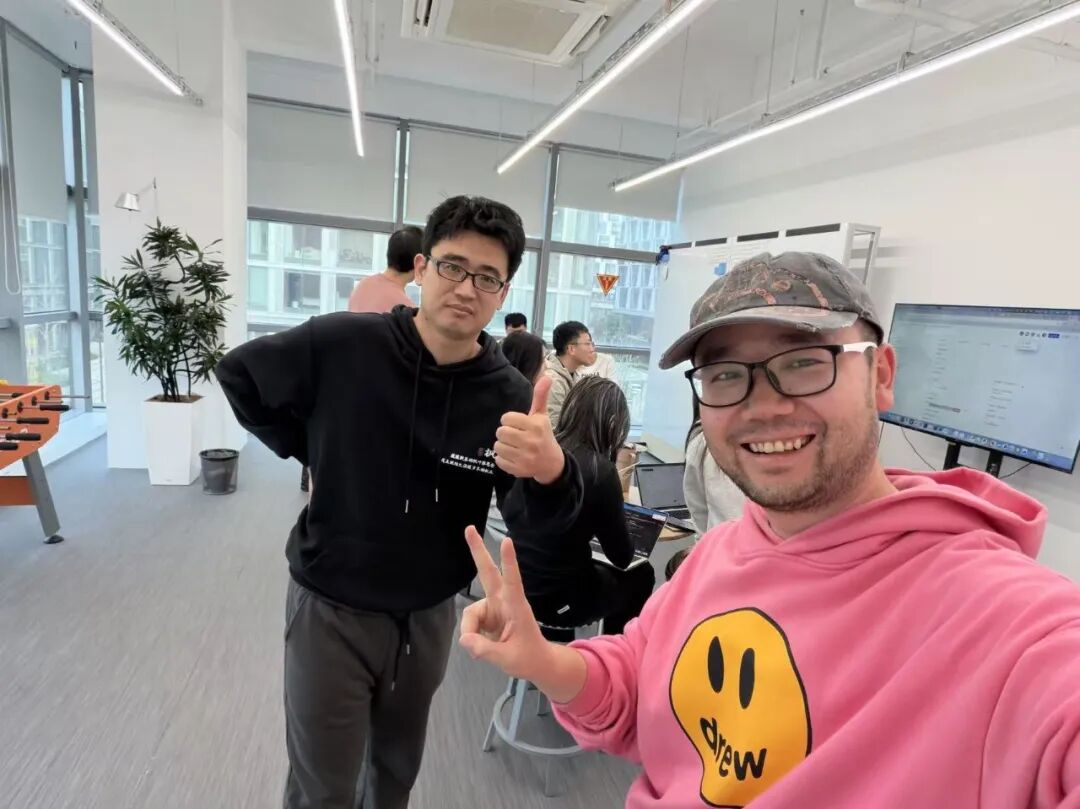
- Jian Song (in fan merch hoodie) and his team, nearly a month without rest
02.
Before DeskClaw, Song's startup focused on e-commerce industry agents. Team members came from Zhipu AI, Alibaba, Tencent, ByteDance and others, with solid experience in memory systems and post-training, plus practical know-how in embedding products into real workflows.
So DeskClaw isn't a simple wrapper. They rebuilt the underlying system in two weeks.
Most critical is the team's extraordinary execution — maintaining daily updates. A product AI Nao tested a week ago looks completely different from what's live now. Song says he sleeps at 4 a.m. and wakes at 8 a.m.; his biggest frustration is not having enough physical stamina.
Recently, they closed a financing round of nearly 100 million RMB, co-invested by Lakeside Partners, Monad Ventures, Gaotu Techedu, and Shunfu Capital.
Below is his conversation with AI Nao. Note: this interview concluded on March 9, 2026. In the OpenClaw space, where things shift almost daily, any judgments about product form, capability boundaries, or business models are not final answers.
Everything here is a阶段性 observation.
It captures a slice of time as a technology moves from the geek fringe toward mass adoption. The technology is changing fast; the judgments themselves are constantly being updated. What truly matters is the state of continuous practice amid that change.
- One-click Xiaohongshu workflow
1. DeskClaw is positioned as one-minute foolproof installation, giving every ordinary person their own shrimp.
I want to reach practitioners across industries — e-commerce operators, content creators, one-person companies. If the barrier is too high, mass distribution is impossible.
The OpenClaw architecture gives all entrepreneurs a new opportunity. If you can build a safer, more stable, more locally-permission-aware desktop product better suited for Chinese users, that's a gateway-level opportunity.
Over the past year, we were building e-commerce agents — vertical applications in real scenarios. We were constrained by platform rules and complex interaction chains, which limited what we could do. DeskClaw is different — OpenClaw solves local permissions, privacy security, and ultra-long-chain planning, enabling a leap from Chatbot to locally-native Agent. Previously AI could only handle "information and text"; now it can help users with more complex "tasks."
2. Entrepreneurs shouldn't get hung up on current technical immaturity. Scenario落地 definitely requires an exploration period.
We chose to first win individual users through extreme ease of use (instant-on, zero-barrier installation), get people using it, discover more scenarios. Once individuals taste the benefits, they'll naturally bring that capability into enterprise environments.
The final piece to solve is security. OpenClaw is open-source with numerous vulnerabilities. We need to build strong security and privacy fences — that's what we focus on fixing daily.
3. After installation, users see a little crab slowly crawling on their desktop. Each "little crab" can be given a "soul" — you can set its persona, its speaking style. It's not just a work tool; it has emotional companionship value, a bit like raising a digital pet.
Eventually you'll be able to change its skins — glasses, hats, different looks.
During an eight-hour workday, your "little crab" can shoulder five or six hours of your workload. With the extra time, you can摸鱼, take a break, play with your little crab.
And at night, if someone else can "rent" it to do tasks for them — earning money in our skills marketplace or task marketplace — it becomes your money-making tool.
4. We're not simply wrapping OpenClaw, because wrapping can't satisfy individual and enterprise demands for stability, security, and collaboration.
Building on compatibility with the open-source OpenClaw, we rebuilt the kernel in-house: streamlined code from OpenClaw's 500,000 lines to under 10,000, developed a self-serve cross-platform client requiring zero configuration, and added enterprise-grade capabilities including security guardrails and containerized management.
By redesigning the memory architecture and reinforcement learning system, we achieve faster intent understanding and more streamlined execution steps. Additionally, the product deeply integrates with Lark, DingTalk, and WeCom Work — something no simple wrapper could accomplish.
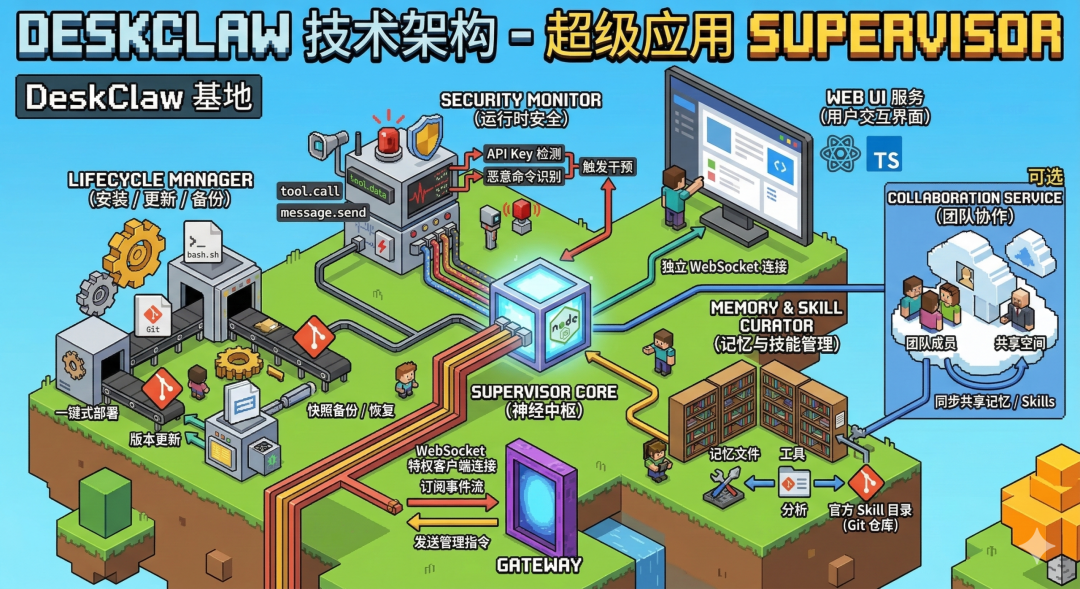
5. Let me emphasize security. For security's sake, we've made many "better safe than sorry" design choices.
The simplest example: many critical operations are built as "binary choices." For deleting files, executing certain dangerous commands — we make you confirm multiple times.
Sometimes users themselves don't fully realize what they're doing. If the Agent blindly follows instructions, it might go too far. So we've added many guardrails in the system — at critical nodes, it reminds you, blocks you, makes you think again.
Simply put, our principle is: making AI smarter is great, but more important is not letting it be "too impulsive."
For critical matters, humans still need to make the call.
6. DeskClaw's clearest current capability is direct deployment into real collaborative work environments.
For example, I've deployed numerous fixed AI tasks in Lark. Just for "morning news briefings," I have six different sources.
I've also deployed three role types: AI admin, AI designer, and AI PMO. You can actively invoke them, @ them directly to get specific things done.
In terms of task completion, I'd say it's already at the level of a specialist.
If you mention finding a certain document, it'll send it directly if it has permissions. If you mention polishing some text, it can give you a revised version directly.
In the latest version, DeskClaw scrapes trending topics, then generates copy scripts, shot lists, image assets, and automatically edits them into short videos, directly posting to your Xiaohongshu account.
Over the past half-month, over a dozen similar scenarios have already been solidified.
On March 7, we released and simultaneously open-sourced our enterprise version, hoping more companies can experience the efficiency gains when AI agents collaborate with humans in work scenarios.
7. Honestly, most users who try the product right now ask: what exactly can this do?
This feedback is normal, and it's what we're working to solve — we need to quickly accumulate more case studies.
My own judgment: in the next three to six months, this wave of hype will definitely cool noticeably, but real usage scenarios will emerge one by one. That's why we must do zero-barrier installation now, give away lots of tokens — because only with users can we explore more scenarios.
Many scenarios will become通用 skills上架 in our skills marketplace; some may require further improvements to the product's underlying architecture, model capabilities, and stability.
8. In my view, OpenClaw is absolutely the "iPhone 4 moment" of the AI era.
Over the past year, from DeepSeek to Manus, my feeling was: close but not quite. They're more like chatbots with brains but no hands. Cursor, Claude Code — powerful, can write code, but that's for programmers. The audience is still too narrow; ordinary people can't really wield them.
OpenClaw's opportunity lies in "democratization." It uses a new architecture to install AI's programming and execution capabilities onto local computers, giving AI real "hands and feet" for handling complex tasks.
9. The industry is getting intensely competitive.
As a startup, don't worry too much. Big tech has massive money and resources, but this isn't their "main battlefield."
Product forms leaning toward individual users, and the linkage between personal and enterprise editions — as a startup, there's still huge opportunity here.
10. Most important is returning to one thing: user value.
Who exactly is the product solving problems for? What are the user pain points? Is the demand scalable? Can the team translate technical capability into product capability?
If the demand is valid, plus a new opportunity window, it's entirely possible to birth a new赛道. Just as in the mobile internet era, companies like KE Holdings, Boss Zhipin emerged by opening up a new dimension outside existing systems.
Claw will bring similar opportunities. Rather than zero-sum competition, everyone is more like creating a new增量 market.
Think bigger, and lengthen the timeline. As for competition? Focus on doing your own thing well, and just keep running forward.
Image sources | Dreamina, interviewee
Join the community