9 Million People, the World's Largest AI Community and Its Underground Guru: An Exclusive Conversation with AJ of "Way to AGI"

She's not the one who writes the rules — she's the one who lights the spark.
By Songdao Tu | Produced by AI Nao
01
In the age of AI, some things are quietly becoming inexplicable.
For instance: 9 million people joined a community — with no capital backing, no traffic support, no tech giant endorsement. They came spontaneously, stayed, organized, and created. They're active in nearly 10 countries, spread across every major tech hub in the world. From tech geeks to entrepreneurs, from students to engineers, people are growing, colliding, and even redefining their identities within the same system.
This community is called WayToAGI (通往AGI之路). It sounds like a roadmap to artificial general intelligence, but in reality, it's something else entirely: a new kind of structure — a massive "organization" growing, expanding, and evolving organically on a global scale.
It's not a product, yet it has more spontaneous activity and stickiness than most products. Not a company, yet it possesses an absurdly efficient organizational and mobilizing force. It does no brand marketing, yet it's generating a new form of identity.
Here, people don't "join" — they belong. AI, within this community, is no longer technology or tool. It has become a collective language, a belief system, and a "new normal" for a new kind of human.
Who started all this?
Her name is AJ, founder of WayToAGI, the "underground guru" of the world's largest AI community. Anytime you see AJ, she's in workwear, with a pair of BOSE headphones around her neck that she never removes — like some kind of permanent interface, her second skin.

- In most settings, AJ presents herself with this avatar
02
From any angle, AJ doesn't look like the "leader" of a 9-million-person community.
She's never raised funding, never given an interview. Even six months ago, she was working as a product manager at an internet company in Hangzhou — normal, invisible.
But at some point, she inadvertently launched WayToAGI. From a shared knowledge base document, this tiny origin point kept growing — to today's 9 million users, monthly self-organized offline AI meetups in 37 cities at home and abroad, a "Global AI Conference" held in Tokyo, and a global network still without clear definition.
It's hard to describe AJ through standard identities.
She's not a typical KOL, not an entrepreneur. She seems to have simply provided a framework, and millions of users began filling it in autonomously. She initiates an activity, and people around the world spontaneously organize and execute it. What she pursues isn't traditional growth and scale, but igniting that spark in people — the "I can do something too" passion and impulse.
She's more the one who lights the fire than the one who makes the rules.
So the real question isn't what WayToAGI has done, but rather:
How could an organization expand so massively without a traditional growth plan?
How could it, without charter or management structure, mobilize and influence more efficiently than many companies?
How could AI + community become a universally recognized mechanism for generating new identities?
Why do people need a "WayToAGI" as their spiritual homeland?
Even AJ herself may not have the answers.
She's just doing — with one knowledge base after another, one meetup after another, like building with LEGO bricks, constructing a new playground that wasn't what she originally imagined.
Recently, AJ completed her first interview with AI Nao. Below is our conversation with her.
Interview with AJ
Part 01
From a Lark Survey
to 9 Million Users
AI Nao: How was WayToAGI born? I heard it started with you making a Lark survey.
AJ: It was probably late 2022, right when ChatGPT 3.5 came out. I tried it and got goosebumps all over. At the time, a group of us friends were planning to go skiing. I remember using GPT to write a little skiing legend for one friend, and it came out so good — it wove in all these very lifelike little details. Anyway, my feeling then was: this time, AI might really be different.
Other products from that period like Midjourney, DALL·E, Notion AI — I tried them all. A lot of the image generation results were still pretty rough, but ChatGPT gave me this overwhelming feeling that "general intelligence is almost here."
I went crazy trying new products, collecting information. Almost every day there were new AI products popping up. Many websites were just a waiting list to leave your email, yet they exploded with traffic off the word "AI" alone. The feeling was: everyone knew AI would change a lot of things, but no one knew exactly how it would land. These websites were like little prompts, igniting everyone's imagination.
I'm someone who really loves to share things enthusiastically, so as I was playing around, I started wanting to aggregate all this new, fun information and knowledge to share with more people.
I first made a knowledge base using Yuque, our company's internal platform, but Yuque wasn't convenient for external sharing. I tried Notion, but Notion didn't work smoothly in China, so I switched to Lark.
AI Nao: When did the Lark document go live?
AJ: April 26, 2023.
Actually, at first I didn't intend to build any community. It was purely the feeling that so much information should be shared with more people, rather than letting the market get ruined by a flood of people selling AI courses and accounts. I wanted to build a relatively clean, tech-oriented space for people who were genuinely interested.
Because of the accumulation from several earlier platforms, when the Lark document launched it already had a lot of what we'd made inside — hundreds of AI websites, tutorials, toolkits, various fun use cases, and so on.
I also added a survey inviting people to co-build together: "Let's make this knowledge base bigger together."
AI Nao: Did you do any promotion? The user numbers seemed to explode pretty fast.
AJ: Promotion was me posting one Moments update that day, and then a lot of friends in the internet circle reshared it.
Mainly I was just so genuinely enthusiastic about this thing itself. I'd meet a friend offline and excitedly invite them: do you want to join and play with us? And in less than two or three months, I remember we already had millions of visits.
AI Nao: Was there a moment when you first felt "this seems to be getting out of control"?
AJ: Pure data doesn't really faze me that much. When I worked at Tmall, I did marketing and membership systems, routinely facing massive traffic — Double 11 flash sales, servers crashing, all of that. But we were a spending department; the essence of traffic was you had to keep buying ads, making money generate better ROI.
But WayToAGI was different. Besides enthusiastically telling everyone about it, I did zero promotion for this document. How did so many people find it? More amazing was that the people flooding in weren't here to grab freebies, nor to make money. A huge number of people were genuinely contributing content spontaneously, sharing their own AI research.
Doing these things had nothing to do with any utilitarian purpose — completely out of interest and passion. Those two points combined, I found pretty stunning.
AI Nao: What do you think drives this spontaneous motivation to participate and contribute?
AJ: I think the core is that everyone in this wave genuinely feels this massive excitement, that "I caught a glimpse of the future" feeling. This excitement wasn't mine alone — it was thousands, tens of thousands of people feeling it simultaneously. Everyone really wanted to know how others were using AI, and really wanted to share what they'd discovered with others.
At the same time, AI was so new that everyone was starting from zero. So you didn't feel like "only experts deserve to share" — instead you felt like "this thing I just figured out, maybe someone else is stuck on it too." A primitive but very sincere desire for knowledge exchange.
For example, Li Jigang started by sharing prompts he'd written himself in the group. Immediately a lot of people took them to test, and after testing everyone went "wow this prompt is really amazing" — which encouraged him to share more and more prompts.
This created a very natural influence path: the more you shared, the more recognized you became, and the more you connected with like-minded people. Later we also collected his prompts into a document library.
AI Nao: From sharing to co-building.
AJ: Right, co-building. Co-builder is the highest honor in our community.
Another example: ComfyUI, a graphical AI tool built by the community. They could have totally sold it or made it closed-source, but they chose open source — partly because it really does iterate faster that way, but partly I think a lot of people genuinely want to participate in that thing of "building the future world together with LEGO bricks." Including open source teams like dify, and later teams that spun out from the community to start their own companies — many weren't initially driven by monetization or commercialization, but genuinely found this interesting and worthwhile.
We joked back then that our community really had too many people "generating electricity for love," but this "love" was passion.
AI Nao: With your increasingly large content base, monetization would be very easy. Was that really not tempting?
AJ: A lot of people told me, why don't you lock this content down, build private traffic, make courses. The monetization path is clear — even if you sold a document for 9.9 or 19.9 yuan, you'd easily make several million a year.
But I felt since this community started as open source, I wanted to stick with that to the end, always encouraging everyone to learn for free.
If I took it for personal profit, the original intention would change.
AI Nao: That's what you thought, but how do you ensure others in the community maintain the same mindset?
AJ: This is indeed something I particularly care about.
So we specifically wrote a rule: content produced within the community can be referenced, but cannot be copied wholesale for monetization. We encourage you to internalize the knowledge, transform it into your own experience and methods, then go teach or profit from that — no problem.
I actually really hope this community can produce a batch of people who make money through AI, on the premise that they do so through their own capabilities, not by directly copy-pasting others' labor.
There have been incidents. Someone we didn't even know packaged knowledge base content and sold courses outside, claiming "systematic summary" and "exclusive across the entire web." The whole community mobilized — everyone reported him across platforms, and in the end they really "took him down," haha.
That moment I was especially moved, because you realize the community had already formed a kind of natural cultural protective shield. There's a shared understanding: this place is worth guarding together.
AI Nao: From your perspective as a product manager, what do you think WayToAGI did right in "product design" to become so popular so quickly?
AJ: I think the reason it's loved is first because the content quality is genuinely high.
Many co-builders in our community feel embarrassed to submit because they worry their content "might be too ordinary." Every time they share, they very carefully deconstruct and polish, afraid their output won't be worthy of the community. So what's amazing is, we never used monetary incentives for output, but an atmosphere of wanting to win each other's recognition pulled content quality very high.
Then I think this community could grow because it naturally has this altruism-driven product mindset. Before sharing content, many people first ask "is this a problem a lot of people are stuck on right now?" "Is there a lighter solution, a faster path?" They're not completing a task, but acting from a sincere desire to help others avoid detours.
This is actually the purest product thinking. Like Wang Yangming said: aim to benefit others, not oneself. I think in our community, many people happen to have this "aim": not driven by fame or profit, but because they feel "I just figured out a bit of the path, and want to quickly tell others."
This wish sounds simple, but it's precisely what transformed an ordinary content community into a place where people light each other up. It's also why, though we seem to have no management and no incentives, we can evolve like an intelligent living organism, developing many things.
Part 02
Going to Tokyo to Host a Global AI Conference
"Why You?"
"Then Who Else?"
AI Nao: How did you come up with the name "WayToAGI"? Did you ever feel it was too grandiose or too chuunibyou?
AJ: It is a bit chuunibyou. I was probably in an extremely亢奋 state at the time — every day new AI models, tools, and玩法 were emerging, and it felt like tomorrow we'd see the future.
AI Nao: What's your attitude toward AGI actually being realized?
AJ: I'm a super accelerationist (note: Accelerationism is a radical branch of AI thought that advocates pushing AI technology development at maximum speed, including actively accelerating social transformation to bring about the technological singularity). Since we believe the endpoint is AGI, we might as well put it in the name, telling everyone we're walking the furthest path.
AI Nao: You said you're someone who really likes fresh stimulation. How is the excitement AI brings different from stimulation you've experienced before?
AJ: I'm ENFP, I especially love new things, but I easily lose interest after three minutes. Like when Uber first entered China, I immediately registered as a driver, picking up passengers every day after work — I thought it was so fun.
And I really love skiing, those moments of overcoming fear on high mountains or hitting jumps in the park — I'd think wow, I can actually do this. I constantly need these endless dopamine hits.
But the stimulation AI brings is on a completely different magnitude. It's not about personally unlocking a new skill, but letting you see a new world generating every day.
AI Nao: The feeling of history pushing you from behind.
AJ: Yes yes, exactly that. And it's not just you standing at the "frontier of the era" — there are thousands, tens of thousands of people charging forward with you.
AI Nao: Last month you held the "Global AI Conference" in Japan. Why Tokyo?
AJ: I just thought doing this in Tokyo would be really cool, right? Because I'm a P-type [perceiver], sometimes I really don't do things with much planning or goals.
Of course it wasn't completely off the cuff. Last November we held a CCS in Tokyo, a ComfyUI community event focused on the visual vertical. Junjie Yan from MiniMax came, among others. That accumulated a little bit of resources.
Mainly we felt AI exchanges shouldn't be limited to domestic circles. Everyone normally interacts with foreign developers and KOLs on X and YouTube, so we wanted to find somewhere relatively convenient — where foreigners wouldn't need visas, and that wouldn't feel too official. Tokyo fit well.
AI Nao: As a self-organized group, how difficult was it to hold an event across borders?
AJ: Definitely difficult. Mainly we had only one month from formally deciding to do this to the event opening.
The venue came through a friend's connection. Before, in Japan we felt it was nearly impossible to find a large venue — 200 people would be the max. Just as we were headache-ing over this, a friend introduced us to J. F. Oberlin University. It's a newly built campus right in Shinjuku, with a venue that could hold over 1,000 people — absolutely amazing for us. And we didn't hire an event company; all the work was done by community volunteers ourselves. Every day we'd walk through Kabukicho to "go to work."
Sponsorship was pulled together in three weeks. At one point we were mentally prepared to pay out of pocket if we couldn't get sponsors.
AI Nao: How did you convince brands to sponsor something you'd never done before?
AJ: Purely by belief and passion, really.
We encountered people asking "this is great but why are you the ones doing it?" or "can you actually pull this off?" I later反问 them: then who else?
We truly hadn't done AI conferences before, let alone overseas. But those days really felt like a massive energy field suddenly appeared. So many volunteers came — our community partners, many from big tech or other companies, all taking vacation at their own expense to fly to Japan and voluntarily help organize. Inviting guests, setting up during the day, discussing content and流程 at night — everyone said what's going on, the passion for doing this is way higher than for our day jobs.
Then the conference started, and all kinds of major Japanese enterprises, many car companies, startups, all came — including SoftBank. 1,000 registered, 1,500 showed up. NHK even came with cameras to interview.
Later we also debriefed: why would people come to such a makeshift operation? The answer is scarcity — [in Japan] there was simply no one else doing this. And the on-site exchange atmosphere was genuinely excellent; many sessions had so many people they couldn't fit.
AI Nao: Is Japan's AI ecosystem thriving?
AJ: Honestly speaking, domestic companies are completely降维打击 for them. Many Japanese AI startups are still in very superficial wrapper states. Their biggest advantage is that they're Japanese companies, so they can get B2B relationships and secure funding.
After this conference, we also had the thought: since our community has gathered so many good projects and resources, why not反过来 help some good domestic projects expand to Japan? We also joked that we could help everyone "wash" into Japanese companies and find local PMF.
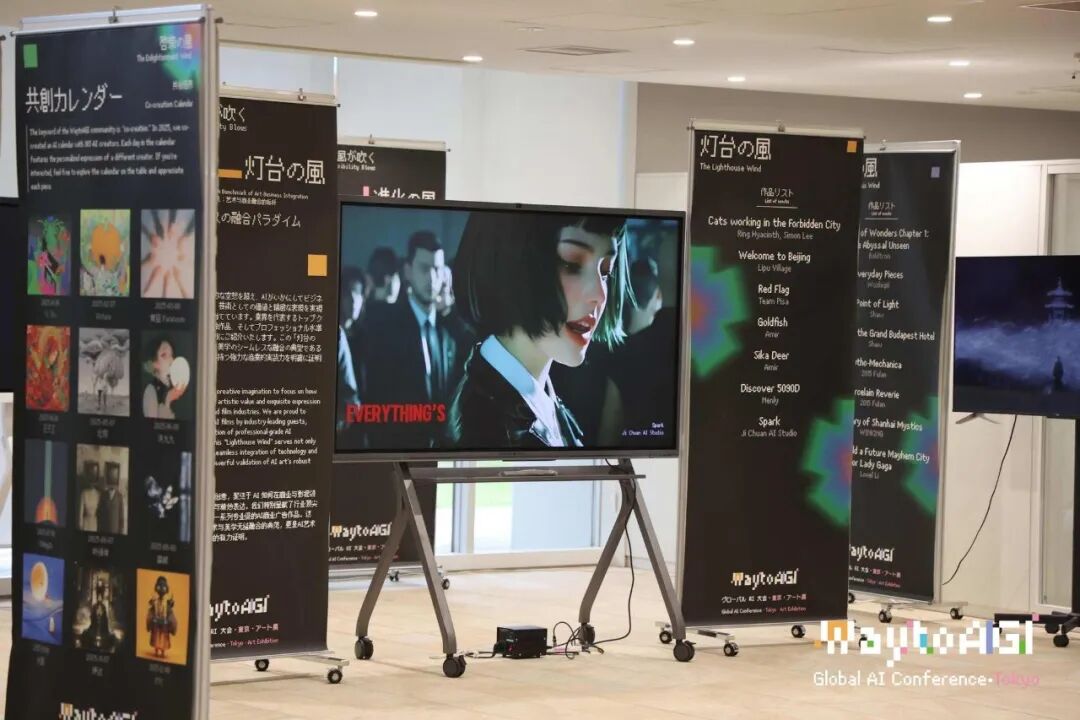
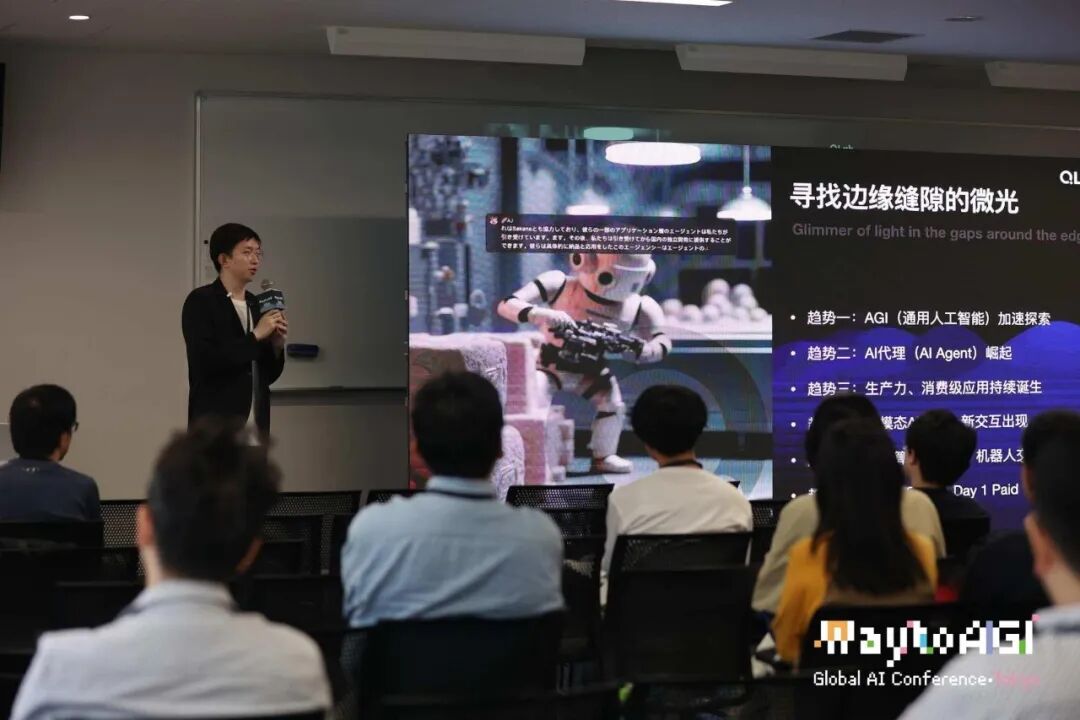
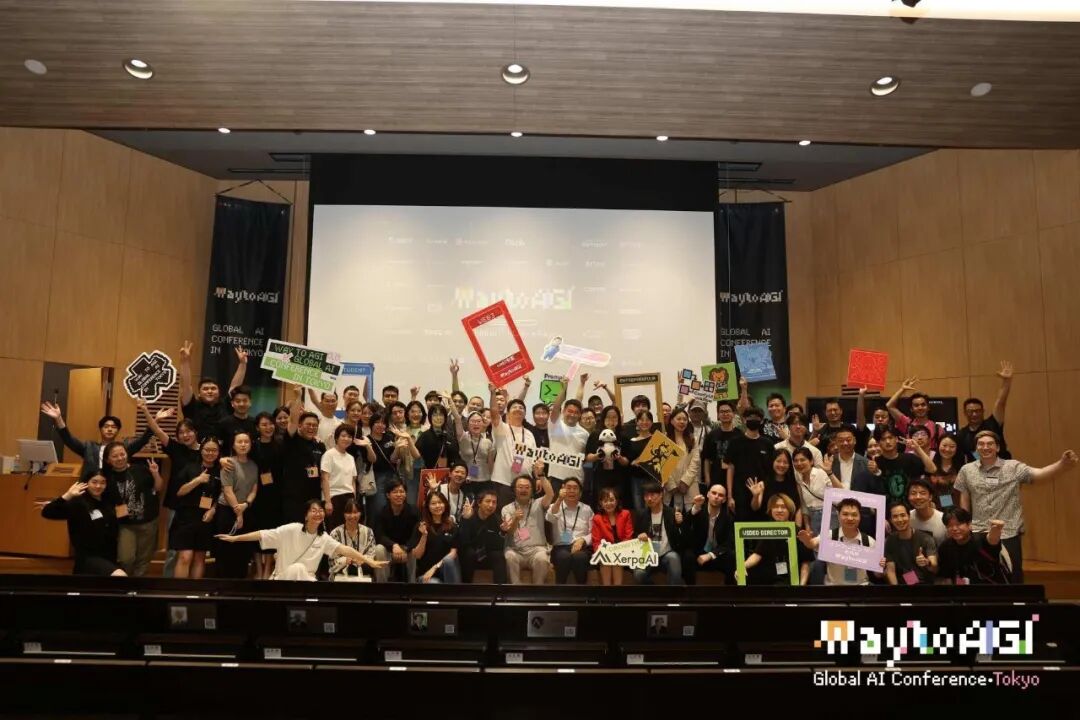
- Tokyo, Global AI Conference site. And a post-event group photo of WayToAGI community volunteers.
Part 03
Doing the Same Thing with Strangers
in 37 Different Cities Worldwide
AI Nao: Your monthly AI meetups reportedly happened simultaneously in 37 cities at home and abroad last month. How did this evolve into its current distributed form?
AJ: This is indeed quite奇妙 — no one expected it to grow into what it is now.
Early on we held a hackathon in Dali, and many people traveled from elsewhere to attend. We realized the offline exchange demand in AI circles was really strong. I even said at the time we should make this into something called AI+X World Tour, covering 10 countries and 100 cities. That was completely off the cuff.
Then later we held one in Hangzhou that really surprised me. We delayed until only one week before opening registration, yet it still exploded — so many people wanted to fly in from all over the country.
I thought: why not have everyone host in their own cities? Lower costs, more sustainable. So at the end of March 2024, we first tried a five-city联动.
AI Nao: Which five cities did you choose?
AJ: Beijing, Shanghai, Guangzhou, Shenzhen, Hangzhou.
The reason was especially simple: at the time, every event required a lot of effort to find a venue, so we asked ByteDance friends to borrow their meeting rooms. These five cities were all the places ByteDance had offices in China, haha.
AI Nao: Now it's grown to over 30 cities hosting simultaneously — who leads the organization?
AJ: We set one time: the last Sunday afternoon of every month. Everything else is completely free. If a city has an enthusiastic and capable community partner, they can apply to be the convener themselves.
Each time we start with everyone joining a video call — 30-plus cities across the world saying hello first. Then it's offline exchanges. Besides the convener, each city also has volunteers who coordinate together, including inviting guests, securing venues, organizing the流程.
AI Nao: Which cities surprised you most?
AJ: Most不可思议, Korla?
AI Nao: Korla in Xinjiang? There are AI practitioners there?
AJ: It's honestly a place I completely didn't expect either.
Korla's convener had previously come to Hangzhou to attend an offline event. After attending, he said: I want to bring this energy back home. He felt the passion he saw in Hangzhou, all these interesting things and possibilities, and wanted to pull his hometown friends into experiencing it too. So we had a Korla branch, and he gathered many people to attend.
I think this is where the charm of AI lies. It doesn't care what your previous job was, whether you have a硬核 resume — as long as you're interested enough and motivated enough, you can play.
There's a friend in Kunming we call Second Senior Brother. He previously worked in construction engineering. After playing in the community for a while, he started AI coding himself — coding very proficiently. Through this he got a lot of positive feedback he never had before.
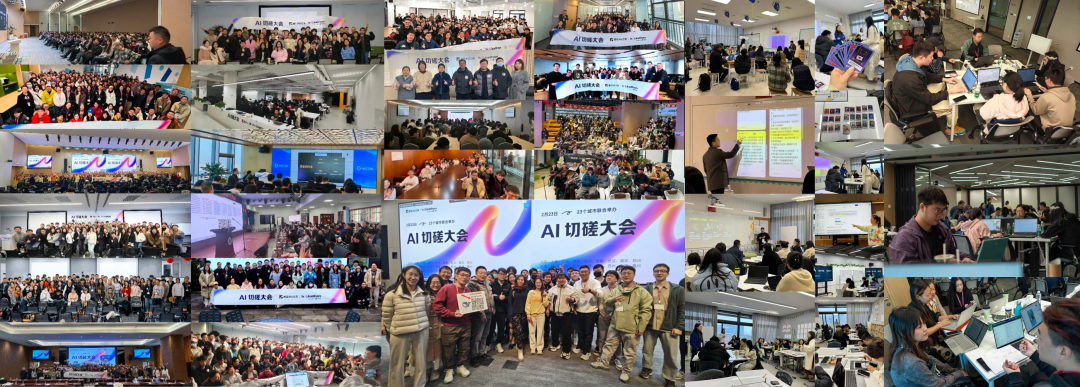
- Monthly AI meetups and global branch connection site
AI Nao: Has anyone changed their lifestyle because of joining WayToAGI, like living an "unemployed" life?
AJ: Do I count? Haha, I resigned at the beginning of this year.
After resigning, I first went skiing in Altay for two months — skiing during the day, organizing online livestreams for the community at night. It was New Year then; couldn't miss that DeepSeek traffic wave.
Actually I'm a bit embarrassed talking about this — I feel like we've captured more and more people to become street wanderers with us. Yes, that's what we call ourselves now. Before this AI wave, everyone was working at big tech, and you couldn't imagine what other lifestyles existed. But actually many people are internally active and hands-on; even without work they'd never do nothing. The emergence of this AI technology, I think, has fueled more and more people's天马行空 ideas, and faster落地.
This morning at 6am, a friend who also used to be at a big tech company came to my house and told me "AJ, I resigned too." He said he's living a more fulfilling and freer life than when he was employed. He previously couldn't code at all; now using AI coding tools he's already built nearly 10 websites, participating in hackathons everywhere, some winning first place and immediately getting $5,000 prizes.
Of course he was already capable — this capability was previously trapped in his ox-horse career. Now he feels so happy; you might quickly discover a website doesn't work after launching, or you might quickly get positive feedback.
AI Nao: Do you have an organizational structure now — like who does what, what decision-making流程 — or still none?
AJ: I especially don't want the community to grow into something "company"-like. People join the community because it's freer, more suitable for creation, where anything can happen.
Of course in actual operation, someone does need to handle massive amounts of granular delivery. Fortunately we now have several full-time community staff who are very professional, very reliable in delivery, and solid at pushing流程 forward. But we still try to avoid establishing formal systems.
AI Nao: Not long ago at the Lark conference you announced the "Super Creator Plan," intending to build an AI-native talent platform. Currently there are more than a few semi-professional social AI products on the market. What's different about the Super Creator Plan?
AJ: Many AI products are doing social, but most start from tools and try to attach a social layer. We're different — we naturally start from people, because the community itself is composed of people. We and our users are already friends who know each other, are familiar with each other — we not only know who they are, but even clearly know where they are on their growth journey and what they're still missing.
So we don't just want to make a simple social space, nor just a new tool. The "Super Creator Plan" will be a community with knowledge base and growth attributes. We hope to help more people in the community be seen by more people, be found by people who truly need them, so everyone can walk into the real AI wave and become part of it — including getting tangible feedback and收益.
AI Nao: If this community has a spiritual core, what do you think it is? Is it some kind of "faith" or consensus that "the future world will become different because of AI," or some micro-tacit understanding of "because of AI we want to live differently"?
AJ: I think this core isn't a particularly明确信条, more like a collective scent. I'm an adventurist; probably many partners in the community have this side too — everyone is somewhat dissatisfied with existing life rhythms, and wants to personally try making a new world. It's that impulse of "we're not sure what tomorrow will become, but we definitely want to try making it different."
In the AI era, I feel everyone has the opportunity to become a new creator, a new creator. Everyone is like on a map that just opened — maybe with a little fear, but more excitement and anticipation. Then trying while drawing boundaries.
AI is like a ship that suddenly appeared; no one knows where it will ultimately sail. But you don't want to just stand on shore watching. We're the batch of people who've already jumped on — learning while building, building while playing.
AI Nao: Has there been a moment when you felt WayToAGI is alive? Like an animal, running on its own.
AJ: Yes, I think it's a fawn.
AI Nao: If one day WayToAGI stops moving, what would it be because of?
AJ: It probably wouldn't stop moving, right? There's always a way to move. I'll find ways to take everyone to play around the world.
Image sources | Provided by interviewee, Unsplash