First-Round Backing from Allen Zhu and Hillhouse: How a Post-'95 ByteDance Alum Wants to Build the World's First Vibe Workflow | A Conversation with Refly.AI's Wei Huang

Between Agent and workflow, Vibe Workflow is carving out a new path.


By Songdao Tu | Produced by AI Nao
Intro
Refly.AI, an AI workflow platform for non-technical users founded by former ByteDance Lark employee Huang Wei (Tom), announced today that it has raised several million dollars in seed funding from GSR Ventures, Hillhouse, and ClassIn. At the same time, Refly.AI version 1.0 has officially launched and entered an invite-only public beta.
In the pre-AI era, Office democratized document, spreadsheet, and presentation creation from professionals to ordinary people, becoming the greatest office software suite.
In the AI era, workplace scenarios have become a key battleground for various Agents. A common scene in 2025: users describe an ideal presentation or proposal in an input box, wait minutes for AI delivery, and are often disappointed — the first draft impresses, but subsequent revisions prove difficult to collaborate on.
Huang Wei, born in 1996, is a practitioner along this evolutionary path. Before founding Refly.AI, he led the Aily intelligent partner creation platform at ByteDance's Lark team and was deeply involved in the algorithm engineering and product design of the Coze platform, experiencing the full exploration cycle from low-code to AI workflows.
Refly.AI defines its core product as "Vibe Workflow" — a no-code intelligent workflow platform built through natural language description, designed to let non-technical users create stable, controllable automated processes. Traditional workflow tools (like n8n) rely on complex configuration, while mainstream Agents lack process transparency. Refly.AI attempts to establish a more accessible, more controllable solution between these two extremes.
Huang told AI Nao that he hopes to define a new category. While everyone is talking about Agents, Refly proposes Vibe Workflow, "meaning ordinary users can build actually runnable workflows in a minute just by talking."
This positioning earned Refly.AI investment from Hillhouse and GSR Ventures at the seed stage. Its goal is not to pursue极致 model capabilities, but to work within current technical boundaries, combining "human work logic" with "AI execution capability" to build a distributable, tradable, iterable system.
Refly's product core is encapsulating expert experience and processes into reusable modules. On the Refly platform, each workflow is a distributable, executable digital unit, with the ultimate goal of achieving standardized, scaled circulation of collective experience.
When this funding round closed, we spoke with Huang Wei about why he believes Vibe Workflow is the key form of next-generation AI productivity.
1. When customers buy tools, they're buying the advanced working methods encapsulated behind them. Excellent processes themselves are products worth paying for.
2. We use natural language description, letting the system decompose and plan, generating a stable, controllable automated process.
3. Vibe Workflow is about letting ordinary people with zero technical background easily encapsulate and reuse their own or others' work experience.
4. Refly's Workflow is a natural reinforcement learning environment. When users debug, they're producing high-quality "chain-of-thought" data.
5. Workflow is simply a more efficient distribution format than Chat. Its business model revolves around converting token consumption into value.
6. One person builds something, another pays for their experience — that's only natural.
7. The best state for an organization is knowing clearly what you need to do, without feeling rushed, consistently staying slightly ahead of the market.
8. We build a system where experience is encapsulated, traded, and those who contribute intelligence receive returns.
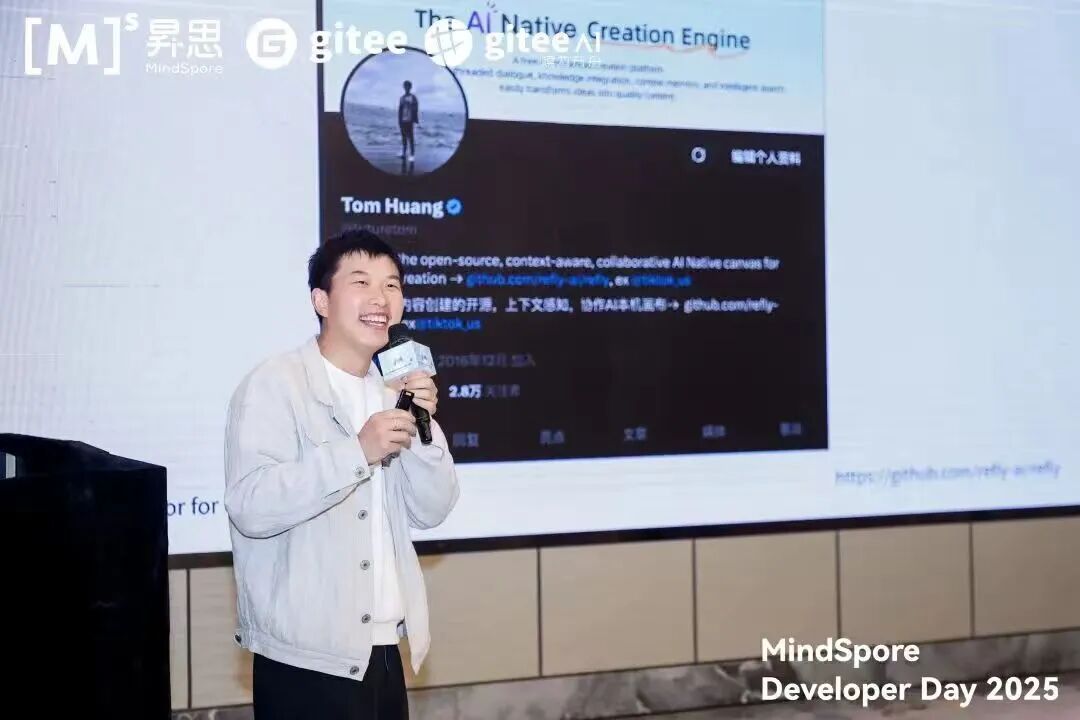
- Huang Wei speaking at an event
Conversation with Huang Wei
Part 01
Vibe Workflow: The "Middle State" Between Agent Magic and Workflow Code
AI Nao: Congratulations on completing your first funding round. Please introduce Refly.AI and yourself.
Huang Wei: Hello everyone, I'm Huang Wei, founder of Refly.AI. Before founding Refly, I was on ByteDance's Lark team, experiencing the full exploration from low-code to AI workflow platforms. This experience made one thing clear to me: when customers buy tools, they're buying the advanced working methods encapsulated behind them. Excellent processes themselves are products worth paying for.
Based on this understanding, we built Refly. What is it? In one sentence: a tool that lets you "just talk" to build AI automated processes.
AI Nao: Refly.AI positions Vibe Workflow as its core — how is this fundamentally different from conventional agents? They both sound like tools where you talk and work gets done.
Huang Wei: Right, we call it Vibe Workflow, and it's fundamentally different from current Agents.
Mainstream Agent products today are essentially black boxes: you input a sentence, it gives you a result directly. This process is uncontrollable, unadjustable, unstable in output, and expensive. Like one-time magic — impressive, but unreliable.
Traditional automation tools (like n8n) represent the other extreme: extremely controllable and stable, but requiring you to be an expert. You need to understand business logic, even write code to configure — ordinary people simply can't get started.
Refly's Vibe Workflow aims to find a pragmatic new path between "magic" and "code." Its core: you describe a task in natural language (Vibe), the system automatically decomposes and plans it, generating a stable, transparent, visual process串联 by multiple small AI modules (what we call node Agents).
This way, you get both AI intelligence and traditional automation's controllability. We keep the complexity, users get the simplicity. The goal is letting ordinary people with zero technical background easily encapsulate and reuse their own or others' work experience.
AI Nao: So Vibe Workflow is how you define yourselves — a hybrid or next-generation of existing forms?
Huang Wei: You could say that. We're not trying to颠覆 anyone, but combining the best of both — Agent's dynamic intelligence and Workflow's stable architecture — into a product that actually solves real problems and anyone can use.
AI Nao: The vision of encapsulating advanced working methods into sellable Workflows is compelling. From this idea to today's product, how did you explore and ultimately land on Refly's current form?
Huang Wei: This was indeed a process of continuous trial and error and convergence.
Early this year when we built Refly's first version, it was like a more beginner-friendly process tool. After launch, we felt strong user enthusiasm, but incoming demands were wildly varied. Users would compare us to Airtable, Notion, and pure whiteboard products like Hyperbase, asking us to add whiteboard capabilities, grouping, notes.
This led us to absorb demands too quickly, delivering without structure. In these months of尝试, we discovered a problem: once product complexity rises, your user scenarios and user base shrink. Even adding one button loses you a few percentage points of users — this inevitably happens.
After securing funding, we made a key shift: from an infinitely free canvas to a constrained free canvas. Specifically, we limited workflow nodes to between 10 and 15, ensuring it could串联 to solve one specific, complete problem.
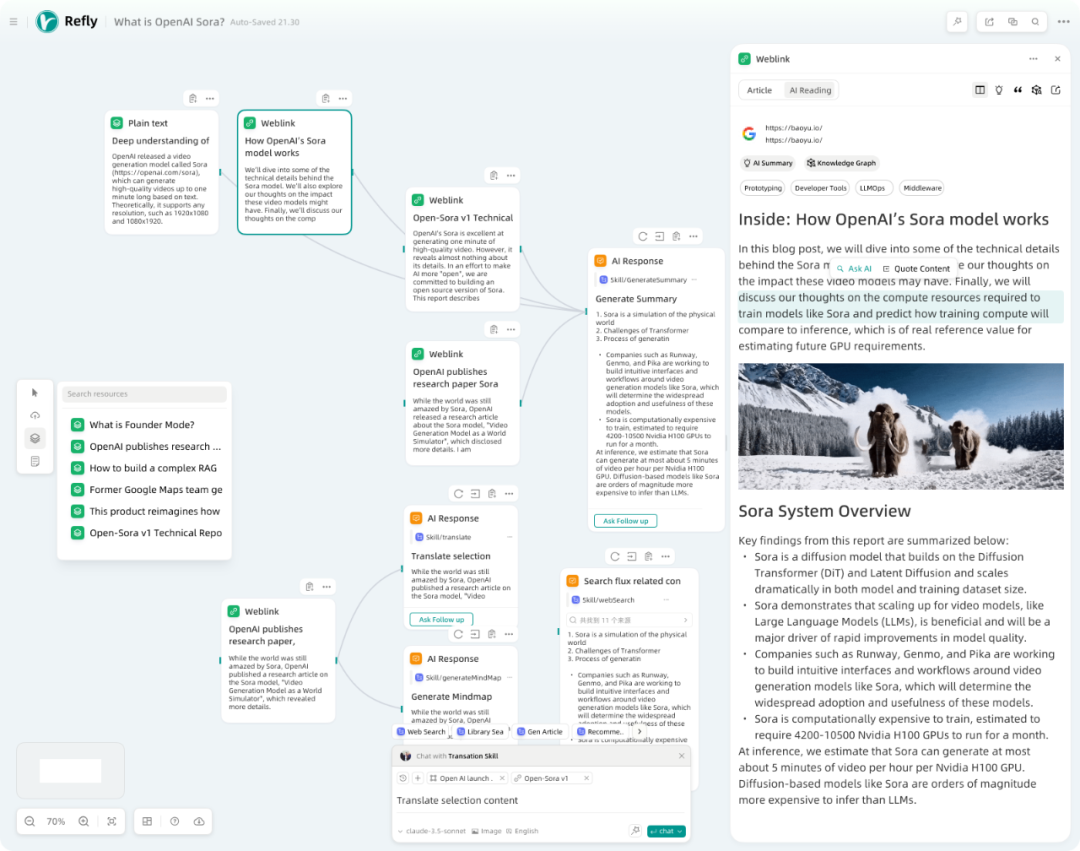
- Refly.AI early prototype
AI Nao: What changes did this convergence bring?
Huang Wei: Tremendous benefits. By limiting task complexity, we could more precisely inject AI capabilities. Our product evolved from 2.0 to 3.0 — making every node in the process an Agent. This completely solved traditional automation's biggest pain point: requiring users to understand both business and code to handle complex parameter-passing logic.
Later we removed all traditional programming concepts — if/else, loops, all gone. Refly is now a white-box modeling product for Agents. Processes built on Refly are naturally distributable units. They carry individual users' personalized experience and knowledge, ready to be encapsulated and sold.
Part 02
From "Workflow" to "New Currency"
AI Nao: Refly uses Vibe Workflow to create an encapsulable, distributable digital unit. What do you see as the long-term moat of this model?
Huang Wei: I believe this directly relates to the core competition in the second half of AI applications: the data flywheel.
Most AI products today lack a true data flywheel, because ordinary users' single-turn指令 inputs are rarely high-quality enough to effectively improve top-tier large model training.
Refly's Vibe Workflow is essentially a natural reinforcement learning environment. When users complete tasks through description, dragging, and debugging, they're actually producing extremely valuable, high-quality "chain-of-thought" data for us. It's equivalent to users unknowingly annotating "the optimal path to complete this task" for the system.
In this structured, visualized interaction between humans and AI, jointly producing high-quality solution path data — this itself constitutes a powerful data flywheel effect. Our algorithm team is designing this system. In the future, the system will become increasingly intelligent at generating Workflows through AI. This is the long-term moat we value.
AI Nao: The Vibe Workflow model enables collaboration and encapsulation, but free canvas usage门槛 is certainly higher than Chatbot. How does Refly address onboarding and operational efficiency?
Huang Wei: You're absolutely right.
Chatbot's linear form is efficient because decades of user habits support it. But Workflow and free canvas have higher efficiency ceilings.
So our current thinking is how to add Copilot to the free canvas, solving user onboarding guidance.
This Copilot will connect to the user's full journey from opening the product to completing their first workflow, running their first workflow, even publishing it as a template. All these guided flows, we hope to let users complete through Chat, this efficient medium.
We're not building a whiteboard or process for its own sake, but to find the highest-efficiency interaction method in the AI era.
AI Nao: You mentioned Token earlier, quantifying the entire process's value. Is there a user case that impressed you, proving Refly's "encapsulated experience" model is already helping super-individuals achieve commercial变现?
Huang Wei: Recently an interesting case. We have an Agency professional with a small studio in London. Using our multimodal, knowledge base, and process capabilities, he built a complete workflow for producing children's educational content. After publishing this as an independently runnable "App," he's already selling to target customers and making money.
A core shift here: previously he might pay to use tools like Manus to improve his own efficiency; but coming to Refly, he沉淀 his own experience, encapsulated it as a product, and directly sells his experience.
This is our PMF validation standard: in the AI era, paying for results and better distribution efficiency means encapsulating your experience into a tradable process. This proves our super-individual service business model works.
Part 03
I Watched The Social Network 100 Times
AI Nao: Getting Hillhouse and Allen Zhu's investment in your first round — what will Refly use this money for?
Huang Wei: Before funding, the entire Refly team was just two people — me and my college classmate Chen Zhe, whom I've known for over 10 years. Our market understanding at the time was 3 to 6 months ahead of the market, I was confident in that. But our organizational capacity couldn't support delivering the product to market, completing the growth and commercialization loop within 3 to 6 months.
So this money's core purpose is expanding and matching our organizational capacity. Everything we're doing now is one validation: given our market-leading understanding, can our organizational capacity keep up and complete product development, commercialization, and growth validation within 3 to 6 months.
AI Nao: Expanding from two people to current scale, what's the biggest challenge in hiring and management?
Huang Wei: The biggest challenge is returning from fantasy to pragmatism. Initially we wanted all-around talent, later found that unrealistic. We quickly adjusted criteria: bounded capabilities, complementary to the team, accountable for clear goals.
In process, we insist on "CEO first interview." All candidates' first round is conducted directly by me — this gives maximum respect while most directly communicating company vision, filtering for认知同频 people.
Interview strategy: first half strictly assesses capabilities, second half clearly paints the future. If I think a candidate fits, I'll clearly explain at the end: who we are, what we're doing, how much potential the future holds. Finally, I ask "what score would you give this interview?" This shifts them from evaluated to evaluator, completing a mindset transformation.
Once matched, we complete all interviews intensively within one day, deciding quickly. An efficient, respectful hiring experience itself is our first名片 for attracting talent.
AI Nao: How do you help new members quickly understand and believe your "half-step ahead of market"认知?
Huang Wei: This relates to how our organization operates. We don't actually manage teams through traditional rules — no attendance, no clock-in, no restricted hours. What drives us? We set a clear goal.
Under this goal, we synchronize all information with everyone. I hope people we hire will spontaneously coordinate with those around them, knowing what they should do. We have daily standups, but simple: each person says where they are, what resources they're missing, how to complete, what problems encountered, how to help each other.
Because everyone speaks, some do better, some slightly worse, creating peer competition. People collaborate, see others doing better, wonder if they should catch up. The team completes goals in a very chaotic, organic way.
So our management radius is very large; however many people join, they can quickly integrate, letting the team grow organically. Newcomers don't listen to us preach, but are immediately immersed in this "collaborating toward goals" real environment, seeing with their own eyes how our认知 becomes product, how results are achieved. They'll feel the rhythm and effectiveness themselves — more effective than any灌输.
I believe an organization's best state might actually be relatively从容 — you clearly know what to do, without feeling rushed, thinking things through, gaining from each action, ultimately ensuring you're slightly ahead of the market. This sustained, stable state may be most effective.
AI Nao: Your entrepreneurial path and product choices are ahead of the curve, but also a harder road. Where does your courage and motivation come from?
Huang Wei: I think it depends on the combination of many factors: your past experience,认知, thinking, and capabilities, plus whether this era's opportunities match.
Why do I believe we have more leading认知? Because I previously experienced the complete exploration of low-code, workflow, and all aspects of AI at ByteDance. For all key details and potential bottlenecks in this domain, I'm someone with clear and complete认知.
When the AI wave first arrived, ByteDance internally had a背水一战 urgency. My team of over a hundred people was pulled to Hangzhou for封闭开发, aiming to build an AI platform from 0 to 1 in extremely short time — somewhat like today's Coze predecessor. That state was very chaotic, but I discovered that precisely under that pressure and chaos, I seemed more激发 a beast-like intuition, establishing order from disorder and experiencing the excitement of it.
Later we ultimately took one month to push a product from "don't know what to build" to the Lark launch event. Having experienced that high-intensity creation and personally achieving key results, I could seemingly never be satisfied with conventional business again.
This experience made it clear: I want to leave, I will start a company.
AI Nao: All experiences were preparing for Refly's entrepreneurship.
Huang Wei: (Laughs) Right, like I watched The Social Network close to 100 times.
AI Nao: 100 times — were you studying Zuckerberg the entrepreneur?
Huang Wei: Studying all details of entrepreneurship. Also studying his every decision, imagining what I'd do in his place — this became almost a mental exercise for me.
How did he complete products? Build teams? Execute beyond ordinary people to get things done? Now much of my thinking and decision-making feels like it resonates with key moments in the film.
Actually earlier, I remember in high school — after reading The Silicon Valley Way, understanding Lei Jun's generation of entrepreneurs' stories, I seemed to have this "I want to accomplish something in such an era" thought. Before that my grades weren't good, playing games daily, but after reading those books I became completely different. I even imitated Lei Jun back then going to Wuhan's electronics markets for parts; when studying in Shanghai, I also visited Hongkou electronics markets, wanting to experience that feeling from assembling parts to truly making something.
AI Nao: Cos it till you make it. Final question — doing Refly, what do you most want to change?
Huang Wei: Want to change one thing: let a person's work experience be as easily copied and used as software.
Essentially, Refly is a tool for encapsulating and distributing experience. You put an effective working process on it, and it becomes a runnable, shareable, even sellable digital product. Our overseas name is Powerformer, hoping it truly becomes a force — letting good working methods be conveniently delivered to those who need them, like electricity.
This sounds somewhat idealistic, but we're doing it in the most commercial way: building a system where experience is encapsulated, letting everyone embrace AI automation, unlocking ordinary knowledge workers' efficiency potential.
Image sources | Provided by interviewee, Unsplash
【Invite Code Express】Refly.AI uses an invite code system, hoping friends truly willing to join the Vibe Workflow ranks will be first to experience, and we've prepared a "Takeoff Fuel Pack" for everyone. Welcome to join the AI Nao community to claim from backend.