The Next Critical Elements for Agents: Interpretability, Tool-Making, and 100% Confirmed Aesthetics | A Conversation with Sheet0.com Founder Wenfeng Wang

Why is getting Agents to "move" the critical next step?
By Pippobei | Produced by AI Nao
01
The key question in the industry right now is: "Who can build a genuinely useful Agent?"
The debate has shifted to "the cognitive boundaries of Agents": How much autonomy? How much contextual understanding? And how to maintain stability in real-world tasks?
This demands four extraordinary capabilities from practitioners: estimating model boundaries, understanding complex systems, product engineering execution, and business scenario insight.
In the view of Wenfeng Wang, founder of Sheet0.com, an Agent is essentially a product form that "leverages model knowledge, combines it with real-time information, and uses tools to solve problems."
The critical question he poses: Why do many Agents still perform at intern level when the underlying models have already reached PhD-level competence?
The gap lies in the fact that the "real-time information" and "tool design" layers haven't been properly adapted to model capabilities.
Sheet0.com is his practical implementation of this Agent philosophy: a product that provides scalable real-time data acquisition for models in the AI era. Launched in mid-August this year, it primarily targets users — data analysts, product managers, engineers, marketers — who spend over five hours on data collection and processing.
A typical use case: A salesperson hunting for prospective AI industry clients. Previously, they'd scour LinkedIn, X, and other social platforms for company information, analyze whether each company actually belongs to the AI sector, then hunt down contact details for target personnel. Building such a program used to take an engineer 4-8 weeks. Sheet0 delivers the complete data spreadsheet in 30 minutes.
Wenfeng believes the core problem his product solves is enabling individuals, enterprises, and this new entity called "Agents" to access data and solve problems at will.
"In economics there's a concept called price elasticity — a metric measuring how demand changes when price or cost shifts. In data, price elasticity often far exceeds 1, meaning a 10x cost reduction doesn't bring 10x demand increase, but rather dozens or even hundreds of times more."
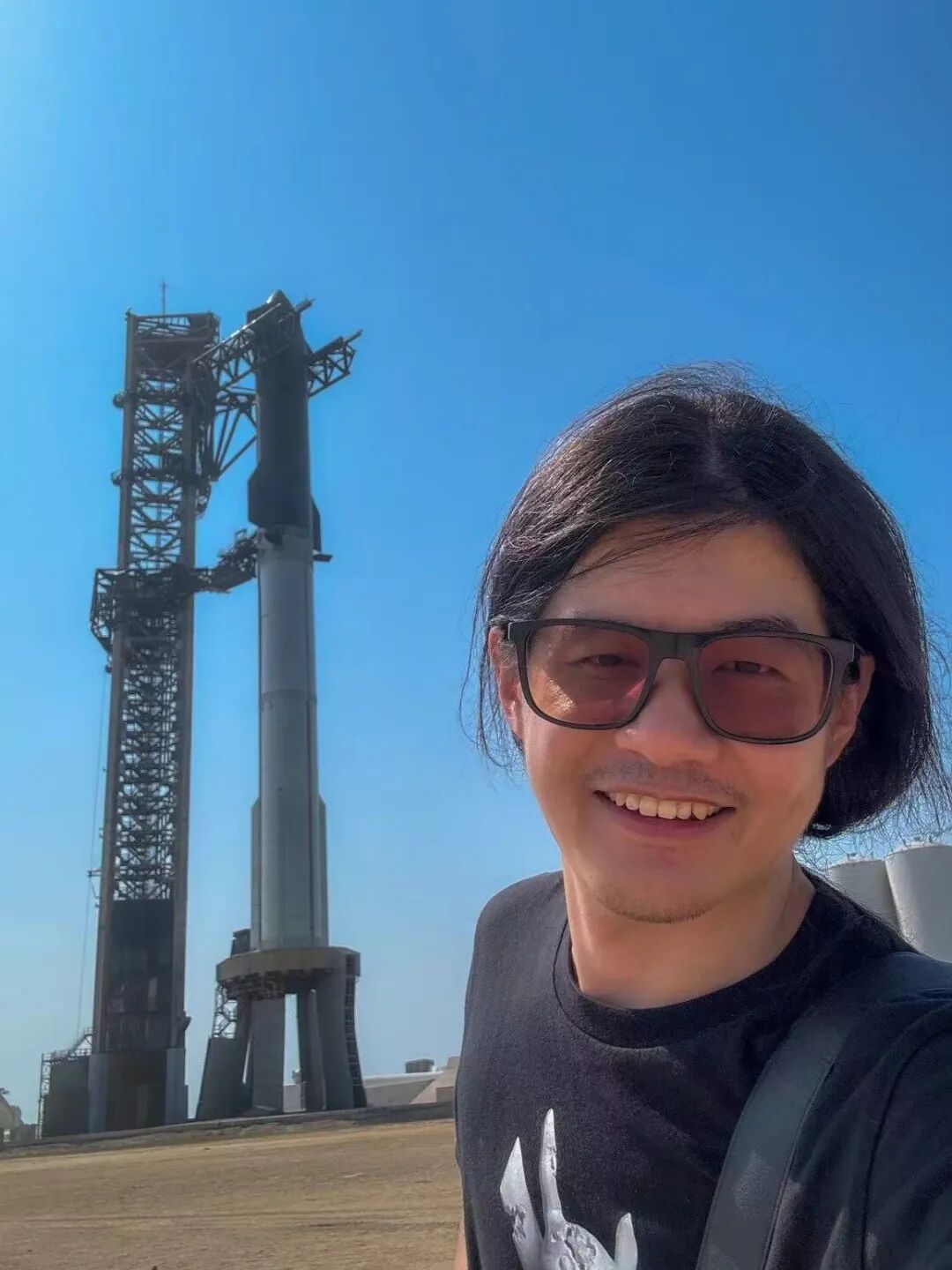
- Wenfeng Wang at SpaceX's Starbase
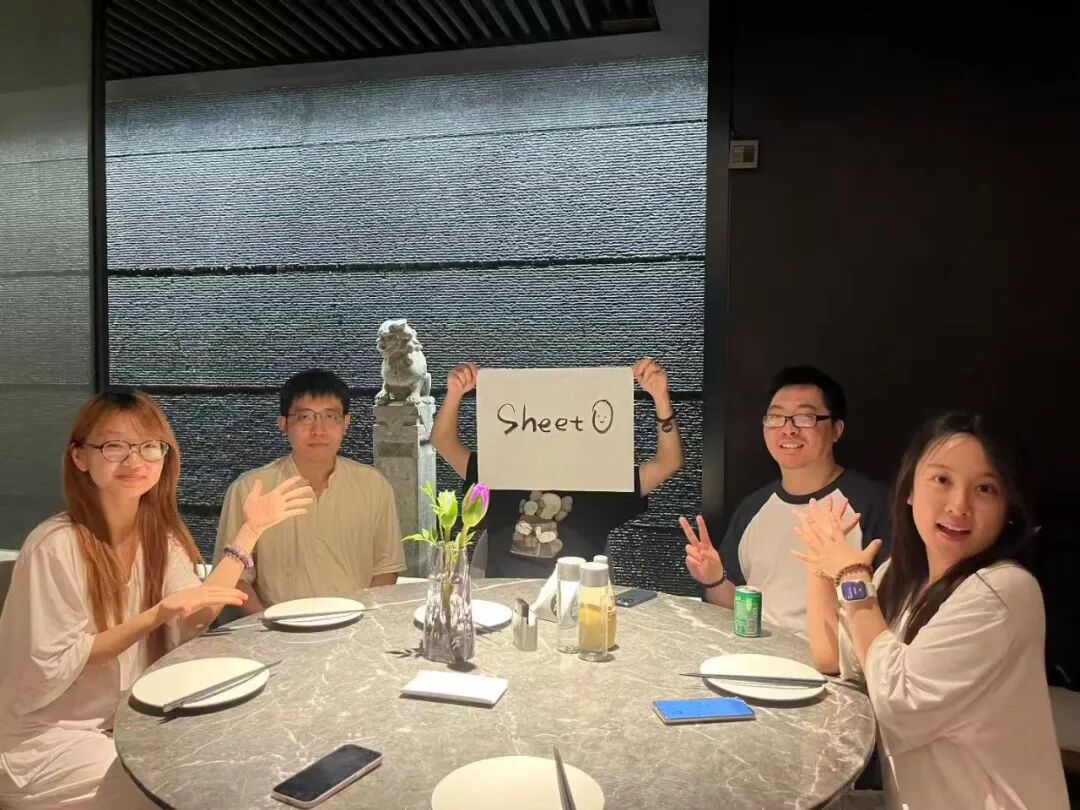
- A Sheet0 team outing; Wenfeng Wang holding up the Sheet0 sign
02
Though Sheet0 has already helped users achieve 10x efficiency gains in data acquisition, Wenfeng doesn't position "time saved" as the core value. He believes "accuracy + speed" is Sheet0's long-term value proposition. Specifically:
-
Guaranteeing 100% data accuracy for users.
-
Maximizing data delivery volume per unit of time.
Building trust between humans and Agents is a long-term proposition. "Behind this, engineers must also trust the model."
All Sheet0 system behaviors are decomposed into trackable, reusable "semantic steps." The Agent must understand what it's doing and be capable of self-repair when errors occur. This is Wenfeng's design philosophy: "Make it smart before making it work."
Making Agents explainable is the critical next step in Agent development.
As a serial entrepreneur, Wenfeng wrote code for four years after graduating in 2017, during which he led the AI data platform at Horizon Robotics. In 2021, he co-founded a company as CTO to build a next-generation serverless message queue, accumulating nearly a decade of development experience in data infrastructure and AI. He joined the AI wave in 2023, embarking on his second startup journey as CEO.
When AI Nao met Wenfeng, he had just returned from the United States, still adjusting to jet lag. Sheet0 now focuses on the US market, with half the team based there; full launch is scheduled for October.
Our conversation centered on his latest thinking about Agents two months after Sheet0's launch. Real-time data acquisition is only the first step — he plans to build more tools for large models, believing that enabling models to autonomously learn tool usage is the competitive key to Agent's future: "Every new tool created is equivalent to unlocking a new skill for the model."
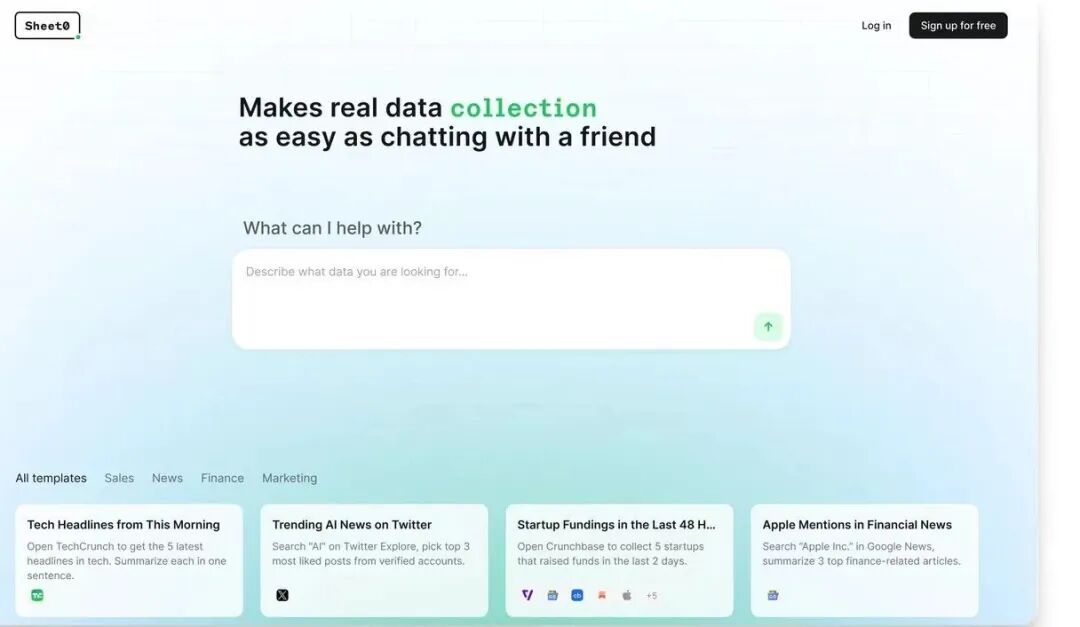
- Sheet0 user interface
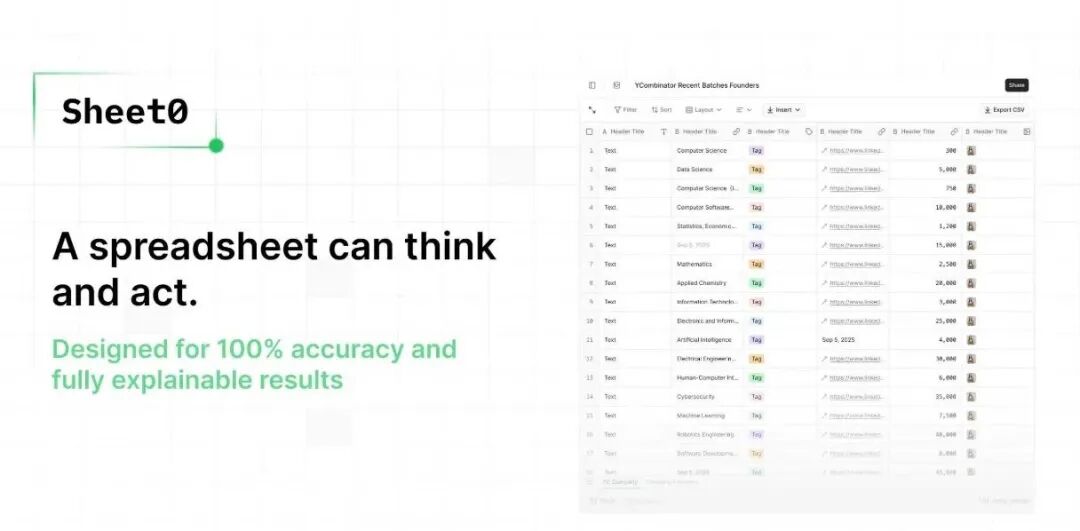
- Sheet0 product showcase
Conversation with Wenfeng Wang
Part 01
Explainability
Get Smart Before Getting Strong
AI Nao: Since the beta launch in August, how has user reception been?
Wenfeng Wang: Registration and paid conversion have exceeded my expectations.
Currently 80% of users come from developed countries, with the US first and Japan second. About 60% of users spend over five hours weekly on data work.
Japan was an unexpected market — apparently a Japanese blogger reposted our US promotional content, driving significant Japanese traffic. Later research revealed stronger Japanese willingness to pay, stemming from their less advanced digital infrastructure compared to the US, with more users still relying on traditional tools like Excel.
For now, the primary goal is to nail the US market first. Once the US market takes off, entering other markets becomes much easier.
AI Nao: What about the China market?
Wenfeng Wang: My first startup was also in software. My experience is: competition is fierce in the US, but everyone can make money. Because there's money to be made, people have more confidence in what they're doing. The commercial soil for domestic software in China is... hard to put into words.
AI Nao: In real user scenarios, what's the most pressing optimization challenge for Agents right now?
Wenfeng Wang: Building a proper feedback loop. It's an extremely granular engineering problem, harder than I anticipated.
What inspired me most in solving this was Claude Code — it made me realize that for an Agent to be truly smart, the key isn't "how much can it do," but "does it know what it's doing."
The Claude Code system is entirely event-driven. Every action, every change gets automatically logged as a semantic message.
For instance, it emits internal messages called "reminders" during work to prompt itself about certain details — messages users never see. In other words, it doesn't just know "how," it knows "why."
AI Nao: What specifically do you mean by "semantic messages"?
Wenfeng Wang: Here's an example: you ask an Agent to organize a table from a webpage. It might take four or five steps: open the page, identify content, spot errors, correct data. But four or five steps is too redundant for a model.
Can we compress these processes into meaningful summaries, like "system automatically adjusted this column upon discovering numerical errors"? This way, the Agent no longer executes mechanically but acts with understanding.
Each step has clear definitions — recordable, reusable, optimizable.
We've now basically restructured our architecture to resemble Claude Code's approach. The goal is for the Agent to not just execute commands, but to understand why it's doing what it's doing, like a real "person." Only then can it continuously evolve.
AI Nao: Before Sheet0 launched, you stated at an industry event that context engineering is key to Agent success. Has this thinking evolved?
Wenfeng Wang: Not at all — if anything, it feels even more important. For an Agent to get smarter, the key is having enough, sufficiently detailed context. Including user interaction history, feedback during task execution, failure cases, and so on.
Only after accumulating enough can an Agent truly learn what to do in different scenarios.
AI Nao: How much accumulation do you think is needed?
Wenfeng Wang: There's no standard answer. Context types are too diverse.
One practice we have now: when user tasks fail — say, webpage data isn't collected — we log the failure case, then find similar successful tasks and compare the differences. We extract successful paths, structure and archive them in an internal knowledge base. Next time a similar task arises, the system can directly draw on this experience, improving success rates.
You could say we're building memory for the Agent — every error, fix, and success becomes the foundation for doing better next time.
AI Nao: Sounds somewhat like building a bad case library for the model?
Wenfeng Wang: You could put it that way. Once enough experience accumulates, this data can directly feed model fine-tuning. What originally relied on external experience gradually becomes the model's own knowledge. In other words, through repeated failures and fixes, the Agent learns to avoid making the same mistakes.
AI Nao: Can this process be automated now? Some industry approaches train a small model to check?
Wenfeng Wang: Not fully automated yet — we're running a semi-automated workflow. Humans still need to participate in lightweight labeling or categorization.
Everyone talks about "end-to-end," hoping models can handle everything from start to finish, but reality hasn't reached that point.
I don't think we've escaped the stage where "how much human effort determines how much intelligence." LLMs have merely amplified the leverage between human work and Agent intelligence. Another key point is knowing when we can move away from human involvement.
Part 02
Real-Time Data
From Using Tools to Creating Tools
AI Nao: Many people question whether Sheet0 is more of a traditional spreadsheet or web scraping tool?
Wenfeng Wang: I understand that impression. The reason is simple — because Sheet0 currently has only one foundational capability: collecting data from webpages.
Sheet0's goal is "providing scalable real-time data acquisition capabilities in the AI era."
Because Agents aim to take actions, they need to make decisions. Decision-making relies partly on model knowledge, partly on real-time data. Take "what to wear tomorrow" — the model needs to know tomorrow's weather, where to find real-time data to decide; knowledge alone isn't enough.
To achieve this goal, Sheet0 takes a bottom-up approach to rebuilding an entire "data work environment" for models. The first step is transforming "any data source into dynamic structured tables." We chose webpages as our first data source because they have broad appeal and sufficient commercial value, allowing us to start generating revenue from day one.
So when people say we look like a "spreadsheet" or "scraper" tool, it's a bit like raising a dog — there's always an awkward adolescent phase before adulthood. Sheet0 is in that awkward phase. I believe in six months, people won't say this anymore. We'll deliver more innovative product forms.
AI Nao: How do you view the division of labor between model capability boundaries and Sheet0?
Wenfeng Wang: I'd rather talk about the difference between models and Agents.
An Agent essentially leverages model knowledge, combines it with real-time information, and uses tools to solve problems. Today we see foundation models reaching or approaching PhD level in multiple domains; yet actual product performance remains at intern level.
The core issue is missing real-time information and appropriate tools.
As the saying goes, "to do good work, one must first sharpen one's tools." So Sheet0's core is designing a series of "handy tools" around data scenarios. We don't think too much about model boundaries, because we believe in the long term, models have no capability boundaries.
For model vendors, if a tool's complexity is too high, they definitely won't build it — complex tools mean owning complex infrastructure.
AI Nao: Based on this understanding, what directions with huge commercial potential remain to be developed?
Wenfeng Wang: For instance, recently a user wanted to find 1,000 UK K-12 parents. Traditional approaches would involve local community sites or Facebook user groups.
But think differently: who could complete this task most easily? Probably students studying in the UK themselves. If they had their own Agents, you could reach out to have them collect 20 parents' contact details for 100 yuan — someone would definitely take it (assuming compliance issues aside).
This data is currently offline but most valuable. How to more conveniently access such data is one of our main goals. This excites me most; we'll definitely find solutions.
In the future, I hope Sheet0 can collect and organize all data for users — private, public, and personalized — delivered in structured form. I emphasize structured because structured data inherently carries semantics, and can further enable models to create tools in real-time through SQL-like tools.
AI Nao: What new opportunities do you see in the Agent industry from H2 2025 to 2026?
Wenfeng Wang: I can't name specifics, but I can share a concept: price elasticity.
This economics concept measures how much demand increases or decreases when the cost of solving a problem drops. When price elasticity equals 1, a 10x cost reduction brings 10x demand growth. My suggestion: think about which problem domains have price elasticity greater than 1. These problems are all worth solving through Agents.
Part 03
The Aesthetic of 100% Certainty
Trust Is the First Principle
AI Nao: Given models' inevitable hallucinations and Agents' severe lack of context, why do you particularly emphasize 100% accuracy?
Wenfeng Wang: My philosophy is that building Agents must first earn user trust. Trust matters enormously, and behind this, engineers must also trust large models.
Model "hallucinations" are determined by underlying principles — essentially, models "summarize information." Give it two hundred webpages, it judges and filters to one hundred, then summarizes content. But compression and summarization carry risk: it might misunderstand or misgeneralize. That's how "hallucinations" arise.
But our data capture logic is closer to "copy-paste." You could say Sheet0 is like a diligent note-taker — what's on the webpage gets captured identically into the table. If it's a company information table on the webpage, our captured data matches exactly.
Technically, our entire underlying layer is dynamically generated code, which is why we can claim 100% accuracy in data delivery.
AI Nao: Does pursuing 100% accuracy this early slow down progress?
Wenfeng Wang: It does slow things short-term, because we've invested heavily at the infrastructure level. But long-term, this is "slow is fast." We avoid things that burn momentum, instead accumulating potential energy over time.
As I mentioned, I believe building trust is the ultimate proposition between humans and AI. We need to commit to this from day one.
Many people aren't optimistic about us, and I completely understand — "because you believe, you see." I can't demand that of others. My past failures taught me that choosing what to persist in matters enormously. This is a founder's taste.
AI Nao: You're now split between China and the US. What has the US AI entrepreneurship environment taught you this year?
Wenfeng Wang: Talking with many US founders, I found their biggest difference from Chinese entrepreneurs is their courage to innovate boldly, to bet.
Chinese entrepreneurs, from day one, get asked "who are your users, why would they use you, how do you retain users, what's your competition, what if big tech copies you" — this is actually quite sad, because focusing on these questions too early kills genuine innovation.
After Lovable took off, people discovered its heaviest users were product managers and salespeople, not programmers. Similarly, after Manus emerged, people realized one person really could review 100 research reports in a week.
AI products should start from human nature, "creating products that match people's imagination of the future" at the right moment. I know it when I see it.

- Wenfeng Wang with his corgi named "Chicken Leg"

- Wenfeng Wang with the backpack in foreground; an avid hiker, pictured at a US national park
AI Nao: Two years into entrepreneurship, the first two projects didn't work out. Were there any dark psychological moments?
Wenfeng Wang: Yes. From October to late December 2024 — nearly three months — it was genuinely bleak. The first project had failed, the second was abandoned, the new direction wasn't set, confidence was completely lost. Plus my mother's health was very poor then; I was probably somewhat depressed.
I really wanted to lie flat then — why start a business, why so much hardship and exhaustion. After handling my mother's funeral in March, I returned to Beijing and began bouncing back from rock bottom. Sheet0 was gradually explored from that state.
Looking back, the first and second products were actually directionally correct, but they failed because I cared too much about short-term targets and couldn't push through.
A friend once asked me: what's the most critical CEO capability? My answer: long-term tolerance for pain. And the ability to endure pain must be supported by a stronger belief. So I want to tell many entrepreneurs: you must believe in yourself!
Images courtesy of interviewee and Unsplash
—Bonus—
We have a podcast now.
Search "AI Nao" on Xiaoyuzhou app.
The full interview with Wenfeng Wang is now live,
unlock more complete content.