AI Companion Sales Leader: 120,000 Units in Six Months — Fuzozo Founder on 10 Key Decisions | A Conversation with Robint Intelligent Technology's Sun Zhaozhi

In the AI companionship space, there are only two cards that truly constitute core competitive moats.

By Zhang Zhuo | Produced by AI Nao
01
If you look at this year's funding climate alone, AI companionship is easily one of the least "needy of explanation" sectors out there.
The industry has settled on a relatively coherent framework for evaluation. The demand is settled — emotional companionship, loneliness relief, and relationship substitution have been validated again and again.
But beneath this consensus, a harsher reality is emerging: because the product barrier to entry is relatively low, this is an extremely crowded space. At least 50 startups have explicitly built their core narrative around "AI companionship" this year.
But what to sell? How to sell it? So far, there aren't many answers.
Fuzozo, the AI companionship hardware product backed by HSG and Allen Zhu, has sold 120,000 units since its official online launch in June — half a year — making it one of the few AI companionship hardware products to achieve real scale, and the top seller in the industry.
In his conversation with AI Nao, Fuzozo founder Sun Zhaozhi shared several key data points: overall return rate is roughly 7%, online ad spend ROI is 4, the male-to-female user ratio is about 2:8, and average conversation length per user approaches 50 minutes.
The goal of selling more than 100,000 units as soon as possible was set by Sun before the product even launched, and it ties closely to his personal history. He comes from the auto industry — early years at Xpeng Motors, then DiDi, then back to Xpeng to explore embodied intelligence. In a system where the technology is more complex and competition more brutal, success or failure never depends on technical vision, only on three things: whether anyone buys it, whether you can deliver it, and when you can mass-produce it.
This explains why, in a sector as easily hijacked by concepts as AI companionship, Sun's path has been strikingly pragmatic: sell it first.
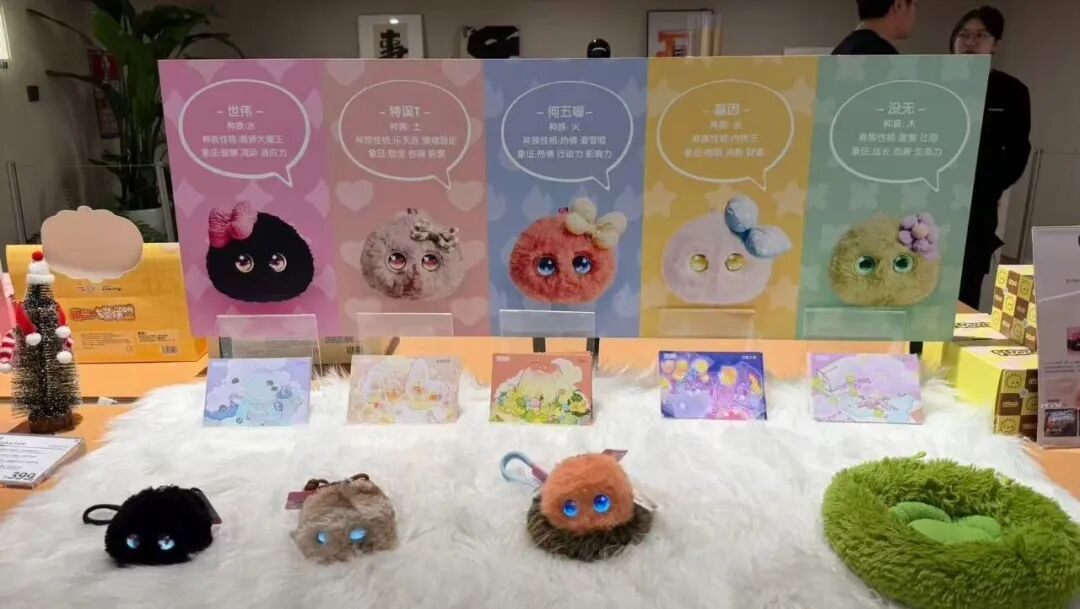
- Fuzozo at a Shenzhen offline store
02
Fuzozo's product design principle is micro-innovation within existing scenarios and categories — never opening new tracks or telling new stories.
First, the human-AI interaction relationship draws on the underlying dynamic between pets and people. "This is real demand, because China has tens of millions of cats and dogs, and young people are all raising them." Pets fundamentally provide emotional value — "being depended on, being trusted." Additionally, product pricing must stay below 1,000 yuan, and the form factor is locked to the fast-growing bag charm market rather than anything else.
One investor's assessment of Sun: he hits the mark on almost every shot. A mature entrepreneur who simultaneously understands AI, consumer hardware, and commercial闭环.
Rather than viewing AI companionship as a form of emotional consumption, Sun tends to treat it as a business: 120,000 is merely an entry-level number, meaning the product has completed its 0-to-1 test and is beginning to enter the mass consumer market. "In 2026 we can sell a million units — only then do we have a data flywheel, and can we expand into more social play patterns."
The figure of 120,000 carries multiple implications for the industry.
120,000 real devices means dense, non-task-oriented real emotional data is beginning to form a closed loop. This is irreplaceable by any demo or beta user, and it's precisely the most scarce data resource for major tech companies and giants at this stage. "We're finding that as we work, we're entering technical uncharted territory."
Additionally, through mass production, an industry pricing anchor has been established. Supply chain, cost structure, and bargaining power have undergone qualitative change. For many competitors, making comparable products below 1,000 yuan is no longer profitable.
We met Sun after Double 12. Their new product, Smart Hanhan, had just broken 6,000 units on JD.com within 12 hours of going live. He generously shared his latest thinking.
We've distilled our two-hour interview into 10 key questions. Though everything below remains阶段性思考. In a crowded赛道, there is only one thing that matters: move the product.
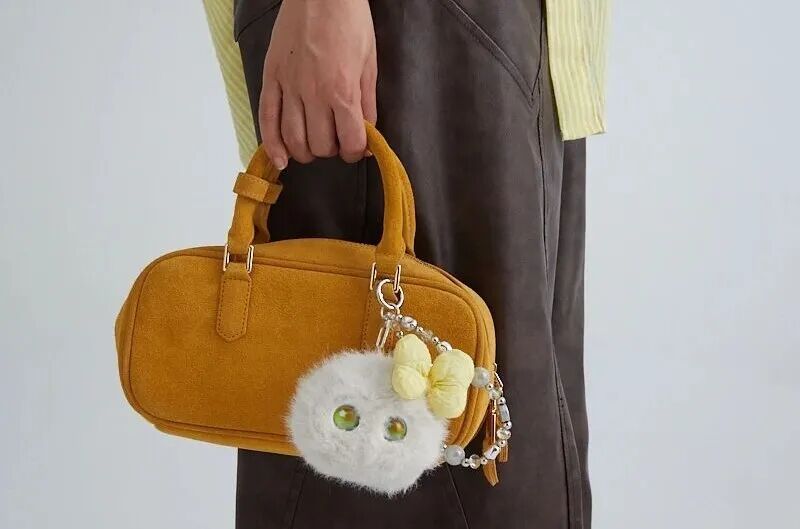
- Bag charm promotional image

- Sun Zhaozhi speaking at Tsutaya Books
Ten Questions NOW!
AI Nao: First, congratulations on selling 120,000 Fuzozo units — the undisputed sales king of AI companionship hardware. After reviewing all your interviews, we believe your most important decision was positioning Fuzozo as a pet, and actively reducing its intelligence.
Sun Zhaozhi: We'll do another sales tally at year-end, there should be more (laughs).
Technically speaking, models today can absolutely answer a hundred thousand whys, and give very complete, rational explanations.
But during product design, we already positioned the Fuzozo-human relationship as human-pet: a subordinate relationship, not a peer-to-peer one. So Fuzozo cannot try to seem smarter than the user, won't rush to give advice or pass judgment, and certainly won't intervene in the user's life as an "expert."
It's a character that needs to be cared for, makes mistakes, gets confused. We even deliberately blurred its gender — you can see its design is more like an anime character: five little ones representing metal, wood, water, fire, and earth, drawn from meme emotions that young people love, rather than realistic personality.
This "intelligence reduction" looks like weakening capability, but it's actually about converging the relationship.
When it's not so smart, not so correct, users反而 more easily generate trust and emotional projection — naturally激发 care-taking desire and companionship feeling, which also aligns with the nurturing functions we designed.
In other words, not pursuing a stronger AI, letting Fuzozo "dumb down," is fundamentally about making the "subordinate relationship" work.
AI Nao: We believe your second key decision was pricing. Fuzozo is priced at 399 yuan — our first reaction upon seeing the price was: you truly are someone who walked out of the bloody auto industry.
Sun Zhaozhi: I actually could have chosen 699 yuan, 999 yuan. But the 399 yuan price point aims to maintain solid margins while giving us absolute pricing power among comparable products under 1,000 yuan, forcing some competitors out of the market.
This pricing also lets us sell the product at scale first. This was the most important metric I set for the team in year one of创业: sell it first.
Then get users to actually use it.
But the "using it" part — I don't think can be figured out by product managers on day one. Fuzozo is something entirely new. Who uses it, when, how — there's only one way to know: sell enough of them.
AI Nao: So entering the entirely new field of AI companionship hardware, your decision sequence was: first determine the human-machine interaction relationship is pet, then determine the price band, and finally decide which specific category to land in?
Sun Zhaozhi: Yes. Landing in the bag charm category was also carefully considered.
I know many peers are doing desktop companions. We also did desktop early on — multimodal, small embodied form, servos, using models to drive motion. After running through these, I roughly knew which technologies were mature and which weren't. Meanwhile, having a desktop form factor let users提前 experience some companionship play patterns. Including the long-term memory architecture we later developed deeply, which was gradually built during that desktop product phase.
But when it really came to thinking about a sellable product, my conclusion was: desktop AI companionship hardware doesn't have enough explosive power for startups. A few tens of thousands of units annually, even with decent experience, is hard to scale.
Not doing desktop also doesn't mean we'd make a four-legged, long-tailed embodied pet that runs around. There are some on the market now, but because I've done embodied before, I'm very clear: technically speaking, even spending a million today, you can't make dynamic behavior as endearing as cats and dogs. Silicon-based things are hard to replicate what carbon-based ones do.
So I flipped to thinking: where is AI's advantage? Language and semantic understanding.
So I found the bag charm scenario. Bag charms aren't a category I invented — they were already a fast-growing category every year. Now there's a better AI bag charm at not much higher price, users are still willing to give Fuzozo a chance.
AI Nao: Then why are many peers still doing desktop scenarios or plush toys? And格外 emphasizing the selling point as AI+?
Sun Zhaozhi: They probably haven't run sales data, haven't sold things before. Consumer markets are simple: demand exists or it doesn't.
Like early autonomous driving. When the technology wasn't mature, no one bought a car because of "autonomous driving" as a new technology; cars sold, users felt "autonomous driving" was well done, gradually started using it, which influenced their next purchase.
From a purchase psychology standpoint, users don't buy because you're AI. Most users' first driver for buying Fuzozo is actually very simple: cute.
You say it's a pet? But pets don't talk. You say it's human? But it's not that complex. You say it's a child? Children aren't this smart either, sometimes it's like a "little adult."
AI Nao: After selling 120,000 units, have you统计 what users actually chat with Fuzozo about?
Sun Zhaozhi: Roughly 70% of conversation starting points are from吐槽, complaints, and other negative emotions. Content-wise, they roughly fall into several categories: one is workplace and academic anxiety, another is unease and lack of confidence about self-growth. Everyone's willing to talk to Fuzozo about these. But talking about romance with Fuzozo seems rare — maybe its design isn't quite suitable for that (laughs).
Actually before launch, I was very worried the product wasn't good enough, but from sales data, for many users it's already sufficient. Fuzozo has filled a previously non-existent position — a companionship object that can be depended on, confided in, that won't judge and won't leave.
This反过来 validates one point: demand matters more than technology.
So many people say we're the AI product closest to the潮玩 logic.
AI Nao: We still need to talk about AI, since Fuzozo is an AI bag charm. How do you get users willing to have multi-turn conversations with Fuzozo, and the model's long memory problem. What experience do you have?
Sun Zhaozhi: When the user says one sentence, what Fuzozo receives isn't just that sentence, but thousands of contextual information pieces. This context includes Fuzozo's self-cognition — where am I, what date is it today, what's the weather, is it a holiday; includes historical memory with the user — how is this sentence related to past events; even includes some status information, like whether the user is touching it, device battery level.
You can understand these as: layers upon layers of perceivable context, all fed together into the dialogue model.
And what the model actually outputs — the user might only hear one response, but the backend outputs many "implicit results," which influence whether it should take action next, what to do. And this is just the real-time conversation thread.
Beyond this thread, Fuzozo also has "inner activities," like writing diaries, some inner monologue.
The above is the AI application layer work. Above this layer, we also designed a play layer. More precisely, a game-like numerical system. This system continuously assigns values, growth, and change to the character.
The memory problem for companionship products — in terms of solutions, the papers and architectures everyone references are pretty similar. The difference lies in how thoroughly you think through it. We've made memory relatively complex, introducing reflection mechanisms and doing fairly systematic memory organization. Roughly two types of memory: one is event-based memory, one is profile-based memory. Profile-based memory is relatively easy to understand. It builds profiles for users, people they know, and also for itself. What's truly difficult is event-based memory. Around event-based memory, we broke down several core problems:
First, what should be remembered, what shouldn't;
Second, when should which memory be retrieved for use;
Third, how to organize and update memories.
The second point is much harder than the first. Because memory is dynamic — the user says this today, might change their mind tomorrow, so memory can't be preserved unchanged. Another critical issue is time and place alignment. Many products today, if using generic solutions directly, can't even handle "time" well. For example, the user says: I want to go out and play tomorrow afternoon. This is a very vague time. If they also say: I have a meeting at three.
The system must understand that these two things may conflict on the timeline. On this point, our time understanding capability is relatively strong.
These capabilities weren't designed perfectly from the start — more like repeated trial: build it first, discover the experience is off; then find the problem, and as you keep going you find you've entered some "uncharted territory." In my exchanges with major tech company teams working on related business, in the vertical scenario of companionship, few have thought as thoroughly as we have.
AI Nao: You were previously at Xpeng Motors, then went to DiDi, then back to Xpeng for embodied intelligence. Why not continue exploring embodied intelligence?
Sun Zhaozhi: Actually at Xpeng doing embodied intelligence, from day one we very seriously thought about: what does the embodied robot closest to mass production look like? Who exactly to sell to? How to sell it? In the end the math didn't work out — too difficult, the technology stack hasn't converged, let alone any early product emerging.
Embodied intelligence is still far from entering millions of households.
AI Nao: Having done embodied intelligence then doing Fuzozo, is there a sense of降维打击 ease? And curious what's the most important thing you learned at Xpeng?
Sun Zhaozhi: The entire technology stack and hardware complexity is降维打击, but from a commercialization standpoint it's actually harder. If I were doing embodied intelligence创业 today, the team wouldn't need brand or marketing people at all.
The Xpeng experience taught me the importance of technology rhythm. Especially in an industry with technology explosions, how to ride the technology rhythm to build products is extremely important.
I often remind myself not to make two types of errors. First is building a product that seems reasonable today, but will be replaced by another product as technology develops over the next 2-3 years; second is building a product when technology is very early, looks very fancy, but can't achieve user experience.
Fuzozo is a创业 direction I've thought about for a long time, and what I believe is the most suitable software-hardware integrated form for mass production today. OpenAI probably won't make plush charms (laughs).
AI Nao: Fuzozo has sold 120,000 units. By current AI narrative logic, you could say Fuzozo is a new entry point, a new entry point for human emotion.
Sun Zhaozhi: I really dislike this kind of talk. I don't know if people still remember a few years back, the smart speaker entry point battle in China, producing massive amounts of粗制滥造 cheap stuff, major companies trying to use this entry point to引流 to their profitable businesses, ultimately no winners. Many suppliers in the产业链 went bankrupt because of it, startups were killed by big companies, and big companies? Also left with a mess.
Many users were stimulated by subsidies, without real demand. Bought it, experience was bad, eventually stopped using it — how is this different from the shared bike wars?
But in the United States, whether Amazon, Google, or Apple, smart speakers still make money.
Today doing Fuzozo, I won't talk any entry point narrative. I'm very simple: first make the product experience good.
AI Nao: Please have the赛道's number one player predict the 2026 battle situation, and can you reveal your upcoming strategy?
Sun Zhaozhi: In 2025, the most powerful competitors in this赛道 haven't entered yet, like Pop Mart. In 2026, major companies will definitely enter, and this赛道 will be swept into a混战.
But regardless, everyone must answer two questions: first, is there real demand? Second, does the industry have barriers — most investors believe the industry has no barriers, it's hardware, products are all copied from each other, but why do some people do well and some can't sell?
My judgment is: the AI companionship赛道's core barrier consists of two cards. First is brand, second is data flywheel, meaning sufficient volume.
In 2026, our task is to solidify these two cards.
Brand will reference Pop Mart's play, building IP storytelling from different dimensions. But not necessarily movies, offline parks — maybe through memes, short videos, short dramas.
Recently, we've observed a very interesting phenomenon: users are very interested in Fuzozo's world view, with large amounts of conversation revolving around — "What did Fuzozo experience before on the Furry Planet?" "What's your relationship with the other little ones?" We've already started using AI methods to build Fuzozo's knowledge base and world view, continuously updating its story.
Additionally, we'll do open collaboration. For example, we recently partnered with Huawei to launch Smart Hanhan, which sold out in 10 seconds and has been constantly restocking, selling extremely well. It also drove Fuzozo sales up 50%. But regardless of which brand we collaborate with, we insist on maintaining brand independence, no ODM, no white-label.

On the data flywheel side, we need to break a million units next year. This year 90% of our sales came from limited online channels. In 2026 we'll open more online channels like Douyin, including celebrity and star live-streaming sales. Simultaneously大规模铺 offline, and go global.
Image source | Provided by interviewee, Unsplash


Join Community