In China's Most Cutthroat AI Coding Race, He Bets on China First to Build the Industry's Pinduoduo | A Conversation with Wuxin, Founder of CodeFlying

CodeFlying's users are middle-aged fishing enthusiasts, water delivery guys from the neighborhood, pork shop owners...
By Pippobei | Produced by AI NOW!
Intro
In 2025, AI coding is undeniably the hottest and most crowded赛道 around — because code is one of the easiest domains for AI to format and contextualize, and it's also where commercial revenue has materialized fastest.
From GitHub Copilot to Cursor, from Replit to Lovable, new products launch weekly and nearly all of them raise funding. According to the latest figures, the Chinese market has already seen over 30 products positioning themselves around "AI coding," covering everything from IDE enhancement and code completion to end-to-end generation.
The subject of today's AI NOW! interview, Mashangfei, is also an end-to-end AI coding product. Open its homepage and you'll see just six characters: "Speak Chinese, build apps."
Its defining characteristic: serving absolute beginners.
Most AI coding tools on the market center on "code completion" and "assisted writing" — Copilot fills in half of what you write, Cursor is half-human half-AI collaboration; Lovable generates step-by-step. But Mashangfei's approach is far more radical:
Users don't write a single line of code, nor do they see any code throughout the process. Just input a request — say, "I want a mini-program to help me lose weight" — and the product launches. Frontend, backend, database, admin panel, even test data all get configured and delivered as a complete product.
This product logic is what founder Wu Xin calls "version-version-version."
- Mashangfei product demo
Mashangfei's approach is controversial.
After all, AI's current programming capabilities are better suited to freeing developers' hands, not empowering ordinary people. Many argue that context lengths need to improve tenfold and model reliability needs to hit 99% before non-technical users can be served.
AI NOW! invited several professionals to evaluate the product. Their assessments included "like a toy," "lots of errors," "not much value," and "why don't they just open source it?"
But Wu Xin has no intention of changing course.
He insists his target user is the kind of person who, upon seeing a download package on their phone, asks how to double-click it. Since launching over a year ago, Mashangfei's users have ranged from community police officers at local stations, to essential oil blenders, to neighborhood pork butchers, to water delivery guys.
Wu Xin is the archetypal technical founder. In his early forties, he graduated from Lanzhou University's computer science program and spent years at Tencent, ByteDance, and other major tech companies — his career spanning multiple technology cycles from PC to AI. What truly moved him to start a company was a test he ran in late 2022 using GPT-3.5. The model completed the coding task accurately. When he pressed it on how, the response shook him: "Because your Open API documentation is online. I've read it all."
He realized the era had shifted. He walked away from a seven-figure salary and threw himself into AI entrepreneurship.
Wu Xin's thesis: as technology becomes universally accessible and the cost of writing code approaches zero, AI coding won't take hold where digitization is most advanced — places like the United States — but rather where it's weakest: China's fourth- and fifth-tier cities, and even further down into county towns. "China first. Do the 0-to-60 work, not 60-to-100."
So while industry peers obsess over parameters, model architectures, and top-tier journal publications, what concerns and anxieties Wu Xin most is product iteration velocity. "We need to be even more radical, even faster, to get this into more ordinary people's hands."
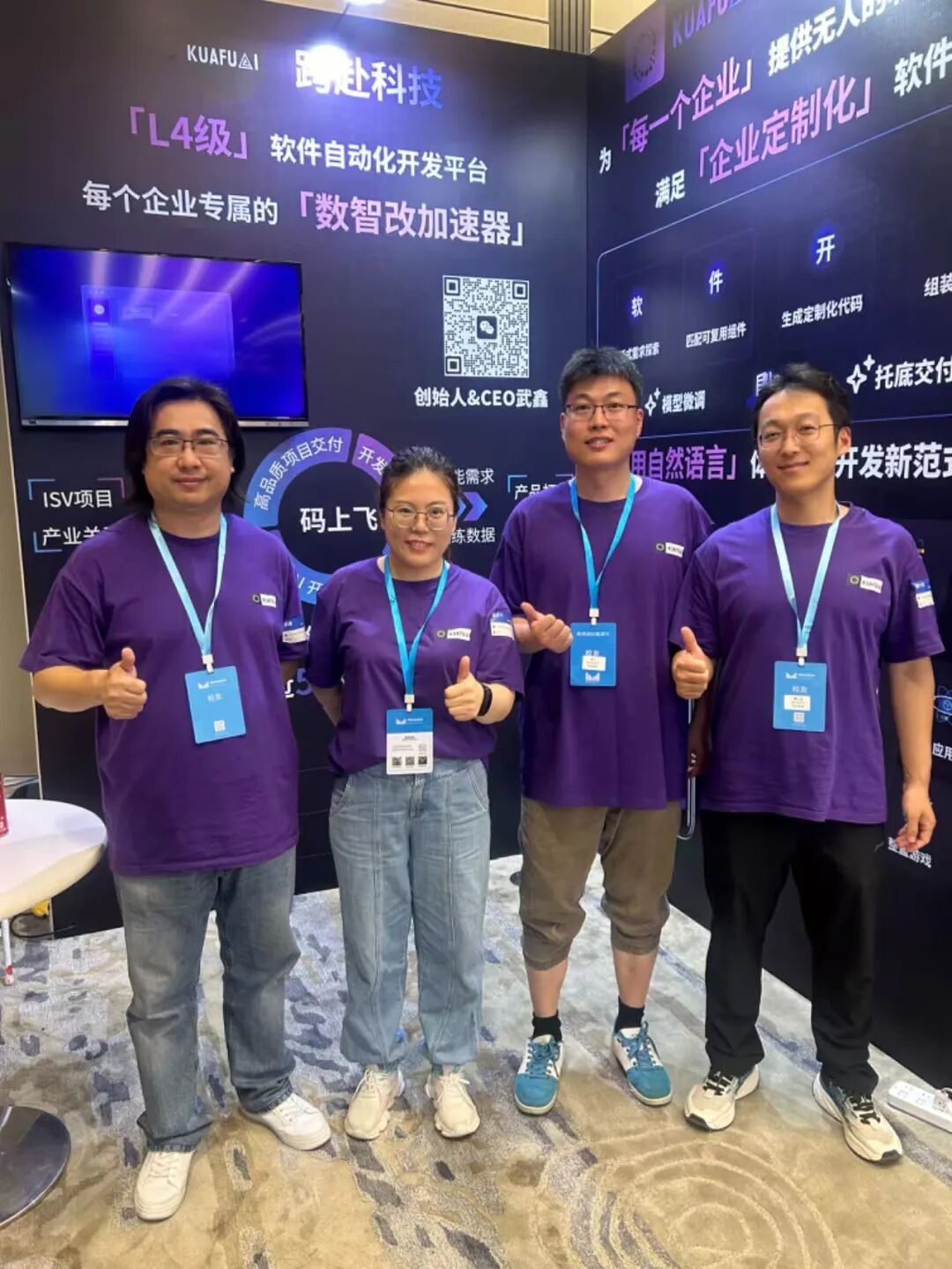
- The Mashangfei team pitching at MiraclePlus forum. Wu Xin is first from left.
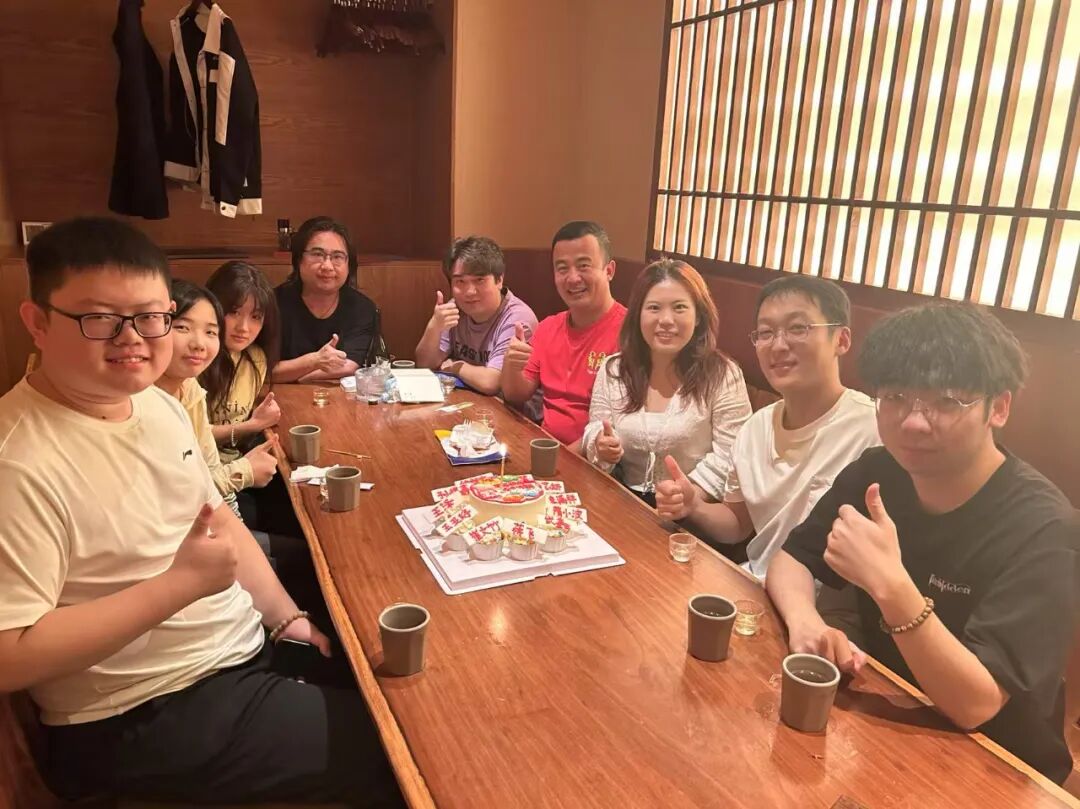
- Regular team bonding. The team is engineering-heavy and has stayed lean at around 10 people.
Conversation with Wu Xin
Part 01
Our Users Are People Who, After Finishing Mahjong,
Go Home to Check How Much They Made Selling Pork Today
AI NOW!: Many industry insiders believe that targeting beginners with AI coding is too aggressive for a startup — even the tech giants wouldn't do this, given that non-technical users represent only 5% of the overall programming user base.
Wu Xin: That's a good question, and one I get asked a lot.
If we only focused on professional developers — which most AI coding products do — there are roughly 10 million professional coders in China, and 40 to 50 million globally. The advantage is clear: the user base is defined, the commercial path is straightforward.
But from my perspective, that isn't why I started this company. If you've ever founded a startup, you know how brutally hard it is. If you're only in it for the money, there are far higher-ROI ways to make a living. You need a powerful vision to sustain you through the difficulties and challenges. I gave up a comfortable package and left my job in mid-career because I wanted to democratize development technology in the AI era — like Prometheus stealing fire, putting digital capabilities into the hands of ordinary people and creating massive social value.
That said, I'm not an irrational entrepreneur. My judgment is that the beginner market will eventually be at least 20 times larger than the professional developer market. This transformation has happened once before: from Photoshop to Canva. The latter now has 20 times the user base of the former.
AI NOW!: Why did you choose mini-programs as your entry point?
Wu Xin: We looked at the deployment path for autonomous driving L4. The technology is still difficult to achieve safe on-road driving, but indoor low-speed L4 applications have already become a massive industry — think delivery robots.
My logic is the same: start with indoor low-speed automated development. Mini-programs are a clearly defined, bounded scenario.
Jump straight to a platform? Sorry, my startup resources don't support that.
AI NOW!: You've explicitly declared "China First." Was it necessary to make this choice so quickly?
Wu Xin: In the mobile era, building products only required observation of needs and human nature — globalization was still the dominant trend. But the world is obviously no longer calm now. To put it bluntly, the globalization we once idealized no longer exists.
I believe that within five to ten years, every founder must factor geopolitics into their thinking: do you build for China-led globalization or US-led globalization?
My choice is China: China first, then impact global.
Going deeper, this comes from my internal thinking about the path to success. Earlier this year, one product blew up overseas first before coming back to China. I know many peers favor this path — it attracts attention more easily. But I often lie awake at night wondering: is that kind of viral success what I actually want?
Probably not. I want the kind of success DeepSeek and Black Myth: Wukong achieved. I believe Chinese founders are already capable of radiating globally through original strength.
AI NOW!: Why, for the Chinese market, did you choose a technical path of delivering complete products rather than giving users components?
Wu Xin: Here's an example: foreigners go to IKEA, buy bags of parts, and bang-bang-bang assemble them at home. Chinese people prefer to move in with their bags already packed. The underlying cultural DNA of the two countries is fundamentally different.
Even when serving non-technical users, single-point tools can work in the US market. But in China, open-source solutions or point tools clearly aren't enough — users still won't know what to do with them. It has to be end-to-end.
AI NOW!: One aggressive detail of your product: you don't even give users a model selection interface, and the entire code-writing process is hidden.
Wu Xin: Our users are fishing enthusiasts, local police officers, neighborhood water delivery guys... You open up various technical options and ask them to choose between Claude 3.5 or GPT-4? How would they choose?
A few days ago I was demoing at Huawei HDC. Many users saw our slogan — "Speak Chinese, build apps" — and started talking directly to the demo screen. That really struck me. I began reflecting: it's not that users have a problem, it's that we in tech are too arrogant. These are the most ordinary users. Since we call it "speak" Chinese, shouldn't we add voice input? In the future, users could say a few sentences and quickly generate a mini-program.
Software engineering complexity doesn't disappear — it only shifts or gets hidden. The dirty work behind the scenes should be ours to handle. Users don't need to know about it.
Going forward, I'm thinking about whether we can handle all digitalization tasks for users. After they build a mini-program, we automatically apply for a social media account for them and start auto-operating content. Truly achieving end-to-end digital services for one-person companies — penetrating deep into the capillaries of China's economy. That's where the most value lies. Users pay for outcomes, not tokens.
AI NOW!: How do you respond to industry critics who say AI coding products are selling emotional value — users pay because they feel accomplished making something, not because it has practical value?
Wu Xin: This is also quite interesting. Our users are predominantly men over 35, mostly non-programmers. Looking at Lovable and Bolt.new, our two overseas benchmark competitors, they have much higher proportions of users aged 24–34. But in the 35+ bracket, our user share is actually higher.
So their users care more about tech trends — tools, software development. Our users care more about secondhand homes, clothing, beauty. Geographically, Guangdong leads, followed by Jiangsu, Zhejiang, and Sichuan — all regions with active individual economies. They're mostly individual merchants with mature business ideas, constrained by development costs running into the tens of thousands, who want to quickly realize their ideas for a few dozen yuan.
I call them one-person businesses. Their logic for paying is saving money and improving efficiency.
AI NOW!: What have these users taught you?
Wu Xin: They're not big operations. Their business radius is just 2–5 kilometers of familiar customers. The guy delivering桶装水 in the neighborhood, the pork butcher... they never planned to sell nationwide, or even outside their community.
I once surveyed a user: why not use Youzan? He said it was too complicated, overkill. He just wanted a mini-program to collect orders, and ideally, after receiving an order, call a courier to deliver the goods. Then he could go play mahjong, and come home at night to count how much he made today.
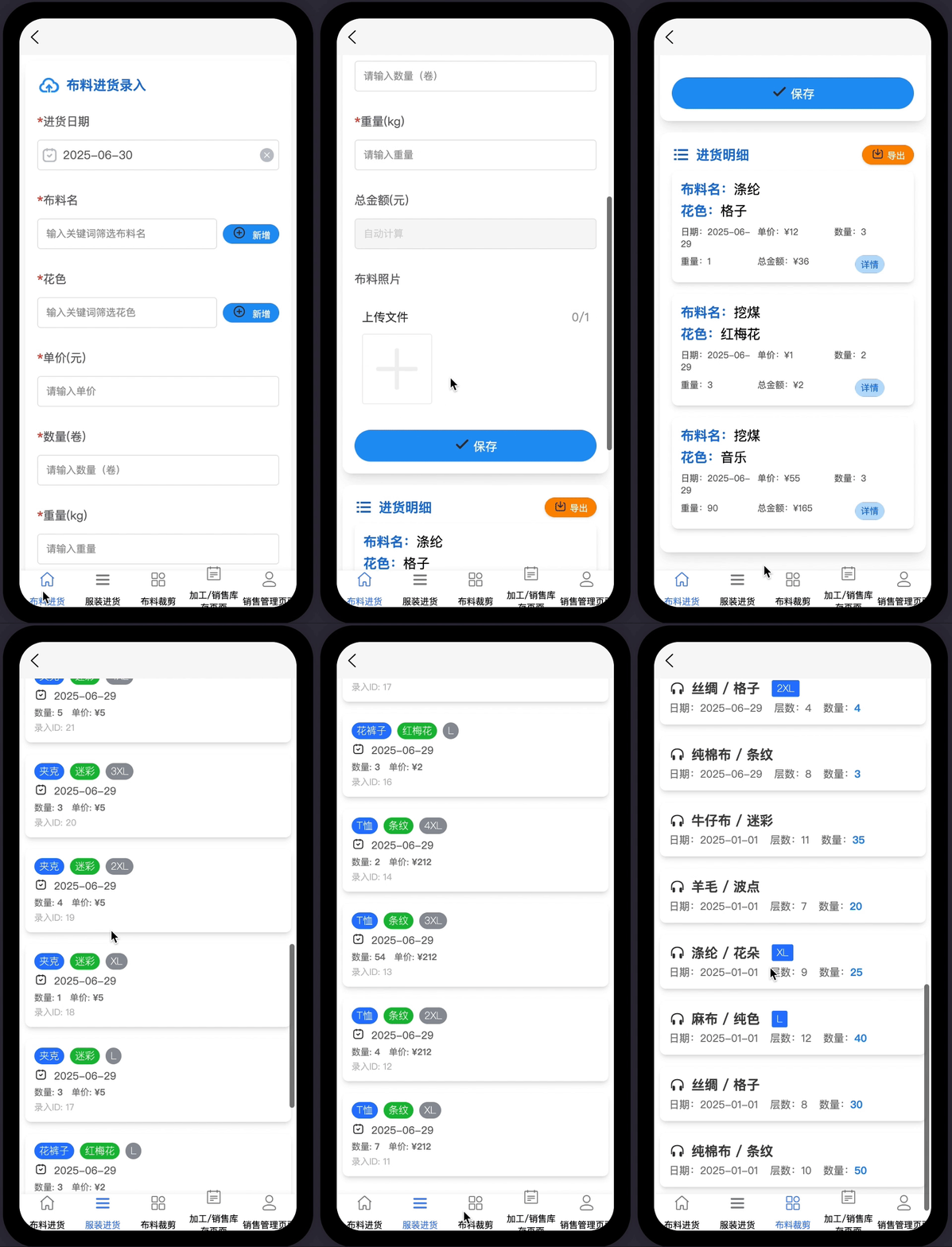
- Mashangfei's first users were mostly individual business owners, with order-taking and payments as core needs.
AI NOW!: What other user scenarios have particularly moved you?
Wu Xin: We have a user who made a quit-smoking app. He used the "Dragon Subduing Palm" as the interaction — tap a button and a quit-smoking trivia question pops up. Show this to professionals and they might think it's ugly. But the user loves it.
My interpretation: previously we built software around the greatest common denominator, finding shared needs. Now that AI has driven development costs near zero, it can generate infinitely many personalized products.
Users start with cost-saving and efficiency gains, then want to find entirely new content formats to carry their unique experiences, knowledge, data, ideas, even emotions.
Like this quit-smoking user — he's already quit successfully. He made it for fellow smokers to help监督 everyone. We also have many users who build mini-programs just to share things. Behind this is the human need for altruism. This has made me realize that technology democratization will bring changes to production methods and creativity.
Part 02
Models Compress Commonality, Lack Individuality,
Cannot Understand the Real World
AI NOW!: We tested one scenario: asking Mashangfei to make a brick-breaker game. The initial understanding was correct, but what finally generated was Tetris. How did this deviation happen?
Wu Xin: That's a bug, stemming from our current engineering principles not being robust enough.
My engineering requirement is to focus on cost-effectiveness. So for a brick-breaker game, we wouldn't develop from 0 to 1 — that's how many AI products waste tokens. We maximize use of existing data to optimize generation efficiency.
The system might match and decide brick-breaker and Tetris are similar enough, and the AI makes its own judgment call. With no human in the loop, AI hallucination causes the generation error. We've been optimizing this constantly — try it now, it should work correctly.
AI NOW!: I also used Mashangfei to build a soccer team management tool — attendance tracking, goal statistics, field fee splitting, etc. The final output differed quite a bit from what I imagined. Was my prompt not precise enough?
Wu Xin: We actually don't want your prompt to be precise. This is on us for not delivering well — my apologies. The reason is that current models' ability to understand you is insufficient. We hope that as model capabilities improve and we accumulate user data, the model will understand "you" better than you do, giving you the application you want most in one shot, rather than expecting you to describe your requirements clearly.
AI NOW!: Do my two cases illustrate that the biggest challenge for end-to-end right now is models' limited contextual awareness? There's always a translation layer from model to software, meaning the product manager role is irreplaceable.
Wu Xin: Yes, the essential problem is that models cannot adequately understand the real world.
Current models' programming abilities already surpass 97% of human programmers. But give them a simple product requirement — "make a brick-breaker game" — and they're terrible. Either the interface is ugly, or it lacks the features you want. Because they don't know enough about real-world software.
How to understand the real world? This leads to a deeper issue: foundation models are constantly compressing common knowledge. They will eventually become very capable AI product managers, but they lack individual knowledge.
This is also why our current strategy focuses more on下沉 users. They have vast amounts of personalized data and experience that will never appear on the internet, and thus never get compressed into foundation models.
For example, we have a user who made a breakup probability calculator. He has a unique formula, and his followers buy into it. This is the kind of data I care about most right now.
Our first step is to preserve users' end-to-end personalized data and experience, building out dynamic datasets. Then we focus on RL post-training based on personalized datasets, and potentially continuous training in the future.
AI NOW!: Specifically for the soccer team management tool I mentioned, what would your ideal engineering workflow be?
Wu Xin: You have this idea, and probably many other users have similar ideas, but everyone's personalized needs differ slightly. In the end, all these needs constitute a massive dataset.
If we've already collected similar user requirements, we'll recommend appropriate solutions based on previously handled scenarios. Then the user feels: "Wow, how did you know this is exactly what I wanted!" — with no need for detailed prompt descriptions at all. As accumulated user scenarios and data grow, the效果 will become increasingly wow-inducing. This is what I meant by making the model understand "you" better than you do.
AI NOW!: So should you push for more aggressive growth to get more users onboard?
Wu Xin: This is something I've been thinking about constantly. Our current growth efficiency is clearly insufficient. For C端 scenarios, you need to scale fast.
We've partnered with Baidu — when users search "develop mini-program," our card appears, accounting for about 30% of our daily organic traffic. We've recently also integrated with Huawei's HarmonyOS ecosystem. Meanwhile we're improving conversion rates to make the user experience smoother.
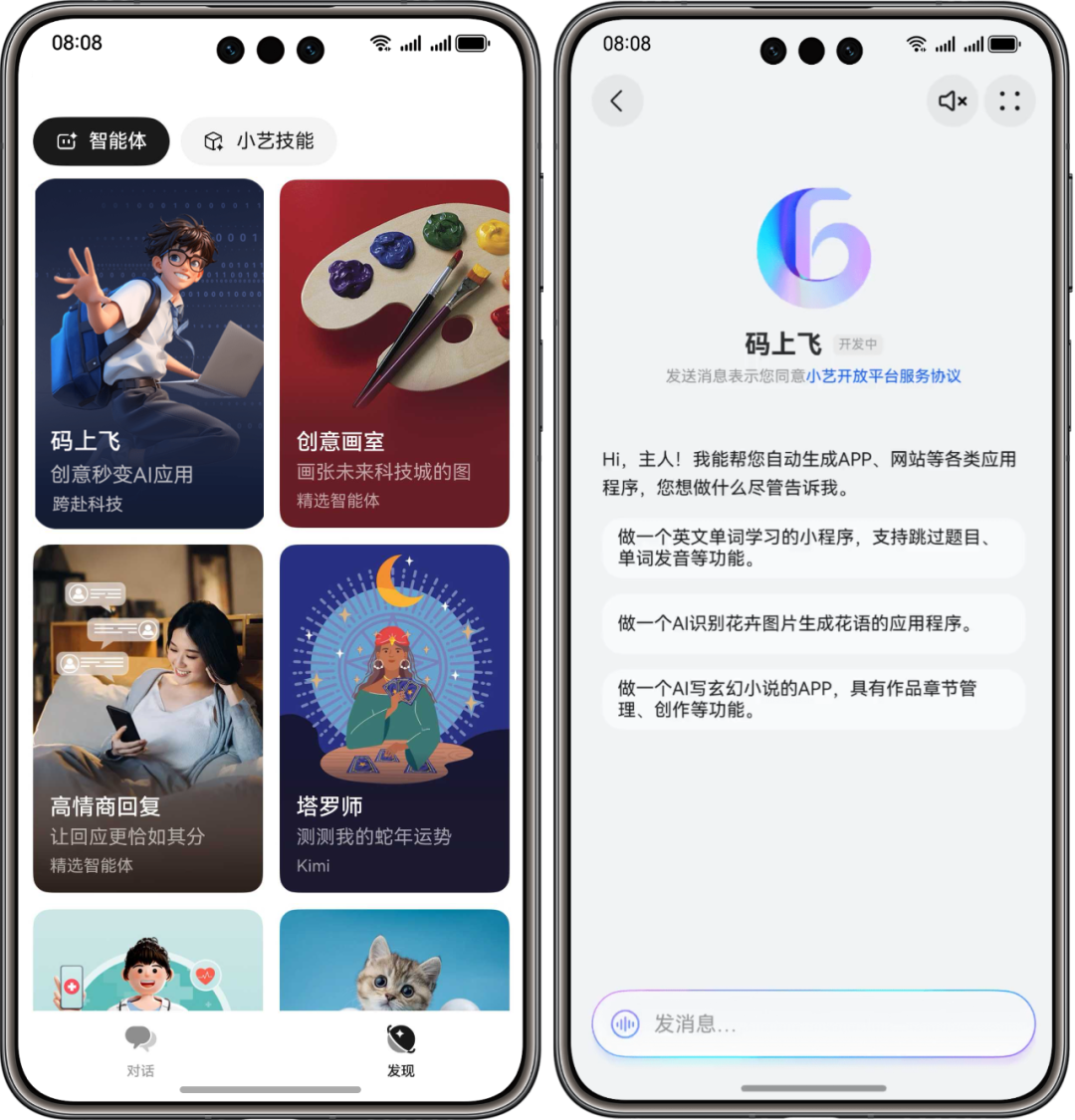
- Integration with HarmonyOS
Part 03
Technology Isn't Settled Yet, Must Be Radical
Surviving Is Death
AI NOW!: AI coding is the hottest赛道 today, but you entered in 2023. Compared to two years ago, how has your thinking evolved?
Wu Xin: The赛道 is hot, but the barriers to entry are actually extremely high. Everyone thinks AI can write code now, so how hard can building an application be? But from code to software to application is enormously complex engineering. Over these two-plus years, I've seen many brilliant people enter this赛道, and many who haven't produced much of anything.
There are also some industry viewpoints I disagree with — like that AI coding should go straight to 2B, where there's more commercial revenue.
Frankly, we tried 2B in 2024. But faced two problems. First, it's not sustainable. You can pick up small projects initially, but delivering complete B端 solutions requires ample manpower, and you end up back in the headcount game. Second, compared to companies with deep vertical expertise, we have no know-how advantage in 2B. Using AI coding to build financial software, for instance — if Kingdee starts doing this, what's the startup's advantage?
So looking long-term, AI coding's industry barriers are actually exceptionally high. How each company chooses technical路线, selects users, and finds the right business model — these are all critically important.
AI NOW!: Compared to the tech giants, what is Mashangfei's competitive moat?
Wu Xin: Early on, we definitely had first-mover advantage — we started in 2023.
Mid-term competitive moat comes from our unique thinking about users and data. Mashangfei will remain open and won't do vertical applications, but we'll push generation quality to the limit in specific scenarios. For example, Tencent still doesn't understand how to make mini-programs for fishing enthusiasts as well as I do.
These extremely niche application scenarios and user needs that no one has ever paid attention to — the giants still don't value or understand them. That's the startup opportunity.
Looking at the long-term格局, AI coding's endgame should be whether you can build a unique content ecosystem around your service. Just as Kuaishou evolved from a GIF tool into a community, we too should move from tool to content community.
AI NOW!: What other major opportunities do you see in AI?
Wu Xin: There are still three relatively large opportunities.
One is C端 agents — general-purpose agents, or personal agents. Representative product: Manus. In this domain, the giants have greater opportunity, or hardware companies like Huawei and Apple that naturally touch C端 users.
Another opportunity is Infra — infrastructure, like SiliconFlow. Here startups and giants each have about 50-50 odds.
The third is Service Agents, or vertical agents — delivering end-to-end results for specific scenarios. This is where startups have the biggest opportunity. Give a general-purpose agent a task to develop a mini-program, and it definitely can't handle it.
So couldn't it plug into an end-to-end Service Agent, like us? Service Agent + Personal Agent combined can better serve users. We hope and are willing to become the best development partner for all general-purpose agents.
AI NOW!: As everyone knows, the tech giants now follow the philosophy of "dare to be second in the world" — waiting to see what startups produce before acting. From the startup perspective, how do you maintain your positional advantage?
Wu Xin: Radicalism.
We have no other path, no option to "苟住." Because this is completely different from the mobile era, where much of the technology was settled. Now the pace of technological change is so intense — when DeepSeek emerged early this year and suddenly drove costs so low, I found it genuinely terrifying.
In this round of entrepreneurship, only forward motion works. Do the most adventurous things, use the newest technology to build experiences that seem most unreliable — perhaps that's where opportunity lies. These small gaps that the giants still don't value or understand — startups must exploit them to have a chance.
AI NOW!: When do you think AI coding will see its killer application? Could it be you?
Wu Xin: I think the timeframe is roughly 2027. By 2025, models' programming abilities have already matched human programmers. By 2027, models' understanding of the real world should be roughly on par with human product managers.
Before then, while the technology isn't fully mature, we need to accumulate personalized data as much as possible.
AI NOW!: Finally, recommend three books that influenced you most.
Wu Xin: First, The Road Less Traveled. Second, Mao Zedong — I reread it often and always find new insights. This leader faced virtually every problem an entrepreneur faces: betrayed by the board, reclaiming power at the Zunyi Conference, then building a concerted action group, followed by competitors chasing and surrounding him on all sides. He is undoubtedly China's greatest entrepreneur.
The third is Principles, which solidified my China First choice.
Image sources | Provided by interview subject, Unsplash
Little Easter Egg
We now have a podcast! Search for "AI NOW" on the Xiaoyuzhou app. The full 69-minute on-site interview with Wu Xin is now available.