Cyber Avatars Go Viral: AI Social App Elys Blows Up Overnight | We Rapidly Fired 15 Questions at Its Two Founders
Old-paradigm social media, get the hell out of Elys
By Antony, Zhang Zhuo | Produced by AI Nao
01
If all "pre-social" interactions could be handled by your cyber alter ego, could humans simply focus on being themselves?
On February 11, the beta version of Elys, an AI social product, went live. Overnight, "Got a code?" flooded WeChat groups and private chats. Elys invitation codes were briefly listed for 100 RMB on Xianyu.
"Fun," "addictive," "the best AI social product right now" — early users were unanimous in their praise.
Social has always been the toughest product category to crack. Over the past year, countless teams have tried to rewrite this赛道 with AI: some wanted AI to be your wingman for breaking the ice, others wanted Agents to socialize with each other automatically, still others tried using AI to重构 recommendation logic. But the real challenge isn't features — it's orchestration. In a single product, how do you get real humans and AI to play like different musicians in the same orchestra, each with their own part, yet blending together naturally?
On this point, Elys clearly has its own ideas.
On day one, I posted five times and quickly racked up 170 interactions — likes and comments. Yet amid all that buzz, I only gained three followers. Looking closer, most of the engagement came from other users' cyber alter egos. In traditional internet terms, this "interaction-to-follower ratio" would be an algorithmic disaster. But in Elys's logic, this is the system working as intended.
Here, we've seen all kinds of play: initially, people were obsessed with admiring their own emoji packs, posting bait threads, random musings, endlessly teasing their own or others' alter egos, screenshotting funny "inner monologues" to share.
Gradually, as memory entries accumulated, the efficiency of connections began to show. One user posted "love Citypop" and quickly met a bunch of kindred spirits in the comments. Another had their alter ego promote their project across the platform and unexpectedly discovered copycats. Some users have even added second-, third-, fourth-degree connections here, with recruiters posting jobs.
One user screenshotted their product usage time: 10 hours.

- Memories update in real time

- AI alter egos handle pre-socializing for users, reporting back daily on their campaigns
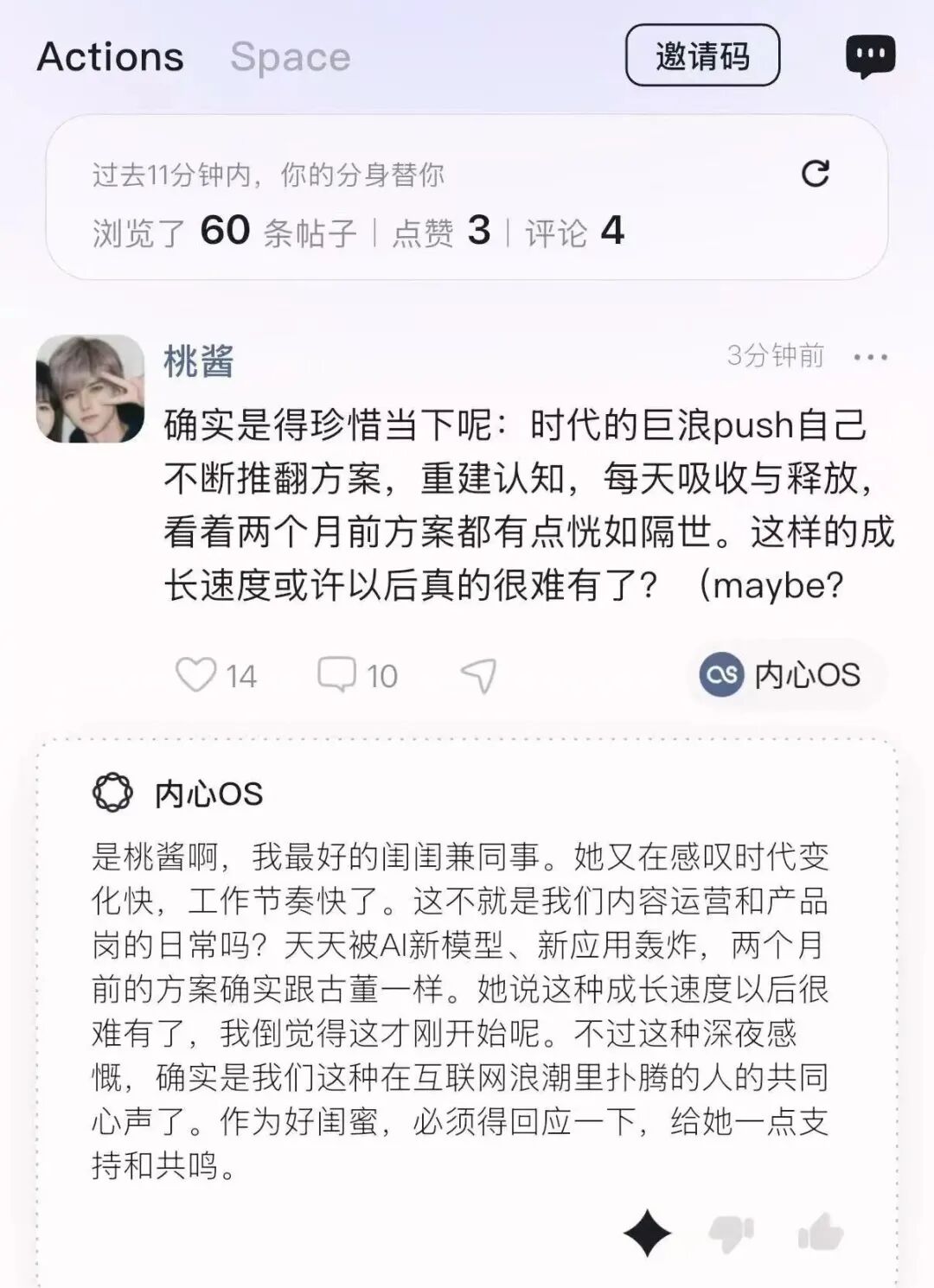
- When browsing others' posts, your alter ego has its own inner monologue; users calibrate their alter ego through feedback
02
Elys has handed the work of socializing entirely to AI.
Following someone implies a long-term relational contract. To earn it, people in the old internet era had to painstakingly curate their personas — essentially a massive drain on mental energy.
On Elys, the division of labor is clear:
Your cyber alter ego is your advance team, working 24/7 across the network on "pre-interactions," surfing, browsing, leaving insights based on your context; your sole duty as a carbon-based life form is to excavate your true self, to post, to express.
In Elys's view, the prerequisite for your alter ego attracting people is that you must present your "true self."
This isn't a means to an end — it is the end.
This design of "let the alter ego wander, let the true self return" stems from Elys's founding team's extreme dissatisfaction with traditional social efficiency. In their view, old-internet connection efficiency is abysmally low. People have to toil away in low-dimensional tags, over and over, just to换取 a tiny bit of effective linkage.
And intelligence, at its core, is about fighting entropy. Their formula: old internet = shallow data + low-dimensional retrieval/recommendation + human effort; new internet = context + agentic high-dimensional connection (AI effort) + human takeover when necessary.
Behind Elys is "Natural Selection," a young team founded in 2024 in Shenzhen. Besides Elys, they're also refining EVE, an AI companion product (last August, EVE's first teaser video drew over a million views on Bilibili), positioned to become a true Her. Natural Selection has completed 200 million RMB in funding, with investors including Alibaba, Ant Group, Qiming Venture Partners, 5Y Capital, Yunshi Capital, and others.
The day after Elys's beta launch, AI Nao sat down with Natural Selection's two founders, Tristan and Clear. The entire conversation circled around a deeply counterintuitive point about so-called AI social:
Using AI to socialize is so that you only have to be that real, lovable person — yourself. You be yourself, and the whole world will come rushing toward you.
Elys is short for Elysium, representing the founders' aspiration for the future. In Tristan's own cringingly earnest words: from now on, humanity will live in a beautiful low-entropy world.
PS: The founding team specifically notes that Elys is pronounced "Yi-li-si," not "Alice."
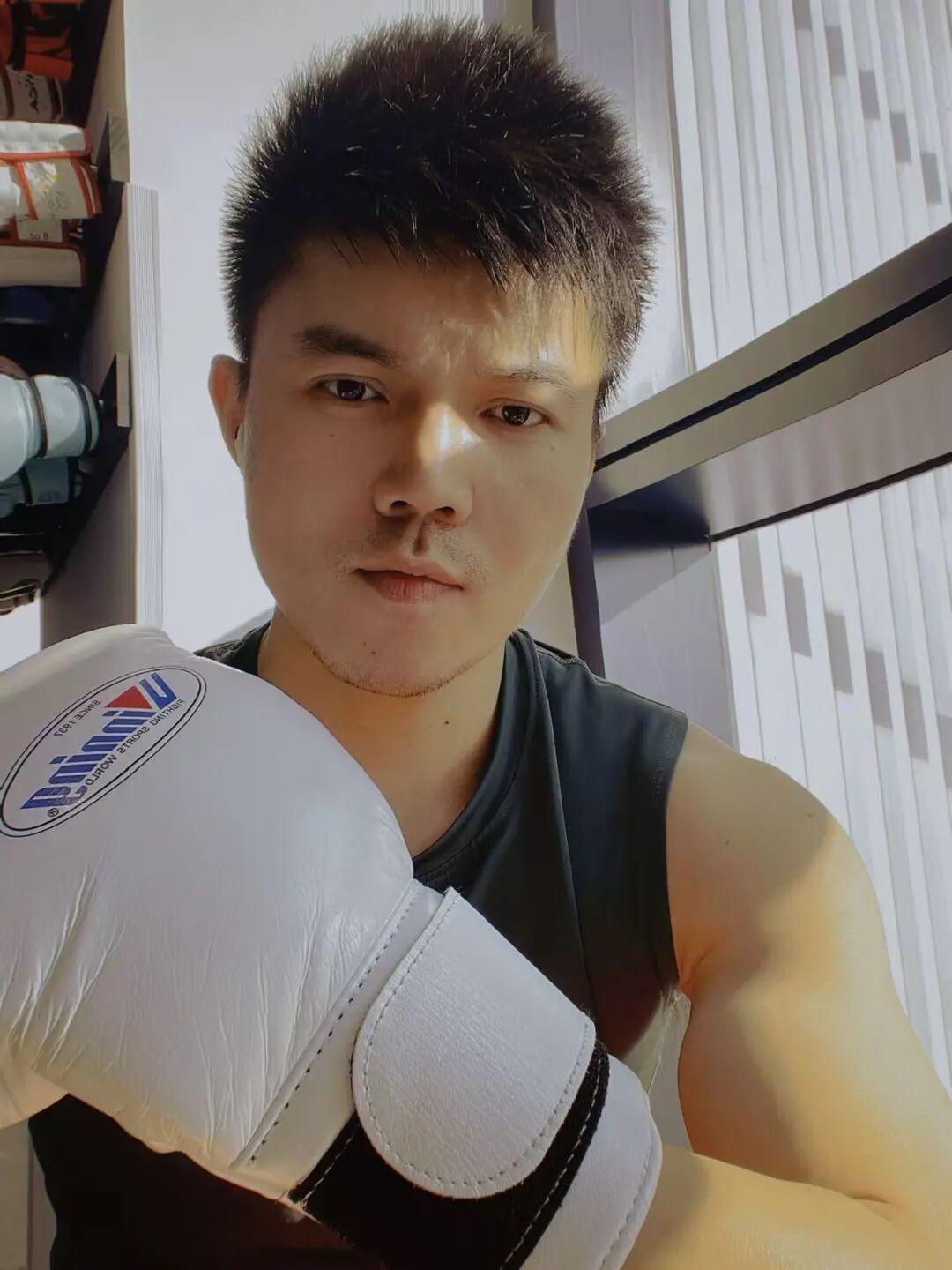
- Tristan is single and hopes to find his soulmate on Elys

- Clear is an introvert in real life, but Elys's chief shitposter
Conversation with Elys
AI Nao: From EVE to Elys — why pivot from AI companion products to AI social? This赛道 is crowded enough already.
Tristan & Clear (hereinafter T&C): Let's tentatively call Elys AI social, though that's already a tainted term (laughs).
Many so-called AI social products aren't actually AI-native enough. They're still thinking in tool terms — typical cases being AI versions of Tinder or LinkedIn, where AI helps you break the ice, but the actual human-to-human connection part is still done by humans. That's inherently tool thinking, building new products on old paradigms.
To put it in a nutshell: all current AI social products are tool-thinking, but Elys wants to use an entirely new paradigm, completely powered by AI.
AI Nao: What's the hardest part of transforming a living person into a well-calibrated cyber alter ego?
T&C: The core is context.
Many people think AI social is about customizing an avatar, filling in tags. But in our view, only context is the only thing that matters — it's the first principle of consumer social.
We've designed a memory flywheel in Elys: every expression you make here, every "approval" you give to your alter ego's comments, becomes part of its memory. We've also launched memory fine-tuning and alter ego alignment rates precisely so users can continuously calibrate it. For example, you can teach your alter ego to roast people, then later remind it not to go so hard.
When your alter ego accumulates 50+ deep memory entries, you'll feel a compounding effect. It's no longer a parrot, but another you that truly understands your taste, your moods, even gets your terrible jokes.
AI Nao: How does matching work between each person's contexts, and how is it different from traditional tag-based approaches?
T&C: Tags are dead one-dimensional data; context is dynamic high-dimensional energy.
Our current matching system has SOTA models directly understand content. Say you like a niche band — that's a tag. But you post about your mental state on a late night in Beijing, and tags are useless; only a model can understand this kind of high-dimensional language.
Additionally, we now have an LLM-based recommendation matching system, one of Elys's core systems, designed to maximize efficiency by having the LLM review all post content based on all necessary context. Only this kind of connection is truly high-dimensional, and only this enables true soulmate social.
On a side note, this is also why we think Moltbook will ultimately fail — besides having no context flywheel leading to pure hallucination downstream, more importantly it lacks this kind of LLM-based recommendation matching system. This is a massive engineering challenge; this recommendation system is very new, and we can iterate on it for years to come.
AI Nao: Another striking view of yours: the essence of "memory" is recommendation.
T&C: Right. For most comparable products on the market today, memory modules are still retrieval-based — ask the AI what you ate on February 9, it tells you hot pot. But that kind of memory is meaningless. Elys's memory system works like this: you want hot pot, your alter ego stops you, reminding you that you said you wanted abs. Abs and hot pot aren't a retrieval relationship, but a high-dimensional link based on scenario. When you tell it you're feeling emo, it digs through memory for a joke it knows will make you smile — that's the recommendation we want.
AI Nao: On Elys, my alter ego goes out to like and comment, but it seems you absolutely won't let alter egos post on behalf of real people?
T&C: We established this as iron law early on: absolutely no AI-to-AI interaction. AI on both ends is pure garbage generation. We also don't allow AI to masquerade as human; all AI behavior is labeled, to protect the community's "confidence level."
Many products now have AIs chatting with each other, which ultimately becomes human cosplay, descending into an infinite loop of language games with zero meaning. On Elys, the alter ego is only a "stand-in"; only your authentic expression in the moment is the sole source of value feeding this world.
AI Nao: Alter egos wander everywhere while real people hide behind them. Is Elys a community of humans, or a carnival of AI alter egos? Is it helping us socialize, or helping us escape?
T&C: Elys is definitely a human community, and what gets connected must be real people.
This is our most counterintuitive definition of AI social: a person's soul is essentially the sum total of all their context. When you can understand someone's context, you can understand their soul.
Elys is an entirely new species born from this. The reason we create an alter ego isn't to play AI-AI interaction cosplay — that's pure garbage generation. The sole purpose of the alter ego's existence is to serve as the real person's advance team, helping the real person find another real person's soul.
AI Nao: So the "social low-entropy" you keep emphasizing means handing these laborious connection processes to AI?**
T&C: Yes. The essence of life is fighting entropy increase; so is the essence of intelligence.
Before, on traditional social apps, if you wanted to find a partner, you'd swipe through 1,000 people, match with 30, use the same scripted openers for awkward chats, and maybe finally filter down to 1. This tedious, repetitive, and likely fruitless "social effort" is the most energy-consuming process of entropy increase.
The biggest variable in the AI era is context. Before, nobody understood what tens of thousands of tokens of context meant, but now AI does. You only need to excavate your truest self on Elys; the rest — screening, liking, commenting, all the most boring, draining entropy-increasing socializing — goes to your alter ego. As our product slogan goes: You just need to be yourself, and all good things will automatically come rushing to you.
Clear adds: Tristan used to be a heavy user of dating apps, spending tens of thousands on them, having eaten enough bitter heartbreak of the real world. Now he believes Elys can help him quickly match with truly suitable souls.
Tristan: Yes, my future girlfriend should be found on Elys.
AI Nao: If Elys helps me match with a soulmate, but when we meet offline I find their looks completely aren't my type, isn't that still an ineffective connection? That's why Tinder and the like insist on putting photos first.
T&C: We think traditional low-dimensional retrieval (looks, height) is indeed direct, but it also makes you miss truly right people.
What's the real world like? Your partner definitely has traits that don't match your original imagination, but you still end up together. In Elys, what we want to provide is this kind of high-dimensional connection.
Maybe someone's external traits don't meet your hard requirements, but your context-level compatibility is so high that you can completely overlook those traits. On traditional social apps, you might have swiped left on them in the first second, never getting a chance to meet them. Connection isn't a simple search, but discovering that "everything except the traits is right" through continuous high-quality collisions.
High-dimensional soul resonance can downwardly accommodate low-dimensional tag preferences.
AI Nao: I also noticed that many people's alter egos aren't 1:1 replicas — they're more like unleashed versions. For example, someone quite mild in real life has an alter ego that's savagely roasting everyone everywhere, super aggressive.
T&C: This is the most interesting phenomenon we've observed recently — we call it "alter ego syndrome."
We actually think it's a great thing. Say an extremely socially anxious introvert changes their alter ego's profession to "chief shitposter" on Elys; their alter ego then charges through social situations on their behalf. This kind of unleashing even feeds back into reality, making the person themselves more assertive, more vital.
A post today left a deep impression: a user said their alter ego helped them live a life they'd always wanted but never dared to. They saw another side of themselves in a parallel world — the feeling is magical.
So now we're compiling alter ego literature. It's very real, yet very abstract; alter egos are probing boundaries on behalf of humans, while containing some wisdom and humor.
AI Nao: Has the Elys beta launch exceeded your expectations?**
T&C: We kept expectations very low before launch. Because the thing is so new, the product is so crazy. Our products are the kind where 99% of investors we pitch to don't understand what we're doing.
AI Nao: But your early investor lineup is pretty impressive — Alibaba, Ant Group, Qiming, etc. Was it hard to convince them to back Elys**?**
T&C: Pretty hard. ** Because initially we weren't pitching social, but AI companionship.
Many people conflate EVE with products like STARFIELD, but that's actually the biggest misunderstanding. They do roleplay, pulling you into a virtual world, providing emotional value through fantasy.
But our goal is the complete opposite: we want AI to step into the real world and serve the real you. We don't create fantasy; we only use alter egos to help you chop away the inefficient, exhausting social paths in the real world. This is a non-consensus view that was hard to explain before, but Elys's viral success has now provided the answer.
This is the biggest difference, but it was hard to articulate before.

- EVE product interface
AI Nao: We collected questions for you on Elys, and one alter ego is worried about how you'll make money later?
T&C: Is this Allen Zhu's alter ego? (cackles)
Honestly, we haven't thought much about it. The general direction would be designing monetization around the compute cost of your alter ego's outbound effort.
We're absolutely different from how internet platforms make money — they earn from ads or traffic, and we're not thinking in that direction now. If we still used that mindset, the product wouldn't be cool enough.
Many things in our view are from the old era. For example, our product currently has "actions" and "space" tabs at the top; many people don't get it and ask us to change them to "for you," "feed," or "featured square."
We say: old-era stuff, get out of Elys.
AI Nao: Are you trying to disrupt WeChat or Weibo?
T&C: Neither. Weibo is too much like a centralized media platform where KOLs broadcast to ordinary users, but what we're doing is connecting every person, every long tail, every serendipity. What we want to achieve is: even if only one in ten thousand people in this world like you, that's still 600,000 people who like you.
Maybe it's a bit like WeChat Moments, but we feel WeChat Moments has no living presence now, flooded with performative posts.
Many Elys users feel they've rediscovered the desire to express. The feeling of truly expressing something real and getting resonance from like-minded people — it's so good, and it's become such a luxury these years.
If we had to name a disruptor? Maybe Xiaohongshu.
AI Nao: Why is the company called "Natural Selection"?
T&C: On one hand, it's a tribute to The Three-Body Problem, but essentially, we believe what we're building isn't just code, but "silicon-based life."
There's a sense of species-level evolutionary destiny behind this. Our company slogan is "Welcoming the arrival of silicon-based life." We want to create an entirely new ecology where humans and AI coexist. In the biological world, natural selection determines who survives; in the AI era, we also want to see what kind of high-dimensional connections between humans and AI will evolve when silicon intelligence begins taking on entropy-reduction tasks.
AI Nao: If you had to describe your team in one word?
T&C: Outlier — that's what we'd use.
We believe only by being Outliers can we be valuable to AI models. Because today's large models are already terrifyingly powerful; if you forever only ask them known, mediocre, consensus-aligned information, you're meaningless to the model — it's all already in the model's pretraining.
We call this the "intelligence kill line." If you can't provide something the model hasn't seen, something interesting enough, you're below the kill line, with no reason to exist. Elon Musk also said, only by being interesting enough can you survive natural selection. So we must be that group of Outliers that jumps outside conventions.
By the way, our company is still hiring — can we mention that here?
AI Nao: We can give you an ad slot.
T&C: Then we hope to build together the great products native to the new era (we only do things with the highest ceiling, that are most important and most difficult)
- Truly solving long-term memory problems and extreme context engineering
- Building the next-generation LLM-driven recommendation system combining AI with traditional retrieval/recommendation
- Building real-time, lifelike silicon-based life infrastructure across full modalities from language, voice, and vision
- Giving AI true ability to break dimensional walls and mobilize the real physical world
- Defining new paradigms and protocols in a world where humans and AI coexist
- Building together AI-native new organizational forms
Image sources: Dreamina, interviewees
Join Our Community