After Closing a Sequoia Angel Round, the Browser Isn't the Best Container for the AI Era | A Conversation with Tan Shaoqing of FloatBoat
Another one, out to dethrone Microsoft.
Client-Side Entry Point | Evolution | Regression | Work Avatar | New Collaboration Platform
Produced by | AI Nao
01
Today, nearly every AI productivity tool asks users to talk to a chatbox.
FloatBoat wants to flip that: let AI learn how humans work first.
That's what makes this product unusual — its client-side form factor. Many see this as a step backward, but founder Tan Shaoqing believes the browser-plus-chatbox model that's popular now is itself an old tool clinging to old production relationships.
Latest news: FloatBoat has secured angel funding from HSG and WeLight.
Tan thinks too many products on the market are overly cumbersome. Users repeatedly upload files, switch windows, and with each new task, have to re-explain everything from scratch. FloatBoat enters your work environment through a desktop client, then distills your experience, judgment, and workflows into skills.
I tried a simple task: I dropped a local interview recording into FloatBoat and had it transcribe — it saved the result locally. Then I asked it to turn that recording into a 500-word memo. The next time I threw in a new recording, it already knew the drill.
The entire process happens in one interface, no more than three steps.
"For enterprise users, the workflow goes even further," Tan says. "A salesperson finishes a client call, drops in the recording, and it can directly populate the CRM." As the product absorbs more work context — files, web pages, tasks, work habits — it eventually learns and evolves into your work avatar.
This is what Tan considers "the most valuable asset in the AI era" — "taking over the user's work context, workflows, and methods, building the optimal human-AI collaborative workspace."
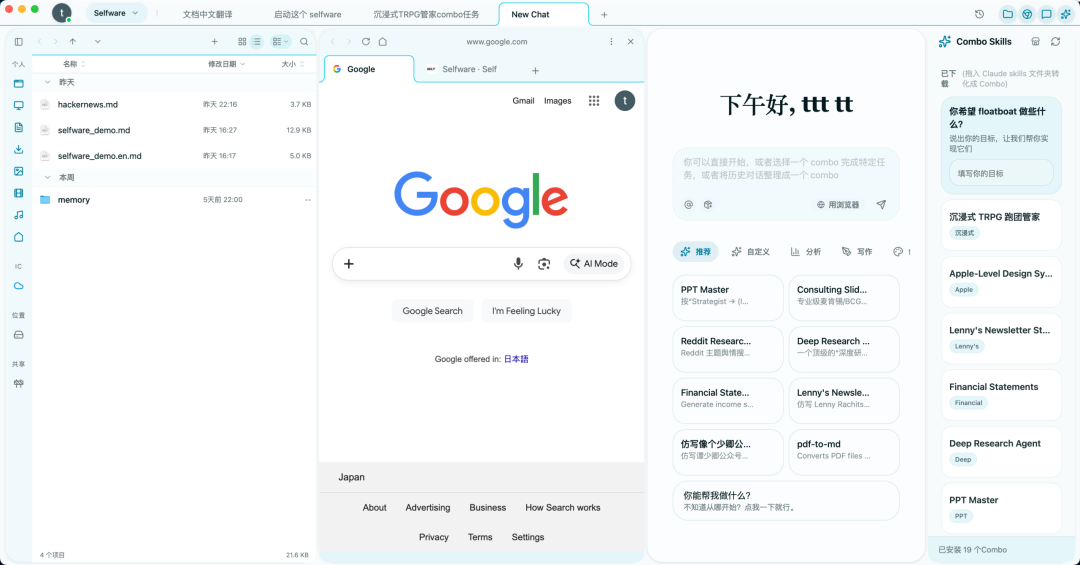
- Product interface
02
What exactly is a human-AI collaborative workspace?
Tan shared a thought.
In the 1990s, Microsoft bundled Word, Excel, and PowerPoint into a box called Office. It defined the PC-era way of working. In 2006, Google moved documents to the cloud; collaboration began replacing local saves. In the two decades since, countless new productivity tools have emerged, but the underlying logic hasn't substantially changed: users open software, manually locate files, switch windows, copy and paste, bouncing between different applications. But AI has once again transformed productivity, and with it, the human-computer interaction model — humans using natural language to have AI complete work directly (Agent).
"You can think of FloatBoat as an AI assistant living inside your computer, sharing the same desktop as you: your files on the left, the web page you're viewing in the middle, and your Agent and accumulated Skills on the right."
Tan has a characteristic calmness — the kind that comes from riding out several technology waves. He's a post-80s entrepreneur on his third startup. His first venture was in smart transportation, followed by mobile security at 360, then AI-ification and internet-ification of Android OEM operating systems. He's essentially traveled the full arc from China's mobile internet to AI — expert systems, machine learning, deep learning, to large models.
He speaks fast, very abstract, occasionally betraying impatience.
The name Floatboat evokes a vessel suspended in an ocean of models — "hoping to create a sense of suspension between humans and models."
Very abstract again.
I asked Tan to just name which giant he's trying to challenge. "Microsoft?" He thought for half a minute, as if confirming he wasn't overreaching. "Microsoft it is. If we pull this off, we replace Microsoft."
A David-and-Goliath story of hubris — but markets love this kind of ambition.
FloatBoat just launched, currently in testing. Its initial user target is the "OPC" (One Person Company), prioritizing overseas markets, with tiered monthly subscriptions. It will soon integrate with Lark, WhatsApp, and other office tools. "If users aren't satisfied with results, they can request a refund — we're forcing ourselves to upgrade our system capabilities."
Tan's vision is grand and clear, but much remains unproven. Over the past year, we've seen countless entrepreneurs aiming to dethrone Microsoft — the real challenge is user volume and trust density.
Will people entrust their work methods to an Agent? Will enterprises open internal workflows to it? If Microsoft integrates similar features, where does a startup's survival space lie? "Workflows belong to individuals as assets" is certainly a beautiful vision, but will it become a trillion-dollar track?
Bill Gates said something in Microsoft's 50th anniversary retrospective: when founding Microsoft, he believed in "a computer on every desk and in every home" — so, will an updated work platform emerge in the AI era?
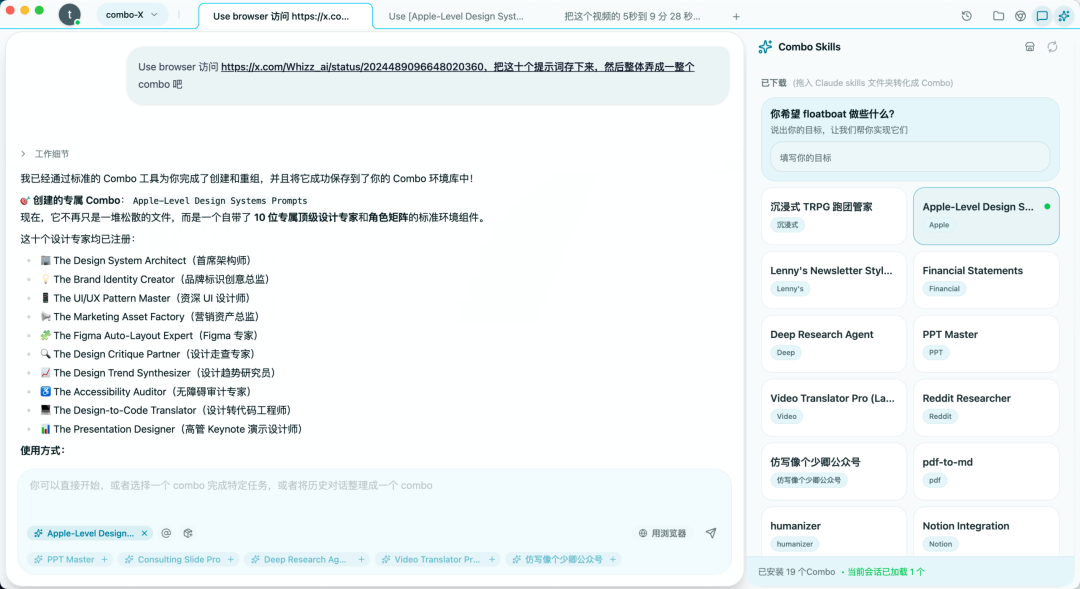
- Packaging your own skill
"In Conversation with Tan Shaoqing NOW"
AI Nao First, why choose to build a desktop client? Many people see this as a regressive product form at a time when enterprise software is getting lighter and lighter.
Tan Shaoqing Our goal is to have the Agent move into your actual work site, then help you operate within a human-Agent collaborative network. There are many reasons for choosing the client-side entry point — I'll mention two. First, browser-based and cloud Agents can't access continuous context.
Second, product design determines user needs. We want to build a product that fully unleashes user demand, which maximizes model capability release. If a user is just staring at an input box, there's a lot of demand they can't articulate.
The current client-side form is only what I consider the most suitable entry point, not the endgame.
AI Nao What do you mean by an AI-era office collaboration network?
Tan Shaoqing Pulling this off takes two steps.
Step one: build an Agent that really understands how you work. Step two: the Agent learns from you, then goes out and works on your behalf.
That's why in phase one we had to choose the client — it needs to learn your workflow first, the environment gets built, and then comes collaboration.
Future collaboration should seamlessly switch across a user's different devices. Phone, computer, glasses. It can also happen between different people. For example, today's interview — I could have handed over a lot of content and materials to my Agent beforehand; you have an Agent too; the four of us — two humans, two Agents — start a group chat and let them communicate first. They don't even have to be our Agents.
AI Nao When I instinctively hit Cmd+T to open a new tab, FloatBoat's split-screen logic did feel somewhat uncomfortable.
Tan Shaoqing Many heavy AI users do find our product overly complex at first glance. But to some extent that's because we've been domesticated by the "browser plus chatbox" product form.
One person on our team initially thought, wouldn't a single input box be enough? Until ClaudeCowork launched — she used it for a few tasks, then said, turns out our design was right.
Actually, a large number of less AI-savvy users find our product structure familiar — this is their native desktop. Someone working in an office essentially uses two things at high frequency: file manager and browser. We seamlessly integrate these two functions into one product.
We're betting that AI has changed division of labor, changed work content and processes, and therefore will inevitably change the interface of knowledge work. In this space, the valuable companies won't be those calling models, but those controlling the interaction layer between models and work context.
Human-computer interaction has never been more important — it's just that people haven't talked about it much these past few years.
AI Nao What do you mean by an interaction layer company?
Tan Shaoqing We call it Floatboat — one meaning is letting users float above the waves; for ourselves, this sense of suspension is actually an architectural requirement.
I break the product into three layers: humans on one side, models on the other. The interaction layer is like a pipe. Good architecture makes that pipe as "wide" as possible, amplifying capabilities on both sides.
The hardest part in development is making sure our product doesn't get locked into any single generation of models, or limited by any technical architecture. As model capabilities improve, our capabilities improve too. Stay suspended, stand from the angle of productivity maximization, be an open and neutral third party. That ecological niche exists.
AI Nao What's truly valuable in the interaction layer is having "context control" — taking over local files, browser, task state, remembering well, managing well — that gets you closer to establishing a new work operating system?
Tan Shaoqing I remember Steve Jobs's first iPhone launch. He said today we're introducing three products: a phone, a music player, an internet device. He called it iPhone. We know what happened next.
Floatboat's design logic can be explained in one sentence: directly build an AI-native productivity environment where your work actually happens. Wherever work happens, it should be there. Not making you jump to a new chat window, but bringing AI into your existing workspace.
Entering from the PC side (where most knowledge work happens) consists of three parts: File Manager, Browser, and a super-Agent that can call upon the entire computer and internet.
Why these three? Because when knowledge workers open their computers, these are what they use — Floatboat directly builds these two most core work territories into an environment for the Agent:
- Files you see, the Agent can see
- Web pages you access, the Agent can sense
- Operations you can perform, the Agent can perform
- With your authorization, the entire computer and network are the Agent's tools
The key difference lies in context construction. You don't need to think "what context should I feed it." You just find and open files as normal — you see it, it sees it. If you don't mention it, it won't go rummaging; if you do, it can see and operate. The entire context flow is extremely smooth.
You can also open any third-party application in Floatboat's browser — ChatGPT, Claude, Manus, even corporate intranets — and the Agent can sense them. The file manager and browser are themselves the interaction interface — no additional chat window needed.
That's step one.
Step two is having humans and Agents form a collaborative network. If we can achieve this, it may be the first time productivity gains super network effects. It won't necessarily happen inside traditional IM, but rather in the productivity domain itself.
AI Nao So next it can evolve into my avatar, working for me in the network?
Tan Shaoqing The key is "on your behalf," not replacing you. That's why I want to build a collaborative office network, and a decentralized one at that.
Suppose I want to ask Steve Jobs about product-making. He's too busy. So I chat with his Agent first. Getting Jobs himself — impossible, or astronomically expensive. Chatting with his Agent, priced at 5,000 yuan an hour — I think there's a market.
But this doesn't mean humans exit. On the contrary, humans remain important. You couldn't serve 100 people before, but with an Agent, it handles most of the work for you.
The essence is massively unleashing the potential of both humans and models — that's another reason we don't go purely cloud-based, so your work assets stay in your hands. We choose decentralized collaboration, facing the future, back to the giants.
AI Nao The critical piece here is trust. How do I feel comfortable handing over my work methods? What if it makes mistakes on my behalf?
Tan Shaoqing I'll mention a very small thing: for something as simple as organizing folders, we've designed it so users can completely undo operations, reverting to exactly the pre-organization state. But that's still not the main point.
The main point is how to expand productivity — how collaboration between different Agents and humans gets realized. We built a dedicated protocol and open-sourced it. This is a file protocol for the Agent era, subverting traditional software and SaaS. A selectable, traceable work record. Humans can intervene anytime — if you think it did something poorly, go in and directly edit.
Additionally, we're exploring pay-for-results. We'll soon launch a "user experience guarantee program" — if you're unsatisfied, directly refund your credits.
As a startup, doing this is our way of exploring a model-suspended evolutionary system, and forcing ourselves to evolve different capabilities.
AI Nao Honestly, Floatboat felt very similar to OpenClaw on first use. Launching at this point, did you reference OpenClaw's architecture?
Tan Shaoqing By July 2025 we already had this product positioning — always clear, never changed mid-course.
Actually, fundraising last year was very challenging. The Skill concept didn't even exist then. ClaudeCowork, OpenClaw — they probably hadn't started writing code. Most people couldn't understand what we were doing at all. Everything I'm saying is verifiable.
Also, what we want to build is an office collaboration network — OpenClaw is not that.
Moreover, every technology and interaction mode has its suited scenarios. IM isn't suitable for heavy office work, otherwise we would have launched mobile first. Floatboat lives in your computer/server, while also connecting through various IMs. It's still about context flow.
OpenClaw's emergence is actually good for us now — it helps prove one thing: client-side entry is viable. That is, Agents can indeed run autonomously locally, using the user's computer as environment, solving general problems through self-improvement.
AI Nao Why not build vertical Agents?
Tan Shaoqing I believe that as intelligence emerges, skill levels across all professions and industries will be flattened. What we need to do is, through better human-computer interaction, thoroughly unleash human potential. Only then can model capabilities be released to humans. To achieve this, models need sufficient context — so absolutely cannot stay vertical only.
AI Nao Professions and industries getting flattened — elaborate?
Tan Shaoqing With AI's arrival, many professions will become skills.
Take driving. It used to be quite a high-barrier skill. Then manual became automatic — many more people could drive. With autonomous driving, maybe the skill disappears entirely. Including old-school typists, and now programmers.
AI Nao Skills become more liquid, turning into capability modules anyone can call — so many professions get dismantled. What happens next? Is this good?
Tan Shaoqing Good question. If I had to put my values in one sentence: Agent-First in technology, Human-centered in product interaction. Agent-native, human-centric.
Despite many voices saying AI will take our jobs, I've always believed that as productivity develops, humanity moves toward better outcomes in the long term. It's just that professions becoming skills is an inevitable trend, and we're choosing to build an AI-native office environment for the next generation of work methods.
Image sources | Unsplash, interviewee provided
Join Community