No product in the world has suddenly become unique simply by adding AI | A conversation with Shaonan, founder of flomo

A Company's Choices in the AI Era

By Zhuo Zhang | Produced by AI Nao
Intro
flomo has always been an oddball in the industry.
As an independent note-taking product, flomo's philosophy is clear: capture genuine thoughts, not pursue efficiency or hoard information. It skipped mainstream features like one-click saving or auto-sync. The homepage is just a simple input box. That's it.
Five years in, flomo has accumulated roughly 100 million notes and collected nearly every domestic app award there is. Its uniqueness isn't technical — it's a deep insight into what "recording" actually means.
In short, in an age of fragments, it strives to protect people's thinking.
This was bound to alienate mainstream users, but it also gave a small group of die-hard fans a sense of spiritual belonging.
Entering the AI era, flomo remains "restrained."
After DeepSeek went viral early last year — with competitors like Youdao Cloud Notes and Evernote rushing to adapt — flomo didn't launch its own feature, "AI Insight," until July.
Restraint, in a sense, is the rationalization of capability boundaries. While the industry races after Agents, long-form voice, and hardware, flomo's discipline is clear: no efficiency tools, no generation, no writing editor.
"No product in this world suddenly becomes unique just because it added AI support," says Shaonan, flomo's co-founder.
On running a company, flomo is equally unconventional.
No fundraising since day one. "Investors might as well put their money in Alipay," Shaonan says. Both he and his partner Light admire Warren Buffett, pursuing simple businesses and steady cash flow.
AI Nao met Shaonan for a long talk in Hangzhou. Initially, we wanted to understand how an independent product like flomo survives amid the AI frenzy.
By the end, we found this self-described "classical" product manager thinking most about "people": how people maintain agency and creativity in changing times. "As long as agency remains in your own hands, AI doesn't really matter."
Below is a nearly 10,000-word interview, lightly edited. Founders who can articulate "what we choose not to do" are rare.

- Shaonan

- flomo's office sits in an old factory district in Hangzhou. No trophies or awards are displayed. Shaonan believes that when an organization starts looking back at past achievements, it has stopped striving.
Conversation with Shaonan
Part 01
AI Can't Just Make You Feel Good
AI Nao: First question, also our biggest curiosity — why did it take half a year after DeepSeek's rise to launch your model-adapted feature? Wasn't that too slow?
Shaonan: It depends on user needs, on how much it actually helps users. After DeepSeek blew up, many competitors quickly integrated it. But I kept asking: what added value would AI bring to our product? Would that value come from DeepSeek's inherent capabilities, or from something new created by combining it with our product?
AI Nao: Do you think it was mostly narrative at the time?
Shaonan: At least around Spring Festival 2025, it was largely narrative.
Of course we felt pressure. Competitors all did it, their rankings rose. Was I anxious? Of course.
Second consideration was cost. Costs have dropped exponentially since, but back then it was too expensive. flomo's annual fee is 99 yuan. If we integrated AI, each use would cost nearly 0.1 yuan. Unlimited use and we'd quickly go under. But limiting usage contradicts user needs.
We were cornered,进退两难, but had to hold back. That was the state.
AI Nao: Was holding back hard?
Shaonan: Very hard. Everyone in the industry felt note-taking products should be first to integrate models, that notes would be the first domain disrupted by models.
We decided not to, because the unit economics didn't work. More importantly, were user needs sustained or just curious?
Early 2025 was pretty tough.
AI Nao: No internal disputes?
Shaonan: Not really, we were fairly aligned.
After calming down, we figured if we were really in trouble, DAU and new user numbers would immediately drop. But in fact, data didn't halve — there was even slow growth.
So we immediately conducted extensive user research. Turns out users couldn't distinguish reasoning models, couldn't even tell what adding one would change.
Many users asked: would adding a model let me chat with my tens of thousands of past notes? That wasn't actually possible then — context windows weren't that large, only loading dozens of entries each time. So results diverged significantly from user expectations.
My feeling: the industry was blazing, but stepping into the concrete world, doing research, considering business costs — the conclusion was clear: for a company our size, it wasn't that urgent.
AI Nao: How did you think through next steps?
Shaonan: Back to first principles: what is flomo's competitive advantage?
From day one, we had no model capabilities. We can't make water; we're just a small boat that needs to float.
flomo's most valuable asset over five years: users have recorded over 100 million genuine notes here. What happens when you combine that real data with models?
Our deduction was "AI Insight" — not assistant, not copilot. It doesn't help you be more efficient. It just excavates what's hidden behind your notes.
AI Nao: Coincidentally, flomo's core value is now "personal authentic context." In hindsight, was your founding positioning luck?
Shaonan: Five years ago when building flomo, I never imagined AI would progress this fast. The product followed a simple philosophy: first, keep recording continuously; second, let meaning emerge naturally.
We got criticized for talking philosophy while the product was "trash," missing many features.
Features like one-click saving — I was tempted. Many products made it their selling point. Our users wanted one-click WeChat official account forwarding too. I resisted it all, because I believed the more articles you hoard, the less you remember. Articles aren't your thinking.
We emphasized the long-term value of recording, hoping users would actually use their brains to note things down. To underscore this, we even wrote a book, The Way of Note-Taking.
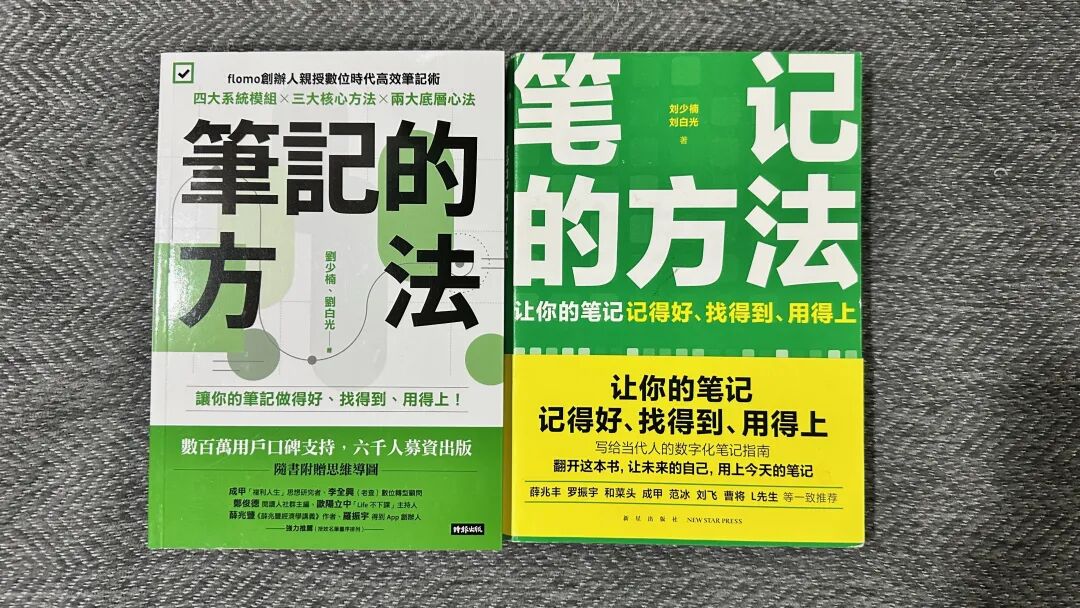
- This book is excellent, highly recommended
AI Nao: Many peers评价 "AI Insight": late but precise. On one hand, as model capabilities improve, insights get better; on the other, wanting better insights actually increases usage frequency.
Shaonan: Right, it became a positive flywheel. We observed that among users who use AI Insight, 40% increased their flomo usage frequency.
Actually, we paid attention to AI early, just acted late. In 2024, when "vectorization" technology matured, we launched "Related Notes" — accuracy improved significantly.
For the first version of "AI Insight," we didn't support custom prompts. We revised the default prompt over 100 times, right up until launch. Fortunately, user feedback was good. Once this path proved viable, we gained confidence to offer more perspectives, letting users choose and play. And interestingly, costs keep dropping.
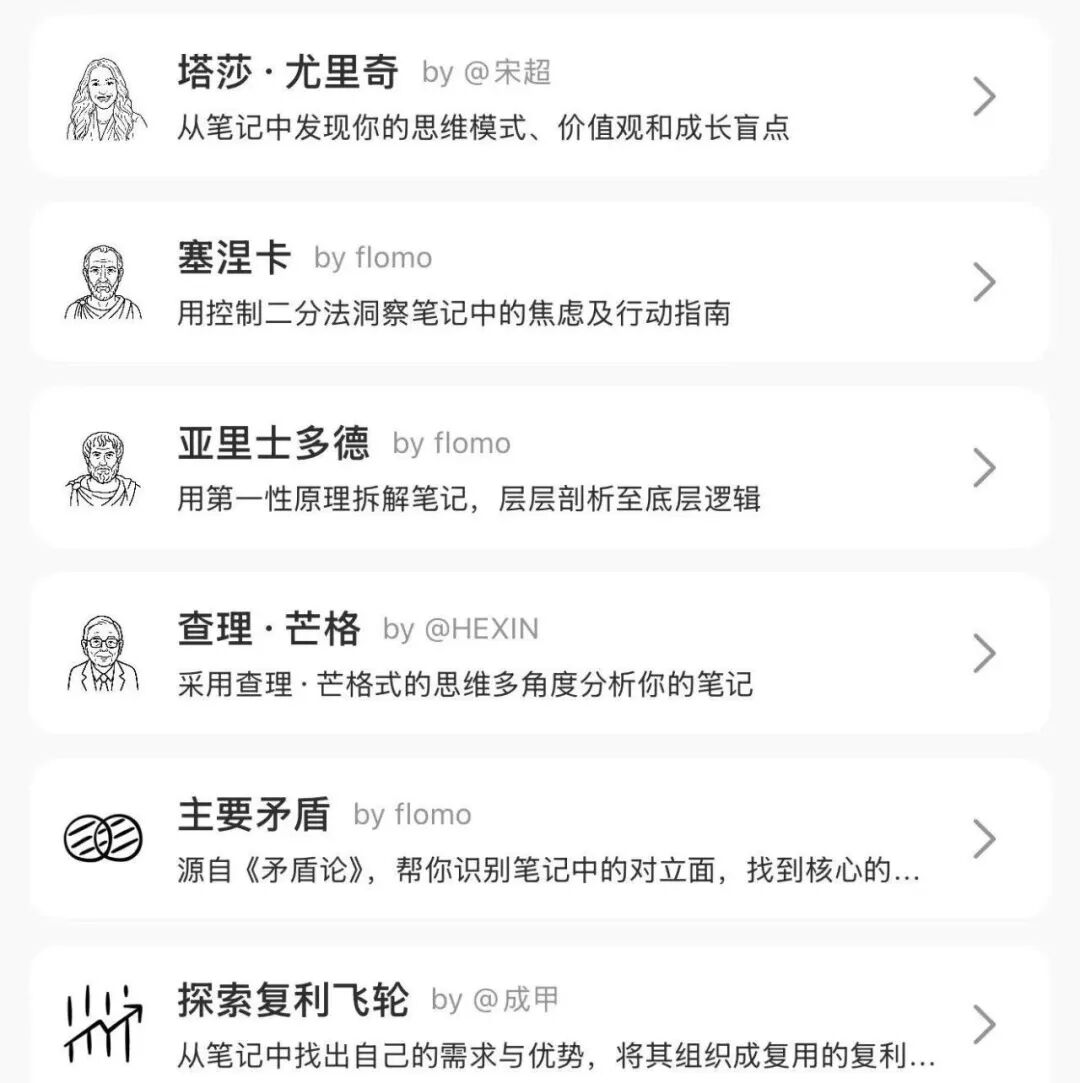
- Users can select perspectives or customize their own
If there's one most important thought, this is something I've insisted on since day one of engaging with AI: AI helps users think, not replaces thinking. So we won't build any pure efficiency features.
AI is a thinking partner — it can't just make you feel good. It must challenge you, argue with you, inspire you.
So using "AI Insight" is pretty tough (laughs). Click, and out spews hundreds of words. You have to read, ponder, might even feel depressed afterward.
AI Nao: I felt depressed after using it — it revealed my inconsistency between knowledge and action.
Shaonan: Maybe flomo wasn't designed to feel "good" from day one, with its "record in your own words" approach. AI Insight doesn't change that.
But from another angle, while this "not feeling good" prevents explosive growth, once users accept it and experience the value, they stay long-term.
It's like playing Miyazaki's Elden Ring. Most people can't handle that hardship, but once you get familiar with the "Souls-like" cycle of death, frustration, and growth, you fall in love with the genre.
Conversely, adding AI Insight doesn't change the product's nature. There's a bigger problem in front of me that needs solving; these are just local optimizations.
AI Nao: What's the bigger problem?
Shaonan: How to get users to keep recording continuously. That's always been the only question.
No note-taking tool in this world suddenly becomes unique just because it added AI support.
AI Nao: Small question — why no one-click save after "AI Insight" generates a report?
Shaonan: Because it pollutes your corpus. The insight report isn't your thinking. One-click saving it into the product means next time you get insights, the timeline is contaminated, no longer authentic.
AI Nao: So you care that much about "authenticity."
Shaonan: I don't want "authenticity" diluted.
Part 02
Hoping People Actively Use Their Brains
AI Nao: What's been the harshest criticism since "AI Insight" launched?
Shaonan: That it's not AI-native enough, the insights are garbage. Compared to Gemini, Claude, it's not competitive.
My response: they're right, but real constraints are hard to break.
For compliance, our options are basically DeepSeek, Doubao, etc. There's a time lag versus overseas models — we can only wait for now.
Second is cost. Overseas models basically start at $20/month. We're only 12 yuan/month. This gap means we can't use the most expensive, best models.
But from another angle, we don't target just geek users. For most users, the experience should be sufficient, since many only encountered DeepSeek in Spring Festival 2025. So overall experience is consistent, no major gap.
AI Nao: What AI features will you absolutely not build?
Shaonan: First, we don't do pure efficiency for users. Second, no ex nihilo features — like generating, expanding, absolutely not. Third, definitely no writing tools.
AI Nao: Aren't you deciding for users what better thinking is? Mass demand is having ideas, but writing articles is hard.
Shaonan: Then I recommend they use other tools to generate.
Our product emphasizes: even writing 1-2 sentences, write your genuine thoughts.
But recently I've had some reflections. It's not fundamentalist to say only hand-typing every character counts as thinking. Maybe recording by voice works too.
And now massive conversations happen in chatbots. Is there human thinking there? I think definitely — chatting for twenty minutes, tens of thousands of words, it's a new form of thinking, just with changed morphology.
In short, I still hope users actively do some work in their brains.
AI Nao: You seem to especially emphasize human agency when using AI.
Shaonan: I've actually researched many users who want AI to help generate articles. Their goal isn't creation; it's quickly building an account. That purpose doesn't match my product.
If you're not that kind of writer, if you want to create but need AI to generate articles from your ideas — I'm afraid you'll lose the dialectical process, lose taste and understanding of things, lose the joy the creative process brings.
Over time, how would you know if what AI generates is good or bad?
AI Nao: Do you have a solution?
Shaonan: For example, I also use AI for writing. My creative goal is making content more distinctive, gaining something myself.
So I start by telling AI the background: why write this? What have I thought about, recorded before? How do I want to begin? What structure do I envision?
Then I have AI challenge me, and I challenge it back. Like: don't conflate A and B, your logic here seems off. We challenge each other until reaching a reasonable structure.
Sometimes I get lazy, throw my notes at it, ask it to find 1-2 suitable examples, build the framework. But afterward I must manually revise. After revising, I dialectic with it again — from logical distinctiveness, word choice, different dimensions, having it continue challenging me.
AI Nao: After all this struggle, what's your thinking percentage?
Shaonan: About 80%. If only 10-20%, I'd feel a bit guilty about what I put out.
I believe creation must come from my agency — my arrangement or command of AI's creation is my creation.
Otherwise, I'll clearly state: this is AI-generated, take it or leave it.
AI Nao: Does writing time shorten?
Shaonan: Previously a 2,000-3,000 word article took 6-8 hours. Still the same now. But I get more exercise in the process. By the later stages of AI chat, my brain is tired.
For me, AI's point isn't efficiency, it's quality.
AI Nao: In creative fields, is having AI directly generate output unlikely to work?
Shaonan: Hard to generalize. But even if it can generate, there's no right or wrong, just different value trade-offs.
Let's think differently: Northeast rice tastes good because it has one season per year; on the other hand, fast-growing rice has multiple harvests.
No right or wrong here — the latter also solved many hunger problems. But for taste, clearly the former is better. Pure AI generation is somewhat like the latter: sufficient in some scenarios, but if you keep feeding your brain such things, your brain may tire of it.
This reminds me of reading The Old Man and the Sea as a child. Felt nothing special, just an old man fighting a fish at sea.
But rereading recently, I find the imagery extremely vivid — the saltiness, rope's roughness, the old man's cracked lips.
How could Hemingway write such details? Because he was an excellent sailor with rich experience. You could have AI tell you all these details. But the problem: even knowing all these details, I wouldn't know how to select and combine them, because only someone who lived at sea has that value judgment.
If our articles, without actual experience filling them, are all AI-generated — what can it generate? Only averages.
Averages equal mediocrity.
AI Nao: Everyone's pursuit differs.
Shaonan: At least for me, AI is a great coach, great opponent, great editor, great reader. But not something to help me quickly糊弄 people.
AI Nao: When we talked with Zhang Chu, he had similar feelings — that AI gives him things too fast. (Conversation with Zhang Chu: AI Is Still Shallow Waters Full of Pretenders, But I Want to Use It to Make an Animated Film)
Shaonan: Right, very easy to get carried away by it.
Every time chatting with it, you must clarify your purpose. Otherwise it's so righteous, so well-reasoned, so fast — you might forget your own purpose.
Part 03
Complexity Is Incompetence; Skill Is Enchanting
AI Nao: What AI features were you recently about to launch but held back?
Shaonan: A colleague wanted to do insight follow-up questioning. I said hold on.
Current AI Insight penetration is under 20%. My rough estimate: maybe 15-20% of those would follow up. Second, AI Insight output is called an insight report. If users continue questioning, what's the definition? Can insights be questioned? Opening a chat window — are chat history, insight report, and follow-up one thing or two? If two, I think it's too much. If one, how to combine them? These lack dialectical clarity.
Many product managers don't care about this. Think of a feature, build it. The product becomes complex and incompatible.
Look how abstract WeChat is: conversation list is just people, brands, services, using text, voice, multimodal — users don't find it complex.
AI Nao: Have you killed 100 features?
Shaonan: Definitely. We're very strict about this.
I especially hate complexity, hate products that give users three input buttons upfront: type, voice, photo.
AI Nao: Why?
Shaonan: This dumps difficulty on users, making them choose. As designers, it's responsibility evasion.
AI Nao: Represents incompetence?
Shaonan: Yes. The product has abstraction capability but doesn't know how to choose, so builds everything and hands it to users. Isn't that incompetence?
AI Nao: Some in the industry say: in the AI era, product managers are no longer needed?
Shaonan: Definitely needed.
Before, I thought product managers were pretty useless — can't design, can't code, all talk (laughs). Now I can directly code myself, capabilities fully unlocked, so it tests product understanding and trade-offs in implementation even more.
AI Nao: Any new features launching this year?
Shaonan: Recently had some ideas. Before, I always thought flomo's smallest unit was the card. But recently realized the smallest unit might be "an idea."
A few days ago a colleague wanted to hire interns; I taught him how to interview. Searched "interview" in flomo, found a dozen cards, threw them all into Claude, had it organize a document for me.
Then I thought: flomo shouldn't do corpus retrieval, or keyword search — those are wrong. We should abstract the "ideas" hidden behind massive user corpora, then continuously update these "ideas" as users update.
A user has so many notes in flomo — roughly what domains? What skills? Which are outdated? Which can keep improving? For writers, could we summarize their writing style? Use AI to present these ideas?
I find this most enchanting.
AI Nao: Skill-like functionality?
Shaonan: Yes, I'm designing it now. The hard part is abstraction. We only have memos; adding another object — what's its relationship to memos? How to connect? How to update?
Overall, still don't want the product to become particularly complex.
AI Nao: Why doesn't flomo become an editor? Many products go from idea to full text.
Shaonan: Users aren't short of editors. Writing, formatting — users can go anywhere, we support export. No need to reinvent the wheel; it's not the product's core.
Same as always: we hate complexity.

- flomo has always maintained a very simple interface
Part 04
Why Take Investment? Better to Put It in Yu'e Bao
AI Nao: How do you view AI note-taking products that have risen in the past year?
Shaonan: Most started with fuzzy value propositions, launched many features, but I couldn't tell where their competitiveness lay.
Then a wave started doing long-form voice, even released hardware. Setting aside whether this decision is right or wrong, long-form voice is real demand — meeting scenarios, for example. But can it make money? I don't know.
AI Nao: Why don't you do it?
Shaonan: The math doesn't work for me. Because essentially it's wholesaling cloud vendor APIs, then retailing to users. Any team can do it, and can even subsidize for market share.
This isn't a game our team can play.
Besides, the giants will definitely do it — they have resources. My judgment then: long-form voice makes sense, but unless I'm preparing to sell the company, using this feature to支撑 valuation, tell a story — otherwise I think it's meaningless.
AI Nao: Why never want to fundraise?
Shaonan: We can be self-sustaining.
Many investors know us well, ask if we want money? I say when I figure out how to spend it, I'll ask you.
I need to ensure spending 1 yuan earns 1.1 back. If that's unclear, why take your money? You might as well invest in Yu'e Bao.
AI Nao: Outsiders might see not fundraising as lack of ambition. Never thought of training your own small model?
Shaonan: As a product company, or "engineering application company," we have no confidence we'd train better than others — why do it? Plus we don't need to tell anyone stories, raise valuations, so even less motivation.
After all, users rarely pay long-term for stories. They still value practical utility.
AI Nao: What about hardware? Or 24/7 around-the-neck recording, multimodal insight into ideas?
Shaonan: I initially wondered if these were future trends.
Back to user perspective: how much information do we actually need to record daily? The room we're chatting in has bookshelves with many books. When you walked in, you roughly scanned and saw books. Now tell me: what books are they?
AI Nao: I don't remember.
Shaonan: Right, you shouldn't remember. Humans naturally allocate attention; you can't notice everything.
So recording 24/7 constantly, then extracting useful information without attention markers — feels very difficult, at least we haven't figured it out.
Aside: I recall Cixin Liu's sci-fi story The Poetry Cloud, where an alien civilization tries to exhaust all poetry by burning out their sun for energy, exhaustively combining Chinese characters. Though this cloud contains all combinations, even poems not yet written, the biggest problem: though they're there, they can't be retrieved.
This problem seems quite similar to AI products that constantly record.
AI Nao: Under what circumstances would the company fail?
Shaonan: First, massive user habit migration — for example, we've recently observed many people not using notes anymore, just chatting with AI since it remembers for them. Like the Web to mobile transition back then. This change, I need to actively think about. Second, self-sabotage, losing user trust.
AI Nao: What kind of company are you actually running?
Shaonan: My partner Light calls it: "Old Industrial Conglomerate."
Today we talked all about flomo, but actually our other product, Mubu, has the largest revenue. We also have Xiaobaotong business, and are incubating new businesses.
Objectively speaking, many of our products don't grow fast, so we hope for more business diversity, with each business healthy.
Ultimately hope to be like Tiny Capital, a Canadian company. They specifically seek companies that are small in scale but have stable cash flow and high profit margins, with simple business logic and unique advantages in niche domains — also called "the internet's Berkshire Hathaway" (laughs).

- "AI Insight" identified this as what Shaonan thought about most this year
Part 05
Memory Is Dream; Document Is Stele
AI Nao: In the AI era, who has inspired you most?
Shaonan: Wittgenstein.
I recently re-read Ten Lectures on Wittgenstein by Lou Wei, recommended by my partner Light. (This book is very hard to read, believe me AI Nao, don't casually challenge it.)
Recently been vibe coding. Before, Cursor was still too complex for me since I don't normally code. But after Claude Code launched, it became simple — after my daughter sleeps, I wrote five or six browser plugins in a week.
Of course I gained new understanding of Wittgenstein's "The limits of my language mean the limits of my world."
Now my natural language can be translated into machine language, machine language can achieve my goals. At that moment, as a product manager who couldn't code, I felt my seal was broken.
Also, Wittgenstein said something like: understanding a language is essentially learning a new technique.
So I keep thinking: how does machine think? What to watch for in machine language? How should I coordinate with it?
This inspiration came from fonter, editor-in-chief of Product Thinking. For example, with machines, I hope my design can be elegant, but "elegant" is too abstract, too feeling-based. I'll tell it: what I mean by elegant is similar to Notion's style — that gets more precise. Then further describe some subtle shadows, some rounded corners, sufficiently low saturation, even tell it some numerical values.
This way, can we and machines better understand each other?
Wittgenstein's third view: to understand language, must return to the rough ground of reality.
My understanding: everyone experiences pain, but everyone's definition of "pain" differs. Must return to specific context. Only with massive context do you know what pain specifically refers to.
Back to our product: I also hope users record lots of things related to their concrete experiences and feelings, so we can slowly give them more authentic feedback. After all, machines have logs — rely on logs to analyze problems, optimize results. But humans have no logs — our "logs" are these concrete, vivid traces of life.
AI Nao: I only realized I should write more moods, feelings, not conclusions, after reading your The Way of Note-Taking.
Shaonan: Right, without clear context, even you won't remember when you retrieve it later.
I suddenly thought while reading manga recently: actually memory is dream; document is stele. Including large model memory, human memory — all dreams. What were you doing three years ago today? You definitely don't remember, even a week ago gets mixed up.
But documents are steles — they authentically record across time.
AI Nao: Back to Wittgenstein's language as boundary — you understand product language, so your coding ability was unlocked. For ordinary people, many AI products claim democratization, but barriers are actually high.
Shaonan: So I think AI era demands for professional knowledge haven't decreased — they've increased. I remember the first AI Insight we launched was MBTI. A very knowledgeable friend said: your prompt definitely lacks xxx, some very professional concept. I said, how do you know? He said: one look at your output and it's amateur. How to professionally analyze this, what methodology — this structural knowledge gap between insiders and outsiders exists.
AI can definitely help us learn fast, but conversely, we must retain reverence for any professional knowledge.
AI Nao: Has your knowledge acquisition method changed?
Shaonan: I've always liked Drucker's Managing for Results, read it 6-7 times.
Recently re-reading, I'll chat with Claude Code about it, combining with things I encounter. Even discuss with AI: why did Drucker say this back then? What limitations?
In short, I read slower now — only 2-3 pages a day. But each point, I discuss deeply with AI.
Before, I didn't question books much. Now I put question marks on knowledge books. With AI here, humans don't need to read too many new books.
AI Nao: Many believe as AI grows stronger, opportunities seem fewer, including entrepreneurship.
Shaonan: I've always been reluctant to answer this, because it's always been hard.
From another angle: entrepreneurship is solving a specific problem in a specific world, specific environment. The macro environment — it has nothing to do with you.
If there's something you really want to solve, any moment you can start a business.
AI Nao: Actually humans have always been good at manufacturing panic.
Shaonan: Recall Huiwen Wang of Meituan said: midlife crisis isn't new to the past couple years. When young, family carried it for you. When old, you don't need to carry it. Wasn't it the same when mobile internet arrived? Engineers were going to be unemployed.
If human agency remains in your own hands, it doesn't matter.
If replaced by AI, you'll definitely find something else to do.
AI Nao: AI is just a small part of the world.
Shaonan: A few days ago, our whole family went to Changdai Village in Hangzhou's suburbs. There's a small bakery — they built their own European-style oven, baking bread in it. Fresh kiln-baked bread was delicious, we bought a bunch, my daughter couldn't stop eating.
That bakery was packed, by a lake, people eating, sunbathing — isn't this also good?
It has nothing to do with AI. Just some people still making bread with care. I don't think in 10 years we won't need bread anymore.
So, life naturally finds its outlet.

- Shaonan photographed this bakery; the owner casually placed a few tables and chairs by the lake
- Image sources: Unsplash, interviewee provided