The Era of Renting an AI Employee? A Conversation with Lucius Founder Zhao He on the Paradigm Shift of AI-Native Organizations
6,000 Yuan, PhD-Level, 24/7/365 — AI Employees More Anxious Than Your Staff? Will New Organizational Forms Spark New Collaboration Models?
By Pippobei | Produced by AI Nao
01
Why is AI so powerful, yet no AI employee has actually emerged that can truly solve problems?
Much of the disappointment around "AI employees" stems from their steep maintenance costs: constantly updated documentation, complex configuration workflows, and management overhead that often exceeds that of a real human employee.
Zhao He, founder of Lucius, decided to embed himself in a real-world scenario — customer service. A year later, he arrived at his answer:
- AI doesn't respond like a human.
Human conversation has rhythm. Some messages don't need an immediate reply; others become problematic if delayed by even a few seconds. Current AI employee models behave more like diligent chatbots than actual people.
- AI completely breaks down in complex scenarios.
Clients can pre-configure common use cases like telemarketing or operations maintenance. But actual work tends toward complexity — identifying a bug, judging whether an installation location is correct. In these moments, AI devolves into "artificial stupidity."
- Insufficient intent comprehension
In real work, human expression isn't always clear. Someone asks for A while actually wanting B. Communication also depends on relationship dynamics and personality. AI lacks this capacity. It cannot yet effectively, persistently probe, test, and verify until mutual understanding is achieved.
- Memory lag
Large models have no "memory." This is an inherent flaw of their training paradigm. They're like exceptionally bright temp workers with terrible recall, requiring humans to update external knowledge, environmental feedback, and real-time relationship changes — which themselves become new organizational burdens.
- Absence of negotiation capability
Trust between people often comes from tilting interests in someone's favor. But AI has no sense of "us." It doesn't weigh trade-offs or judge what's advantageous for itself or its team. So what worries many companies isn't AI safety — it's interest alignment: whose side is this AI employee actually on?
Based on these observations, Zhao He set out to build a genuinely useful AI employee.
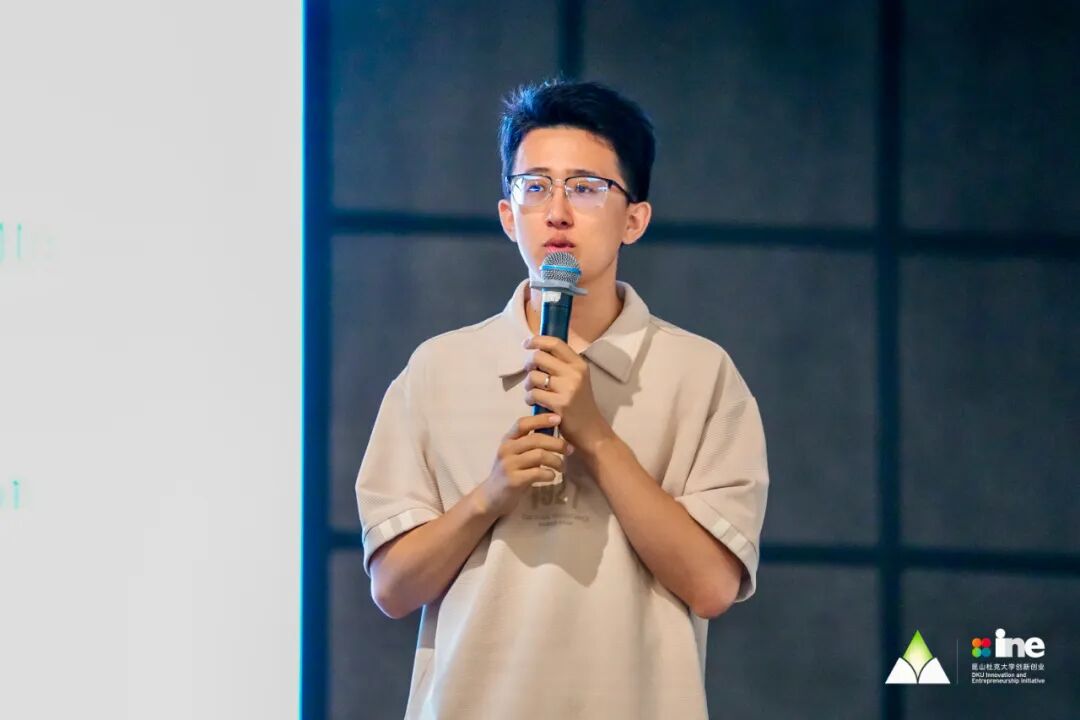
- Zhao He giving an industry presentation
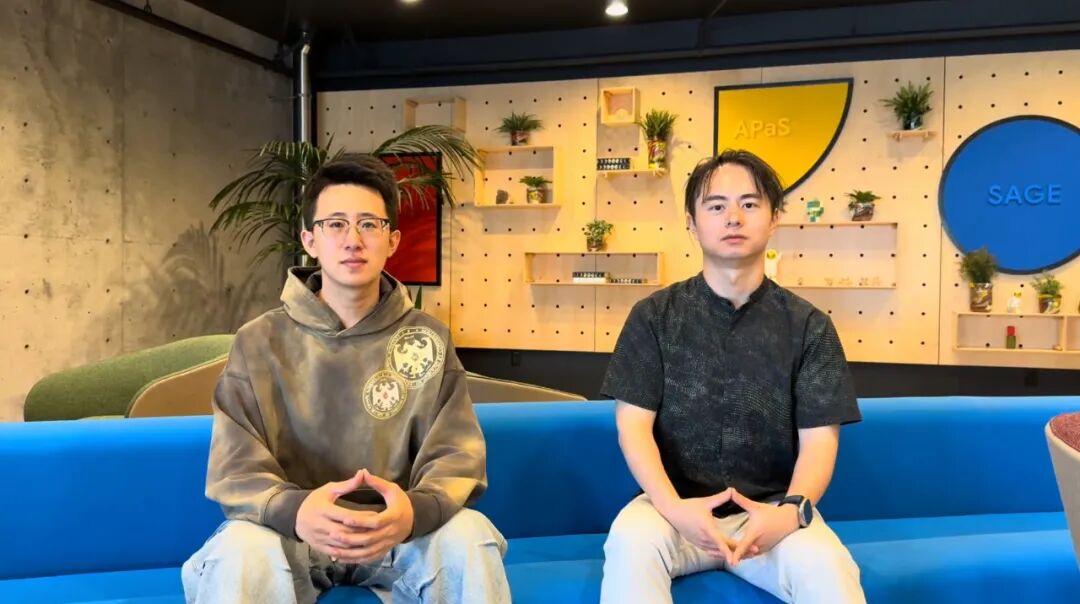
- Zhao He and co-founder Yucheng Liu filming a product promotional video
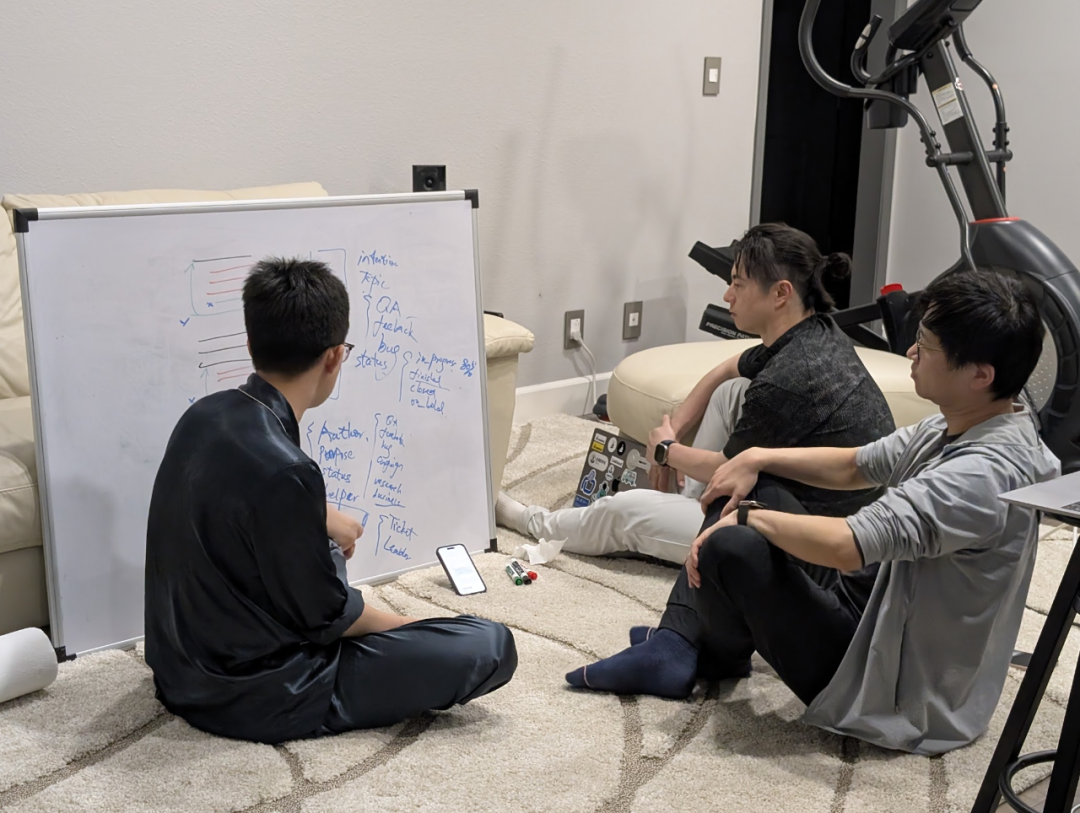
- Core team members discussing product form
02
Zhao He's career has consistently centered on software delivery.
He graduated from China Jiliang University in 2017, then joined Oracle in Haiyan, Zhejiang to work on agricultural projects. In 2020, he joined Functor Z's Zion (overseas version: Momen.app), a company providing full-stack no-code development platforms. But Zhao He quickly discovered that Chinese clients wouldn't pay for tools: "What's actually valuable is the complete solution — the product. Clients are willing to spend 500,000 to 1 million RMB on that, but we were only making 30,000 to 50,000 on tool fees."
So in 2024, he started his own company, focused on building custom AI employees for enterprises. "We handle all the training. It's essentially renting an AI employee to the client."
Building on the pain points identified earlier, he developed his approach: start with partial replacement.
First, target execution roles. "My philosophy is: pick the low-hanging fruit. AI will replace the weakest roles in an organization first." Second, leverage what models do better than humans — summarization and insight extraction — leading to the conclusion that AI employees can initially replace jobs with "fixed work routines."
"White-collar desk jobs. Office work with minimal physical world interaction, no creativity, no decision-making."
He targeted outsourcing, then narrowed further to software as the first client vertical. Through research, he found that the strongest outsourcing demand in software currently came from overseas operations. So he chose an even narrower entry point: Discord communities. "I looked up what companies actually hire Brazilian and Filipino contractors to do, then tailored our features to that."
Lucius operates on a subscription model, $500–$1,000 per month. After one week of autonomous learning, it can take over a company's community operations.
We obtained a Lucius client survey from a third party.
This was a browser company with 20,000 Discord users, operated by a single part-time intern. Lucius provided them with an AI employee costing 6,000 RMB per month.
Its responsibilities included: community information compilation and feedback, automatic bug report generation, database queries, answering basic product questions for users, nightly automated summaries of issues and user information, and alerting through the client's internal IM for urgent matters — 24/7, year-round. "More anxious than our own people," the client assessed.
Zhao He believes the priority now is getting AI employees to start as capable "interns." The future involves taking on full operations responsibilities, then migrating from single-point scenarios to more complex roles. "Like serving as an AI salesperson for a Fortune 500 company — that's what I most want to do."
When AI Nao met Zhao He, he was constantly replying to client messages. The team now has seven people, six of them full-stack engineers. He's the do-everything CEO. Lucius means "light" in Latin; it's also the name of Batman's butler. "People who know DC culture immediately understand what we're about."
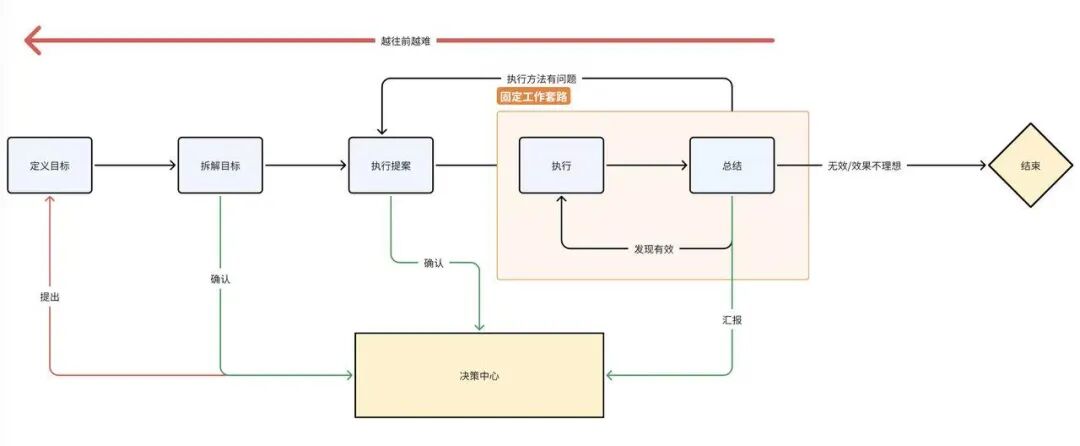
- Zhao He's product boundary diagram
Conversation with Zhao He
Part 01
A True AI Employee
Partial Replacement, Self-Iteration
AI Nao: In one sentence, what value does Lucius deliver to clients?
Zhao He: We rent AI employees to clients.
We don't make clients build and configure various tools themselves, like many products on the market. We directly train the AI labor force for them.
AI Nao: Why did you choose community operations as your first scenario?
Zhao He: Community work is relatively less time-sensitive, with more tolerance for error.
The first task is community moderation. Previously, clients using tools had to configure and maintain their own tables. Now, with our AI employee, it can autonomously learn based on its understanding of the community and the client, quickly figuring out what content shouldn't be posted.
Another task is feedback and bug detail collection — an extremely tedious scenario. It needs to distinguish real problems from user errors. For the former, it should probe extensively and provide detailed feedback to the client. For the latter, it needs to resolve questions itself.
These are the two main service scenarios we currently provide clients.
AI Nao: Many companies also outsource legal and financial functions. Would you consider those?
Zhao He: No, those are high-end consulting services. A good outsourced legal or finance person can make a million RMB annually. Training costs for the model would be very high, making them difficult to replace in the short term.
AI Nao: The operations functions you're replacing now are relatively shallow information services. What slightly more complex scenarios will you explore next?
Zhao He: Next, we want to push into event operations: helping clients run holiday or special event campaigns. Then we'll move into content operations — helping clients make their communities buzz — ultimately meeting clients' quantitative community activity metrics like message volume, participation rates, and retention.
AI Nao: How long will developing these capabilities take?
Zhao He: At least half a year to a year. We need to fill in more context and industry know-how.
Yi Zhongtian once said human knowledge has three levels. The first can be transmitted — that's knowledge. The second requires demonstration by others — that's method. The third requires enlightenment. The best state for an AI employee is to handle the first two levels — executing fixed work routines well — which would already be a massive breakthrough.
Also, I've consistently advised against handing "decisions" to AI too early. First solidify repeatable, verifiable fixed work. Then abstract optimizable recommendations from event memory, forming small-scope self-adjustments, and only then gradually delegate authority. If you attempt full replacement from the start, lacking feedback data, it's hard to land, and the AI can't "grow."
AI Nao: The company's been around for a year with only four clients. What's the challenge?
Zhao He: We're in an incubation phase, making the product adapt to various market challenges.
So I don't care about client count at all — only about how difficult the scenario is. This lets me map the boundaries of AI employees, helping me understand what capabilities to accelerate and what scenarios to avoid.
Also, perfect the product before pursuing growth. My vision of growth is: 10 clients this month, 10,000 next month.
I ask my team every day: if tens of thousands of companies rented AI employees tomorrow, could our product handle it?
AI Nao: Aren't you considering external market heat, including competitor iteration speed and market competition?
Zhao He: This is my second startup. I launched during the 2018 no-code peak — just like today's Agent market. I witnessed an industry go from hot to irrational to ignored. I realized that truly good products emerge after capital enthusiasm recedes.
I believe in entering through scenarios one palm wide and one kilometer deep. This is counterintuitive; many investors don't buy it.
But as I said, starting with a big story is useless. Real落地 still returns to vertical scenarios, tackling them one by one. Every industry is different.
Part 02
AI-Native Organization
Will Reshape Collaboration Boundaries and Responsibilities
AI Nao: Compared to similar products, Lucius doesn't require clients to write documentation, which some see as too closed and inflexible. Why this design?
Zhao He: Flexibility is a false proposition.
I know many peers give clients configurable tool platforms, canvases, drag-and-drop interfaces to plan their own SOPs.
I completely disagree. I used to do low-code. Even low-code is already quite simple, yet the proportion of clients who actually configure things themselves remains very low. Most clients are lazy.
Clients don't want to write documentation. Users just want to give commands. So I choose to give them packaged best practices, delivering results directly. As for external environment and industry knowledge base updates, we'll handle those through autonomous learning, designing a relatively engineering-oriented solution.
If clients find it unusable, they can just yell at us. We need to fully deliver a pre-trained AI employee to the client.
AI Nao: "Autonomous learning" is the most critical capability for many Agents now. How did you design it?
Zhao He: Lucius's core is what we call the OAK self-learning architecture. It doesn't just "generate responses" — it "reviews behaviors and encapsulates experience."
Observation layer: Automatically identifies task triggers and semantic intent from high-frequency event streams (Discord messages, tickets, feedback logs, etc.).
Action layer: Executes actions (reply, tag, escalate, trigger workflow) driven by context and state machines; extracts "phenomenon–cause–measurement" triplets from historical cases, records behavioral consequences, and precipitates them into reusable SOPs and automation strategies.
Knowledge layer: Through Reinforcement Feedback and Causal Loop post-hoc evaluation mechanisms, transforms human/system feedback into retrievable, executable knowledge, continuously improving action strategies.
Moving from looking up answers to "summarizing experience" — Experience Encapsulation.
AI Nao: At this stage, which client feedback surprised you?
Zhao He: We had one very interesting client. He referred an excellent product manager from his own company to me. His pitch to that product manager was: if one day I fire everyone in operations, this AI employee will be the last to go.
I was very surprised. Around that time, I'd been a bit worried whether AI employees were too weak, too easily fired.
Later, talking with clients, I realized something. Through autonomous learning, our AI employee can rapidly precipitate a high-quality knowledge base for the client. So the AI employee becomes a new collaboration hub — clients come to it asking for data, business details, and new forms of collaboration emerge around it. I hadn't realized this before, and as a result, we now take collaboration very seriously.
AI Nao: Will this new collaboration model prompt you to adjust your product architecture?
Zhao He: We'll redesign the task system, because all current task execution is asynchronous and we need to solve the problem of tasks interfering with each other. Also, we need to redesign trigger mechanisms. Current Agents are mainly instruction-triggered. We need more flexibility — active, passive, and various event-triggered supports — to accomplish persistent organizational tasks.
AI Nao: You believe that when industries across the board start accepting rented AI employees, AI-native organizational forms will inevitably emerge. Will this change traditional organizational division of labor?
Zhao He: First, division of labor will be restructured. More bridging work between departments or progress tracking will be handed to AI employees. Humans will collaborate end-to-end, each oriented toward final business goals rather than process nodes.
Also, client execution review and adjustment efficiency will improve dramatically. Organizational decision-making speed and data-driven orientation will increase substantially. Organizations will no longer rely on periodic reports or hierarchical transmission to correct course, instead forming "instant feedback–rapid iteration" dynamic systems. Additionally, organizational knowledge沉淀 logic will change, with AI continuously summarizing experience, encapsulating it, and reusing it.
Ultimately, company boundaries will weaken. External teams, freelancers, clients, even suppliers can collaborate through the same AI system. Management will shift more toward system design and decision-making.
Part 03
Starting from Model Defects
The Advantage Is Not Fearing Getting Hands Dirty
AI Nao: I spoke with one of your early investors. He believes your advantages are deep Agent understanding and software delivery experience. Does this form your engineering foundation?
Zhao He: I indeed start from what model technology fundamentally changes.
I believe Agent is essentially a more flexible RPA. Their paradigms are the same — RPA also uses workflow control. It's just that with large models, it understands humans better.
Models currently do two things best: intent judgment, which surpasses previous NLP, and Mapping — finding mapping patterns. As entrepreneurs, we should first leverage these two capabilities, then wait for models to improve.
AI Nao: How do you ensure Lucius doesn't get swallowed by models?
Zhao He: From day one of product design, every meeting focused on: will this design get consumed?
My judgment logic starts from Transformer core flaws. The biggest problem with training paradigms is inability to remember state. What's state? Facts change, people's attributes change, relationships between people change, relationships between people and things change — Transformer can't solve this unless one day the training method changes so training can carry state. Many people are researching this now.
AI Nao: Transformer took off because it landed in the chat product form, gained user acceptance, then attracted massive capital investment. What other model architectures do you think have this potential?
Zhao He: AlphaGo, used for Go, is also an excellent architecture. I'm a big fan.
Its core capability is博弈 — game theory. The best scenario for博弈 is sales, especially final negotiation stages. When to attack? When to defend? Calculating win rates.
AI Nao: What do you see as your biggest advantage as a founder in this direction?
Zhao He: I'm less afraid of getting my hands dirty than most people, more willing to outdo others on delivery details. That's why I could tackle operations first — many find it troublesome, but I see great value.
My personality is liking to figure out what others are thinking. My proudest achievements may not be company valuation or funding raised, but truly solving problems for clients — that gives me a strong sense of mission.
AI Nao: We've also collected some skepticism. Many similar products切入 more professional scenarios like insurance, but your scenario has low difficulty. How will you make the leap? Is the commercial imagination limited?
Zhao He: I firmly believe that in professional scenarios, core competitiveness is still know-how. Model capabilities currently still can't match domain experts. Technical designs made for professional scenarios likely aren't transferable.
For me, operations scenarios easily generate data at scale and validate learning loops, making them the best starting point. What I can see is that through this early accumulation, the transferable technical沉淀 produced can support more complex roles in the future.
Image sources | Provided by interviewee, Unsplash
—Bonus—
We have a podcast now.
Search "AI NOW" on the Xiaoyuzhou app. The full interview will also be updated there, where Zhao He shares more industry non-consensus views and practical experience transitioning from software delivery to Agent.