A Founder Praised by Qi Lu as Having "the Most Silicon Valley Product Mindset" Shares: Four Foundational Product Capabilities Every AI Native Needs | AI Practitioners

How to Upgrade an AI Application from Basic RAG to a Multi-Agent Architecture

By Haoran Zhang | Content planning by pippobei | Produced by AI Nao
Intro
AI Nao's new column: AI Practitioners
We focus on AI builders who use new paradigms and fresh perspectives to solve real problems in the AI space. We believe that in a period of rapid technological change, experience matters just as much as opinions.
Over the past two years, everyone in the industry has been asking: "What does a product manager look like in the AI era?" or "Do we even need to hire a product manager in the AI era?" The evolution of technology has blurred job boundaries, and in this wave of AI entrepreneurship, conventional product experience has largely become obsolete.
This issue's practitioner is Haoran Zhang, whom Qi Lu has repeatedly praised inside MiraclePlus as "the most Silicon Valley-like product manager." He has spent ten years working on productivity tools and is now exploring an enterprise-grade multi-agent product.
He started with traditional RAG and workflow orchestration, then iteratively evolved it into a complex agent ecosystem after entering the AI era. Along the way, he has rewritten the architecture countless times and stepped into enough pitfalls to fundamentally reconstruct the product's underlying thinking.

He has distilled four core capabilities that every product person must have in the AI era:
- From workflows → to defining goals and boundaries
- From scenarios → to abstracting patterns and atomic capabilities
- From single agent → to autonomous, multi-agent collaborative ecosystems
- From right/wrong → to performance ranges and evaluation systems
This article is based on Haoran Zhang's WeChat post AI Product Thinking: How I Upgraded an AI Application from Basic RAG to Multi-Agent Architecture, with his latest thinking added. Follow his account for more.
This piece avoids technical deep-dives and grand strategic concepts. It is written for product people designing AI agent applications or builders working on the front lines.
If you're also a practitioner figuring things out in the trenches — whether in product, engineering, operations, or as a founder — we'd love to hear from you. "AI Practitioners" is an open column, and we look forward to featuring your experience next.
Capability 1: From Writing "Workflows" to Building "Boundaries and Goals"
In the traditional software era, everything in a product person's workflow was deterministic: logic was explicit, interfaces were static, and user behavior followed predictable paths.
The product person's job was to write requirements, document workflows, hand them to developers, and have users follow along.
But AI is fundamentally probability distributions — language, reasoning, emergence, extreme instability.
Product people simply cannot design a "deterministic" AI system. Because users ask different questions every time, and even when they ask the same question, the context may differ.
Therefore, locking workflows into fixed frameworks often constrains AI's ability to self-learn. At this stage, the priority should be defining the product's goals and boundaries:
- What is the business objective this agent is responsible for?
- What should it not do?
Haoran Zhang gives an example in his article.
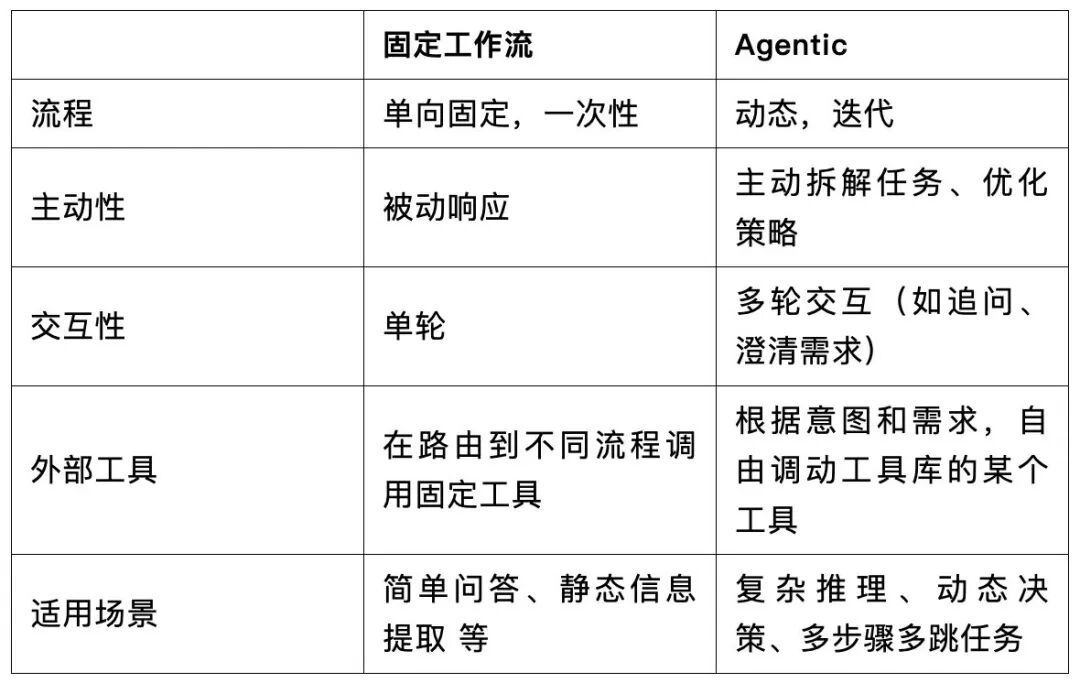
Before 2023, most enterprise AI customer service bots followed fixed frameworks. Input an idea, and the AI would break down tasks based on a specific workflow, search for information via RAG, and return a result. In narrow, single-scenario domains, this approach worked. But once scenarios expanded, the architecture's limitations immediately became apparent.
For instance, a user asks: "I want to return the wireless earbuds I bought last month, but I lost the receipt. I still have the original packaging, and my order number is A12345."
Traditional RAG retrieval struggles to understand the relationships between these complex factors. In the AI era, the product person's first step in handling this problem is to define boundaries.
Haoran Zhang gives another example. A user says: "I'm going back to Beijing next week, help me schedule time with DK and XY, and create a reminder in Lark so I don't forget." First, we need to understand that the user has a meeting in Beijing, but the boundary is fuzzy. The product needs to use multi-turn dialogue to pin down: which specific day.
User: "Wednesday afternoon, around 3pm. We can meet at the Starbucks in Sanlitun."
At this point, there is sufficient information, and the AI can break down the objective.
Capability 2: From "Features" to "Abstract Thinking"
In the traditional software era, product people's favorite activity was conducting user interviews, then adding features.
But in the AI era, most interaction between users and products happens through natural language. On the surface, a user might say "I want you to help me check my order history," but behind that could lie 100 different needs: maybe they want to issue an invoice, maybe they want to review recent living expenses, maybe they want to repurchase.
A product person should not — and cannot — create a feature for every possible expression. This demands highly developed abstract thinking.
Haoran Zhang summarizes three capabilities:
- Pattern recognition: Identifying user needs within diverse expressions
- Intent mapping: Understanding the various ways users express similar needs
- Boundary definition: Clearly distinguishing what falls inside and outside the AI's responsibilities
He gives a classic distinction. A user wants to query an order: the traditional product person's requirement would be "add a reorder button." The AI product person has the agent understand and execute the user's intent to repeat a past purchase in any conversational context.
The steps should be: Clarification → Information Gathering → Task Decomposition → Tool Routing → finally Execution.
In other words, whenever a user mentions something they bought before and want to buy again, the "repurchase agent" pipeline should activate.
Put differently, abstraction isn't about writing concepts — it's about routing the same category of problems onto the same pipeline.
AI-era product people can no longer use linear thinking to decompose user intent, building one-off solutions for individual cases. They must abstract stable, reusable patterns.
An excellent AI product person should never care about how to do something, but rather define "what capabilities the system should master to handle all variants."
Adding capabilities to the system, not features — this is the essential leap from "concrete" to "abstract."
Capability 3: From Judging "Right or Wrong" to Managing "Performance Ranges"
In the traditional software era, product people verified whether a system worked by checking if functions produced expected outputs — a clear binary logic: right/wrong, usable/unusable, pass/fail.
But Haoran Zhang argues that when systems evolve into LLM-driven agentic systems, this mindset completely fails. Because AI output is inherently probabilistic, continuous, context-dependent, and emergent. "The quality performance of an AI system exists on a continuous spectrum, not a simple either-or judgment."
This means AI product people can no longer rely on "scenario acceptance" or "feature walkthroughs." They must build an entire "performance range management system."
This includes more complex testing questions:
- Across 100 real samples, what is the system's average performance?
- Which subcategories have the highest error frequency?
- Should a reflection loop be triggered?
- Which tasks should be escalated to human review?
- Which scenarios require prompt or agent structure modifications?
- Which failures stem from tool call failures?
Haoran Zhang gives an example: in the user return request scenario, traditional RAG paradigms would stuff in large amounts of information at once, causing the model to suffer from "relevance dilution" within limited context and fail to produce an answer. This kind of product bug isn't functional — it should be called "performance degradation."
Information gets drowned out, causing output to become vague and imprecise. Evaluating this problem can't rely on a single test; it must use "batch sample evaluation" to demonstrate system stability across different phrasings.
The AI product person's responsibility is no longer "accepting features" but managing "performance ranges." This requires building unit tests, eval sets, batch evaluation, and drift monitoring — and feeding results back into the design of prompts, agent topology, tool chain scheduling, and memory systems.
Capability 4: From "Single Product" to "Complex Ecosystem"
Entering 2025, traditional single-turn RAG and linear LLM workflows can no longer support real-world problem complexity. The now-dominant framework is building multi-model, multi-agent, tool-using systems. Especially now that user demands for AI have risen to expecting AI to act more like a real employee — Manus's viral success this year confirmed this.
Haoran Zhang believes that building such collaboration requires product people to understand how multiple agents cooperate to complete more complex tasks. In other words, AI product people need to design an ecosystem that is "autonomous, collaborative, and reflective."
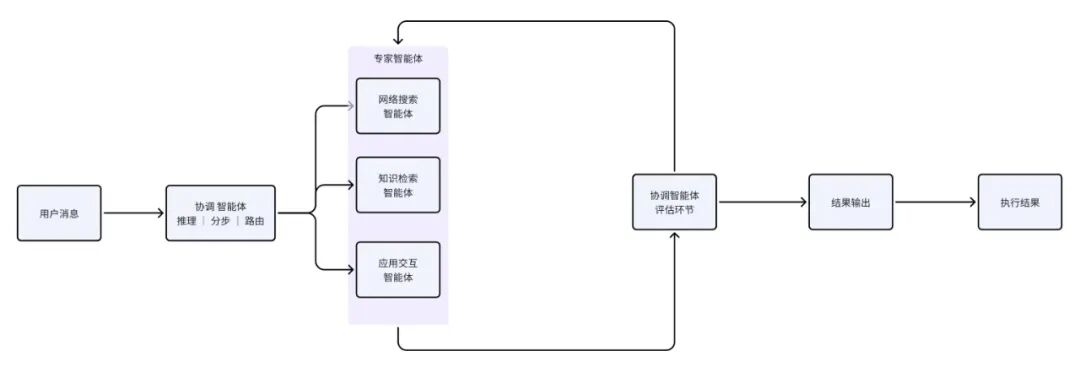
The key capabilities of this ecosystem — which can also be understood as each capability corresponding to an agent — are:
- Intent understanding
The Orchestrator agent is responsible for understanding intent, filling in requirements, planning tasks, and scheduling other agents. It is the brain of the entire system, and also where AI product people most need to define boundaries and goals.
- Professional capabilities
Specialist Agents: Every industry is different. Building industry know-how requires search agents, knowledge retrieval agents, and app API-calling agents, each taking on different capabilities to form a modular capability network.
- Evaluation
The Evaluator agent: Used to judge whether results meet objectives, whether retry is needed, whether further retrieval is required. This is especially critical in probabilistic systems.
- Long-term memory
Responsible for short-term, medium-term, and long-term memory, building truly personalized experiences. Otherwise the system cannot maintain contextual coherence across time-shifted tasks.
To enable these capabilities (agents) to collaborate, AI-era product people must also understand topology — choosing star, chain, or message pool architectures — then continuously evaluate performance, boundaries, and collaboration patterns.
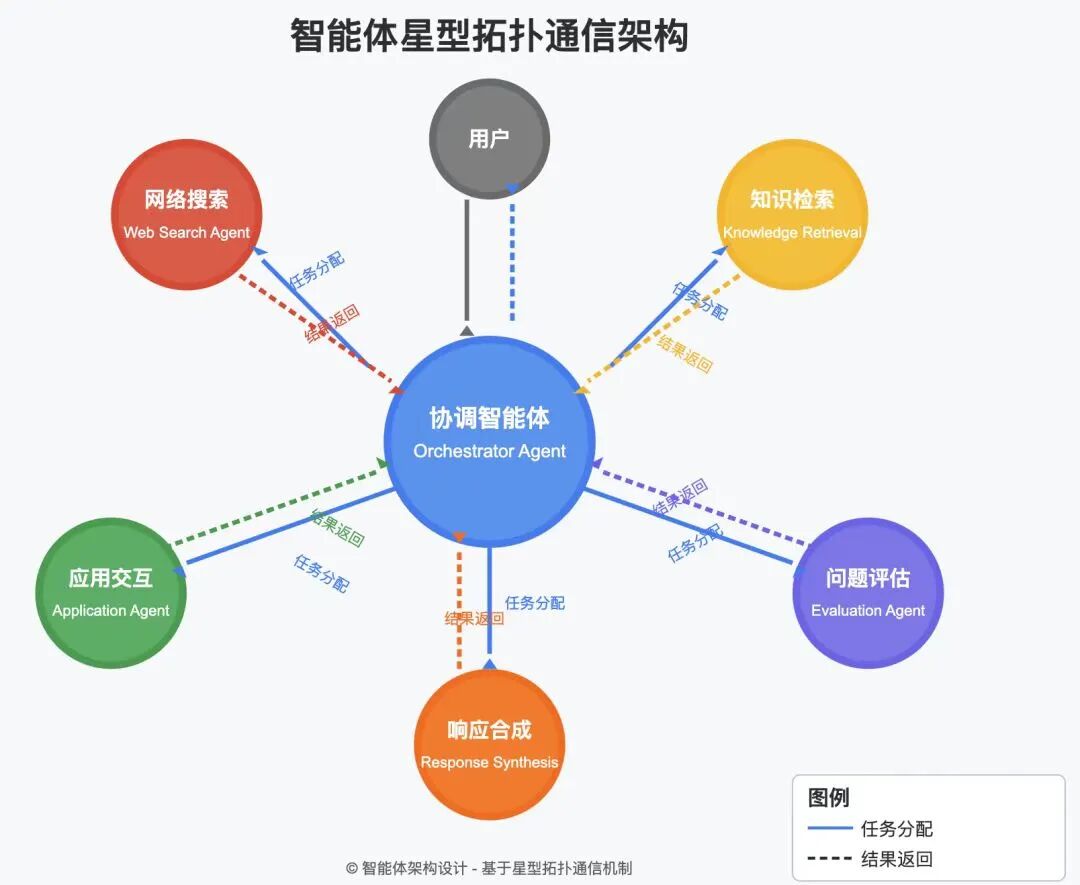
Haoran Zhang's latest thinking: if in the future users use natural language to complete complex tasks, then agents will inevitably need to call various different tools. So how do we build an agentic system that understands the user's business, thereby tuning tool usage more precisely?
This is an entire complex AI system. In the past, product people only needed to define a workflow, then hand it to backend and frontend teams.
Now, a qualified product person needs to force themselves to become a full-stack AI builder.
— Finally, we quote the ending of Haoran Zhang's original article —
"Not everything that can be counted counts, and not everything that counts can be counted." Albert Einstein's famous quote may be the most fitting insight as we face the paradigm shift in AI product thinking.
In the traditional software world, we were accustomed to linear thinking, deterministic assumptions, and predictable outcomes. We mapped user journeys with flowcharts and defined product boundaries with feature lists. This approach worked well in deterministic systems, much like Newtonian mechanics' precise predictions at medium scales.
However, with the paradigm shift brought by artificial intelligence, we have entered an entirely new cognitive domain where the rules more closely resemble quantum mechanics — full of probability, uncertainty, and emergent properties.
In this domain, products are no longer static tools, but dynamic partners dancing with humans.
As physicist Niels Bohr said: "If quantum mechanics hasn't profoundly shocked you, you haven't understood it yet."
Likewise, if the new paradigm of AI products hasn't made us fundamentally rethink the nature of product, we may still be trapped in the cognitive framework of the old world.
Image credits: Unsplash, contributor submissions
— Share With Us —
If you're also a builder figuring out AI products on the front lines, we'd love to hear your story.
Contact us via the "card email" below.