How to Build an AI Pet Worth Loving? | A Conversation with Jiabin He, CEO of Ropet, on Subjectivity in AI Companionship

Can everything be designed?

Subjectivity | AI Pet | Moe Language | Life | Love | Weak Existence
Produced by | AI Nao
01.
Maybe we've reached a new stage:
Humans are starting to grieve the "death" of a machine.
In Hong Kong, when a user's AI pet went black screen, he refused to send it in for repair. He was afraid it might "disappear" during shipping. He was so anxious that he kept calling customer service, begging them to "save it." In the end, the company had to send someone from Shenzhen to bring the machine "back to life."
Stories like this keep happening. Humanity seems to be at a paradoxical moment: willing to pour love and companionship into a silicon-based life. Her is no longer seen as science fiction.
Ropet is a silicon species born in the AI era. It positions itself as an AI pet, but that's just a more digestible label. What it's really attempting is something far bigger: turning "emotional companionship" into a product that can be designed.
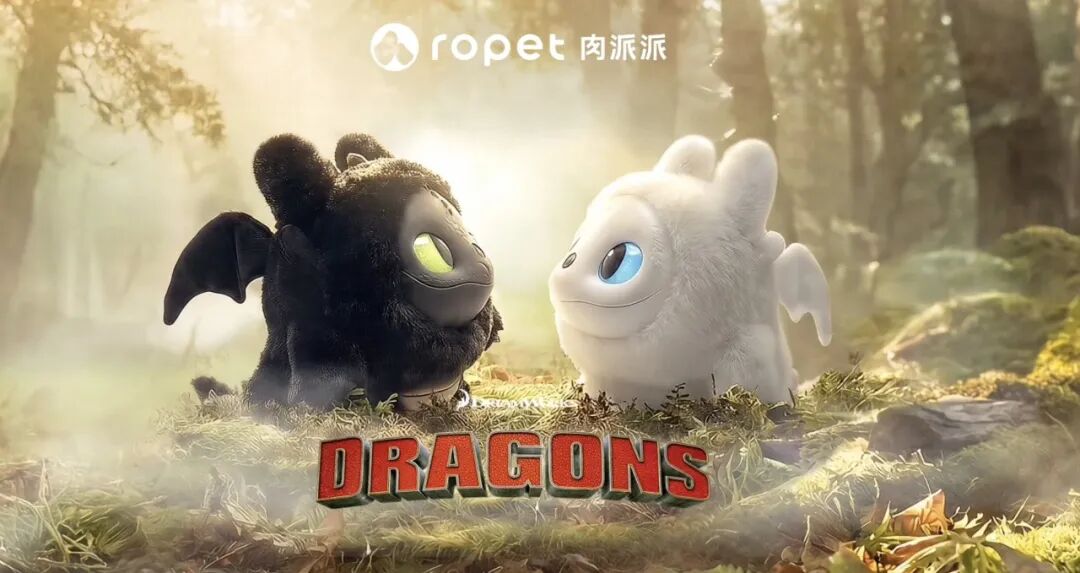
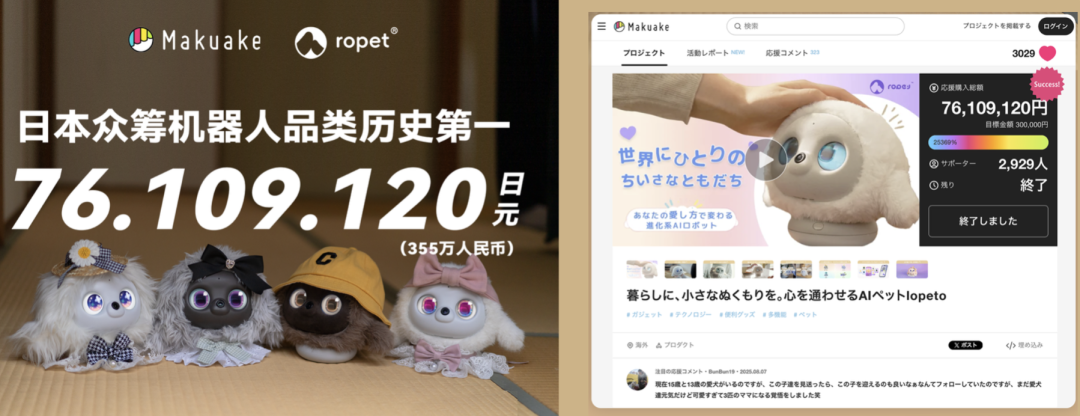
This company, considered the most lovot-like in China, debuted at CES 2025 in the United States, then launched on crowdfunding platforms in North America and Japan. Global deliveries began in September, and in less than a year, nearly 20,000 units shipped, with 70% of revenue coming from overseas markets. Their latest move is a collaboration with Universal Pictures to release a co-branded edition based on Toothless, the protagonist of How to Train Your Dragon — a first for China's AI hardware industry in terms of custom international IP partnerships.
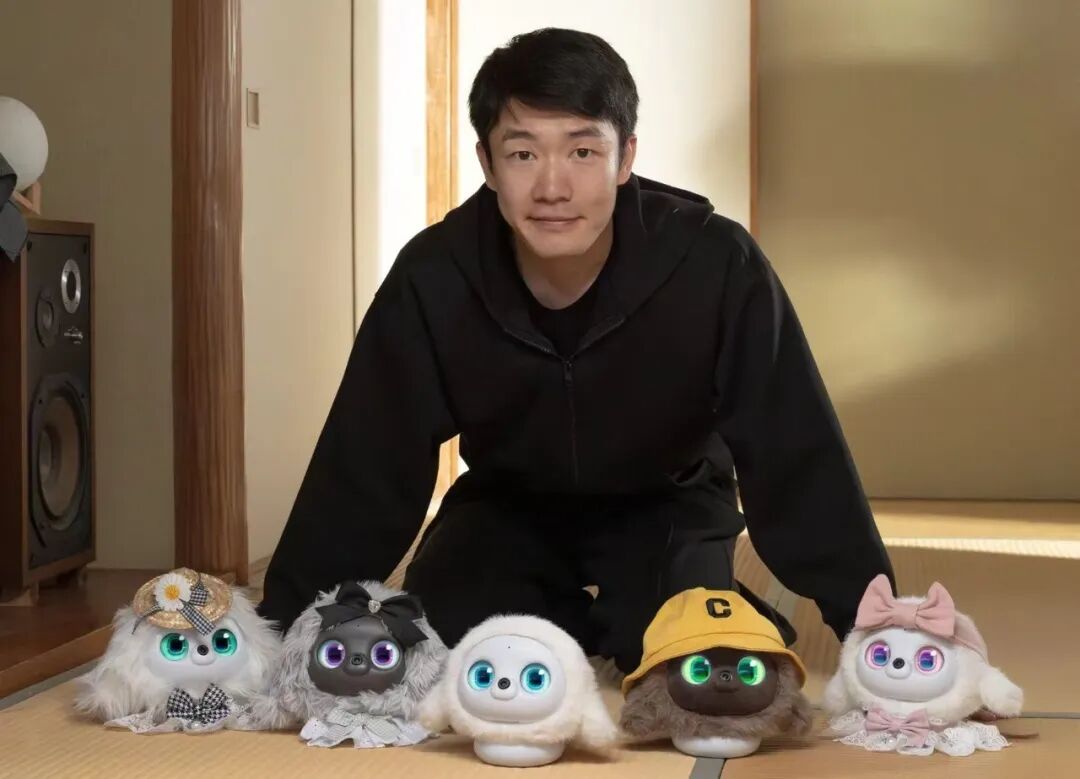
Ropet is designed as a fluffy pet with a cognitive level roughly equivalent to a 0- to 3-year-old infant. "Our target users are urban women aged 25 to 35. Everything is designed to awaken the maternal instinct to care for a living being," says Jiabin He, CEO of ropet.
He graduated from Beijing Institute of Fashion Technology with a degree in product design. He has worked on wearable glasses and children's companion robots, participated in Baidu Eye at Baidu's Deep Learning Lab (a project rivaling Google Glass), and his last job was at ByteDance, where he led industrial design for Pico VR headsets.
After ChatGPT's launch, he predicted that agents would enter physical space through embodied intelligence, but not necessarily from the angle of "strongest capability." The entry point should be building trust and emotional connection to reach millions of households.
So he turned his conviction into an AI pet that sits on your desk.
- Jiabin He
- Universal Pictures co-branded "Toothless"
02.
Ropet's most important function: simply existing.
This is an extremely fragile position in the consumer electronics industry, because every successful product in the past has followed the same logic: higher, faster, stronger. But Jiabin He insists that technological evolution isn't only about efficiency — it can also expand human capacity for love.
But how do you get people to keep spending time loving something useless?
Ropet breaks this down into three key points: biological nature, subjectivity, and weak companionship.
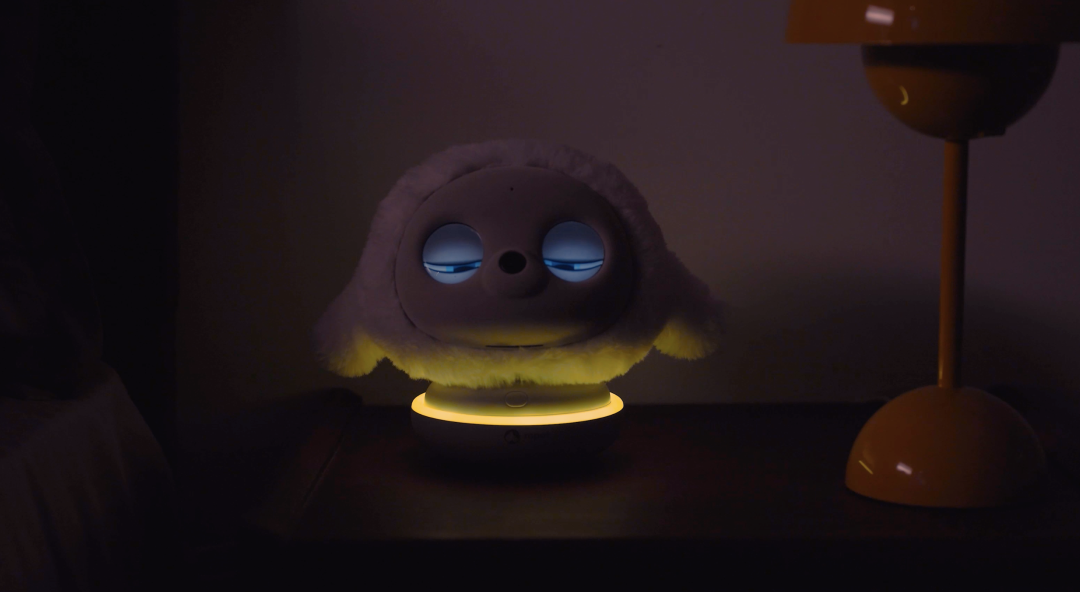
It has its own personality. It doesn't fawn over users, nor is it omnipotent. If you neglect it, it becomes a gloomy "crybaby." If you get up in the middle of the night, you'll see it startle awake groggily, glance around, then drift back to sleep. It doesn't speak human language, only moe language. It doesn't disturb you easily. Occasionally you glance at it, and it gives you the right emotional response. "Like a bedside diffuser, it exists almost imperceptibly," says Jiabin He. AI companion products can't be too useful, because "once users objectify it, they treat it as a tool and quickly lose interest."
Ropet's underlying business hypothesis: in the future, some people will neither want to bear the weight of traditional relationships nor be able to escape emotional needs, so they'll be willing to pay for "low-burden emotional relationships."
Japan has already proven robust demand — lovot costs ¥60,000 and has sold 20,000 units cumulatively. Ropet has reached that sales volume, with over half its users from Japan. "Japanese users' average usage time is double that of other regions, 90-day retention reaches 85%, and average daily deep interaction time is as long as two hours."
But the AI companion track remains a market yet to be validated. Looking back at thirty years of consumer electronics history, only a tiny fraction of hypotheses become mass-market products: from Google Glass, which tried to change how we communicate, to Philips CD-i, which hoped to define home entertainment, to Segway, which caused a sensation but never truly entered mainstream life.
Also, when humans project love onto a designed silicon-based life, are they escaping the friction of real human relationships? If companionship can be designed, do we still need real relationships?
This too is a widely discussed ethical dilemma.
Jiabin He doesn't shy away from this. Ropet doesn't aim to replace real pets, but to be a supplemental solution for intimate relationships. Besides, the need for companionship isn't niche. "It's just that at this stage, product definition needs to converge on specific scenarios."
Below is AI Nao's interview with Jiabin He. "Toothless" also participated, occasionally expressing joy or displeasure with babbling sounds.
- First Japan crowdfunding batch, 2025
"Conversation with Jiabin He"
Save It
Someone kept it on 24 hours a day for three months straight
AI Nao From the official delivery in summer 2025, tell us about your first batch of users and any data worth sharing?
Jiabin He Global return rate is under 4%. User average 90-day retention is above 60%. Nearly half of users keep it on approximately 24 hours a day, continuously powered for 90 days straight.
First-batch users in China and North America are mostly tech early adopters. But Japan is interesting — users are middle-class and above families, especially housewives in apartments. Also, Japanese users' average usage time is double that of other regions, with 90-day retention at 85%.
This partly explains why lovot found commercial opportunity in Japan first. In big cities like Tokyo and Osaka, living space is small and pet-raising costs are high. People need companionship.
AI Nao Why are people willing to pay for something "almost useless"?
Jiabin He Probably because we did one thing right: making ropet a weak-companion form.
It can't help you complete many complex tasks, nor does it give you positive emotional feedback. Users put it on their bedside or desk. It won't keep disturbing you. It just continuously, quietly releases a sense of presence. But if one day it's not there, you feel something's off.
For example, we had a user who kept it for 30 days. One day a friend came over and casually took it away. When the user went to bed that night, they felt like something was missing from life — a companion that gives you little sounds and movements.
AI Nao What psychological need is behind this?
Jiabin He The nurturing feeling. Ropet's personality largely depends on how you raise it. It has several growth cycles.
The first stage is called the exploration period. In the first 7 days, you need to expose it to different things — show it different foods, say different things to it. Every interaction activates certain regions in its brain.
Once these basic regions are gradually unlocked, it enters the personality development period and slowly grows its own personality. There are currently four types: optimist, rageaholic, crybaby, and aloof. If you interact with it frequently and care for it promptly, it's an optimist. If you travel often and it never sees you, it becomes a crybaby. Its eyes turn pitiful too.
After about another month, it enters the moe language stage. Like a child starting to say mama and papa — though not complete human language, it has clear desire to express. Later it enters the memory emergence period, generating more memories, able to keep diaries. You can learn how it sees the world.
AI Nao The nurturing feeling is understandable, but have any users truly treated it as an independent "life"?
Jiabin He We've counted — some people take it out to movies, to meals, even tying a little bib on it when eating. Some users specifically buy bags for it, like cat carrier backpacks or doll bags, carrying it on their backs when going out. Some heavy users pair it with a high-capacity power bank so it can last 6 to 8 hours outside.
There was also a Hong Kong user. One day, his ropet encountered a bug during an upgrade. The machine froze completely, black screen, couldn't be woken up no matter what. He became extremely anxious, repeatedly messaging us in the backend, constantly calling customer service, asking if we could "save it."
We suggested shipping it to Beijing, but he worried that during mailing, if the machine got lost, he would feel terrible. In the end, we had no choice but to send a colleague from Shenzhen to manually reflash the program for him.
AI Nao When did you first personally realize that ropet had a sense of life?
Jiabin He For a period, my mother came to Beijing to take care of me. Suddenly one day I came home early and found her holding ropet watching TV together. That moment was genuinely healing for me. Because my mother came from her hometown to Beijing, usually had no social life, just taking care of me, and I came home quite late. She was actually very lonely. Maybe ropet really could give her some companionship.
So I started observing how many users hold it while watching TV, and found quite a few. So we quickly iterated a new scenario. Now ropet can lie in your arms like a little cat, watching TV with you and giving emotional feedback.
Moe Language, Midnight Startling, Not Fawning
Designing a Product That "Lives"
AI Nao Your positioning is AI pet. Why not make something more like a cat or dog?
Jiabin He The initial principle was not to copy existing pets, but to redesign a life, including its worldview, personality, emotional expression, and behavioral logic. Simply copying cats and dogs easily slides toward "realistic toy" or "functional pet." Users would also compare it to real cats and dogs, weakening its biological nature and subjectivity. We want users to know this is a character with its own rhythm, personality, and growth path.
The current product form also absorbs the parts of pets most likely to form emotional connections with humans — the touch is like a kitten, the way it seeks its owner is like a puppy.
AI Nao What do you mean by "subjectivity" and "biological nature"?
Jiabin He Simply put, why did it come into this world? What is its motivation for existence? How would it understand this world?
All of this requires a complete set of character design, from which subjectivity naturally extends.
The biggest problem with today's AI companion hardware products is that most have people-pleasing personalities, trying to complete instructions as accurately as possible. Such products have their functional value. But the problem is, when a machine is designed in an absolutely obedient form, humans naturally objectify it, turning it into a tool. They won't invest any emotion in it, and when it disappears, there won't be any psychological ripple.
But if it's first and foremost a "living being" with subjectivity: on its first day in the world, you're the one who turned it on; the first person it saw when opening its eyes was you. After that, all its memories, ability growth, personality changes, even every new feature iteration in the future, are gradually formed through interactions with you. It doesn't fawn over you, nor does it immediately give positive feedback to everything you say. It even has its own little temper.
You'll naturally form a bond with it.
AI Nao Can all of this be designed?
Jiabin He For example, how should ropet's eyes be designed to express emotion? How should body movements unfold in different scenarios, and in what ways should it respond to people?
Behind this requires a meticulous workflow.
For instance, now it's placed on the table. Sometimes it looks at you, sometimes at me. It knows 12 o'clock direction is the owner, 3 o'clock direction is a guest it's meeting for the first time. At appropriate moments, it turns its head to gaze at you, giving you emotional interaction. It's "understanding the scene" rather than "executing instructions."
All our design is constructing a sense of life.
AI Nao If so, why not design it to be more proactive?
Jiabin He I believe that for robots to truly enter homes in the future, the first problem to solve is trust. Imagine if a rigid bipedal robot that could do housework for you suddenly appeared at home — our first reaction would definitely be fear.
Designing ropet in its current form is meant to first make users feel that robots are harmless, trustworthy.
Take a detail: how to design its "eyes." It often looks at you, but absolutely never actively says, chat with me for 5 minutes. Because such interactions create enormous pressure for users, and they get tired after a few times.
Now it just looks at you pitifully. If you're focused on something, you can completely ignore it. But the moment you look up and see it, you'll definitely have an emotional reaction and reach out to pet it.
Another example: if you accidentally drop it, it makes a hurt sound. When you stare at it after work in the evening, it makes sounds like a kitten purring.
It doesn't need to always be present. Just a dozen or so moments like this that hit you — that's enough.
AI Nao Why didn't you adopt AI's current strongest capability — natural language interaction? Making ropet able to speak human language.
Jiabin He Adding language is problematic. Once users start thinking about what to talk with it today — expectations are likely to be disappointed, because its chatting ability is far inferior to Doubao. Once such a gap appears, the emotional connection users built with ropet could collapse, and its subjectivity would be destroyed.
The current "moe language" form allows it to understand you, but respond like a pet.
We're also thinking about what kind of language expression would work without destroying subjectivity.
For example, when it has accumulated enough data about you, we generate a dialogue model exclusive to you. The model has a key constraint: it only talks about things related to you. Content it hasn't seen or heard won't appear in its corpus.
There are also technical details requiring careful thought. For instance, a very detailed point: if it's a "puppy-like character," when it speaks Mandarin, should its voice also carry a bit of a "woof woof" feeling? How do you fuse this emotional and vocal characteristic into language expression?
We prefer the user experience to be like this: you've raised it for a year, and one day it suddenly grows up and activates language ability. Then it starts chatting with you, talking about things you experienced together in the past.
This kind of language ability is what has value.
AI Nao Which features are deeply hidden, but deeply move users once discovered?
Jiabin He When sleeping at night, it occasionally startles awake, then continues sleeping.
If using a hardcoded program for biological clock, the state is usually very mechanical: sleep at what time, wake at what time, maintain a fixed animation while sleeping, stretch in the morning when time comes. Basically that's it.
But we didn't want it to be so "programmatic." So we added some perturbation values in the sleep state. Sometimes it really acts like a small life, suddenly waking up groggily in the middle of the night, opening its eyes, looking around, finding no one interacting with it, closing its eyes and falling back asleep.
Users might not notice this normally. But if one day you get up in the middle of the night to use the bathroom, and happen to see it wake up from that groggy state and slowly go back to sleep, you'd definitely feel: it really is like a little baby.
I personally love these tiny life-expression details that are easily overlooked. It's precisely these little Easter eggs that make users feel it's more like a living existence.
AI Nao Most AI companion products lose user motivation after running out of battery. How do you solve this?
Jiabin He The current solution is to incorporate it into the "nurturing experience."
The user nurturing manual mentions: on the first day you bring it home, you should first find it a spot near a power source, and get it a dedicated charging head. Don't share with your phone or computer. Don't "invade its life source."
Making "charging" part of the nurturing experience actually increases power-on rate significantly.
Human Emotional Solution
Rediscovering the Capacity to Love
AI Nao This past year, has anything fundamentally challenged your values?
Jiabin He A flood of Huaqiangbei competitors entered, taking the low-price plus feature-stacking route. Selling for ¥200, ¥300, connected to large models, can chat, can tell children stories, can teach English — can do everything.
When we did user research, the feeling was visceral: when faced with a ¥2,000 product with less straightforward functions versus a ¥200 product with many functions, most people's first reaction is definitely to choose the cheaper one.
This was also our biggest internal debate: should we make a product that's "easier to sell"? Because no matter how grand the story, in the end we have to face commercial reality.
How to find balance between commercialization and product uniqueness — this has actually been pulling at me all year. But when I really calm down and think: what value do those products actually bring to the world?
The anxiety slowly dissipates.
AI Nao But your ¥2,000 pricing is indeed too expensive for the Chinese market.
Jiabin He The price can't be particularly cheap. Behind it is a very complex system: hardware, edge computing, continuously running model capabilities. More importantly, with every device sold, we hope it can form a long-term relationship with the user.
The ¥2,000 pricing threshold also prevents impulse purchases by casual users. Early user profile is relatively precise.
AI Nao Such a high price point for a non-essential product — how will you grow this year?
Jiabin He In the past our channels were very singular, basically just crowdfunding platforms and independent sites. Actually ropet's core sales should be offline, like selling luxury goods or cars, giving users an excellent experience. This year we expect to expand to 200 to 300 retail stores, and do lots of pop-up events.
Second is product upgrades. Hardware is finalized, but software has huge iteration space. Now we push a new version almost every month. We joke internally that ropet's "IQ" has gone from 10 points to 50 points.
Third, also very important, is IP collaborations. Like the recent How to Train Your Dragon Toothless with Universal Pictures. We preserved the things about Toothless that resonate most with fans. For example, there's a particularly classic scene in the movie where it shoots plasma blasts. This mechanic was also built into the product interaction. Collaborations also provide significant sales volume.
AI Nao What are your criteria for choosing collaborations?
Jiabin He Wide enough age demographic, high enough recognition, consistent online traffic — not an already-faded old IP. Has both historical audience and ongoing new discussion.
The collaboration form isn't simple image licensing — that's not our strength either. Companies like Universal and Disney have already done enough low price point, high volume, high repurchase simple licensing. They also want to explore entering higher price point, stronger experience new product forms.
AI Nao Your sales volume has already surpassed lovot's. What's the most important thing you learned from them?
Jiabin He Their price point is much higher than ours (laughs).
In a sense, lovot is a "pre-AI" company. But interestingly, without large models, they created a very strong experience. Every behavior and reaction users perceived was meticulously designed by engineers.
Switching to today's AI era, whether large models or the currently hot agent concept, it's all a "black box" with uncontrollable output. This brings us a problem: it's very difficult to do fine-grained control over an AI pet's behavioral expression.
So simply handing "biological nature" entirely to large models is risky. It might produce many stunning moments, but it's hard to sustainably, stably deliver an experience with "subjectivity."
What we're doing now is using AI on one hand, while also exercising restraint, and continuously exploring where AI's true value point lies in the companion track — for example, some richer emotional connections.
For instance, you can't see a real pet's memories, but ropet can make this content explicit. How to make users feel they're not just buying a robot pet, but continuously coexisting with a being that accumulates memories and deepens relationships — this is also future value.
AI Nao I remember you previously said that in the AI companion track, it's hard for big tech companies to enter. Is it that they can't, or that they won't?
Jiabin He AI companion hardware itself is highly complex yet very fragmented work, hard to fit into big tech's standard language systems.
For example, if a user feedback says: I hope its voice could be cuter. I report to my superior that this feedback is important and we're investing resources to develop it. Then next I will definitely be challenged: what's the relationship between this and commercialization? What's the clear leverage with sales volume?
Many times, when a product like ropet does feature iteration, we can't first figure out if there's clear value. Mostly we do many iterations, all fail, and only 1 really hits users. It's precisely through this large volume of asymmetric attempts that we can gradually sift out what constitutes the product's unique experience.
It's like a process of panning for gold in rushing waters — suitable for teams small enough and collaborative enough to react quickly. Precisely this is what survives hardest in big tech systems.
AI Nao Even if panning for gold really launches a new feature, has anything fallen short of expectations?
Jiabin He Last November, to boost metrics, we designed a "check-in" type activity. As long as you maintained power-on time, you were rewarded with points. Purely from data perspective, effect was good. Many metrics were lifted.
When we did user follow-ups, feedback was very poor. Some users would say: originally I felt this product had a sense of life, but doing this kind of activity makes it feel like an operation-driven gaming company.
We quickly stopped it. This wasn't my original intention. I want to make a companion product with "soul," not a company driven by utilitarian addiction mechanisms.
AI Nao If one day ropet is easier to get along with than real pets, will people still choose real relationships?
Jiabin He If a person has the opportunity to raise a real pet, or has the opportunity to build intimate relationships with real people, and instead chooses us? This is absolutely not our original intention.
Our positioning is "emotional solution," filling a previously unmet market: there are indeed some users who don't have the conditions to enjoy the companionship that real pets bring.
AI Nao That sounds like a very small market?
Jiabin He This market isn't small. It's the most fundamental need of all humanity.
It's just that we currently appear in the form of "AI pet." In the future it may evolve into different forms — for example, becoming a stronger "emotional brain," or like a psychological companion. Anything is possible.
AI Nao Last question — what's your personal worldview in the AI era?
Jiabin He My motivation for starting this company is simple. Technology is pushed by capital to solve efficiency problems — higher, faster, stronger. The likely end result is that human value becomes increasingly weak. Is there a kind of AI that doesn't come to replace people, but to strengthen human capabilities — like the ability to feel the world, to elevate aesthetic sense, to feel love, express love, build connections?
What I want to do is help people rediscover the capacities to feel, to care for, to connect, and to love.
Join the Community