An AI Spreadsheet Takes Over 2025's Double 11

China's e-commerce industry is making its first attempt to redefine the operating system with AI agents: can an intelligent hub that understands users, comprehends products, and acts autonomously completely replace Excel and ERP?

By Zhuo Zhang | Produced by AI Nao
A multi-trillion-yuan sales festival, for the first time, orchestrated by a single spreadsheet.
After the "large vs. small model" wars and the "Agent free-for-all," the AI industry's first truly mature and proven enterprise efficiency tool turned out to be the "AI spreadsheet." And its first large-scale deployment came during the 17th Double 11 in the 2025 e-commerce season.
On November 5, DingTalk's AI spreadsheet announced a major technical breakthrough in collaboration with Alibaba Cloud's engineering team, becoming the industry's first smart spreadsheet with a single-table capacity of 10 million hot rows. For an event like Double 11, where business data hits a "flash flood," brands no longer need "manual table splitting" — all data can truly run on one spreadsheet.
Who Actually Understands E-commerce?
An Alibaba executive had previously stated that this year's Tmall Double 11 would deploy AI technology at scale, fully empowering merchants with first-time mass application of AI tools.
Months before Double 11 began, usage curves for DingTalk AI spreadsheet and related products shot up sharply. Meanwhile, responding to urgent real-market demand, DingTalk and Alibaba Cloud's ADB-PG database team spent over 100 days on technical breakthroughs, pushing the AI spreadsheet's single-table capacity to 10 million hot rows.
Smart spreadsheets aren't DingTalk's invention. So why did DingTalk's AI spreadsheet catch fire in e-commerce first?
Because the difficulty isn't technical — it's about who actually understands e-commerce.
New technologies typically originate in industries with the highest data density and shortest feedback cycles. E-commerce processes trillions of transactions annually, manages millions of SKUs, and navigates hundreds of marketing nodes. During Double 11 especially, real-time data and feedback demands from both buyers and sellers multiply by 100x or even 1,000x compared to normal times. In 2024's Double 11 alone, Alibaba's gross merchandise volume across the entire network approached 1.44 trillion yuan, 1.5x normal daily transaction volume.
Yet e-commerce has historically been stitched together from countless Excels, CRMs, and ERPs: cumbersome to adopt, slow to respond, inconsistent in data definitions, and error-prone. What should be an efficiency tool became a hidden drain.
First, e-commerce data is extraordinarily fragmented — inconsistent fields across systems, mismatched definitions, permission silos. Getting an AI spreadsheet to connect to this heterogeneous data and update in real time is essentially prying open a company's "data infrastructure." Second, workflows are unstructured. Every industry differs; apparel and fast-moving consumer goods are entirely different categories. During Double 11 specifically, tasks span promotional scheduling, influencer partnerships, inventory reallocation, customer service alerts, and after-sales compensation — information scattered across group chats and emails, with most decisions relying on human judgment. Without genuine e-commerce know-how, reconstructing a merchant's back-end is impossible.
DingTalk, backed by the Alibaba ecosystem, happens to be one of the few global AI spreadsheet platforms that can directly connect to e-commerce's underlying data architecture. It understands retail — connected in real time to shelves, inventory, user feedback, and marketing funnels — while also grasping Chinese merchants' flexible, ever-changing needs. All this means DingTalk's AI spreadsheet is inherently more "e-commerce-literate" than competitors.
So when DingTalk used a single "AI spreadsheet" to take over 2025's Double 11, the deeper logic was about transforming China's e-commerce industry's antiquated back-end operating system — using AI to drive smarter human decisions, rather than letting people drown in complex coordination tasks while vast data gold mines sit untouched.
As AI spreadsheets reconstruct how e-commerce works, the industry is also pushing DingTalk's AI spreadsheet to evolve. Today's AI spreadsheet has already become a lightweight Agent that can think, execute, and collaborate.
It's no longer seen as traditional SaaS, but as the entry point to an entirely new business operating system.
Currently, brands including Semir, Yintai Department Store, and emerging streetwear label AlmondRocks are all using DingTalk AI spreadsheet to prepare for Double 11.
One Person = One MCN Company
In August this year, AI Nao interviewed DingTalk CEO Wu Zhao, who emphasized three principles for DingTalk's AI transformation: first, build around AI rather than adding AI to technology — create truly AI-native products; second, people should help AI understand the real world, letting AI quickly take over work while humans make decisions; third, never be arrogant — genuinely immerse yourself in every industry. Dialogue with DingTalk CEO Wu Zhao | AI Native, Disruptors, and New Opportunities
DingTalk AI spreadsheet follows these three principles: build an AI-native product, solve real problems, and deliver real results for businesses.
AlmondRocks is a Chinese original designer streetwear brand, built on "comfortable, design-forward, reasonably priced" positioning. Starting from socks, it has expanded to loungewear and base layers. It's both a "design brand" and a "content brand" — driving growth primarily through Xiaohongshu seeding, Douyin livestreaming, and influencer partnerships, a typical omni-channel operation brand.
Founder Zhang Qi has long struggled with "operational efficiency." They collaborate with over 6,000 influencers annually, handled by just 4-5 employees. Data from each platform is scattered: pricing sheets in Excel, logistics in WPS, influencer scripts in WeChat documents. One business development staffer exports seven or eight tables daily. Errors are routine.
After adopting DingTalk, they moved all influencer information — quotes, sample shipments, logistics, feedback, content output, conversion data — into the AI spreadsheet. Where employees previously manually entered dozens of fields, now only 5-6 fields need input; the AI spreadsheet auto-captures the rest. Additionally, the AI spreadsheet auto-generates an influencer performance heatmap, using algorithms to identify which influencers merit long-term partnerships. More importantly, different roles — business development, legal, operations — can work on one spreadsheet with all information updating in real time.
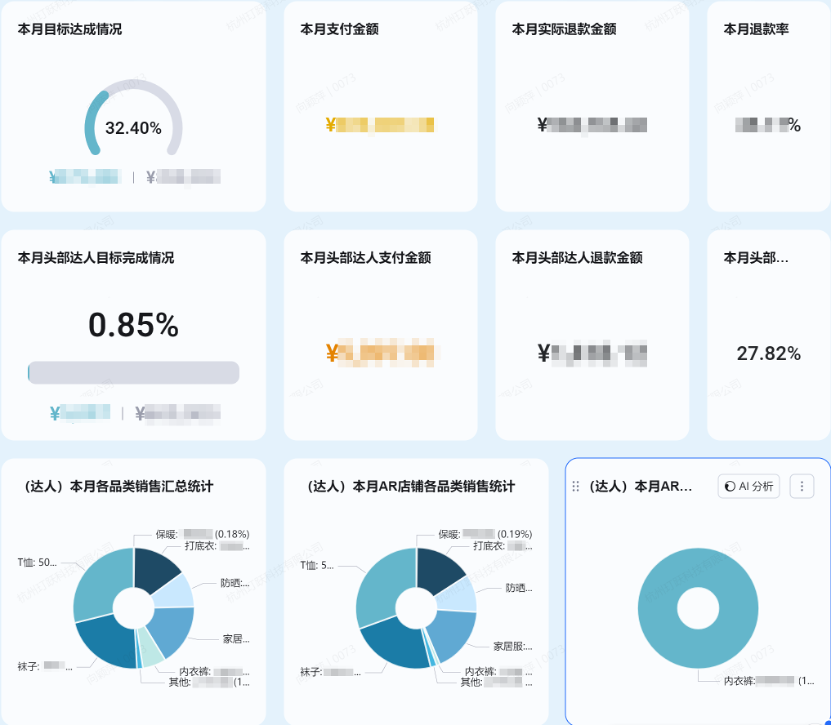
For example, when DingTalk detects that a particular sock style is selling well, back-office staff can immediately see real-time inventory turnover, channel sales distribution, and price elasticity sensitivity — amplifying single-item blockbusters. What previously required three days to decide now takes one day.
Emerging brands like AlmondRocks number in the tens of thousands across China's e-commerce ecosystem. They never had dedicated IT staff. DingTalk's AI spreadsheet gave them a "data middle platform." Founder Zhang Qi put it directly: DingTalk's AI spreadsheet is more like a smart employee, "an intelligent hub for data-driven decisions, the core competitiveness for winning every e-commerce battle."
AlmondRocks proved that DingTalk's AI spreadsheet can give smaller brands stronger operational capabilities. Yintai Department Store proved that when DingTalk's AI spreadsheet enters a thousand-person organization, it can equally enhance collaborative power.
Yintai Department Store is one of China's most traditional retail department store brands, with 60+ properties nationwide. Li Kai, Yintai's content operations lead, decided in 2024 to use one DingTalk AI spreadsheet to synchronize group-buying livestreams across 62 malls nationwide.
Li Kai's first move was getting all offline malls working in the same AI spreadsheet: each mall fills in prices, inventory, and coupon combinations for group-buying products, with the system automatically aggregating, verifying, and generating a master table — auto-identifying anomalous fields, inventory gaps, even pricing conflicts.
Building such a complete livestream business system, Li Kai alone can accomplish with DingTalk AI spreadsheet. "You could summarize it as: the AI spreadsheet helped me become an MCN company."
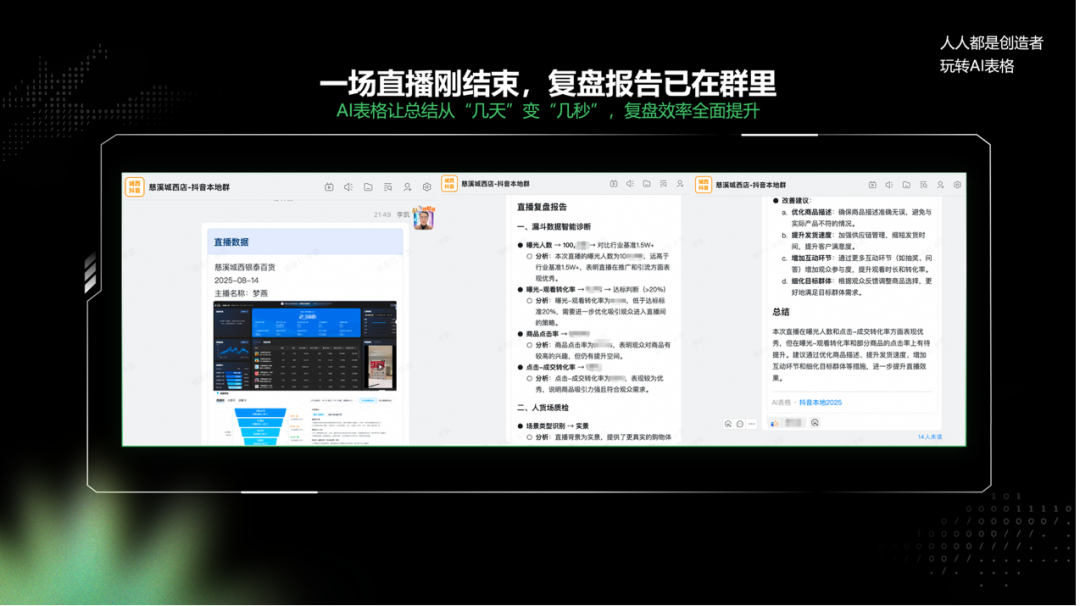
Before each livestream, DingTalk AI spreadsheet also auto-reminds and proactively pushes projects forward; within two hours after a livestream ends, it automatically outputs GMV, verification rates, and ROI comparisons.
In traditional department store operations, this level of work previously meant hundreds of rounds of communication, weeks of preparation, and dozens of Excel versions. Now Li Kai leads just one person, completing everything in five days — and scaling from 3 group-buying livestreams per month to 10.
Domestic apparel industry leader Semir, meanwhile, applies AI spreadsheets directly to "product iteration."
For a long time, traditional apparel brands like Semir have stood at a difficult crossroads: on one side, the market keeps declining — in 2024, China's total apparel retail grew only 2.1% year-over-year, a ten-year low; on the other side, consumer tastes shift rapidly — social media has shortened fashion cycles, with one viral video able to change an entire quarter's hit direction. Consequently, competition for apparel brands is shifting from "channel capacity" to "market perceptiveness." Whoever captures consumer feedback fastest can produce more blockbusters.
Before introducing DingTalk's AI spreadsheet, one customer service agent could process 400-500 user feedback items daily at most. The work was tedious and unrewarding: screenshots, recordings, and reviews had to be copied into Excel, then categorized and summarized. Different platforms (Tmall, Douyin, Xiaohongshu) had different definitions and fields. During Double 11 especially, agents were often overwhelmed by messages.
Most frighteningly, "user feedback was completely unstructured and couldn't directly feed back into production," said Lü Wanlong, customer service supervisor at Semir Co., Ltd.'s customer service center, who has spent ten years in Semir's customer service management, witnessing the evolution from paper records to Excel. "We also wanted to accumulate longer-cycle user feedback, like one year or even five years, but Excel operations were extremely cumbersome."
DingTalk AI spreadsheet helped Semir transform user feedback into "product commands" for the first time. The first problem solved was "understanding what users are saying": the AI spreadsheet can auto-capture feedback from all platforms daily, with AI semantic models identifying emotional tendencies, issue types, and automatically tagging negative information, issuing alerts when severe; daily auto-updating visualizations help brands rapidly pinpoint problems.
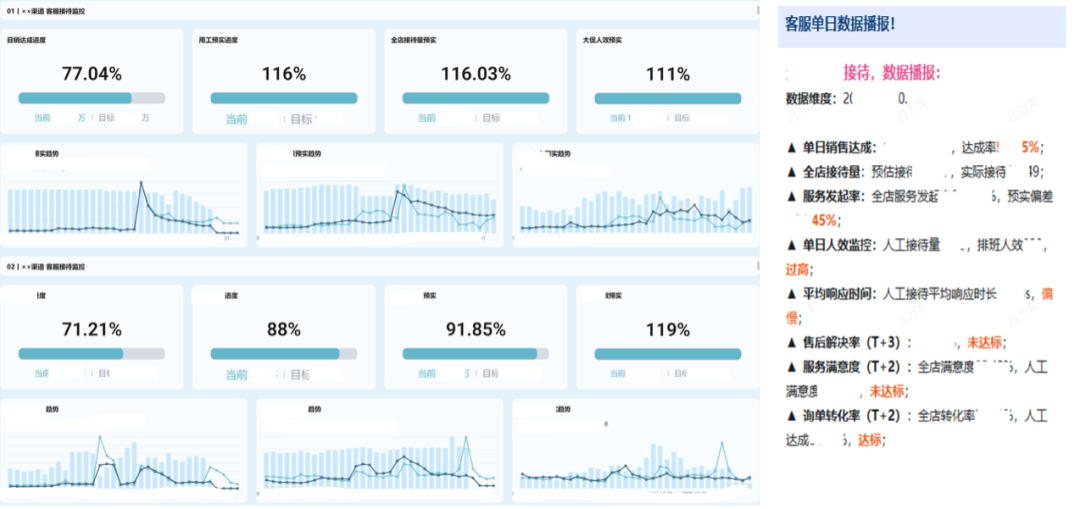
For example, suppose one week before Double 11, the AI spreadsheet detects that "runs small" tags for a women's down jacket increased by 87 feedback items within three hours, concentrated mainly in northern regions. The spreadsheet auto-generates an anomaly report. Ideally, the production department can adjust the pattern template the next day, and through the AI spreadsheet's "supply chain linkage field," sync to partner factories to modify shoulder width and bust measurements — re-sampling without changing raw materials, enabling style adjustments during Double 11 rather than waiting until after the promotion.
Now, frontline roles like customer service and operations have become the most important interfaces for collecting user data. Every human response also trains the AI spreadsheet to better understand consumers, ultimately freeing people up so enterprises have ample time for thinking and decision-making.
The Competition Logic Has Changed
As of August 2025, over 300,000 enterprises have used DingTalk AI spreadsheet, spanning e-commerce, manufacturing, retail, education, real estate, and other industries. E-commerce and retail enterprises are growing fastest, up 280% year-over-year. According to DingTalk's internal projections, by end of 2026, smart spreadsheet application penetration will reach 80% in the retail e-commerce industry, with all high-frequency collaboration scenarios including sales, customer service, production, and finance taken over by smart spreadsheets.
This means DingTalk's AI spreadsheet has initially formed network effects. This growth mechanism is incomparable to any single-point SaaS.
DingTalk's AI spreadsheet has also fully covered the core scenarios e-commerce requires — from frontline customer service to back-office finance. According to DingTalk's internal data, AI spreadsheets have helped enterprises improve information flow efficiency by 10 to 15 times, shortening average decision cycles by over 60%.
In other words, what will determine a company's success or failure in the future is no longer scale, but speed. After the traditional e-commerce "traffic war," a new competition is underway, with victory determined by two curves: the curve of decision speed and the curve of execution automation.
DingTalk's AI spreadsheet is accelerating on both curves simultaneously.
In the future, organizations will no longer rely on hierarchical operation, but more on AI spreadsheet-driven intelligence: a user's emotional fluctuation, a livestream's inventory change, an SKU's anomalous feedback — all will form new decisions within minutes.
Moreover, DingTalk AI spreadsheet's most unique advantage is that on one side it connects to Qwen's large model capabilities, Alimama's marketing algorithms, and Tmall's transaction data; on the other side it connects to Cainiao's supply chain network and Alipay's settlement and credit systems.
If Microsoft's Copilot excels at documents, Notion reshaped how knowledge is organized, and Airtable made programs easier to build, then DingTalk AI spreadsheet is rewriting how retail enterprises operate — it's not automating a single task, but in real time orchestrating models, data, logistics, and finance within the e-commerce ecosystem, making the entire system think and act at AI speed.
The spreadsheet was humanity's most primal computing method. For decades, all business logic was built upon those grid cells — recording inventory, calculating profit and loss, measuring growth.
When spreadsheets begin computing, analyzing, and deciding for themselves, humanity is also entering an entirely new form of work.
This year's Double 11 is the first time DingTalk's AI spreadsheet fought alongside merchants, and also Chinese e-commerce's first attempt to rewire its operating system with AI: an intelligent hub that can read users, understand products, and act autonomously — can it completely replace Excel and ERP?
The answer remains uncertain, but that future is accelerating toward us.