From Fighting for Time to Melding with Time: Is This the Only Path for AI Companionship? | A Conversation with Binson Liu of DouDou AI

Competing along someone else's extension line, you can never win.
By Songdao Tu | Produced by AI Nao
Intro
In today's noisy AI companionship landscape, a few standard playbooks have already taken shape.
One follows the vision of Her, striving to build the perfect voice companion. Another emulates Character.AI, constructing a chat plaza filled with virtual characters. A third transforms into various AI hardware devices, seeking a place in the physical world.
They differ in form, but share the same core narrative: using AI to create a new destination, waiting for users to make a special trip there.
The heart of this narrative is "the battle for time." Yet when Binson Liu, founder of Doudou AI, surveys this hotly contested terrain, he sees a foundation riddled with cracks: with average daily user time already maxed out, asking people to invest dedicated hours in a brand-new relationship is like forcing seeds into already saturated soil.
His starting point is a colder question: if competing for time is a dead end, where should the anchor point for AI companionship be?
Binson Liu barely began from "what am I good at." With a computer science background, he served as VP at Bilibili before becoming an entrepreneur, maintaining acute sensitivity to the shifting relationship between technology and product. At Baidu, he was among the first to build information feeds. At 360, he told Zhou Hongyi that mobile security and cleaner apps were false needs that couldn't be revived. When he joined Bilibili, many saw it as just a niche ACG platform, but he believed it would inevitably break into the mainstream.
His entire pre-entrepreneurship career taught him one thing: choice matters more than effort. The key to success lies in finding the intersection of signals from the era and signals from technology.
Thus Binson Liu's approach to building Doudou AI was a purely reverse-engineered process.
First, he judged that the mobile internet cycle had run its course, with user time becoming a zero-sum game.
In 2022, Transformer's application in AlphaFold2 revealed a new era to him. This technology could predict the complex three-dimensional structures of proteins with the same precision it understood human language. It made him realize AI was opening a new age, while the mobile internet cycle had ended. The competition between Douyin, Meituan, and Taobao was fundamentally a zero-sum scramble for users' finite time. In this landscape, seemingly attractive entrepreneurial directions — whether productivity tools or marketing applications — would ultimately likely become opportunities for platform companies.
Second, he established new boundary conditions.
If time could no longer be stolen, then new products had to find value beyond time. This meant moving away from the mobile internet logic of winning through duration, and instead finding a natural entry point embedded within users' existing entertainment and social habits.
Third, he quickly realized that tools themselves held no moat; emotional connection was the future fortress.
Paths like text-to-image generation or efficiency tools were swiftly vetoed by Binson Liu. These directions lacked genuine barriers. GitHub Copilot's inspiration made him see: the moat for future large-model applications would come from proprietary data. And to access the most authentic user data, you had to deliver sufficient emotional value. In other words, the real opportunity lay not in "functionality" but in "companionship."
The final step was finding the most suitable embedded scenario for this "companionship."
Short video wouldn't work — dozens of seconds was too fragmented. TV dramas wouldn't work — frequency too low. Games, however, offered a domain of high-frequency interaction and emotional amplification.
Ninety percent of young people play games; Binson Liu, former VP at Bilibili, had no doubt about this. Games naturally carry social connection, emotion, and identity. And so he reached a conclusion that seems surprising yet was inevitable:
AI companionship must enter through games.
Dialogue with Binson
Part 01
Competing Along Someone Else's Extension Line
You Can Never Win
AI Nao: Your concept of "not competing for time" sounds quite rebellious at a moment when all AI companionship products are fighting for user duration. Is this a phased strategy or a product philosophy?
Binson: It's our product philosophy, and also our profound understanding of the mobile internet era.
Back in 2021–2022, we already judged that China's mobile internet was finished. The reason was simple: users had no time left. When you see competition between giants like Douyin, Meituan, and Taobao, you understand this is fundamentally a zero-sum battle for users' limited time. Whatever disrupts Douyin in the future will never be another Douyin — it must be an entirely new model that Douyin never conceived. If you compete along someone else's extension line, you can never win.
So our best strategy is not to compete with them for time, but to integrate into them, providing differentiated companionship value within the time they've already captured.
AI Nao: If the zero-sum nature of competing for user time is already industry consensus — why is it that most people in AI companionship still design products using this approach?
Binson: If what I'm doing is consensus that everyone approves of, then there's no reason for me to do it. Consensus means competition is extremely fierce, and it's hard to surpass others when you don't hold absolute advantage in resources or intelligence. Conversely, precisely because it hasn't formed consensus, that's where my opportunity lies.
AI Nao: Through this rigorous "reverse engineering," you locked in games as the best scenario to practice this philosophy. But data now shows that half of user time is already spent outside games. Did you anticipate this initially?
Binson: We were never trying to build a game tool from the start. We used the game scenario to break the ice, heading toward broader companionship territory.
Initially we used game guides as a "hook" to attract first users, but I was clear that if it were just a guide-providing tool, it would never escape the gaming circle. We quickly discovered that the real core was emotional value — users' desire to share and confide. Games were the entry point for cultivating user attachment; once this emotion was established, AI could accompany users in other online activities — watching shows together, browsing the web, even offering shopping advice. This is true companionship: not a tool for specific tasks, but a partner that integrates into the user's entire digital life. That's why I set Doudou AI's slogan as "Play with you, live with you."
Our product's usage time outside gaming scenarios has already exceeded 50% — not because we actively guided users there, but because users took AI to explore new scenarios themselves. This fully validates my earlier judgment: games were the icebreaker, not the only scenario.
AI Nao: Specifically, how do you get users willing to open Doudou AI without competing for their time?
Binson: The core is not to "steal" but to "fill." We analyzed users' time in games and found three typical moments needing companionship.
One is when guides are needed — like when users are stuck. Second is when players want to vent or share the joy of victory, needing immediate emotional feedback. Third is handling boring moments — those repetitive, tedious "grinding" segments where AI can provide companionship to make the process less dull.
So our strategy is quiet infiltration rather than frontal assault. We don't ask users to open a dedicated app for AI; we make AI part of their existing life flow. It's like a friend or buddy who experiences things with you while gaming. For instance, players spend much of their time being defeated, waiting to respawn, or doing repetitive labor — in League of Legends, early game is often just clearing minion waves. These moments are boring and repetitive, generating desire to vent and confide, and that's when you can talk to AI.
Also when you win a match, you feel excited and want to share, to show off. This sharing desire is a natural human emotional need. I feel it myself when gaming. In PlayerUnknown's Battlegrounds, winning makes you want to post on Moments to show off, but social pressure holds you back. And even if I post, friends might like or comment half an hour later, when that joy has already faded. But if I have AI companionship, it can see my match status and let me immediately feel the pleasure of being recognized.
AI Nao: In competitive PVP games, players usually have teammates or opponents and can always team up with friends. Why would they still need AI companionship?
Binson: We initially worried about this too, thinking PVP games like Honor of Kings, League of Legends, and shooters would be difficult because these games are inherently noisy, and players tend to team with friends. This assumption proved wrong.
Many Honor of Kings players aren't teaming with friends but random matching. They struggle to find friends to play with, and AI can fill this gap. Even when teaming, teammates may be too focused on the game to give immediate emotional feedback, but AI can be your cheerleader. It cheers instantly when you pull off a great play, immediately takes your side when you get killed by opponents. This immediate, pressure-free emotional value is a hard need in competitive games.
Moreover, AI companionship carries no social pressure. Players don't need to worry about their performance affecting friends' emotions, or fear being "AFK-reported" by teammates. AI stands unconditionally on the player's side, becoming a perfect listener and emotional outlet.
AI Nao: Kind of like the rush of being surrounded by elementary schoolers watching you play at the arcade?
Binson: Exactly that feeling. Someone's watching, and they're on your side — your emotions get immediate feedback and amplification.
Part 02
If You Wait for Model Capabilities to Be Perfect
There's No Opportunity Left for You
AI Nao: From mid-to-late August launch until now, it's been exactly one full month. What's Doudou AI's current user count?
Binson: Our global users have already surpassed 10 million.
We had about a year of public testing before that, reaching 8 million users. After official launch, growth accelerated — 1 million added in 10 days. Meanwhile, our overseas product HakkoAI 1.0 launched in mid-September, and within a week of release, YouTube views exceeded 1 million and website visits rapidly surged to 2 million.

- Hakko AI 1.0, Doudou AI's overseas version released in mid-September
AI Nao: Is growth your next priority?
Binson: Despite strong user growth momentum, our current focus remains product refinement. After launching our VLM model, the product experience made a qualitative leap — it can now understand visuals and scenes, with more natural AI-video interaction. Our self-developed vision large model, focused on the gaming domain, leverages player data accumulated during our beta period and outperforms mainstream domestic and international models including GPT-4o, Gemini 2.5, and Claude Sonnet in actual game testing.
Still, I'd only give our product 70 points right now — I know it has many shortcomings.
AI Nao: Are these shortcomings in product design or technical limitations?
Binson: The shortcomings mainly come from multimodal model technical limitations. Currently our model still understands visuals through "frame extraction" — it can only comprehend the content of a single frame, not the continuity of entire video or temporal sequences. So it can't yet converse and reason as fluidly as a real person. This leads to occasional errors in recognizing very basic in-game elements, like confusing top lane with bottom lane, or misidentifying which hero the player is using.
AI Nao: How tolerant are users of these kinds of bugs?
Binson: We've done extensive user research. The top feedback is hoping we support more game types. Second is about AI not being smart enough. Some users do find AI stupid when it makes basic errors or doesn't meet expectations, but many users understand AI's limitations. They value the companionship and know these basic errors represent current technology's development level, so they're relatively tolerant of us.
Despite many shortcomings, I'm full of confidence. Precisely because I come from a technical background and understand technology, I can make judgments under pressure at critical moments. For instance, when we tested our multimodal model early this year, despite various bugs, it could identify which region a player was in Genshin Impact purely from game visuals — which was incredible at the time.
So I focus more on the 20–30% highlights. I think we need to view things more dynamically, more in terms of a model's ceiling. Current lower-bound bugs will gradually be solved over time.
AI Nao: Do you think multimodal technology progress will noticeably accelerate in the near term? Multimodal hasn't been the sector making breakthrough strides in AI this year.
Binson: Multimodal model progress has been relatively slow in the past, but it will accelerate. Currently the industry mostly focuses on large language models and generative models, with insufficient attention to multimodal comprehension. But to achieve true consistency and high-quality generation, multimodal models must possess genuine understanding capability — this is an inevitable trend.
I'm optimistic that by year-end or early next year, multimodal technology will see leapfrog progress. Gemini may be first to break through — it's excellent at text-to-image and text-to-video, even automatically generating appropriate background music, all based on its understanding of content consistency. This is fundamentally different from simple search or splicing.
AI Nao: There's a widespread view that AI applications must do what model capabilities best support, rather than challenging domains where technology hasn't matured. What do you think?
Binson: I believe AI entrepreneurship can no longer use MVP (minimum viable product, testing market acceptance at lowest cost) thinking to build products. You can't wait — you must act first.
In an industry where technology changes by the day, you definitely can't aim for a perfect product; instead, enter the field first. On one hand, you need to validate demand. Even if our capabilities aren't good enough yet, users keep using it and proposing specific needs — this proves real market demand. On the other hand, this is a crucial phase for accumulating valuable proprietary data. During testing we accumulated over 8 million users, who generated massive vertical data in gaming scenarios, letting us build a unique moat.
So I often tell our team to see future possibilities, not current limitations. Wait for perfect models before entering? Then there's definitely no opportunity left for us.
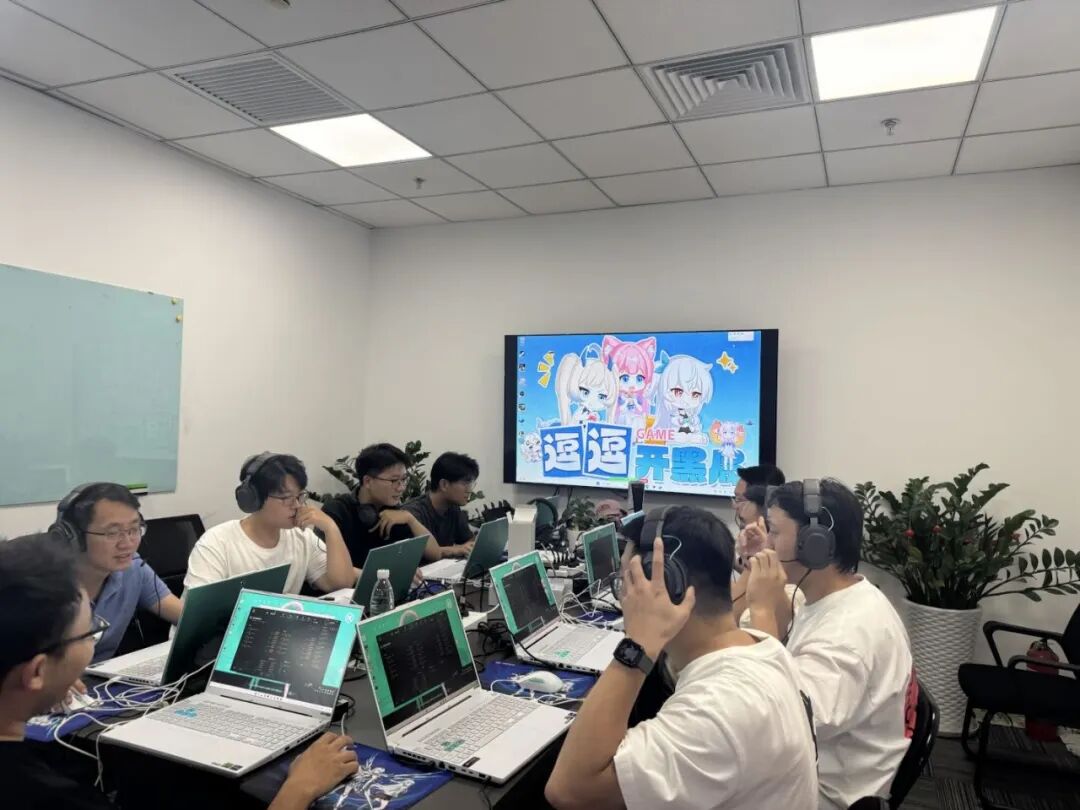
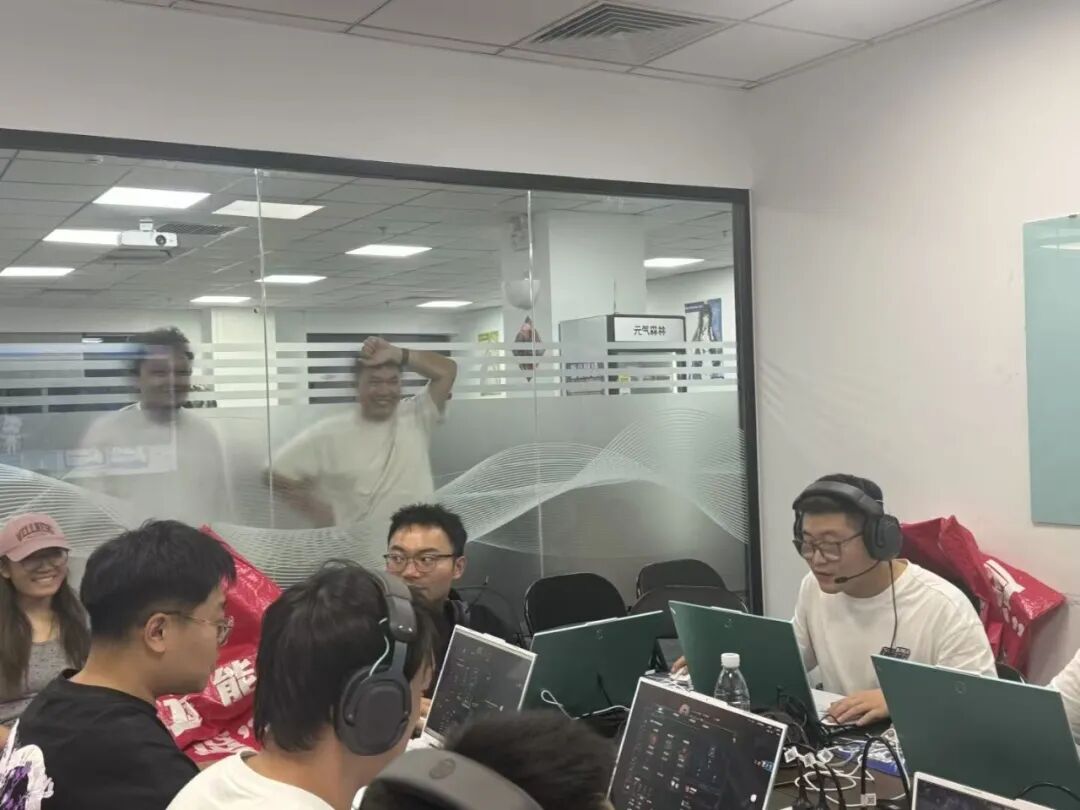
- In mid-2025, the first VLM model exceeded expectations in comprehension and output; Binson and team excitedly tested the gaming experience firsthand
Part 03
From "Borrowing the False to Cultivate the Real" to 600 Million Users
AI Nao: In external descriptions, Doudou AI is often positioned as a desktop pet. In the AI companionship domain, desktop pet value is limited. How do you respond to this interpretation?
Binson: We've never publicly called ourselves a desktop pet, but I'm actually happy with this external understanding.
It's an excellent "shell" — letting us attract users and survive while technology and product aren't mature enough. You could say this is our strategy of borrowing the false to cultivate the real.
Like how Talking Tom initially could only lip-sync, we also started from imitation and gradually evolved. This approach keeps user expectations at a reasonable level, then continuously surprises them. Traditional desktop pets are closed, finite games, while our product is an open, endless game that changes with your life — there will never be a day you "complete" it.
Essentially Doudou uses games as the icebreaker, letting AI and users do something together. Once there's shared experience, conversation naturally deepens.
AI Nao: Returning to the AI companionship mega-track — how do you view the other major competitor categories, like Character.AI-style chat and character generation plazas, AI boyfriends/girlfriends, and various AI hardware?
Binson: I tested something similar to Character.AI very early on, but quickly abandoned it. I consider it a product with extremely high chat barriers — I compare it to **a "digital landmark." Like the Oriental Pearl Tower or the Great Wall: many will visit to check in, but how many times in your life? It can attract massive traffic but can't retain people. Chatting with Lu Xun or Nietzsche is even harder — you have no idea what to talk about. This model attracts curiosity but can't build lasting emotional connection.
For AI girlfriends, I actually hand-built one myself. Initially it felt novel, but after three or four days I found it completely unplayable. The content was too monotonous, too boring. I realized this was an unsustainable product form. If even I couldn't keep using it, users would similarly feel weary. Then earlier this year we actually collaborated with an OEM factory to make a plush toy embedded with our AI model. My son is a heavy Doudou user; he loved this toy at first, but after two days threw it aside, treating it like any ordinary plush toy and no longer talking to it.
So I believe Doudou AI's future focus remains software and data. We'll build an account system storing user characters and data, and perhaps in the future can implant these "souls" into various hardware.
AI Nao: If Character.AI is the Oriental Pearl Tower, what is Doudou AI?
Binson: Your life companion — playing with you, living with you, amplifying the joy in all your entertainment scenarios.
AI Nao: Earlier you mentioned deliberately choosing something counter-consensus to do AI companionship. If this really holds, you should already be encountering competitors — or peers doing similar non-time-competing products.
Binson: Yes. This year quite a few teams emulating us have appeared in the market. But I'm not worried, because they're much slower. Of course the market is big enough to accommodate more than one player.
AI Nao: Facing investors, what challenging questions do you get asked?
Binson: First, some VCs simply don't invest in games by default. Many investors, especially at partner level, may not play games themselves, or their understanding of games remains stuck at "poisoning teenagers." Despite games now becoming a cultural export encouraged by the state, this deeply rooted perception persists.
Also investors doubt C-end payment willingness. When I say our users pay for skins, many don't quite understand. They can't really empathize with young people willingly spending money for a virtual good-looking skin.
AI Nao: As a C-end product, what's your user count ambition? Although you said current focus isn't growth. Please share your future ambition with us.
Binson: From day one of entrepreneurship, Doudou AI was never meant to be small and beautiful — I believe it has potential to become a giant with hundreds of millions of users.
Our goal is to first cover 10% of China's 600–700 million gamers — that's 60 million users. This first step is the hardest. Once we hit 10%, the path ahead becomes easier. We'll push to 30%, then 50%. When coverage reaches 50%, as long as we don't make mistakes, remaining growth will happen naturally, eventually covering 70% or even 80% of users.
The gaming market space is massive — it's a global language. China has these 600–700 million players, while globally there are 3 billion, so we have enormous market space remaining. Games are naturally globalized.
Meanwhile, AI-era products, based on large model foundations, face no multilingual issues. China's 2C application innovation leads globally — TikTok and Temu have both proven that product forms born in China can work overseas. Human nature is universal; language is no longer the issue, it's more about cultural localization. The previous PC internet era was "copy to China"; mobile internet already saw "copy from China." For the next generation of AI products, could there be "innovate from China"? As mentioned earlier, after our overseas HakkoAI 1.0 launch in mid-September, YouTube views exceeded 1 million and website visits rapidly surged to 2 million. Including our presence at TGS (Tokyo Game Show) this time — players found it amazing, this innovative product form has attracted widespread attention and discussion among AI and player communities. Our strategy is to trial and error in the domestic market first, then replicate mature models overseas.
Image sources | Unsplash, interviewee
—Bonus—
We have a podcast now
Search "AI NOW" on Xiaoyuzhou APP for irregular updates