Mismatched Memories: Welcome to the Era of Pan-Purpose AI Socializing | A Conversation with AI Suda Serein

I came looking for investors — could AI land you a life partner instead?
By Songdao Tu | Produced by AI Nao
01
Every AI social product is talking about the same thing: matching. AI is a smarter algorithm, so it should be able to find the right people for you more efficiently.
Yet a product called AI Soda has produced a set of counterintuitive data that directly challenges this matching logic.
This social product, which cold-started from the venture capital circle — a quintessential workplace scenario — found that 50% of its users tagged their social purpose as "finding a partner," nearly half gravitated toward "shared interests," and of course, 70% tagged "professional networking." These overlapping percentages sketch out a chaotic picture that even the users themselves would struggle to define.
"Our early users were all young people from the VC and tech worlds," founder Serein told us. "But the data speaks for itself — 50% chose dating. That generalized, mixed demand is already there, just waiting to be met."
Serein is a post-90s woman who previously worked in creator operations at Taobao Live before leaving Big Tech in 2022 to found magipop, a creator community. Drawing on her understanding of community building, she entered the AI social space. Soda's seed users were entrepreneurs, investors, and creators from Serein's own network; the product has since grown organically to tens of thousands of users. It blurs the three traditional boundaries of workplace, dating, and interest-based social products. This "lack of focus" left even her technical team puzzled — who looks for travel buddies on a professional networking app?
But in AI Soda, seemingly mismatched connections have become the norm. A founder who came looking for a co-founder ended up playing sports with a matched investor. An investor looking for romance matched with a growth expert and successfully referred them to a portfolio company.
Welcome to the era of multi-purpose socializing.
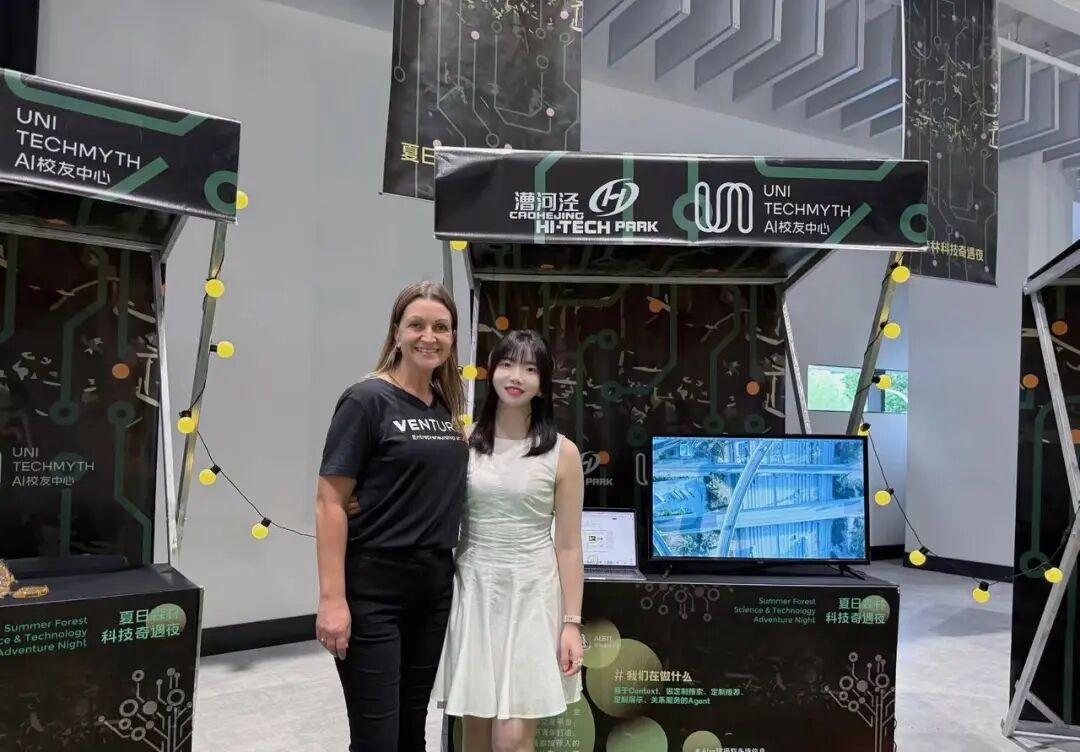
- In summer 2025, Serein set up a booth at HI-TECK Park, where a user ran up to tell her they'd found a co-founder on AI Soda
In Serein's view, this scene captures the universal portrait of today's 20-to-35-year-olds: they are in life's "climbing phase," where social needs are compound and fuzzy — career anxiety about moving upward, a craving for emotional companionship and shared recreation, and practical resource exchange all layered together.
This hybridity and lack of differentiation represents new social vitality.
In the traditional social network paradigm, one app aggregates one type of need. A workplace network helps users find career opportunities; a dating app helps them find romantic matches. Algorithms can efficiently support this large-scale, goal-clear demand.
But today, this paradigm faces challenges. On one hand, users' identities and motivations have grown more ambiguous and generalized — finding like-minded companions, exploring possibilities, seeking cross-domain collaboration — these are hard to capture with traditional tags or behavioral data.
On the other hand, AI now possesses sufficient perception and generation capabilities to actively "stitch together" this fuzziness. It no longer passively waits for user input; through deep semantic understanding and high-dimensional vector analysis, it can detect latent cognitive patterns and complementary potential, generating new possibilities for connection.
So what is the next stop for AI social?
Most likely a "possibility engine."
It no longer merely answers "who matches me," but shifts toward a more exploratory and forward-looking proposition: what can we create together?
This new logic of connection is precisely the new possibility born from AI social.
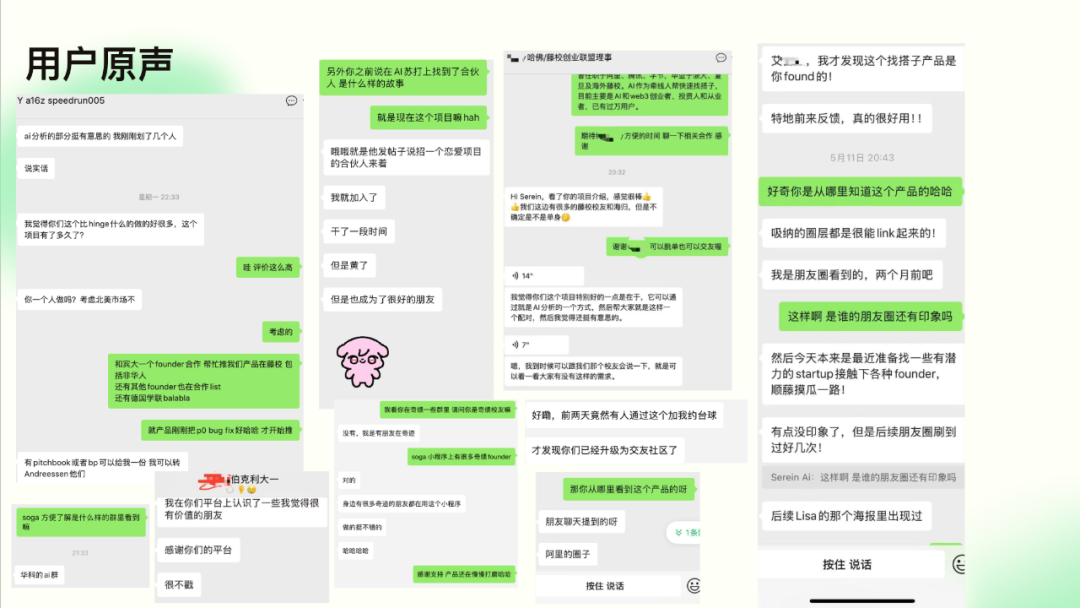
- AI Soda operates WeChat communities approaching 100,000 members
Conversation with Serein
AI Nao: Please introduce us to AI Soda. What kind of product is it? What does a new user experience when they first open it?
Serein: Hi everyone. We're building an AI social product. "Soda" is a pun on "su da" — fast matching, quick connection. You can think of AI Soda right now as an AI super connector. Its core function is AI-powered matching with like-minded people, then pulling you into group chats to break the ice. In the future, we'll build personal agent avatars that represent users in socializing — screening, summarizing, maintaining, and deepening relationships and information.
When a new user first opens the app, they need to choose their social goals first. You can simultaneously select workplace networking and dating, or interests and workplace. Because we believe people's social needs are inherently compound.
Then comes the personal information input. We've iterated this several times. The core principle: the information you fill in should be strongly relevant to your chosen social goals. For users who select dating, we explore how they handle conflict, their love language preferences. For workplace users, we focus more on their resources and collaboration style. The quality of AI matching is directly tied to how deeply it understands you.
After completing this, AI Soda starts recommending a batch of like-minded people daily. If you're interested in someone, our AI assistant helps form a group chat, sends both parties' profiles, suggests icebreaker topics, rescues dead conversations — many people naturally transition to WeChat for deeper conversations.
AI Nao: "Like-minded" is a crucial term. In the internet era, social products could also algorithmically recommend people from the same school or industry. How does AI's understanding of "like-minded" differ?
Serein: Fundamentally different.
Traditional internet products completely structure your information, then do tag matching. You search "Alibaba," you get everyone with an "Alibaba" tag — but the ranking has a huge gap from your actual needs.
AI's comprehension is unquestionably stronger. First, it can process unstructured text — you give it a long paragraph, it understands. This lets us collect richer data, which in turn deepens AI's understanding of people and their needs.
More importantly, AI can do semantic-level analysis and reasoning. Say you wrote "likes skiing" and someone else wrote "likes skydiving." Traditional algorithms see two completely different tags. But our AI can analyze that your core is "adventure-seeking." We also explore your "relationship patterns" — are you someone who prefers direct, upfront resource talk, or indirect, nuanced communication? These deep behavioral preferences are invisible to traditional tags.
So what we pursue isn't surface-level tag similarity, but deeper alignment in spiritual core and relationship patterns. That's why some of our users have even matched with real-life close friends on here — because the AI truly "sees" that deep connection between them.
AI Nao: You mentioned users can select multiple social goals, which differs from traditional social products. Most successful social products in the past won through single-point breakthroughs — LinkedIn for workplace, dating apps with their own logic. Why did AI Soda design it this way?
Serein: Great question, and one we've debated extensively internally. This design didn't come from theoretical deduction — we were educated by our early users.
AI Soda cold-started from the VC and tech circles, a group that's inherently high-density, high-value nodes. But when we observed their usage, we found a counterintuitive phenomenon: a user who entered with a clear "workplace" purpose, upon seeing so many outstanding peers on the platform, would naturally think "maybe I can find a partner here too" or "find a hiking buddy."
The data confirmed this. Among users we brought in from workplace communities, up to 50% actively selected dating, and nearly half selected interests — far beyond our assumptions.
Of course these percentages add up to way over 100% because many people multi-selected. This confirmed the cross-cutting nature of user demand for us. So this design wasn't invented out of thin air — it was users voting with their behavior. We simply returned the choice to users, acknowledging that human social needs are complex and fluid.
AI Nao: When users themselves carry mixed, even fuzzy intentions, this poses higher demands on matching algorithms. You mentioned AI matching has two logics: similarity-based recommendation, and explicit-need matching. In actual operation, how do you balance these two?
Serein: Our balancing strategy is layered. When users take no explicit action, base traffic prioritizes high-similarity recommendations. Not just hard tags like school or company, but lifestyle, deep relationship patterns, and so on.
This ensures the recommendation foundation is "like-minded" while creating unexpected connections — we've had users match with real-life good friends here.
When users express specific needs — "looking for AI sector investors" or "hiring full-stack engineers" — matching weight immediately shifts toward precise need-to-feature alignment.
The situation you mentioned (matching difficulties) likely stems from insufficient user density for specific long-tail needs in the current pool, preventing vector-based similarity ranking from pushing them to the top. For social products, this is definitely a challenge. Matching precision heavily depends on user group density. We certainly need to continuously expand user base and scenarios.
So this isn't an either/or choice. Similarity guarantees connection quality and serendipity; need matching is the weapon for satisfying explicit goals. Our aim is for AI to flexibly respond to both states.
AI Nao: You just mentioned serendipity. But efficiency and surprise are somewhat contradictory. In AI Soda, which is your core pursuit?
Serein: This is interesting — my technical team (all men) does lean toward extreme efficiency pursuit. They feel matching's essence is quickly solving problems then leaving. Following that logic, we'd just do need matching — essentially a tool.
But my observation and conviction is that much valuable human connection happens in those "aimless" border zones. Someone who came for romance ends up providing an excellent career opportunity for their match — this is a real case on our platform. These are precisely the surprises brought by similarity recommendations. If it were pure need exchange, the product's charm and sense of trust would be greatly diminished.
So the efficiency we define isn't "fastest achievement of a preset goal," but "high probability of finding people worth knowing." This "worth" encompasses possibilities of commercial value, emotional value, or pure joy. This is indeed the harder path, but I believe it's the essence of social.
AI Nao: How did you decide to enter from the venture capital circle?
Serein: VC and tech is what I know best, and also a typical high-density, high-value social network with high trust needs. People here have strong pain points and willingness to pay for "efficiently finding the right person." This let us well validate one of the product's core values — whether AI matching can truly create effective connections.
We've gotten fairly clear positive feedback here now. For example, one founder found a partner-level candidate through us in a single day — this speed and precision is hard to achieve through traditional channels. Starting from here, we've now expanded to broader elite university and top-company demographics, who similarly possess high credibility and social expansion needs.
AI Nao: Starting breakthrough from VC and elite university/top-company circles, to what extent do the social needs shown by this group reflect universal human needs?
Serein: Most successful social networks have walked this path. Facebook started from Harvard's campus, Zhihu from internet heavyweights — not to be a niche club, but by serving influential "seed users" well to establish product brand mindshare and trust. When more users come in, they'll believe they can find the kind of people they want to connect with here.
The vast majority of our users now are between post-90s and 2010-born. I think more than the VC or elite school/company concept, people at this life stage share greater similarities. Ages 20 to 35, what I see as life's climbing phase, is when people are most vital and most willing to expand their social circles. Grinding on career, finding partners, expanding networks, making friends, exploring hobbies — stacked together, everyone's needs are naturally compound and undifferentiated.
The VC circle may simply be the group that felt this pressure first and actively sought solutions. I believe this "upward socializing," this desire to find like-minded companions, is the common state of all young people striving to move up. What AI-era social needs to solve is such a universal problem.
AI Nao: This is no longer a problem matching can solve. What do you think is the endpoint of AI social, and how does it complete the revolution from screening and matching to "creating possibilities"?
Serein: We're still very far from discussing this. Honestly, we're very clear that AI Soda's current interaction form — semantic-based recommendations — hasn't achieved a qualitative leap from the mobile internet era's swipe-left-swipe-right. It's still distant from the AI revolution many people imagine.
We chose the current form because it's faster, letting us first run through a minimum viable loop. Our current positioning is a super connector — first doing the matchmaking solidly. Right now, users still prefer chatting and socializing with humans, so first build a matchmaker agent: AI can form groups, break ice, rescue dead conversations, learning from real user social chat data to better understand user social behavior and needs. Beyond the 1v1 group chats mentioned earlier, we recently launched community features so users don't just come to find people, but can browse posts and hang out — like scrolling through an AI-curated friend circle.
Our future vision certainly goes further. Next step, we want AI to evolve from matchmaker to everyone's social avatar. Say everyone has their own agent assistant, operating completely from your perspective, proactively going into various groups and posts to find valuable people and information for you, then reporting back: "I think this person is worth knowing." This is what our possibility engine looks like in our minds.
If we tried building social avatars from the start, the difficulty would be too great. How do you get users to continuously input information? How do you get AI to truly understand people? The scenarios are too numerous. So back to reality — what I care about most right now is user retention and monetization. As long as users are willing to stay and pay, greater possibilities will naturally grow.
Image sources | Provided by interviewee, Unsplash
—A little easter egg—
We have a podcast now.
Search "AI Nao" on the Xiaoyuzhou app
for more complete content.