Alibaba Brings the AI Race Back to Its Most Familiar Battlefield

Not fighting for the entry point anymore?

Compute Power | Data Centers | Utilities | Revenue
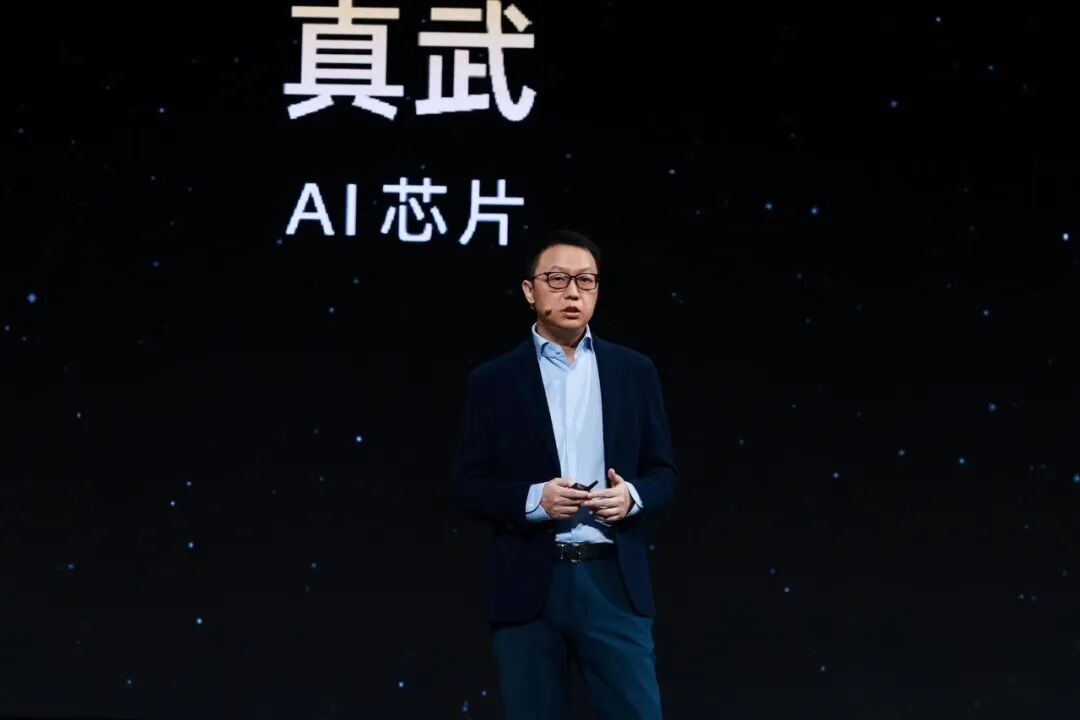
Every autumn, the Apsara Conference is Alibaba's formal annual statement on technology strategy. After listening to Eddie Wu's presentation this year, here's my immediate reaction.
Compared to a year ago, when Wu mentioned "Agent" 18 times in his speech, he only mentioned it 4 times this year. There's a clear sense that Alibaba is downplaying its "platform" positioning and emphasizing instead "how to become a scaled infrastructure service provider."
Alibaba is entering the logic of doing the math for AI.
So rather than arguing what AI applications should look like, as he did last year, Wu focused on two questions: First, why will the future need staggering quantities of models, chips, and data centers? Second, why is Alibaba the only company that can pull this off?
Because "the total amount of machine thinking will exceed total human thinking by more than 1,000 times" — the supply of utilities has no ceiling.
To understand Alibaba's shift this time, you need to understand how Alibaba sees its own advantage: the open-source model strategy.
Qwen has surpassed 3 billion global downloads and 300,000 derivative models, making it the world's largest open-source model matrix. At least in the US-China competition, open source is a sharp weapon, continually diluting the pricing power of American closed-source models.
This creates the logic of "commoditizing the complement": models are the complement, while cloud and infrastructure are the monetization layer — expand adoption at the model layer, capture revenue in inference, storage, databases, runtime environments, and operations.
Analogous to the era of electric lighting: models are the "cheap, reliable lightbulb," while the real money is in the "power grid."
Wu mentioned the power grid logic multiple times in his speech. Alibaba wants to become the utilities of the AI era, thereby more forcefully controlling supply and cost structures.
But this logic has a precondition: companies that commoditize a complement typically need to hold a deeper profit pool somewhere else — Google has search ads, Meta has social ads, while Alibaba Cloud itself is a business under price pressure; compared to advertising margins, cloud margins are thinner.
This year's speech dedicated a lengthy section to self-developed chips, something new. Last year chips were mentioned, but as part of cloud infrastructure.
Through today's presentation, the outside world learned for the first time the specific model numbers, cluster scale (500,000 cards), and shipment projections for Alibaba's upcoming chips. Wu compared chips to "generators," with tokens as electricity.
Over the past year, Chinese AI has lacked generators, creating a supply bottleneck. According to a Caixin report: in Q1 2026, Chinese AI compute demand grew 417% year-over-year, while supply only grew 128% — high-end chips were "impossible to find."
Compute power became a scarce good; vendors must increase "production capacity."
But risks lurk too. Alibaba may face overcapacity when it actually delivers these chips — after all, every major tech company is pouring in investment. Reference the fiber optic bubble of 2000.
In the final sentence of his speech, Wu mentioned a number: 20 GW. "By 2030, the global data centers operated by Alibaba Cloud will exceed 20 GW."
PS: GW is a unit of power. 1 GW equals 1,000 megawatts, roughly the electricity consumption of a single hyperscale AI data center campus — 20 GW can be understood as "more than twenty giant compute factories."
This is a critically important signal.
Using the industry's common calculation method: 1 GW of compute corresponds to roughly $12 billion in annual revenue — 20 GW at full capacity implies a theoretical ceiling of about $240 billion per year, with over 70% from external customers, or roughly 1.2 trillion RMB.
Extrapolating along this path, Alibaba's related revenue could reach $300 billion by 2032, implying annual growth of roughly 48%.
However, achieving this number has three preconditions: the demand gap persists beyond 2030; compute prices don't decline as supply expands; and prepayment models can scale. Additionally, "pay first, use compute later" contracts and data centers co-built with partners can compress compute payback periods to 2.5 years (the previous generation of cloud vendors typically needed 5–8 years to recoup data center investments).
The overall takeaway from this speech: Alibaba's AI strategy has shifted from storytelling to showing the math.
This reflects a change in how Alibaba understands AI competition.
If Qwen or any Alibaba-owned product ranks first in global downloads, does that constitute competitive advantage?
My read: Alibaba thinks not.
Any application can be deployed to other cloud services or on-premise servers. What constitutes advantage is a better and cheaper full-stack service, from model architecture to chips, networking, and inference systems.
For Alibaba, the ideal customer behavior is: first build a product using the open model, then hand ongoing operations to the cloud — the model serves customer acquisition, while the production environment serves monetization.
So essentially, Alibaba's strategic intent is to pursue a much larger business, but one that will be under continuous price pressure.
This is the challenge, and the test.
Notably, there was an intriguing omission in Wu's speech this time, something he didn't say.
If the future "entry point" doesn't belong to Alibaba, can Alibaba become a supplier so difficult to replace that customers stay, based on cost, performance, and production environment services?
Historically, companies with open source but no entry point look more like Red Hat — a good business, sure, but the fate of infrastructure providers is typically determined by the concentration of demand-side power.
So in the coming quarters, several data points at Alibaba are worth watching: whether its owned applications effectively convert to paid cloud usage; whether full-stack coordination genuinely helps customers reduce costs; and whether new compute capacity generates cash returns within reasonable timeframes.
From 2025 to 2026, the narrative shift between Wu's two speeches is only what's visible above the surface.
Below the surface lies the past year, during which Alibaba's AI business experienced the most concentrated turbulence in the company's history.
In the mobile internet era, due to the nature of its own businesses, Alibaba's organizational transformation followed a consistent theme of decentralization: let those closest to the customer make the decisions. But AI is talent-intensive and capital-intensive, not a traffic asset. When Tongyi Lab was building models, Alibaba Cloud was selling MaaS, Qwen was doing consumer-facing products, and DingTalk was doing enterprise services, compute and resources were being duplicated and wasted internally.
In March this year, Alibaba established the ATH (Alibaba Token Hub) business group, consolidating all AI operations under Wu's direct management. Core objective: create tokens, deliver tokens, apply tokens.
In June, the Tongyi Large Model Division and Future Life Lab merged into the Token Foundry Division, still under Wu's direct management.
Two group-level restructuring moves within a single month — the ATH business group and the Group Technology Committee — unprecedented in Alibaba's history.
During the same period, Wu accumulated multiple roles: Group CEO, Cloud CEO, Taobao and Tmall CEO, plus head of the Technology Committee. The AI business reporting chain was compressed to its shortest possible length.
In July, Alibaba released Qwen Office, widely seen as a frontal assault in the AI workplace entry point battle against ByteDance's Lark and Tencent's WorkBuddy.
Then in September, Wu's speech at Apsara can be understood as Alibaba, after a full year of adjustment and turbulence, finally presenting its group-level battle map. The battlefield has been consolidated around one question: in the AI era, with what organization, what capital structure, and what business model will Alibaba compete?
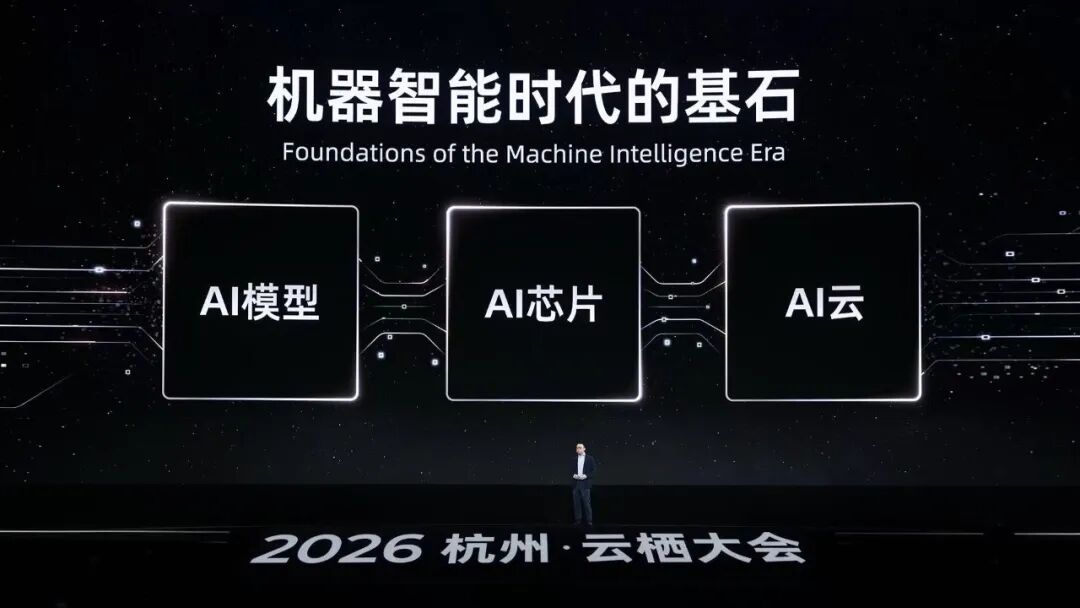
The answer: provide models, compute, and runtime environments to other companies' AI businesses. The three cornerstones are AI models + AI chips + AI cloud.
This shift brings Alibaba back to its most familiar battlefield.
As the AI battle enters 2026, Alibaba, Tencent, and ByteDance are showing clearly divergent strategic choices. Behind this lies the difference in their primary revenue sources, and therefore different paths to recouping AI investment.
Tencent's revenue over the past year was roughly 751.8 billion RMB, with gaming and social networks still its largest revenue source (over 300 billion RMB). Its advantage is a shorter AI payback path: retrofitting existing assets, improving monetization efficiency on existing traffic and transaction relationships. Tencent's Q2 2026 marketing services revenue grew 22% year-over-year, domestic gaming 17% — both driven by AI efficiency gains.
Tencent's AI strategy carries the lowest risk, but AI remains Tencent's "cost center + efficiency tool." Meanwhile, Tencent is still playing catch-up on models.
ByteDance's path is clear — compete for the user entry point in the AI era: advertisers need cheaper content, platforms need more and better content. So ByteDance is providing video generation and creation tools on one hand to increase content supply; on the other hand, Volcano Engine sells models and cloud services to enterprises, while embedding AI into existing recommendation systems and e-commerce services to improve monetization efficiency.
Additionally, ByteDance continues exploring hardware, hoping to control the next-generation interaction interface. This also means ByteDance is trading profits for strategic entry points — in 2025, ByteDance's net profit declined over 70% year-over-year. However, once the entry point is in hand, its leverage to squeeze cloud vendors on price becomes the strongest.
Alibaba is betting on infrastructure — intelligence will become the utilities of the AI era. Alibaba is also the only one of the three that has made AI into an independent revenue curve and publicly stated financial targets.
Over the one-year span from 2025 to 2026, Alibaba Cloud's growth rate rose from roughly 26% to 45%, AI revenue has grown triple digits for 12 consecutive quarters, and self-developed chips have entered 650 customers.
Wu Wu's two speeches spanning two years also unfolded against an increasingly tense external environment.
External sanctions have accelerated China's closed loop of compute self-sufficiency. China's AI chip self-sufficiency rate rose from roughly 10% in 2021 to roughly 41% in 2026 — NVIDIA's share of China's AI chip market is projected to fall to 8%. Jensen Huang was still calling for US-China AI dialogue in April, then admitted in May that he had "basically ceded the China market" to Chinese companies.
The US-China AI competition is heading toward "two completely parallel systems." China is leveraging its complete industrial scenarios and power infrastructure to go deep on "AI + manufacturing" and "AI + supply chain."
The most likely scenario over the next three to five years: the United States maintains leadership in cutting-edge models and chips, while China achieves self-sufficiency in application penetration, industrial integration, and compute power.
Each goes their own way.
Returning to the beginning: in 2025, Eddie Wu talked about "the future"; in 2026, he started talking about "how to make money."
The competition between giants has therefore taken on a deeper dimension: models determine capability boundaries, chips determine supply, developer ecosystems determine how technology enters real business. Perhaps you don't need to be first on every benchmark.
Good enough full-stack capability, acceptable pricing, and deployable solutions can also change the competitive landscape — and make money.
The precondition: making "good enough" into the industry standard.
AI Nao is looking for writers and interns
If you're curious about the people and stories in the AI wave, and skilled at writing
Please contact: shizao1123@hotmail.com
Email should include: 1. Personal introduction; 2. Relevant articles; 3. Your favorite AI Nao article
We offer competitive compensation and professional editorial guidance
Looking forward to making noise with you