ByteDance, Former Philosophy Professor, Tang Bohou Expert: He Wants to Build the Disney of the AI Era

Video tools don't naturally evolve into content platforms — not unless you build the supply side first.

Aesthetic Archetypes | Supply-Side | Creator Incubation | Visionary | Disney
Produced by | AI Nao

01.
In the AI video race, most entrepreneurs are repeating the same playbook: build a tool first, lower the production barrier to attract users, then hope a community and platform emerge organically.
Liu Geng doesn't see it that way.
In mid-2024, Liu left ByteDance to found Elser.AI, securing investment from MiraclePlus and Zhengxuan Capital. From day one, his vision was crystal clear: Elser.AI would be a content supply platform for Prosumers, not just another creation tool.
This conviction came from Liu's experience incubating creators at ByteDance: content platforms don't succeed simply because "more people are creating." They depend on whether there's a stable supply of content worth consuming. Elser.AI was designed around this group from the start — giving Prosumers more efficient production tools, more reliable distribution paths, and monetization mechanisms. The essence was to build the "supply side" first, not to scale the user side.
So Elser.AI deliberately abandoned the most popular category of AI video products today — tools centered on generation capability, chasing "produce-to-consume" instant gratification. In Liu's view, these products solve one-off generation experiences but don't produce reusable, shareable content assets. Users entertain themselves briefly; sustained supply never forms.
Elser.AI chose to do one thing that's narrower and harder: enabling Prosumers to consistently produce "content people watch repeatedly," and building a platform on top of that.
02.
Why start a company?
Because Liu is, first and foremost, a fanatical creator. He once wrote an entire short drama script every day during Spring Festival vacation, knocking out ten in a row. This past New Year, he wrote and Elser.AI produced the short drama Reborn Ten Thousand Times, I Just Want to Fall in Love, which debuted on Tencent Video. (Liu clarifies: this wasn't the only one — he has three short dramas hitting Tencent within two months.)
But if you stop at "creator turned founder," you'd still miss the point.
Liu's background sits at an improbable intersection. On one side, the most coveted résumé in AI entrepreneurship: ByteDance pedigree, former head of product and R&D for ByteDance's education vertical, later moved to Douyin's CRS team overseeing creator incubation and cultivation. On the other, a completely unrelated academic foundation: nine years in Peking University's philosophy department, associate professor at Wuhan University, specializing in aesthetics — particularly Tang Bohu.
And the thread connecting these two experiences: Liu had also founded a company before, an online education business that made money.
I asked Liu, what did aesthetics give you?
Liu said aesthetics provides countless story archetypes. The Oedipus archetype, where the hero must "kill" / conquer the father to become himself. The twelve stages of the "hero's journey." These archetypes are rooted in humanity's collective unconscious — the underlying code that makes stories move people. From classical literature to Jin Yong to modern power fantasies, the vast aesthetic models embedded in Chinese literature generate powerful narrative momentum, forming the bedrock logic behind the sustained explosion of Chinese short dramas. By contrast, Western storytelling as a whole has been weakening — in film and series alike, from The Walt Disney Company to Netflix.
This is why Liu is confident leading Elser.AI's overseas expansion. Better stories, not lower production costs or faster throughput — the wealth of aesthetic archetypes from China's story system can bring freshness and competitive edge to the short drama market.
"So Elser.AI wants to be the overseas Hongguo?"
"No. We want to be the Disney of the AI era."
03.
Originally, the opening ended here.
But before this interview went live, Liu suddenly told me: he'd built something new — Elseland.
He'd initially intended it as a small experiment. Unexpectedly, the more he built, the faster it went. Calling on 17 agents to collaborate, the codebase rapidly ballooned to 300,000 lines, and a new product emerged.
Liu defines Elseland as an AI open world. He did this because he realized: manga-drama consumption is essentially one-time — users finish watching and leave. But an IP's lifecycle extends far beyond. Once a character is loved, it can enter games, social scenarios, even user-created content, being reused and extended repeatedly.
In Elseland, this extension is packaged into ten toolized "editors": creators can deconstruct a manga drama, using characters, scenes, and plot nodes to generate mini-games, character edits, interactive theater, even mock trials — letting characters enter lightweight social relationships where they continue "living."
Users no longer just watch and leave. They can re-enter this content repeatedly, participate with very low barriers, and build content of their own.
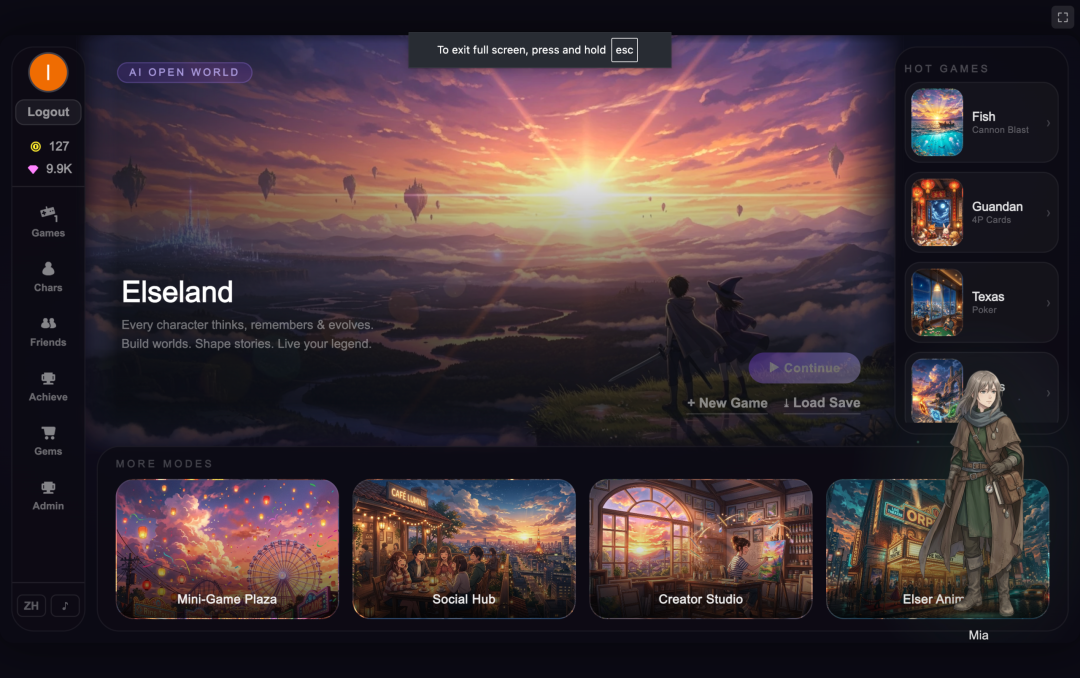
- Elseland homepage, which Liu defines as an AI open world
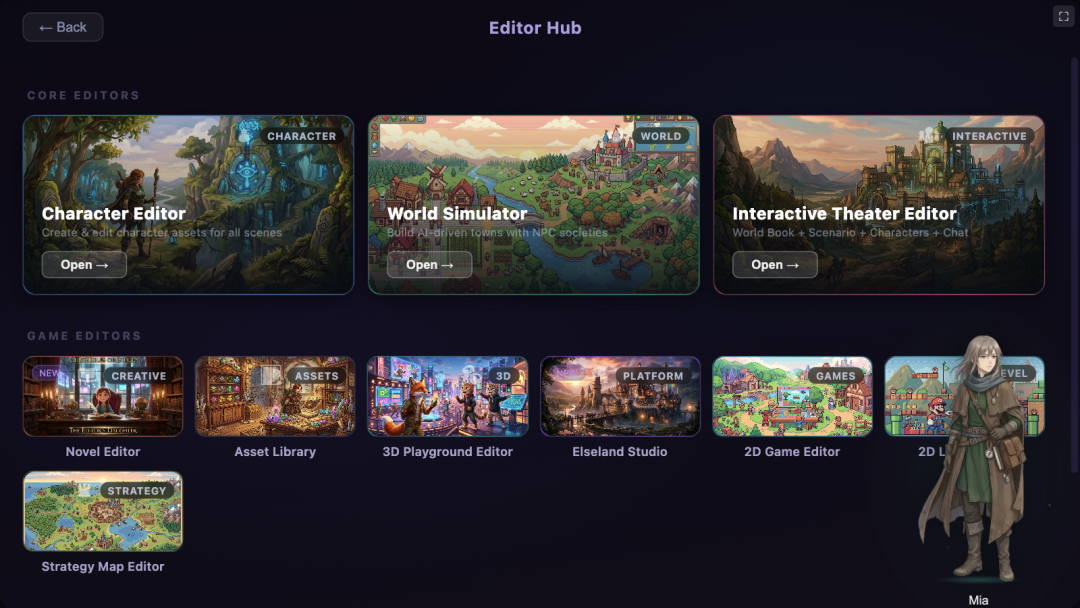
- Elseland editor plaza
"Almost every interactive entertainment form that AI can currently achieve can be presented on Elseland," Liu said.
Elseland is about to launch closed beta.
This is Liu's path toward AI Disney.
「 Conversation with Liu Geng 」
Content Tools Don't Lead to Content Communities
Unless You Solve the Supply Side
AI Nao There are no fewer than 20 AI manga-drama platforms on the market. What makes Elser.AI different?
Liu Geng Everyone's telling the same story, from video tool to platform. But the key is — did you figure out the platform logic on Day 1? Do I just build a tool, wait for creators to grow, and then suddenly one day a community hatches out?
AI Nao You don't think it works that way?
Liu Geng
Probably not. That means you burn a lot of money, a lot of investor money to pull creators in. Meanwhile they have no distribution platform, so everyone still has to redistribute content to existing traffic pools like Douyin and Xiaohongshu. So your AI video tool becomes just a production workshop, not their home.
AI Nao So you think tools don't naturally lead to community?
Liu Geng Correct. Tools can make tool money — you can cut to B-side for stable revenue, or cut to C-side for social media content. But they won't naturally grow a community.
Community is something you have to figure out on Day 1. You have to find currently scarce supply, scarce content, where there's also massive demand. Only then can you simultaneously leverage supply and users, forming a flywheel no one else can take away.
AI Nao What do you think is scarce supply?
Liu Geng Domestically, Hongguo has already succeeded — there's no opportunity to build another platform. But overseas, there isn't one yet. And manga drama as a category separates creators from consumers — out of 100 viewers, probably not one can make dramas. So you can't do what Douyin did, waiting for consumers to naturally become creators. You have to solve supply first.
AI Nao So Elser.AI targeted overseas from the start?
Liu Geng Yes. And we don't cut to B-side — B-side goes wherever the money is, and even if you cultivate them, they'll leave. We cut to professional creators between PGC and small-B (Prosumer, hereafter "P"). They have passion, they can produce consumer-grade content, and they need tools, distribution, and monetization pathways. This group is the scarcest supply right now.
AI Nao But cutting to P is heavier than choosing B or C.
Liu Geng Harder, but not heavier. Hongguo's path worked domestically — consolidate existing supply, pull traffic through free content, then monetize with ads. But it won't work overseas. Overseas doesn't have that much ready-made supply. So you have to build supply yourself. Find creators online, find P. Most AI manga dramas now are doing C-side — users who write a prompt and AI generates a video for them. That feels great in the moment, but it can't become consumer-grade content.
AI Nao Produce-to-consume, and then nothing. How do you define P?
Liu Geng People with professional capability who don't want to join institutions, don't want to do assembly-line production at short drama companies. They're the most creative, and the ones who can benefit most from AI productivity gains. We've calculated: a PGC creator using our tools can earn ten to twenty thousand a month. If they joined a big company like Jiangyou, they'd likely only make three to four thousand. AI lets them do this with love, with time freedom, and still earn money, happily. The output quality from these people is higher than B-side average.
How to Actually Build Supply
AI Nao How do you find these people? How do you get them to come to Elser.AI?
Liu Geng This is what I spent my last two years at ByteDance doing.
At the end of 2021, I moved from ByteDance's education vertical to Douyin's CSR department. Douyin's CSR was different — not donations or charity ads, but business-model approaches. For example, we helped farmers sell tea on Douyin.
The situation then: Douyin had massive traffic, users scrolling all day, but almost no tea merchants on the platform. So giving traffic was useless — there was nothing to sell.
AI Nao What did you do?
Liu Geng Built from zero. We didn't find already-famous KOLs and ask them to switch to selling tea — too expensive, and no social value. If that were the case, the e-commerce department would handle it; CSR wasn't needed. We found ordinary farmers, returning youth, small tea growers — they wanted to do it but didn't know how. Three steps:
First, online training. Teach them Douyin's traffic logic, how to shoot video, how to add product links, how to ship. This was volume play — get as many people in as possible.
Second, incubation mechanics. We set up challenges: you post, we give traffic incentives; good content gets boosted. From 100,000 people, we'd filter out roughly 1,000 who could reach 10,000 followers.
Third, heavy operations. For these 1,000, we created groups, gave strategy, gave resources. From there, 100 would hit 1 million followers, maybe 10 would reach 10 million. These top creators could sell 300 to 500 million RMB in GMV annually.
AI Nao Activating the community through incubating top creators?
Liu Geng You got it — with these top creators, the community truly activates. People see this actually works, and they all come. Tea GMV on Douyin grew from a few billion at the start to 12 billion in 2022, and by 2023 when I left, it had exceeded 20 billion.
So this is why I believe we can do P incubation, even build a community creation platform. At Douyin, I built a creator ecosystem from zero. Douyin had traffic; we found sellers who could actually sell tea. Now Elser.AI has tools; the next step is finding creators who can actually create. It's fundamentally the same thing — you have to first find the people willing to do it, and run alongside them until they make it.
AI Nao But everything you just described — traffic incentives, challenges, boosting — Douyin could do because it had a traffic pool. You don't have a traffic pool now. What do you use to incentivize P?
Liu Geng That's why we need tools. We did consider: if the endgame is platform, why not just use others' tools? Just find creators directly?
The logic of last-generation content platforms: phones and cameras had already solved the productivity problem; you only needed to do distribution. But this generation is different. With AI-generated content, you first have to solve the productivity revolution. Once tools exist, the supply-side problem is solved — creators can first make content, and stay.
B-side won't stay — wherever the money is, they'll go; even if you cultivate them, they'll leave. But P will. Because manga drama is different from Douyin short video: with short video, if you don't like it after 5 seconds you swipe away. But with drama, if a user watches 3 minutes and then finds the rest is terrible, that's massive damage to the platform. So drama can't be self-published; it must go through platform review and curation.
Here's where a gap appears.
Platforms like Hongguo need "ready-made, already-validated, batch-suppliable content." They have traffic, money, procurement budgets — but they lack the ability and willingness to discover and cultivate P. They wait for P to emerge on their own, delivering finished dramas to the door.
But P's problem is: making 100 episodes costs too much; they can't finish the whole drama first, then find a platform. And they don't know what platforms want, how to connect, how to price.
So neither side moves — platforms wait for supply; P waits for channels.
AI Nao Elser.AI fills this gap.
Liu Geng Yes. We give P tools so they can make good content; for platforms, we have quality creators in hand, helping them one-click distribute to various platforms to get traffic. When content forms a differentiated consumer-grade advantage, creators can earn money, can accumulate fans — then even if major players want to come in, they can't easily poach creators directly.
So what we do is fundamentally closer to creators, closer to the content they're producing.
AI Nao How big do you think the P population doing AI manga drama can actually be?
Liu Geng Goldman Sachs data says globally there are roughly 30 to 50 million professional PGC video workers. But of these, by 2025 less than 1% have become professional AI creators — maybe two to three hundred thousand. So this is a state that hasn't achieved mass penetration yet.
Our product positioning is: experts in control, beginners kept simple. The core is experts in control, but using AI to let more people in, ultimately helping them grow.
AI Nao What's exceeded your expectations so far?
Liu Geng P's willingness to pay is higher than I imagined. We currently have over 30,000 paying users, and the highest annual tier is over $1,000 — many pay directly. B-side clients, on the other hand, dawdle, want to negotiate for weeks, need to talk to the boss. B is very calculating.
AI Nao P is more willing to pay than B?
Liu Geng Not just willingness — P's output quality is also higher than B-side average. Many creators add personal touches in shots, not assembly-line production. Fundamentally because their passion is higher — doing this with love and freedom, and still earning money. That's what makes this truly interesting.
AI Nao Do you think the timing is right for the overseas manga drama market?
Liu Geng I think signs started appearing late last year. A batch of (manga drama) accounts emerged on TikTok in Q4, rapidly gaining over 100,000 followers, with great traffic. This shows user demand is rising.
But overseas differs from domestic. Domestic short drama grew from lower-tier markets upward — first free model, then cutting to high-value content. Overseas, the large paying population is upper-middle class — Netflix, Disney users. They have strong payment ability but also high content quality demands.
Look at what female-oriented content works domestically: strong female leads, independent career women, fallen families making comebacks. What works overseas is still plots waiting for male rescue, very much like China in the 1990s. This shows overseas high-quality narrative hasn't been satisfied yet. That's the opportunity.
ByteDance, Tang Bohu, and Visionary
AI Nao Before joining ByteDance, you were a philosophy professor at Wuhan University. That résumé probably has no second in AI entrepreneurship.
Liu Geng Actually there was a connecting chapter. Around 2018, I first co-founded an online education product with friends, somewhat similar to Kaishu Storytelling, and made some money. It was after this experience that I went to ByteDance.
AI Nao Which business line did you join at ByteDance?
Liu Geng Education, called GuaGuaLong. I was head of teaching research. ByteDance wanted someone who understood product to lead teaching research — most teaching researchers in the market only had education backgrounds, no internet product sense. I was probably one of the few young university teachers they'd found who had founded a company, so they recruited me. Our business actually ran very fast, but later encountered the double reduction policy, and the entire education vertical was restructured.
AI Nao Malvin from Lovart also worked at GuaGuaLong.
Liu Geng Yes, we were colleagues. I led teaching research, he led product. We were very successful then, fought battles together. At the time, Yuanfudao's Zebra was the first mover; we were the follower. But we were very restrained early on — very low ad spend in the first two to three months. Some people wondered if we couldn't grow. But actually we were testing models — testing conversion, testing NPS, testing renewal. Once NPS and ROI both beat Zebra, we started aggressive spending. Growth became very explosive after that, monthly revenue reaching around 600 million.
AI Nao Many people around Malvin have started companies in recent years. ByteDance pedigree is itself a golden signboard, but you don't seem to play up these points externally?
Liu Geng Yes, many do this, but I don't see the need. Malvin is my friend; I'm happy for him. But why would I trade on a friend's success? Also I was somewhat unusual at ByteDance — I entered as an associate professor. In meetings I dared to directly oppose the CEO. I wasn't much like someone factory-trained by a big tech company.
AI Nao You studied philosophy at Peking University for nine years, bachelor's through PhD. Then taught philosophy at Wuhan. Very few AI founders have your background. What did you mainly research in philosophy?
Liu Geng My graduate studies were in Western aesthetics history; my PhD shifted to Chinese art history. Because my doctoral advisor researched Ming literati painting, whom I greatly admired and liked, so I followed him and shifted to Chinese art. And during my PhD years I also wrote a lot of xianxia fiction, haha. Later at Wuhan I taught aesthetics.
AI Nao Who's your idol in aesthetics?
Liu Geng Tang Bohu counts as my idol. I have deep sympathy for him. Actually when Cao Xueqin wrote Lin Daiyu, many images were derived from Tang Bohu — including in Burial of Flowers, carrying a flower hoe to bury flowers, that act itself was something Tang Bohu did. He's someone with fervent love for life, for all beautiful things in the world.
AI Nao The libertine is actually the one who loves the world most.
Liu Geng Yes, libertinism is their way of loving the world.
AI Nao Besides entrepreneurship, you have so many different experiences and tags. If you could only choose one identity to define yourself, what would it be?
Liu Geng Visionary.