ByteDance Gold Rushers: The Most Expensive Thing Is the Halo

Moses wandered forty years without reaching the Promised Land; ByteDance founders who've entered the wilderness find the hardest thing to escape is ByteDance itself.
Divergence | 10 Billion | Problem Solvers | First Tier


The Hunt
In 2026, valuations of ByteDance alumni founders were "cut in half."
An angel round for a ByteDance 4-1 (director-level) founder was $2 million — down from $4 million just a year earlier. Partly because AI applications had cooled (the vast majority of ByteDance alumni were building in AI applications), and partly because the competitive window was slamming shut. "Everyone who was going to come out has come out. Capital is now reverse-engineering motivation — did they actively want to start a company, or did they leave because they weren't advancing internally?" said an investor at a top-tier firm.
Over the past two years, as the world's largest unicorn, ByteDance has been exporting AI entrepreneurs globally.
Based on publicly disclosed funding data, from January 2023 to present, roughly 70 to 80 ByteDance alumni have founded companies, raising approximately 18 billion RMB in total. The most active investors behind them are HSG, IDG Capital, and others.
A leading fund inside Beijing's Second Ring Road established an OKR as early as 2024 requiring every investment team member to meet with core ByteDance staff at least once a month, tracking their thinking and maintaining ongoing conversations about entrepreneurial ambitions. AI Investment at Halftime: Talent Wars, Faith Divides, and Super Opportunities.
Among them, HSG has taken the most aggressive approach, operating like an incubator — deciding on a direction first, then finding the right people from ByteDance. A representative project involved data cleaning and annotation for a model company: they poached two product and operations leads from ByteDance's data platform team and set them against each other in parallel efforts. Hillhouse, this year, hired Thomas, former product lead for Doubao, to independently run an internal Seed fund, attempting to replicate HSG's playbook. Thomas's earlier experience was in early TikTok product strategy.
Creekstone is a newly established early-stage fund. Of the dozen-plus AI projects in its first fund, more than half are founded by ByteDance alumni. To outsiders who think they only invest in ByteDance people, their explanation is: after meeting countless AI entrepreneurs, the organization with the highest density of AI talent remains ByteDance. Three reasons: first, ByteDance has the most comprehensive AI product matrix and a constant stream of horse-race projects, gathering people closest to the models; second, their core metric for evaluating founders is GPU hours — ByteDance employees average the highest GPU hours industry-wide, with abundant and strong algorithm talent. Third, ByteDance people are flowing into AI startups in large numbers, creating an active entrepreneurial ecosystem.
"Some ByteDance people haven't even left the company yet, and we're already helping them find direction," Creekstone investor Gary told AI Nao. One heavily backed project involved a core ByteDance product manager they introduced to a big-model startup's Agent lead. "Originally both were going to start their own companies, but after talking, they decided the ByteDance person should be CEO."
The VC with the clearest ByteDance ties is Jinqiu Fund, named after the residential community on Beijing's Zhichun Road where Yiming Zhang rented an apartment in his early entrepreneurial days. It was founded in 2022 by Jie Yang, former head of ByteDance's financial investments.
Jinqiu has never publicly marketed itself as a ByteDance ecosystem fund, but many of its portfolio companies told us that Jinqiu's advantage is faster sourcing of ByteDance alumni — easier access to senior talent than HSG or IDG, and more direct due diligence.
Compared to non-ByteDance founders, ByteDance alumni command a 1.5x to 2x valuation premium, thanks to a proven methodology absorbed at ByteDance (A/B testing, data-driven decision making, growth strategy, international expansion). They also raise faster — most complete their first round within six months of leaving, some before their product is even publicly launched.
One financial advisor told us that this wave of ByteDance founders has largely taken money from market-rate VCs, a clear contrast with the Alibaba model (dense Alibaba strategic investment plus executive personal angel checks).
Over the past two decades, capital has chased trends, sectors, and business models. But such uniform, concentrated hunting of employees from a single company is unprecedented. Why not Tencent, Alibaba, or model companies? Because ByteDance is one of the few parent organizations still growing rapidly while dramatically raising the ceiling for talent.
This year's cooling of ByteDance founder valuations stems first from external conditions: capital cycles have shifted toward model infrastructure, embodied AI, commercial aerospace, and other hard tech. The primary market's pricing logic for applications has become "returns."
"Last year there was an application explosion, and the market was genuinely FOMO-ing. The obvious first choice was ByteDance alumni — they're the most battle-tested. But to date, no ByteDance alum has cracked the business model for AI products," judged one dollar-fund investor. It's not that ByteDance alumni aren't capable — AI applications are simply hard to turn into massive hits. The core reason is insufficient compute: "The major platforms don't have enough compute for themselves. Companies that can sign annual contracts above $100 million are few and far between."
The Substance
AI talent profiles are also diverging: researchers, engineers, professors, and base model trainers have become the new wealth targets.
An investor who previously worked in a ByteDance AI department and now does early-stage incubation believes that many ByteDance alumni founders are factory-configured for the last era's wars. "The first-tier talent is still inside ByteDance."
Why does first-tier talent stay? First we need to understand why this wave of AI entrepreneurs left ByteDance.
ByteDance began with Toutiao, then expanded through Douyin to TikTok, with verticals like Dongchedi (auto), Fanqie Novel, Hongguo Short Drama, and Qishui Music interspersed in between. Each wave's core team had completely different talent profiles.
The Toutiao system, centered on Wenjia Zhu, actually produced many entrepreneurs, but that era is distant and ByteDance's talent density was not what it is today.
The Douyin system grew out of various ByteDance video products (Volcano Video and others), with Kelly Zhang, who joined through acquisition, later reassigned to CapCut. Douyin's product format had no real innovation — it relied early on distinctive content supply. So Douyin's most core talent was early operations, represented by Alex Ren (Juanjuan), who started his company in 2023 and technically doesn't belong to this current outflow. He first did jewelry e-commerce, then AI 3D generation plus manufacturing, with his latest Series A and A+ raising $50 million.
TikTok came from ByteDance's acquisition of musical.ly, with Jun Zhu (musical.ly co-founder) at its core. He is now ByteDance's VP of product and strategy and overall head of the Flow department. TikTok's most valuable people were on the product line, bringing entirely new interaction patterns to early TikTok.
Recently, Arthur from the TikTok product line left to start a company (a -1 to Jun Zhu's core lieutenant Adem), a 1997-born founder building in social gaming. He raised four rounds in three months at a $200 million valuation, with Jinqiu as the first-round investor.
The Lark product line is also valuable, but with stage distinctions. Early Lark served internal employees — the most demanding users — so product experience was pushed to extremes. Some high performers from that period were merged into the corporate IT department. Senior hires who joined later had more limited scope and resources.
The true bulk of AI-era entrepreneurs come from the CapCut, education, and Doubao systems.
Education outflow needs no elaboration. The CapCut system has produced 10-plus founders in two years, the largest number, mostly choosing tools. The reason is harsh: as a tool business, CapCut's internal priority ranked below Doubao and Seed. After Kelly Zhang took over, organizational changes plus product commercialization narrowed business scope, causing a large outflow. A representative is Melvin Chen of Evoken. "CapCut as a tool, with front-end traffic fully supplied and product not falling apart, won't perform badly within ByteDance's large system. CapCut founders as a whole need more observation," said a headhunter familiar with ByteDance internals who requested anonymity.
Early this year, the Doubao system began talent outflow. Several product line leads who left Doubao shared a common assessment: Doubao is a strategic priority, but internal direction was once chaotic, business oscillated, and feedback loops were too long. "Doubao's current performance depends first on ByteDance's self-developed models being strong, second on the high growth brought by Zhao Qi who led the growth middle-platform last year. The business urgently needs someone with Allen Zhang's extreme sensitivity to user needs and product interaction."
Compared to the Doubao system, the caliber of ByteDance hardware alumni is harder to judge.
First, by battle results: short time, no major wins yet. Second, some senior hires from Huawei and DJI struggled to adapt, because ByteDance management had blind spots in hardware understanding, requiring senior talent to spend enormous time educating them.
A former ByteDance hardware HR lead told us she recruited one senior from Huawei after nearly a year of communication. The match was poor because he was more accustomed to Huawei's HarmonyOS ecosystem. "Investors daring to bet on ByteDance hardware is indeed a kind of FOMO — there's significant information asymmetry internally and externally."
ByteDance's most expensive and best talent currently sits in the Seed team. Seed originated from the large model team formed in 2023 by Wenjia Zhu. Its largest component came from the AI Lab founded in 2016 — a frontier exploration organization whose early scientists were mostly algorithm backgrounds.
In October 2025, Seed and AI Lab formally merged, with Yonghui Wu as the lead. Around this reorganization, talent outflow occurred. Early entrepreneurial representatives include Changhu Wang, AI Lab director and founder of AISphere, and Hongxia Yang, former ByteDance language model lead and founder of InfiX.ai.
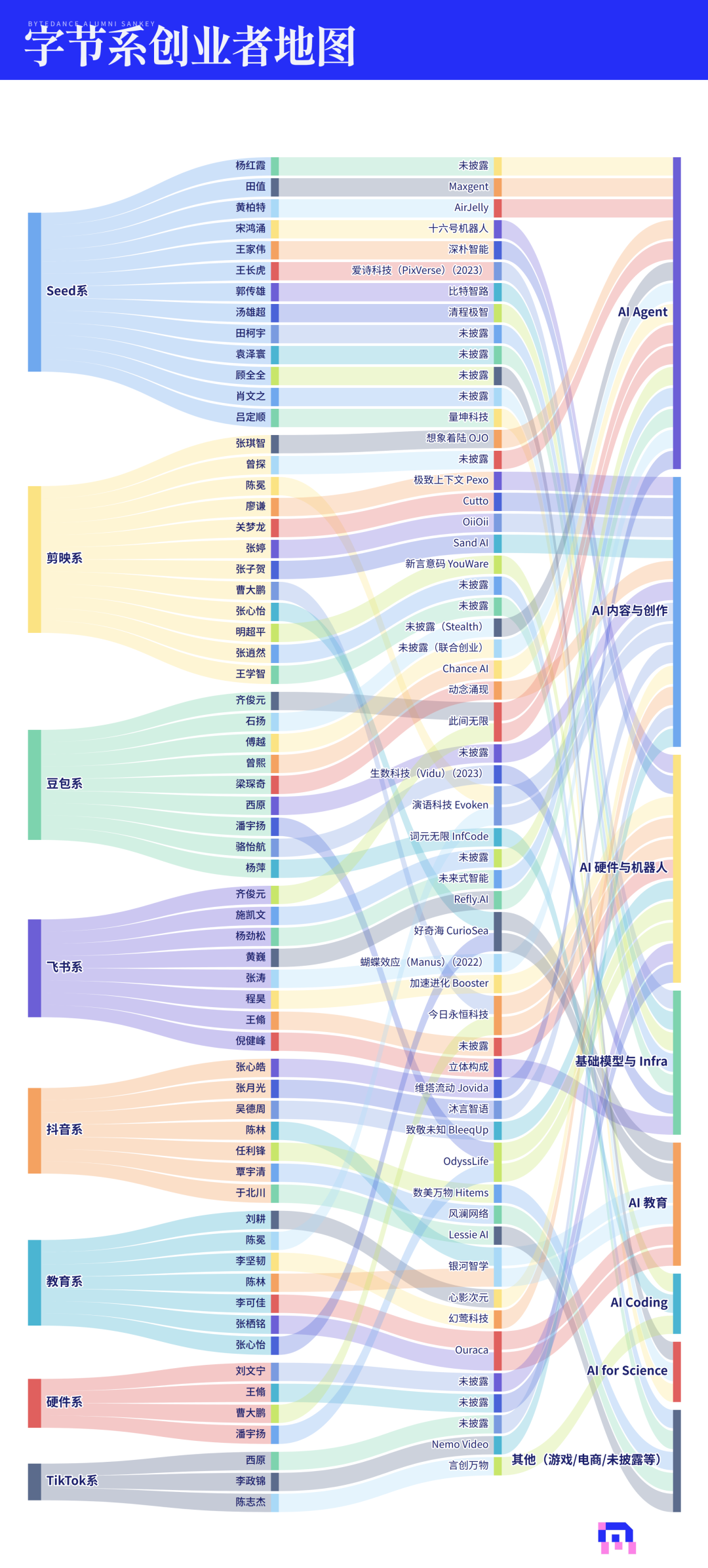
By total disclosed external funding, the top three ByteDance business lines are Seed system, Doubao system, and CapCut system. For individuals specifically — one must carefully examine their business stage at ByteDance, specific business line, and long-term reporting boss.
"Some may not be as strong as early people at StepFun, Moonshot AI, or SenseTime — those people truly built from nothing and tried many projects," said someone who previously worked in ByteDance strategy and now invests. "Douyin's product wasn't as valuable as its operations, Lark's commercialization wasn't as valuable as Lark product, CapCut's commercialization is negligible. Specifically for Seed, young researchers doing frontline work are more valuable. Some people say they're from Seed, but likely they're from Seed's predecessor AI Lab doing algorithms — algorithmic technical choices may not keep up with the times."
Divergence
ByteDance's organizational culture leans entrepreneurial. No boundaries, permission to explore entirely new things. For the same type of business, horse-racing is permitted. Hierarchy is far less rigid than at Tencent or Alibaba. Hiring preferences favor people who've started companies. The pattern of acquired entrepreneurs creating massive value for the company has been repeatedly validated.
A former operations lead at one of ByteDance's high-growth businesses described the culture as "law of the jungle," having previously worked at Tencent and Alibaba. "Alibaba is top-down, high-density, high-intensity push — war style, listen to the boss, execute properly. Tencent is the company with the lowest personality quotient — the WeChat way is to exhaust all possibilities at the dialectical level, internally battle each other, validate before pushing features, from Allen Zhang's classical product style. At ByteDance you quickly validate, pivot if it doesn't work. ByteDance likes employees who are smart, outwardly willing to express and fight for resources, inwardly able to straighten out logic. Everyone desperately finds work for themselves, spiritually very intense — so indeed suitable for producing entrepreneurs."
But the paradox is: this wave of AI entrepreneurs, the ones defining key paradigms and benchmark figures, don't come from ByteDance — DeepSeek, the model Six Little Dragons (Tsinghua/Microsoft/SenseTime lineages), including Manus. Even comparing big-company backgrounds, there's Jingkun Baidu's Genspark and Justin Lin's angel round at a $2 billion valuation from Alibaba.
To date — objectively speaking — the ByteDance alum with the best-looking numbers is Melvin Chen of Evoken, with ARR breaking $300 million and Hong Kong IPO preparation underway. But Chen's high-growth-for-scale model comes from the ancient bike-sharing wars, commercialization unvalidated (still loss-making).
The deeper problem: ByteDance alumni seem less skilled at defining "problems," more skilled at "solving" them. They were trained in the same system. Most ByteDance founders AI Nao has encountered share one strategic methodology: start from the end, then execute极致ly.
At ByteDance, business leads are required to update annual plans every six months and three-year plans yearly, all derived from "how to become world number one." For example, Kelly Zhang demanded of subordinates: "Think极致ly, do极致ly, don't care about current cost得失, derive from endgame what matters most today."
On one hand, this gives ByteDance founders global ambition from day one. On the other, this system cultivates perfect professional-manager thinking (Jack Welch would applaud): set goal first, reverse-engineer path, relatively controllable upper and lower bounds, pivot quickly if data is poor. Moreover, thinking in three-year cycles to become world number one is short-sighted, fundamentally a false proposition.
ByteDance mass-produces optimal executors on known maps, while founders must define problems where no maps exist. Using the same framework and problem-solving approach, it's hard to produce different outcomes.
Defining new paradigms requires being crazy enough, patient enough, even holding non-consensus persistence in chaotic environments — Steve Jobs, Jeff Bezos, Elon Musk: dropouts, outsiders, cynical bad boys. None had long tenures at successful companies. Even Yiming Zhang.
Counter-example: Google, similarly one of America's best organizational cultures, has produced almost no successful entrepreneurs.
Wealth magazine editor White, who long observed corporate organizations, concluded that the companies producing the most entrepreneurs aren't the best companies but bad companies and bad managers — the Fairchild case, where anger was productive. "The function of a good company isn't to kill genius, but to make genius voluntarily stop wanting to be genius."
But fairly speaking: it's too early to judge ByteDance alumni. AI rewrites its landscape every six months. The famous PayPal talent network took a full decade from dispersion to canonization.
The greatest difficulty these ByteDance departees must overcome: muscle memory etched in DNA and massive organizational inertia.
In building ByteDance's early culture, Yiming Zhang absorbed global best practices: OKRs from Google, "Context, not Control" from Netflix, "Always Day 1" from Amazon. The only original contribution:大小周 (alternating six-day weeks).
A former core member of ByteDance's hardware business experienced the hardware business's prolonged lack of progress. When the company decided to acquire a Shenzhen headphone company, their presentation to Yiming Zhang listed numerous problems. Zhang responded in half an hour: acquisition approved, these are all known problems, so give them special time. "Were ByteDance's headphones successful? Not really, but the core team remains at the company. Yiming is quite matter-of-fact — when problems arise, he cares about why, what was learned, what to do next, explain clearly and it's fine. He doesn't actively abandon people."
Compared to other major platforms' frequent executive turnover, Yiming Zhang's core team has been relatively stable, with extremely high mutual trust and rare executive infighting. Evidence: frequent ByteDance executive rotations with minimal external outflow.
A 5-1 who left for special reasons told us ByteDance is already one of the world's frontier companies, with spiritual fulfillment and material income satisfying senior talent, without entrepreneurial risk — why start a company? "My most suitable position is still 5-1. If I have the chance, I still want to return to ByteDance."
Wanaka founder Yang Zhang, who previously led ByteDance international expansion, started his company (Jinqiu invested in the angel round). Doubao tried to recruit him back; he refused. He admits working at ByteDance was great: "We built an India version of Xiaohongshu, 50 million DAU in just seven or eight months — like riding a rocket." But he wanted to participate in the era as an individual, not within an established system.
This May, Yiming Zhang saw press coverage of his startup and invited him to dinner, in a conference room at a ByteDance business line's office area. The meal lasted over two hours, with Zhang mostly asking questions, very detailed ones — why AI games, his thinking path. "For someone at the top of such a massive company to still be this hands-on meeting people," Zhang was shocked. "Yiming kept reflecting that apparently building AI games requires enormous patience — including that ByteDance's previous game efforts essentially failed from insufficient patience. Games require longer waiting time than other content categories like video or novels; one must objectively recognize the difficulty."
Toward the end, Yiming Zhang gave two suggestions: first, move to mobile quickly; second, quickly explore video interactive content. "I told him then, on video modality, I can't beat ByteDance — you will definitely do this."
Yiming Zhang listened, and smiled.