A Conversation with DingTalk CEO Wu Zhao | AI Native, Disruptors, and New Opportunities

Back to day one of building DingTalk — it had to be born for AI.

By Pippobei | Produced by AI NOW
1
Four months ago, Wu Zhao's return to DingTalk was seen as the final piece of Alibaba's comprehensive AI-native transformation, following explorations in core products like Alibaba Cloud, AutoNavi, and Quark.
Wu founded DingTalk inside Alibaba ten years ago, then left to start his own company overseas five years later. Upon his return, his guiding question was: If he were a founder again, back on day one of building DingTalk, how would he approach it in the AI era?
The answer, first and foremost, demands being a true believer in AI — never reversing course on technology, and pushing aggressively for AI implementation. Second, identify real problems, solve real problems, and deliver genuinely commercial products to customers. "Lots of companies have good technology, but they're out of touch."
On August 25, Wu presented his answer. Unlike previous attempts that added limited AI features or modules, this was DingTalk rebuilt from scratch with AI — not DingTalk plus AI, but AI DingTalk.
At the launch event, DingTalk unveiled nearly ten AI products at once, including a hardware device called DingTalk. From AI secretary DingTalk One, to AI Search, to AI Spreadsheets, Wu's ambition is clear: he wants to use AI to redefine how the world works, and that's why he came back to Alibaba.
This full AI-native overhaul also means DingTalk must strategically cover more industries and scenarios — not as a short-term feature fix. Conveniently, this plays to DingTalk's ten-year advantage: a deep bench of industry clients.
After the event, AI NOW joined Wu for lunch — boxed meals for everyone. His style remains as direct and blunt as ever, including how his perspective has shifted since returning to Alibaba, how he positions himself in his new role, and how he examines himself.
The conversation follows.
In Conversation with Wu Zhao
Part 01
Internet People Shouldn't Be So Full of Themselves
AI NOW: What was your starting point for solving "how to build DingTalk in the AI era"?
Wu Zhao: The overall approach is still that DingTalk needs to be built for AI.
Right now, most people in the industry don't really understand AI, and few have figured out how AI will actually land in the next two to three years.
I'll give you an example. The steam engine emerged in Britain as a transformative technology, but its mass adoption came with the invention of the assembly line. AI is the same today — the way most industries use AI resembles building a single textile machine during the steam age, one unit at a time, without turning the technology into a production line that humanity can use at scale.
So I care more about AI accessibility, about whether it can solve universal problems, whether more people and more industries can use it, whether it can penetrate the physical world and solve real problems.
AI NOW: The examples DingTalk showed at the launch included metallurgy, home furnishings, and so on. Does that mean you're more focused on AI landing in traditional industries?
Wu Zhao: No, we're not particularly focused on any industry. We only care about solving real problems. It's just that most office products built by internet companies are unwilling or unable to understand other industries.
Ten years ago when I founded DingTalk, I was arrogant too — I thought Alibaba's way of working was the best. But in reality, China's internet tech companies are quite isolated from other industries. Can a small shop owner learn from advanced companies and implement OKRs? First of all, can you even afford it? OKRs only work for high-margin industries.
We assumed internet work methods were universally applicable, standing on high ground looking down. In reality, facing real customers, it solved nothing. We were full of ourselves, and we got slapped in the face.
AI NOW: Can you give a concrete example?
Wu Zhao: When I started my own company five years ago, I used an internet office product. After using it, my reaction was: what is this? It thought its way was the best, but it was completely wrong. I started a business to make money, but what I needed, it couldn't help me with.
That's when I realized — the product I had built before was just self-indulgence. I couldn't even serve a one-person company well.
AI NOW: DingTalk is DingTalk's first hardware product — combining voice recorder, conference device, translator, and AI assistant, similar to Plaud. It's not a new product form factor. Why hardware? Is this a real刚需 scenario for businesses?
Wu Zhao: In real work scenarios, relying on phones and computers is actually pretty unreliable.
Many internet companies judge what users need based on their own experience — build an online document, optimize a workflow, and think they're being advanced. But does it really matter? How many cases and documents does Alibaba have? Does anyone actually read them? If you survey traditional industry bosses, they'll tell you writing documents is a waste of time. I've started companies — rapid discussion, rapid碰撞, rapid action is what matters. No time for documents.
The real scene every day is: a customer comes, you chat; a client comes, you chat. The A1 hardware makes all this physical-world communication and discussion visible to AI and digitizes the process. This is definitely a刚需.
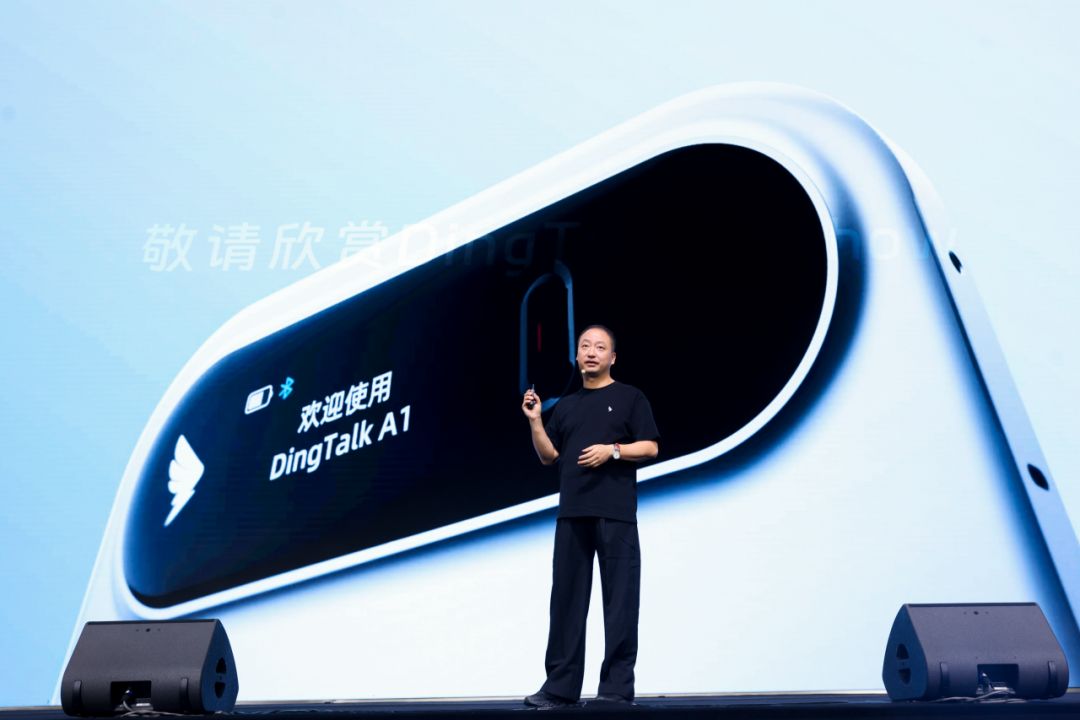
- August 25: Wu Zhao introduces DingTalk at the AI DingTalk 1.0 launch event
Part 02
Redefining How the World Works
AI NOW: You've said that in the AI era, you sense a major opportunity — that for the first time, Chinese people have a chance to define how the world works?
Wu Zhao: Before, when we built documents, communication tools, workflows, we were basically looking at what Office was doing and copying it. No generational gap. Without a generational gap, why would anyone switch?
Catching up using someone else's methods, you can only be slightly better. To achieve full replacement, to change how people work globally — impossible.
AI NOW: Microsoft is also going all-in on AI, including launching its own AI browser, Copilot?
Wu Zhao: But being极致 excellent in one domain makes it hard to revolutionize yourself. It's like how people who are great at neural network algorithms rarely become large model experts.
Sometimes success is a constraint too.
AI NOW: What are your thoughts on AI reconstructing work scenarios?
Wu Zhao: Previously, humans wanted AI to help them. But true AI-native should be humans helping AI understand the world.
For example, the customer service scenario we're heavily exploring. Past AI customer service was essentially quick semantic search — hit a match, then let AI polish it. The metrics looked fine on the surface, but dig deeper and it's full of problems.
Because real human customer service is fundamentally based on human knowledge沉淀. But previous intelligent customer service used RAG and knowledge graphs without integrating human knowledge. How could this kind of customer service satisfy clients?
So making AI understand context and industry, then letting AI respond — that's what you can call AI customer service.
AI NOW: How do you view competitors?
Wu Zhao: They're all excellent. If they're better than us, we learn. No competition in the industry would actually be the problem.
AI NOW: Can you accept DingTalk falling behind competitors?
Wu Zhao: We'll fall behind at any moment, but you can't judge by advanced or behind, and competing for competition's sake is meaningless.
We're building the next generation of global work methods, solving enterprise problems. This has nothing to do with competition.
AI NOW: Which technical direction are you most focused on for DingTalk right now?
Wu Zhao: Whether we can integrate into industry scenarios.
First, sustained investment. Second, bring in industry experts to tell us what to do — we can provide the underlying capabilities.
So accessibility is key. Otherwise we become just another general model company, doing some documents in office scenarios at best.
Only by connecting with the physical world, entering human production and manufacturing processes, can we achieve a massive transformation in productivity.
AI NOW: What will work look like in five years?
Wu Zhao: AI will first become people's岗位 assistant. Then we'll wait for new model capabilities to emerge, letting AI develop more genuine understanding of the physical world.
Also, most models now are large models. When large models can do small models, theoretically they can mimic the human brain — humans have both a cerebrum and cerebellum.
Part 03
I'm a Product Manager for the AI Era
AI NOW: Four months back, team of just over 1,000 people, launched more than ten AI products including a hardware device — isn't the resource spread too thin? How do you ensure everything gets done well?
Wu Zhao: Don't look at the surface. We actually have the support of the entire Alibaba system — we're just the ones driving it. How could we possibly drive Tongyi on our own?
AI NOW: How do you handle cross-department collaboration?
Wu Zhao: I've founded a company. If I can convince investors to give me money, I can't convince colleagues to help me out? Plus, some people you can just smell whether they actually want to do it or not. If not, find someone else.
AI NOW: You split the team into more than ten innovation groups. What criteria do you use to judge results?
Wu Zhao: I point the general direction first, move in that direction, don't run wild and don't go backwards.
Then you must combine with real scenarios, observe real customer needs, never be先入为主. I'll ask the team: did you go to the customer's office? No? I'll take you, I'll do it once myself. Watch and learn, then do the same.
Also, don't tell me how you think, how amazing this feature is. I only care: is it usable? Is the customer satisfied? Does it solve real problems?
AI NOW: Are you a "my way or the highway" kind of boss?
Wu Zhao: I'm not a dictator. I'm willing to work with everyone. But most of the time, it's hard for others to convince me.
There was only one time a team was presenting their business, I thought they were kind of bullshitting, I had my own ideas. But they showed me the actual results, and I was convinced.
As long as you show me concrete things, I'll be convinced.
AI NOW: How do you keep the team in an innovative state?
Wu Zhao: Anyone can propose ideas, even an intern. Come directly to me — my desk sits right with everyone else. I run a flat organization. As long as you've thought through the general direction and can clearly tell me what you want to do.
AI NOW: How do you identify now — entrepreneur within the Alibaba system? Professional manager? Or CEO of DingTalk?
Wu Zhao: A product manager for the AI era.
AI NOW: You were quite marginal at Alibaba early on, then built DingTalk with something to prove. Now you're back, and DingTalk is already a major strategic priority for the group. What's driving you now?
Wu Zhao: Early on, definitely wanting to prove myself. But ten years ago, during Laiwang, that mindset was already gone. Including early DingTalk days — because I接触ed so many customers, I developed a sense of mission. The drive became helping enterprises across industries. When you can help others, you realize life has meaning, and you feel so small, you're nothing.
AI NOW: What performance metrics does Alibaba leadership have for DingTalk?
Wu Zhao: A commercial company definitely has commercial metrics, plus a certain tolerance period.
AI NOW: DingTalk four months ago when you returned versus today — what's changed?
Wu Zhao: We've taken the first step into AI, qualifying as an AI-native product.
I've also answered what DingTalk should look like in the AI era — what it looks like today is what it should look like. In a year or two, it will definitely look different again.
What we're showing now is just the tip of the iceberg.
Image source | Provided by interviewee
—Bonus—
We have a podcast now
Search "AI NOW" on the Xiaoyuzhou app for first-hand interview recordings