Why Compete on Models When You Can Compete on Orchestration? CrePal Wants to Be the Creative Director for AI Video Models | A Conversation with CrePal Founder Jiaming Liu

By "orchestrating" the best video models on the market, it helps users generate complete videos from a single sentence, dramatically compressing a complex process that once took days and cost thousands of yuan.
By Pippobei | Produced by AI NOW!
AI video is becoming the most capital-intensive and fiercely competitive赛道 in tech.
This year, total funding in the space is expected to surpass $10 billion. As one of the fastest-growing segments in AI, its explosive growth is no accident — driven by leaps in technology, the push from social media, and content creators' urgent demand for efficiency tools and personalized expression.
From OpenAI to Google, from ByteDance to Kuaishou, the giants have all jumped in, waging battles over parameters, camera work, and resolution.
But as an ordinary creator, I often feel that while AI tools seem to multiply by the day, actually making a video keeps getting harder.
PJ ACE, a power user on X, once livestreamed a tutorial on making AI short films — from script, storyboard, characters, soundtrack to editing, requiring toggling between five or six platforms. A well-known Xiaohongshu influencer calculated that producing a one-minute AI video drama took her seven days, at a total cost of roughly 2,000 RMB.
AI video seems accessible to everyone, yet ordinary people are stuck in complex workflows. Recently, AI NOW! discovered a video agent called CrePal. Its biggest selling point: targeting everyday creators, generating a usable video from a single sentence.
For example: "Make me a 20-second McDonald's hot pot ad." Then you do nothing — the video generates itself.
CrePal's fundamental difference from model products like Keling AI, Dreamina, and Vidu is that it's not "a model" but "the director of models."
In other words, when you know what effect you want but lack the time or ability to handle complex steps yourself, CrePal fits better. When you want to generate a shot, a frame, with professional attention to detail, then model products like Keling AI and Vidu remain solid choices.
CrePal targets self-media creators who want to make AI videos. Its core capability: "completing video creation tasks by orchestrating various video models."
| Logic | Traditional AI Video Tools | CrePal |
|---|---|---|
| Creator's Role | Tool user — understands prompts, tunes parameters, edits clips | Creative director — states the goal, system handles execution |
| System's Role | Provides features | Actively understands, orchestrates, and completes tasks |
| Model Usage | Single-point calls | Multi-model automatic orchestration |
| Production Workflow | Cross-platform operations | Full-chain integrated output |
When we give CrePal a single sentence, it automatically completes the following:
- Understands intent: Are you making a brand ad, a vlog, or a narrative short?
- Breaks down tasks: Decomposes text into script, shot planning, asset generation, audio matching, clip editing, transition effects, and other subtasks.
- Script planning: Outputs video scripts and camera planning tailored to your needs
- Generates still frames using Midjourney or GPT-Image;
- Generates video assets using Veo, Keling AI, Seedance, and others;
- Generates stylized BGM using audio generation models like Suno;
- Finally unifies everything in an auto-editing system for rhythm alignment and subtitle matching.
- Outputs final cut: The finished piece is in social-media-ready format, and you can even choose Douyin-style, Xiaohongshu vertical, or YouTube Shorts as output templates.
If you're an advanced user, every step in CrePal is manually selectable.
AI NOW! tested CrePal. The goal: whether it could handle a relatively complex scene. The prompt:
"Please generate a 3-second 16:9 frame. Content: In a future ruined city, with drizzle falling from the sky, looking out from a semi-basement window. On the windowsill sits a simple, broken flowerpot, from which a very simple, unassuming little red flower has bloomed. In the background outdoors, in the rain, you can see some trash placed nearby and farther away (like soda cans, glass bottles). The perspective is that of a 17-year-old black-haired girl. The camera starts from one side of the back of her head with spatial relationship, then pushes in to a close-up of the flower and pot."
This was a technically demanding request, involving changes in shot scale, focus, and subject.
Apart from a comprehension bug in how the flower finally appeared, it was basically passable — capable of replacing some entry-level storyboard artist work.
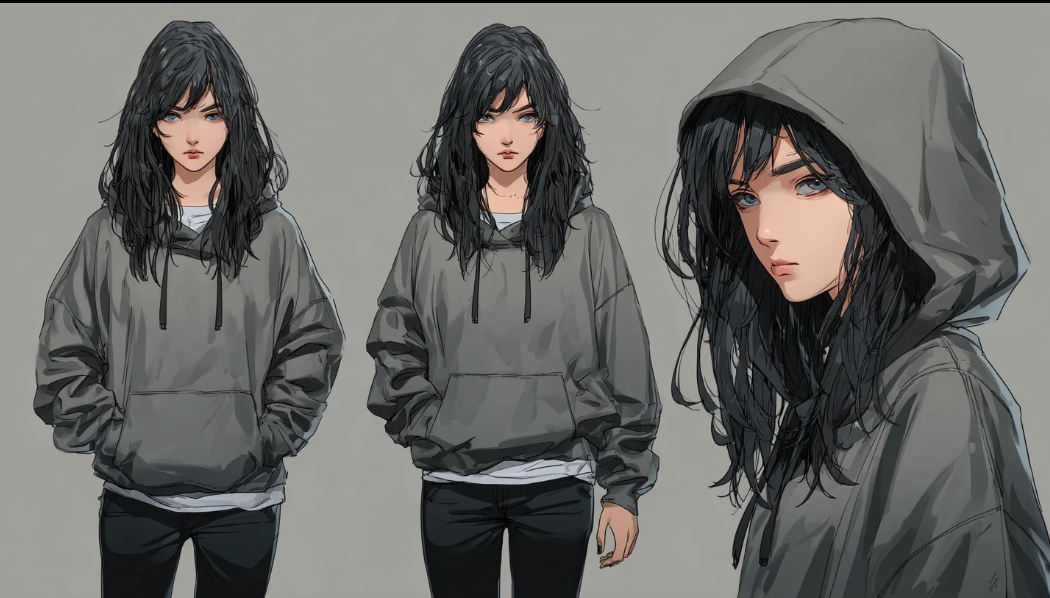
- Protagonist reference image, basically close to expectations

-
Main visual reference image, achieved some sense of ruin
-
Final output showcase
2
CrePal's founder, Jiaming Liu, started his career as an AI product manager at Tencent's WeChat business group in 2020 — more than two years before ChatGPT's release.
Jiaming noticed that the more ordinary the user, the more they overestimated AI's capabilities. "A kid might ask AI how to assemble his toy car; an elderly person might use dialect to ask AI to buy things for them." Yet these were things AI couldn't do at all back then.
He shifted his interest toward researching agents — before the term "agent" even existed. "Some people in the industry called this kind of AI a digital lifeform — an intelligent entity that could solve problems and had memory."
In March 2024, Jiaming decided to start a company. His first direction was an AI dating assistant, but he quickly found it overly dependent on early promotion resources, then pivoted rapidly to an AI video agent. Earlier this year, he released "AI VLOG," an AI editing tool for vlog enthusiasts, which briefly hit #1 on Product Hunt's weekly and daily charts.
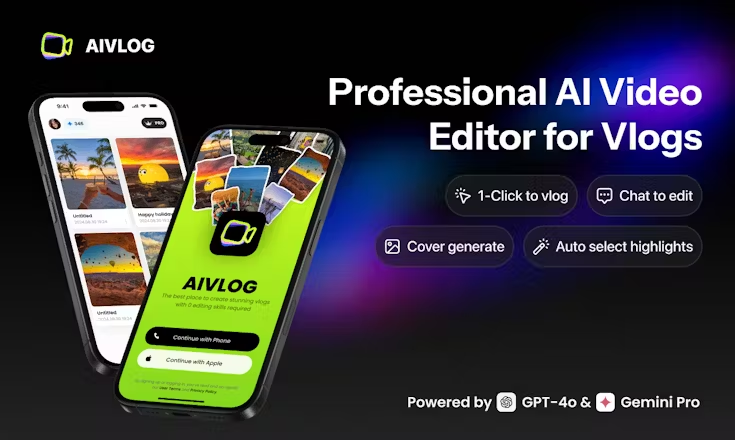
However, AI editing tools' user activity was heavily constrained by "video shooting speed." So Jiaming taught himself AI video, wanting to understand where creators got stuck. He paid for many video courses and found they were all "watered-down" — none addressed his most genuine pain points.
This was the original motivation for founding CrePal.
"Ordinary people don't not want to make AI videos — there's just no agent that's both professional and understands you."
Currently, CrePal remains in early validation. The system hasn't fully escaped the limitations of underlying model capabilities; video output stability and aesthetic quality are still heavily constrained by how mature the base models are.
But what's interesting is this: in an extremely crowded赛道, it escaped tool logic and shifted from "model power" to "orchestration power."
This defines its unique position in the industry: not a model vendor, not an editing platform, not a SaaS tool, but a video orchestration hub and collaboration interface.
Below is AI NOW!'s interview with Jiaming. At the time of the interview, CrePal had been live for two weeks, with revenue far exceeding Jiaming's expectations. He was energized, preparing to relocate from Shenzhen to Hangzhou. Jiaming said that from day one of building CrePal, he knew he'd made the right call. "There's a strong sense of being called by the era — to speak boldly, it fits me so perfectly, it had to be me."
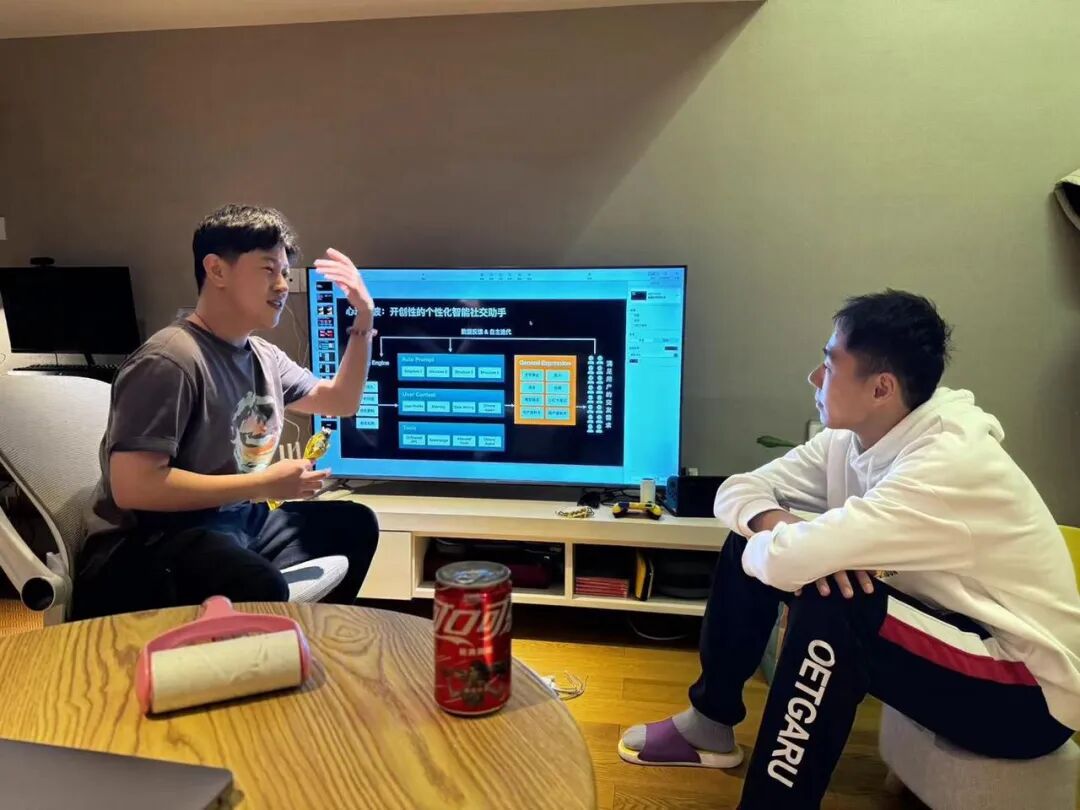
- Company founded February 2024. Jiaming (left) in a meeting with colleagues
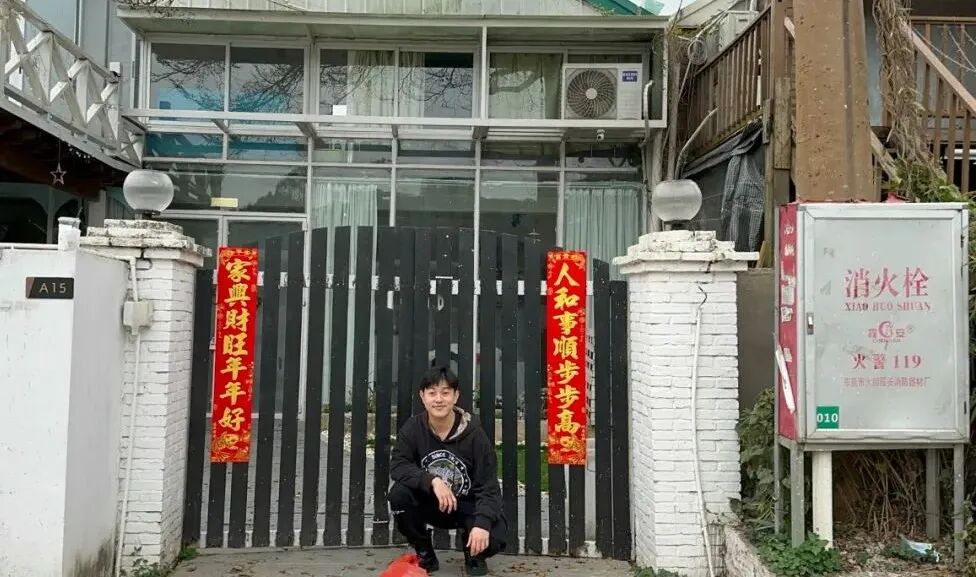
- The company initially operated in a flower market, a standalone small building; Jiaming put up Spring Festival couplets for the company during New Year
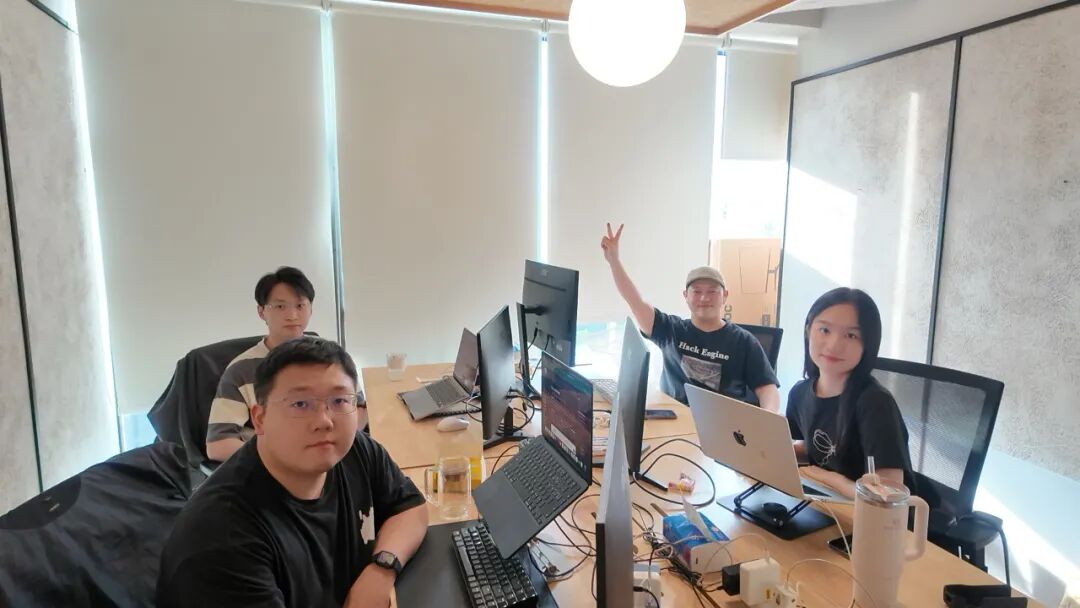
- July 2025: The CrePal team has moved into a WeWork in Hangzhou
Conversation with Jiaming
Part 01
Not About Perfection
We Solve Saving Money, Saving Time
AI NOW!: CrePal debuted at the Guancha launch event. After hearing your presentation, my first reaction was: this addresses my biggest pain point in video production. My second reaction: how come no company did this before?**
Jiaming: First, before 2025, AI video technology wasn't mature enough. The real shift happened early this year, when many video models could let self-media creators generate passable clips. Plus, Gemini Cloud's powerful multimodal reasoning capability — this is CrePal's most essential function. When we launched AI Vlog in 2024, we were somewhat straining against technical limitations; this year the infrastructure matured.
Also, market understanding of agents matured. In 2024 when I started building agents, many investors thought I was a scammer — what's an agent? Does it make money? What even is an agent? Users couldn't understand either. I have to thank Manus's explosion this year for thoroughly popularizing the word "agent."
Actually, many great products need the right timing. The era will summon them forth; the entrepreneur's mission is to deliver them to the world.
AI NOW!: AI video is the most crowded赛道. As a startup, why still enter?
Jiaming: Fundamentally, I just think everyone else is doing it poorly.
Templates and workflows, widely adopted by competitors, are about to be eliminated. How could an especially polished AI short video be generated from one sentence? What normal human can figure out complex node drag-and-drop interfaces?
Many AI video startups don't actually understand user pain points. I don't know if they're too well-funded or what, but they're very superstitious about their own judgment. The industry's dominant approach is either hiding model information entirely and training a small model themselves, or directly giving users template effects. If you've actually done self-media, you'll discover this is an extremely unfree interaction.
Creators need to be inspired during the creation process, then adjust themselves, then input new ideas.
My judgment is that most current products from startups in this direction are destined to be eliminated by the era within a year or two; workflows will soon become history.
Time will prove that a fully open, one-stop agent like CrePal is the optimal application form for this domain.
AI NOW!: CrePal opens every step to users — from script planning, visual reference to final generation. But specifically, how do you do "multi-model orchestration decision-making"?
Jiaming: For script planning, tested in practice and through exchanges with professional creators, DeepSeek performs better at this kind of divergent shot design and artistically demanding content; other models are relatively more rational.
For main visual reference images, Midjourney is basically passable. If you have a clear visual reference — say, you want Liu Yifei as your main character — paste the image into the system, and Flux Dev also generates well.
In the video generation step, we use a combination of closed-source models. Through a dynamically evolving knowledge organization, the system understands what tasks each model excels at, then uses that knowledge to judge your task and match the most suitable one: for example, Hailuo does small animals diving into water best, so the system directly selects Hailuo and won't choose Keling AI.
AI NOW!: When I used CrePal to make a demo of my original short film, there were still some bugs in final video generation. Why?
Jiaming: CrePal's value isn't giving you a perfect video from one sentence, but letting you spend less time and less money than you otherwise would.
So first-version videos inevitably have small bugs; ordinary people also can't fully articulate a video concept in one sentence. Using AI video models directly, you'd also need to repeatedly revise prompts, draw multiple times, ten times before getting satisfactory results. CrePal can't make these things disappear, because it's determined by base model capabilities, but it can help you with automatic optimization and automatic filtering of quality assets.
We also recently planned to add "self-evaluation," letting the agent autonomously reflect on results at each step.
Part 02
Good Wrappers Are Never Just Token Arbitrage
AI NOW!: From an engineering perspective, which module is currently most difficult? How are you solving it?
Jiaming: The hardest and most energy-consuming part is actually editing, because no existing model on the market supports editing well.
Fortunately the team has strong execution. We quickly built an agent editing system through engineering methods. Right now CrePal's editing capability, looking across AI products worldwide, is the best both in understanding precision and in degree of free interaction based on commands.
AI NOW!: Can you give an example of a product detail you spent lots of time optimizing, but users don't notice?
Jiaming: Generating scripts based on commands, then producing scene or character reference images.
Behind this lies a difficulty: anyone who uses AI image generation knows that to strongly control style consistency and ensure unified details, prompt writing technique requirements are extremely high. We actually spent enormous effort on prompt optimization, making the agent understand you better.
Though this also benefits from text-to-image models becoming increasingly stable — much stronger than video models.
AI NOW!: CrePal positions itself to avoid direct competition with giants on underlying technology, so shouldn't core competitiveness be unique interaction experience? How do you plan to optimize it?**
Jiaming: Right, we're still optimizing some interaction points I'm not fully satisfied with, aiming for smoother flows that better match creators entering flow state.
For example, text-to-image currently generates one by one. Can we identify what can be batch-produced? After completing script planning and character design, can we generate ten storyboard frames at once, then directly place them on a timeline preview interface, using a storyboard format to give users rapid feedback? Users can see the images at a glance, and if they want to modify, quote-select the image or text to adjust.
Another priority is launching community features quickly, letting users share works to the community for mutual inspiration and exchange. This is also very important and my highest priority.
AI NOW!: You said at the launch event that you'd absolutely never do token arbitrage. Your current business model is calling model APIs at cost, earning service fees through orchestration and integration capabilities. What's the thinking behind this?
Jiaming: First, I want to help users save money. I guarantee that for 90% of AI video creators, using CrePal is absolutely the cheapest option. For example, some models are less bug-prone with certain frame structures for first images — knowledge only people deeply familiar with various large models and with hands-on experience would have. Now CrePal can help you reduce the number of draws needed.
Users are buying CrePal's reasoning capability and service value — this is what I consider the most reasonable business model for agents. Because we didn't make the models ourselves; the model companies did. Our value isn't in the models. Reselling models to users for token profits doesn't fit long-term business logic. The value of helping users overcome learning curves and improve efficiency is what we should earn long-term.
AI NOW!: Since launch, what are CrePal's revenue and growth?
Jiaming: Beta officially launched July 16. As of August 1, we've acquired 5,000+ registered users, with $500+ in subscription revenue within 48 hours of launch.
Part 03
Those Who Control Orchestration Control the World
AI NOW!: You've been committed to building agents since starting your company in 2023. Now the agent concept has been "shouted to death." Where do you think agent's true value and moat lie?
Jiaming: Innovative interaction mechanisms, enabling collection of enough process data and user memory — this will constitute an unshakable moat for the product's future.
But I find that in practice, people don't actually value this. Which data is worth organizing, which memories worth calling upon — industry understanding remains shallow.
I remember in early 2024, a partner at a well-known institution told me directly during an exchange that he didn't believe agent memory would be valuable in the future, because a sufficiently powerful model could reason with minimal information. I argued with him then — I found it absurd: at that time people had blind faith in large models, but as someone who entered AI in 2020, I understood model fundamentals and evolution very clearly. Even a god-like model, without appropriate, sufficient, and rich context as support, cannot demonstrate its proper performance.
AI NOW!: Some agent skeptics in the industry believe that agent + application is essentially just wrapping, not particularly difficult.
Jiaming: Contrary to popular belief, developing an excellent vertical agent application — the most important thing isn't how deep your domain know-how is. That matters too, but just being passable is enough.
What matters most is whether the team's experience and cognition in agent system development are solid enough, whether they can organically combine know-how with agent development. So any company not professionally building AI agent applications — agents made by people who are just good at video — are basically unusable.
Take League of Legends: a top player like Faker might play phenomenally, nobody in the world can beat him, but he lacks the professional knowledge and skills to make games. He definitely wouldn't become the best game developer.
AI NOW!: CrePal's core value is orchestrating various large video models. In the future, will "discourse power" in AI shift from model vendors to orchestration platforms?**
Jiaming: Definitely. My understanding of AI orchestration power is like Dianping or Xiaohongshu — having actual guiding influence on users, solving real problems.
Right now there just aren't that many AI model vendors. But imagine, after another year, as AI video models develop and become more diverse, with even new vendors joining the fray — creators will be even more confused: which combination should I use to complete my creation?
Models solve whether something can be done; I help everyone achieve it through the shortest path, using which models.
Once users start using CrePal, it's hard to go back to the old state of tasking across platforms, because we provide tenfold better efficiency and experience improvements.
CrePal is a very down-to-earth product. Whether in terms of discourse power or industry influence, I believe it will in no way be inferior to any impressive model company in the future. It's destined to be a standard answer in the human-computer interaction era — I'm very confident about this.
AI NOW!: How does CrePal maintain continuous leadership in "orchestration"? What if other major companies start making similar products?
Jiaming: I'm not very worried. Because our team understands this extremely deeply, with very strong execution and implementation capabilities.
Frankly, in my view, teams worldwide with stronger agent-building capabilities than ours are all working on general agents or their own vertical agents. If someone right now claims to be doing the same thing as us, it's mostly hype.
CrePal's product form is also currently the only one of its kind globally.
AI NOW!: But you haven't claimed "first" or "first-ever"?
Jiaming: Our users — who cares if you're first or second? They only care if you're good to use, if you can help them solve problems end-to-end, and save them money?
I only focus on user needs.
AI NOW!: Finally, recommend three books that influenced you most.
Jiaming: First is Game Theory, which gave me an entirely new perspective. Like when I'm often asked how to understand future relationships with big companies or model companies, I use game theory to formulate company strategy. Second is The Crowd: A Study of the Popular Mind — every entrepreneur should read it, helping understand how groups perceive your product and how to use that to formulate communication strategy. Third, I recommend Advanced Mathematics — the limit method is a very useful thinking tool for judging things.
Image sources | Provided by interviewee, Unsplash
—A Little Easter Egg—
We have a podcast now
Search for "AI NOW" on the Xiaoyuzhou app