A Conversation with FateTell Founder Levy: AI Can Read Destiny, but Life Can't Be Fully Calculated | 100 AI Creators

"Standing in childhood and looking ahead, the future is uncertain; standing in old age and looking back, you can only discover a single path of fate."
Produced by AI NOW!
01
Do you believe in destiny?
Would you pay for an AI fortune reading?
If your life were already written, would you buy the spoiler?
Young people today are increasingly drawn to destiny studies. Even though the discipline is vague, subjective, and unfalsifiable, they maintain a reverence for fate — perhaps because in uncertain times, they seek some kind of certainty.
Recently, we came across an Eastern destiny product called "FateTell," built on large language models. It's been live for nearly six months and has basically reached break-even.
Metaphysics, once dismissed as feudal superstition, is now one of the most commercially viable verticals on content platforms. And Eastern destiny, as the most complex and systematic metaphysical framework, is finding new life under the boost of large models' reasoning capabilities.
FateTell's founder, Levy Xiyuan (hereafter "Xiyuan"), graduated from The Hong Kong University of Science and Technology, where he studied English and statistics with a focus on natural language processing. He previously worked at a Hong Kong-based legal AI company, building SaaS products for patents and trademarks. He then spent time at Lark and a Shanghai-based agent platform company, exploring how to close the commercial loop with AI.
His personal interest is researching the I Ching, the Eight Trigrams, and the Yellow Emperor's Inner Canon. Because he has "spiritual energy," his former boss in Hong Kong took him to visit various Buddhist and Taoist sacred sites. A Taoist temple abbot once suggested he become a monk. "It was hilarious, like something out of Stephen Chow's Kung Fu Hustle. 'Young man, I see you have extraordinary bones. You'll surely become a grandmaster someday. Come be a monk with me.'"
At the end of 2023, when reasoning models exploded onto the scene, Xiyuan immediately recognized their superior fortune-telling capabilities. Without hesitation, he locked in his entrepreneurial direction.
And so AI and Eastern destiny — two distant disciplines — merged through his lateral leap into an unexpectedly coherent new species.

- Xiyuan, who was told by a Taoist abbot that he had "extraordinary bones," counts Eastern destiny research among his daily interests
02
Destiny studies are one of the best landing scenarios for large AI models.
When most people hear "destiny," they picture a Taoist monk counting on fingers or tossing copper coins — so esoteric it seems to belong to unverifiable "metaphysics."
But strip away the surface, and destiny studies, especially Eastern systems like the Four Pillars of Destiny (Bazi) and Purple Star Astrology (Zi Wei Dou Shu), are fundamentally highly structured symbolic deduction systems: "destiny models" built from heavenly stems and earthly branches, the generative and restrictive cycles of the five elements, palaces and star positions — no different from graph theory, probability and statistics, or discrete mathematics in mathematics.
A human destiny master's thought process resembles neural network inference and generation — it's a quantifiable process.
The core of large models is also reasoning. Fundamentally, both large models and destiny rely on symbolic systems for structured modeling and inferential output.
As AI breaks through in coding ability, semantic modeling, and logical generalization, destiny studies are becoming one of the most suitable and easiest-to-land vertical application scenarios for AI.
Xiyuan says that breakthroughs in model capabilities visibly improve destiny calculation results — for example, OpenAI's o1-pro is noticeably more accurate than o1. But currently, general-purpose large models only reach the level of a junior destiny master.
The core reason is that general models can only use reasoning methods from publicly available internet datasets, which contain substantial noise and tend to over-index toward one or two schools, making it difficult to form systematic, precise deduction capabilities.
For AI destiny applications, high-quality training data is key to feeding the model — far more important than simply chasing scale. But vast amounts of practically valuable destiny data obviously don't appear on the open web; they're buried in individual masters' personal notes and practical experience.
How to acquire this tacit knowledge, then structurally extract, annotate, and integrate it into the training pipeline — this is the core link through which Xiyuan is pushing the model's destiny capabilities to leap forward. "AI destiny isn't fundamentally different from the AI law work I started with — both are highly structured data," Xiyuan says. No one understands or is better suited to this entrepreneurial direction than him.
In December 2024, FateTell's first product, "The Book of Fate" (Ming Zhi Shu), went live.
03
Enter your birth date and time, and FateTell will parse your destiny chart and generate a report within minutes.
How is this different from "internet-era fortune-telling products"?
Xiyuan explains that internet-era destiny applications mostly relied on template assembly — pulling content from fixed corpora based on a few variables, then piecing together results. If a user bought ten reports, they'd find only minor word changes or paragraph adjustments, with most content nearly identical.
FateTell, built on large model generation, treats each user's Bazi as the sole input for real-time model calculation. "Every piece of content has high contextual consistency and linguistic naturalness, achieving truly personalized results for thousands of individuals."
FateTell launched as a paid product from day one. It has two main service modules: The Book of Fate and The Book of Fortune (Yun Zhi Shu). The former provides a life overview across four topics including marriage and wealth; the latter analyzes fortune by year, month, and day.
For follow-up questions based on results, an agent on the right side of the product can engage in dialogue. For example, if the system advises you to collaborate with others, you might ask: What zodiac signs are suitable partners? Around when might they appear?
FateTell's most avid user once had over 600 rounds of dialogue with the system, triggering a backend alert. One North American user, torn between offers from Google and NVIDIA, had FateTell provide advice based on fortune trends combined with real-time analysis of both companies.
Another user wanted to sell their house. The system's advice: 2024 was favorable for transactions; otherwise, they'd need to wait until 2027 or 2028. The user then asked how to sell quickly this year, and FateTell began calculating transaction speeds across different selling platforms. On the last day of 2024, the user actually sold the house.
"Human destiny masters charge anywhere from a few thousand to several hundred thousand yuan annually. Our product costs one-tenth of that and is available 24/7," Xiyuan says. Almost no user has questioned FateTell's pricing, because this category naturally integrates conversion intent, emotional value, and repurchase motivation.
Compared to humans, AI destiny also has richer general knowledge and more comprehensive vertical domain knowledge. "After all, even the most senior destiny master would struggle to give you a prioritized ranking of 2024's home transaction platforms."
The essence of destiny is "the emergent result of behavioral patterns." Different people interact with the world through different behavioral patterns, thereby harvesting different destinies.
Western astrology's 12 zodiac signs and the MBTI based on 16 personality types have dominated globally because they classify and analyze individual behavioral patterns, becoming important tools for the masses to understand themselves and their futures.
Eastern destiny's structure is far more complex: the Four Pillars alone can generate over 1 million chart types, each dynamically changing with annual fortune cycles and other temporal variables. In Xiyuan's view, Eastern destiny's such fine-grained individual characterization should possess even stronger behavioral guidance power, while also implying a market with greater potential.
On the eve of FateTell's profitability, AI NOW! sat down with Xiyuan for a conversation about users' understanding and acceptance of AI destiny, the product's ethical values, and visions for the future.
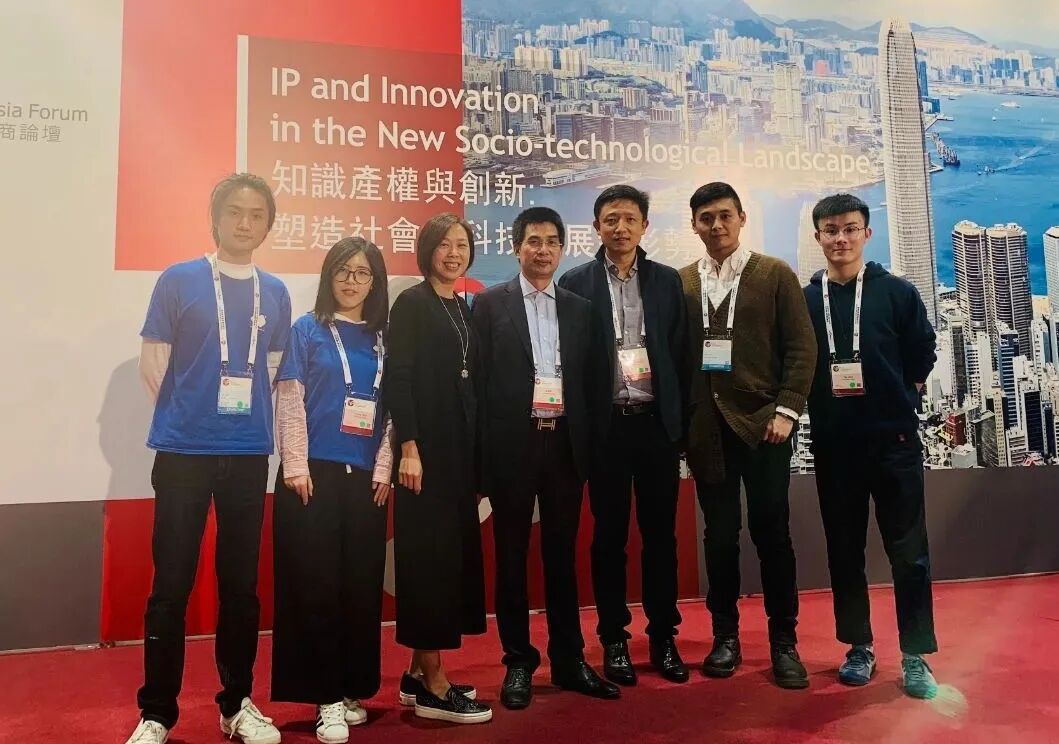
- In 2018, Xiyuan — then working at a legal AI company — attended an intellectual property forum in Hong Kong
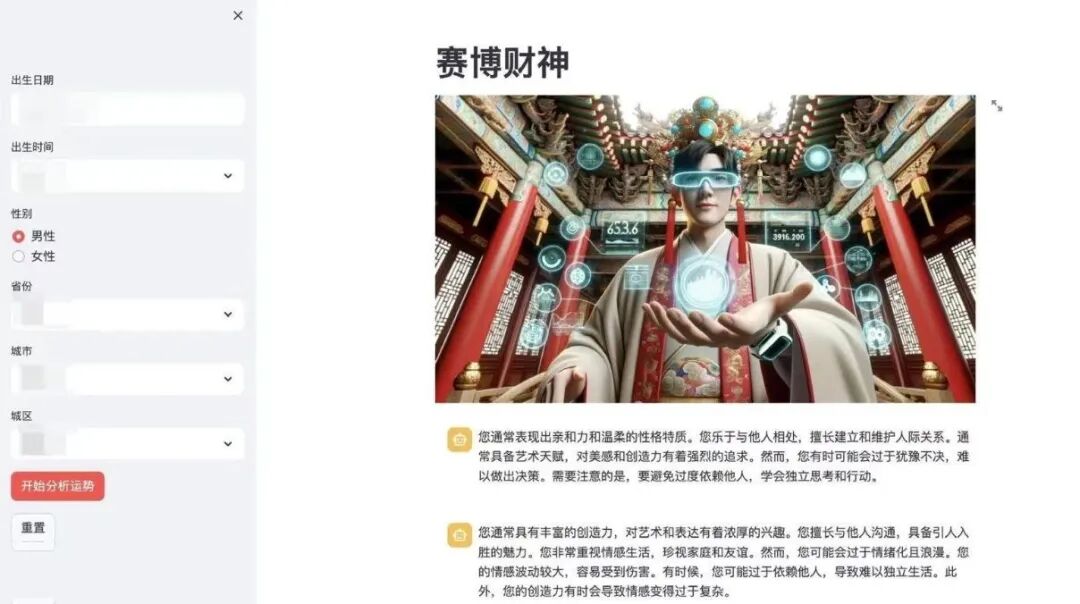
- FateTell team's 2023 hackathon project "Cyber God of Wealth," the predecessor to today's "Book of Fate" agent
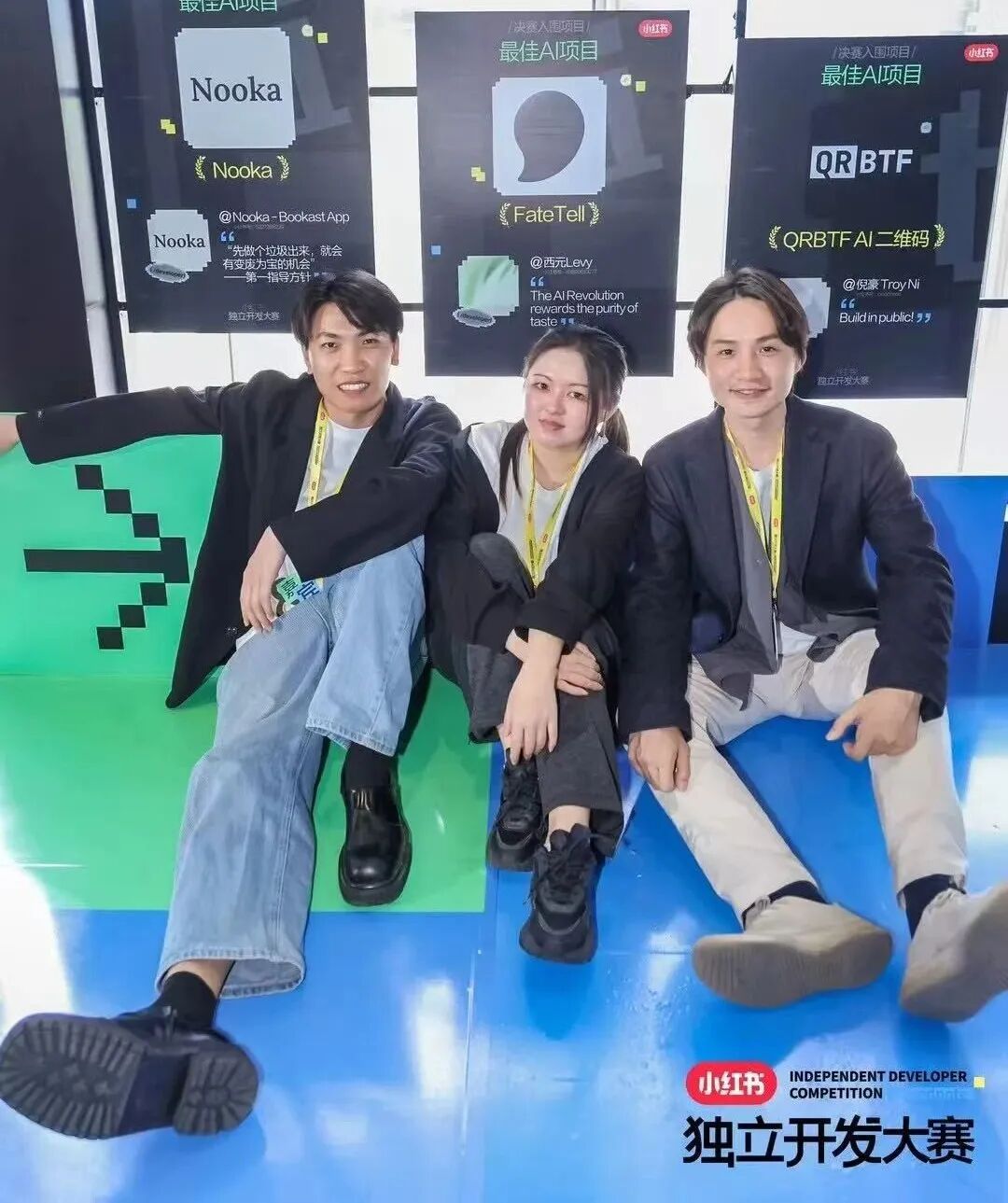
- April 2025, FateTell team at the Xiaohongshu Indie Developer Competition. From left: Kod (technology), Sally (operations), and Xiyuan
Conversation with Levy Xiyuan
Part 01
About the Product
Must be 100x better than human destiny masters
AI NOW!: Many people find Doubao or DeepSeek's destiny readings quite accurate. What draws users to FateTell?
Xiyuan: Fortune-telling actually has three steps, and general-purpose large models like DeepSeek easily stumble on every single one.
Take chart calculation: converting Gregorian to lunar calendars, calculating major fortune cycles and annual cycles — the algorithms themselves are prone to errors. DeepSeek is a language model; it's weak at math and frequently miscalculates charts. Then there's chart interpretation: DeepSeek's data mainly comes from public internet content, easily skewing toward certain schools and containing large amounts of low-quality interpretation data, lacking comprehensiveness. Finally, there's explanation: large language models excel at "people-pleasing," tending to say nice things to make you happy rather than giving honest judgments based on facts.
FateTell's core lies in extreme refinement of these three steps — using professional algorithm plugins to solve chart calculation, using expert systems to integrate multiple destiny schools, and using human destiny masters for value alignment.
AI NOW!: You hire human destiny masters to participate in model quality debugging and training system setup?
Xiyuan: Yes. Human destiny masters mainly handle two modules: the "evaluation system" and the "curriculum system." Both serve the product first, but ultimately serve our self-developed model.
Let me focus on the evaluation system. Sufficiently professional evaluation-driven development is key to winning in any vertical agent project. Our human destiny masters are directly accountable for the quality of model-generated content. They work with us to build Bazi evaluation sets, and together with product managers and algorithm engineers, optimize based on evaluation results.
AI NOW!: Are human destiny masters expensive?
Xiyuan: We selected masters from the high-end professional market. Their public hourly rate is about 30,000 yuan, though it's not that expensive for us — but still considerable cost.
AI NOW!: What's FateTell's underlying model now?
Xiyuan: We use DeepSeek, Gemini, GPT, and Claude. But honestly there's still huge room for technical improvement. Our entire workflow is very complex and takes a long time to run, making generation speed relatively slow.
The impossible triangle of large models is cost, efficiency, and speed. In the early stage I need to guarantee the accuracy of destiny results — this is the most important element for building user trust — so I chose to sacrifice some efficiency.
But fortunately, in the destiny scenario, users are willing to wait. In fact, "waiting" isn't necessarily a drawback; it can even be an enhancement.
AI NOW!: What's human destiny masters' attitude toward AI-ifying metaphysics?
Xiyuan: Mixed. Some refuse; some see the trend is unstoppable, so if you can't beat them, join them (laughs).
The necessity of bringing in professional masters comes from my experience doing AI law entrepreneurship in Hong Kong. Vertical scenarios must have a dual-wheel drive of product manager plus industry expert — otherwise it's impossible to build.
AI NOW!: In a previous interview you said that as models develop, you'll add voice and video. Why insist on multimodality? Text-generated reports already solve users' core needs.
Xiyuan: Because I believe our product only has real competitiveness if it's 10x better than what offline human destiny masters provide. Single modality can't achieve 10x better than human masters, but multimodal experience can reach 10x, even 100x.
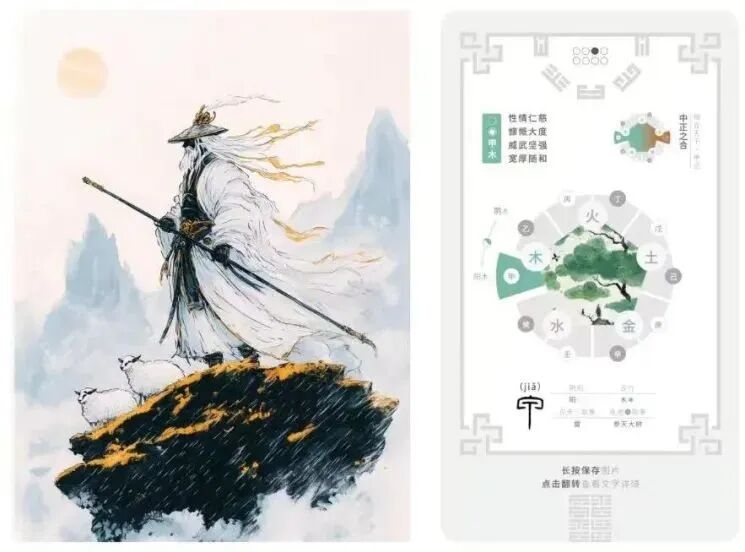
For example, if the calculation shows you're "Jia Wood" (Jia Mu), many people new to destiny don't understand this term. If you ask a human master offline, they might give you a few explanatory sentences, but most users without foundation only half-understand. But we use AI with voice-generated explanations and dynamic images, even a video about you — the first frame shows a towering tree, then your Jia Wood growing in a relatively cold water channel, then revealing a body of water. This tells users about their current limiting factors, subsequent destiny trajectory, emotional energy field, and potential opportunities.
Multimodal approaches can give our users a 10x immersive experience. And ultimately, great products compete on aesthetics and taste. Eastern destiny has very imagistic beauty, and multimodal technology can realize this beauty.
Additionally, a core metric for AI application-layer companies is: as technical capabilities improve, are you happy or unhappy? For me, all AI technology is additive. I just need to prepare the technology in advance and wait for the aha moment.
Part 02
About Users
98% of users care about wealth and career
AI NOW!: FateTell chose to launch overseas first. Where did your first users come from? What's their profile?
Xiyuan: Xiaohongshu and Jike. Users are mostly 25-35, highly educated, with product payment habits and basic knowledge of Eastern destiny. Overseas markets are currently dominated by Chinese users in North America and Australia.
The payment rate is about 5%, higher than I expected. Repurchase rate is also good — many users buy for family and friends after using it themselves.
AI NOW!: Do you think users fundamentally need decision-making help or emotional companionship from FateTell?
Xiyuan: I believe that in Eastern destiny, "getting it right" — that is, "providing decisions" — should be the 1, with subsequent emotional value being infinite 0s. Without the 1, it's deception; but too few 0s also won't work.
I've met some masters who are incredibly accurate but utterly merciless. Users finish terrified, very fatalistic — not what we want to see.
Here's a specific example. We've recently integrated preliminary psychological coaching modules. When users consult, if they directly say "I've been feeling very confused lately," the agent doesn't immediately begin destiny services but enters "coach mode":
"I can sense the turmoil and unease within you right now, like autumn leaves swirling in the wind, finding no place to settle. This chaotic state is precisely your inner self reminding us to pause and listen."
"In the wisdom of divination, we emphasize 'one matter, one reading.' What do you most want clarity on right now — a choice in a specific situation? The direction of a relationship? Or confusion about career development?"
The hexagram is like a mirror; we need to guide users to first "become aware of themselves."
AI NOW!: Some users feedback that your wealth calculations are quite accurate, but marriage predictions are weaker.
Xiyuan: We did user research. Among FateTell's first seed users, 98% cared about wealth and career, while only 60% cared about relationships and marriage. So with limited resources, we do prioritize training and evolution in wealth and career. Compatibility and marriage matching demand is certainly large too, but we haven't done it yet.
Something interesting: astrology products have always skewed female. But FateTell's gender ratio is 1:1. Maybe Eastern destiny is simply a more pragmatic discipline (laughs).
Accuracy also has many objective standards. For example, predicting exactly which year you'll marry may not be that accurate. But identifying which year you'll enter a major fortune cycle, which year wealth significantly grows or declines — these broad directions our product currently handles well.
The strength of Bazi lies in capturing major predictive trends, knowing what to emphasize and what to let go.
AI NOW!: You've been saying you don't focus much on DAU at this stage?
Xiyuan: The core reason is that I believe FateTell's true value isn't in high frequency but in long tail. In fact, if a user constantly, repeatedly uses FateTell for fortune-telling, needing destiny to make decisions for every big and small matter, I don't think that's healthy or what we want.
The mobile internet classic formula is high frequency, hard need, high average revenue per user. Head high-frequency scenarios are basically already solved by mobile internet products, but long-tail demand has huge incremental value.
Fortune-telling is a typical scenario with massive long-tail demand, penetrating every aspect of people's lives — arguably one of the few lifelong service scenarios. This is something AI can serve well.
It also aligns with that widely circulated HSG closed-door meeting article from a while back: going forward, products should charge based on outcomes. (HSG AI Summit: 6 Hours Behind Closed Doors, Consensus Emerges Among 150 Founders — AI No Longer Sells Tools, It Sells Results)
AI NOW!: You position FateTell as "Notion + lululemon." How do you understand this?
Xiyuan: It means we want to be an efficiency tool plus a lifestyle brand.
Benchmarking against Notion is because FateTell's first product form is closer to a personal efficiency tool. Notion does technological democratization; we're also doing a kind of democratization, because the best destiny masters in the past not only had extremely high hourly rates but even served only royalty and nobility — ordinary people simply couldn't access this resource. Now we use AI to let professionalized destiny services be enjoyed by ordinary people too.
lululemon took yoga, a very Eastern, mystical ritual, and made it a global lifestyle. That's fascinating.
I believe Eastern destiny has the same opportunity.
Part 03
About Values
Changing destiny? Better to know destiny
AI NOW!: If FateTell calculates that someone is destined for poverty, do you tell them to accept their fate or help them change it?
Xiyuan: I strongly reject the so-called objectivity of some traditional destiny masters — looking at someone's chart and deciding it's not worth reading because there's nothing there.
FateTell would never tell users their wealth level. If the calculation indeed shows no connection to prosperity, we'd say wealth is just one dimension for evaluating life, and you have advantages in other areas — academics, wisdom, family... These are all important parts of life.
And indeed, wealth is just one dimension of life.
AI NOW!: Is this the emotional value FateTell provides?
Xiyuan: This isn't self-deception. After engaging with destiny studies, I made an important observation. On one hand, so-called great-wealth charts do exist. But everything has its price — almost without exception, these charts require "bearing" something else.
In strict terms, there's no such thing as an absolutely good destiny.
I was perhaps fortunate to have opportunities in my student days to meet many bosses with wealth levels above 1 billion. Their destinies indeed carried enormous wealth magnitude, unrelated to their education, personality, character, or even emotional or intellectual intelligence.
But everyone had their own suffering, or rather, their own burdens to bear — physical health, family of origin, siblings, marital emotions, children, countless things.
AI NOW!: "No absolutely good destiny" — is this FateTell's value?
Xiyuan: Let me share a story. After starting my company, I attended a Zhou Yi (I Ching) class. Over five days, the teacher detailed over 100 case studies covering different social backgrounds and classes — CEOs, a woman under thirty divorced three times, a man who lost his wife and daughter in a fire, but mostly ordinary people.
One day at a meal, I asked the teacher: You've seen so many cases, has anyone successfully changed their destiny? The teacher put down chopsticks, looked at me, and slowly uttered: Changing destiny is changing the heart.
Traditional Chinese culture has always regarded "knowing destiny" as an important life milestone. But the teacher's words — how simple, yet how difficult.
AI NOW!: Many people believe in terms like "karmic retribution" and "past lives," then use various methods or props to "change destiny." How do you understand this?
Xiyuan: Eastern destiny divides into "technical schools" (Shu Shu) and "magical arts schools" (Fa Shu). Technical schools use mathematical reasoning logic; magical arts use various props. Terms like "karmic retribution" belong to the magical arts school, which typically gives you some props.
We don't do this. Before building FateTell, I drew a line: don't use magical arts to explain life. We advocate scientific fortune-telling, using statistics as much as possible, and don't want users obsessing over karma or sayings like "the more you calculate destiny, the thinner it gets."
AI NOW!: From destiny studies' perspective, human fate frameworks are quite deterministic — like humans viewing ants' fates. What does FateTell ultimately provide?
Xiyuan: In my vision, FateTell needs to go through a process from Presentation to Curation to Activation — from passively showing users their destiny, to actively guiding users to make positive changes through specific behaviors, ultimately becoming the protagonist of their own destiny and the curator of their own life exhibition.
This is a process from "knowing destiny" to "accepting destiny" to "changing destiny."
Although everyone's destiny chart is predetermined, there's actually very large space between the upper and lower limits of that chart. This space depends on differences in human subjective initiative.
Similar destiny charts: some people can live wonderfully, actualizing their upper limit. I certainly hope every user can live out the best possible state of their life within their capabilities.

• Biggest AI shock in 2025?
Xiyuan: If we extend to 2024, Cursor surprised me, and Google's Notebook LM surprised me. For 2025, the biggest surprise is still DeepSeek, especially its Chinese and even classical Chinese capabilities — it can even get the rhymes in ci (lyric poetry) tune names right, something no overseas model can do.
• If you could personally shut down one AI product or trend — something you think is completely pseudo-demand or wrong direction — which would you choose?
Xiyuan: FateTell's initial product form was a Character.AI-like product where users could have conversations. But we quickly discovered users didn't know what to ask. Even with suggested questions, people still didn't know what to ask. Later we changed the product form to The Book of Fate and The Book of Fortune — first generating a 20,000-word report, then users ask questions based on the report.
• At AI's current stage of development, what do you think is undervalued? What's overvalued?
Xiyuan: General-purpose agents are overvalued. I previously saw arguments that once a super powerful general-purpose agent emerges, competition is over. I believe even a super powerful general-purpose agent can't solve all problems. Ultimately, it's thousands of industries, each with their own vertical models.
What's undervalued is data quality. I've always said: however much human effort, however much intelligence. Especially for vertical scenarios, data quality matters more than quantity. But people probably still get excited about trendy concepts — workflows, prompts, architecture, or algorithms. At the bottom layer, all model performance is a representation of its dataset.
• A "minority opinion" you hold in your entrepreneurial journey?
Xiyuan: The direction of AI destiny studies. Many people think it's feudal superstition — this view alone filters out many people.
• Finally, recommend three of your favorite books!
Xiyuan: First is Wittgenstein: The Duty of Genius — it helped me through an existential crisis, you could say it saved me. Second is Ezra Vogel's Deng Xiaoping and the Transformation of China — I believe this is the greatest entrepreneur and CEO of modern times, bar none. Third would probably be John Ding's The Consciousness Only (Wei Shi).
Image sources | Provided by interviewee