Gen Alpha Is Embracing 'Brainrot,' and Douyin Is Already the Previous Generation's Product | 100 'Social Product' Hot Takes from Wapoo Founder Yang Mingyu

"My ambition is to build a product with 330 million daily active users. Why not?"

Social | 3.3 Billion DAU | Video Interaction | Playable
Intro
Over the past two years, the AI interactive video track has already gone through two waves of iteration: Sora debuted with world-shaking model capabilities, only to fail (1% 30-day retention, 0% 60-day retention). After that, similar products started competing on templates and special effects, yet still failed to produce healthy DAU or retention. The problem with both phases was treating AI as an efficiency multiplier for existing workflows, without changing the product container.
The AI era will definitely produce a TikTok-level national phenomenon, but the key is this: it absolutely won't look like TikTok's current form.
Mingyu Yang, founder of Wapoo, previously built TikTok's Story feature from zero to one and later led TikTok Now. His view is that TikTok is already a product of the last generation. Using old containers to build AI products is a death sentence.
The product container — the interface users see at first glance — determines everything that follows. Facebook opens to identity. Snapchat opens to camera. TikTok opens to a content feed. Each generation of container creates specific user expectations.
AI video is the fourth type of container. Yang calls it "playable."
To understand why it's "playable," you first need to understand Gen Alpha.
Yang is probably among the internet's most knowledgeable entrepreneurs on video products. He started his career at Kuaishou doing user research, conducting over 800 one-on-one deep interviews in ethnic minority areas of Qinghai, Brazil, and India. He has extraordinarily granular observations about video products: in Qinghai, Kuaishou's penetration exceeded WeChat's. "Users who could barely speak Mandarin would open Kuaishou's local feed every morning like reading a newspaper."
This insight — video as infrastructure, not entertainment — extends to his read on Gen Alpha. Yang believes Gen Alpha's cultural grammar is "brainrot": a conscious, joyful embrace of disorder, absurdity, and recursive mutation. So the first social container for post-2010 kids definitely won't be an information feed. "TikTok's passive consumption stream is a degraded experience for them." It should be something closer to Roblox's product form — a platform where by default all objects, avatars, and environments are forkable.
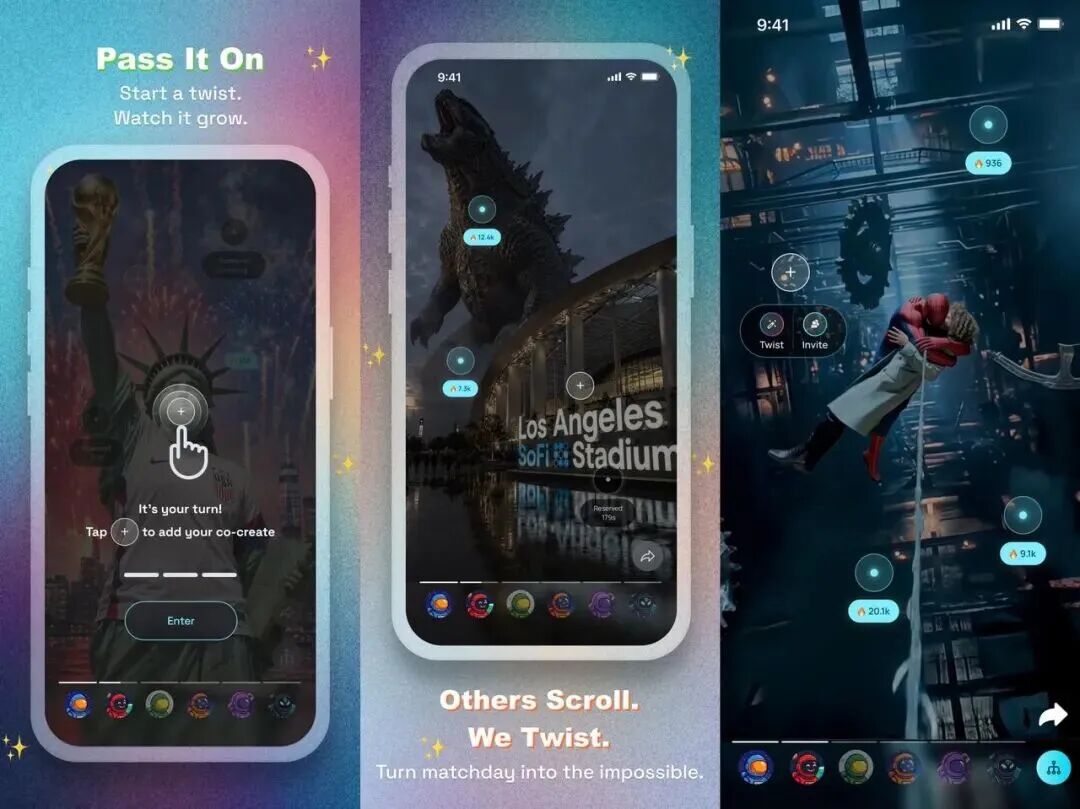
Wapoo's product mechanism is designed simply: every video can be edited by the next user, who then changes the ending.
Yang is a Sagittarius, studied abroad at the University of Michigan, and claims to be the founder in China who best understands American fraternity culture. He spends his free time boxing, playing soccer, and posting various cringe-worthy videos (check Xiaohongshu). His most memorable personality traits: an overwhelming output mode (he'll talk nonstop if you don't interrupt him), and near-delusional confidence in Wapoo. "The more I build, the more I feel like my era has arrived."
Wapoo has secured nearly $10 million in angel funding from a strategic investor under a major Chinese internet group, an institution that has previously invested in a series of AI interactive products. Wapoo launched in the North American campus market in May, initially covering universities in the Big Ten athletic conference. Yang's public target is 3.3 billion DAU. "Facebook has about 2.1 billion DAU, WeChat about 1.2 billion. Add them together, that's 3.3 billion."
The history of consumer social products is, in some sense, the history of product container changes. Every decade produces a dominant interface that satisfies a generation's specific relationship with digital content — from Facebook's list, to Instagram's camera, to TikTok's feed. Today, AI is often discussed as a technology for faster content production. That's not wrong, but it's insufficient. AI's deeper disruption is this: it erases the boundary between consumption and creation.
What you see is what you can edit. So inevitably, a new product will emerge to carry this. The only question is: what product container will Gen Alpha choose? This is where the opportunity lies for AI applications going forward.
The following are three conversations with Yang, from July last year, February this year, and August, distilled into 100 hot takes on social products — not observations, hot takes, he says. Feel free to disagree.

- Yang's abstract daily life in California
- Product interaction
Rebuilding TikTok Is a Death Sentence
-
Most people don't understand what younger generations need. Sora was clearly built by old-timers: zero innovation in gameplay, just trying to build a TikTok with faster supply. TikTok is already a product of the last generation.
-
Sora's initial seed user targeting was also wrong. Riding OpenAI's fame, it attracted geeks, product managers... These people cannot define popular culture. All social products break out by defining cultural trends first.
-
American popular culture has always been created by teenagers.
-
AI lowers the cost of generating content, so everyone's instinct is to think about supply side. That thinking is wrong.
-
The so-called interactive video projects from earlier this year — their "interaction" only improved creation capability, without lowering interaction costs on the consumption side. It's anti-interaction in essence.
-
More fatally, interactive games leave no compounding assets — you can't see what friends played, can't build on their versions. Too low information density, can't form community.
-
Similarly, in the AI era, talking about content supply and Vibe Coding capability packaging is meaningless. First consider why users would stay on your platform.
-
Many people haven't seen that on the consumption side, AI has one huge strength: randomness. Randomness is poison for efficiency, but rocket fuel for "fun." And randomness doesn't require overly polished content.
-
For production tools, randomness means inefficiency. But for social and entertainment, randomness is the content.
-
User input, potentially different results each time — this feedback between intention and accident creates the dopamine hit.
-
This also shapes my understanding of "interactive" products: users find it fun. See a video, change the ending however you want.
-
True interaction is when consumption and creation are directly coupled.
-
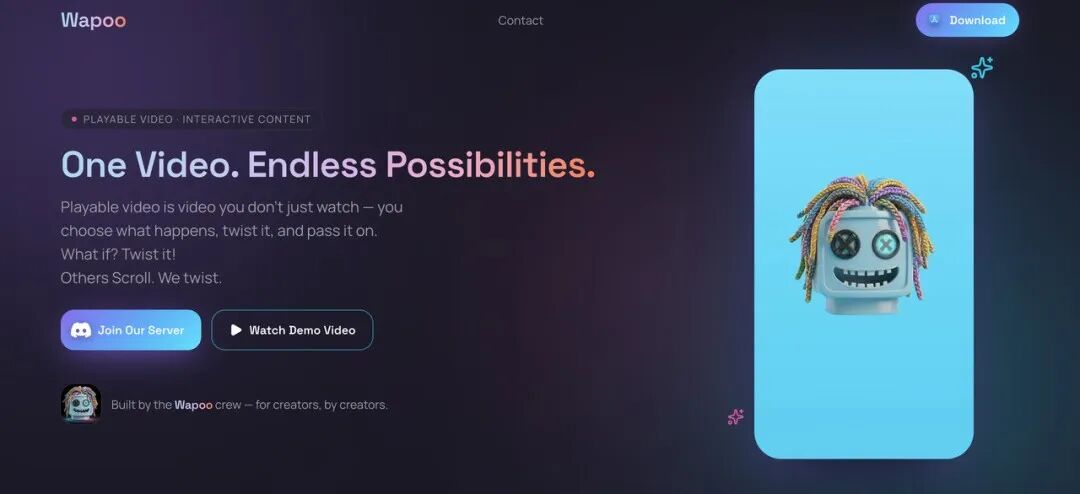
Wapoo's positioning is "playable." Users open it and immediately know this is a "fun" product. They see content and want to get their hands on it, modify it. And their feed pushes friends' content.
-
In the AI era, without a "play" mindset, C-end products will definitely be gorgeous "dead nets."
-
How exactly to play? Let me give an example. Donald Trump's wife evaluates him: "My husband is America's greatest president."
-
First user changes it: next second she starts cursing, says everything before was wrong, actually my husband is a hypocrite who bullies me at home every day. Second user sees this and changes again: Trump's wife is actually a puppet, with a film crew manipulating her from behind. Third user changes again: suddenly someone runs out and punches Trump's wife.
-
One video, a hundred people edit, a hundred versions, sedimenting into an ever-extending "thread."
-
AI lowers users' reply costs, making a video not an endpoint but the starting point of conversation.
-
Wapoo has no comment section. It's video replying to video.
-
We've changed several things. First: getting users from "scroll" to "play." With previous short videos, you're constantly watching new ones. But on Wapoo, you might spend two hours on just 2-3 videos, immersed in experiencing and modifying.
-
Second: the platform no longer relies on "influencers." Traditional platforms depend on top creators — TikTok and Kuaishou are both trapped in this logic. But on Wapoo, groups jointly maintain a work. Other platforms can't poach an entire group at once, and even if they did, they couldn't recreate the same sequence. Creator count plus sequence — that's Wapoo's asset sedimentation.
-
Third: distribution mechanism. Traditional platforms have fan-creator relationships, creators on a pedestal. On Wapoo, the boundary between consumption and creation blurs. A consumer's contribution to a work might exceed the original creator's.
-
Our distribution: 60% to the top 5 most interactive users, incentivizing those who edit best and play wildest, ensuring content quality. 20% to everyone — even if you just casually tweaked something, you get a few cents, lowering participation barrier. Remaining 20% to the earliest 5, rewarding pioneers.
-
Lists can overlap, rewards can stack.
-
It's collectively co-creating an asset. Ten years later, you might still be earning from it.
-
Wapoo's future business model will also differ from TikTok's. AI makes every element in a video editable — clothes, background, props. Brand assets can be natively integrated into content itself, rather than inserted as interstitial ads between videos.
-
TikTok pursues extreme efficiency because its ad logic is spatial: more videos per hour equals more ad inventory, so users need to scroll more content.
-
Wapoo's ad logic is ontological: every object in a thread could be purchasable, wearable, replaceable. Everything is an ad. So it requires immersive user experience.
-
For now, Wapoo isn't considering monetization. Early priority is user social density.
- Endless meme potential
Brainrot + Rot
-
Initial seed users are locked on American campus teenagers — they're the engine of American popular culture.
-
This connects to my real experience. From 2013 to 2017 I did undergrad at the University of Michigan, witnessing two phenomenon-level products explode on campus: freshman week everyone added each other on Snapchat, and for the next year, your social circle was basically set. By junior/senior year, Instagram's Story feature launched, and the whole campus was using it. If you didn't use it, you were out, no one would hang with you.
-
This confirms the iron law of history: all products with massive user bases definitely started from campus. From Facebook, Snapchat to Instagram Story — all of them.
-
Campus provides the ideal petri dish: existing social relationship chains, strong group identity — inter-school competitions, fraternities, sororities; plus sufficiently high daily interaction frequency. The core is campus pride. Pride is winning and losing, rivalry — young people's favorite topic.
-
Wapoo's campus strategy is more extreme. Target demographic starts at 15. Why 15? Because from my past extensive research, everything changes dramatically after a person turns 15. The biggest social need becomes expanding your network, meeting new friends.
-
Network expansion is continuous metabolism.
-
I saw a shocking dataset at Kuaishou: under-18 users clear friends on average every two months, clear some posts every 1.5 months. I'd see a user with 20 friends today, 150 next month, 80 the month after.
-
Constantly making new friends,淘汰ing disliked ones. Social relationship chains are dynamic.
-
This dynamism defines Gen Alpha's social底色: semi-acquaintance social, no relationship sedimentation, constant清洗 and重组.
-
But even more hidden than relationship chains is their cultural grammar. This also comes from extensive research I did in America. I call it "brainrot" or "brainrot."
-
A state of disorder, loss of control, chaos, nonsense — the encrypted language of the Gen Alpha generation.
-
There's a wildly popular video on YouTube called Skibidi Toilet. Initially just a human head appearing in a toilet, but within a year went through insane secondary creation. Many creators are post-2010 kids. Their恶搞 content has no reason, completely absurd. Someone turned the toilet into the throne in a church. Someone swapped the toilet head for Donald Trump.
-
Similar examples are countless. Gen Alpha's need is "everything is editable." They're the first generation of digital creators, grew up playing Roblox.
-
Their way of showing mutual recognition: I can become your meme, you can break me — that's my greatest honor. Not just liking or commenting.
-
Most video products on the market currently are uneditable. Many post-2010 kids told me this frustrates them.
-
One of Wapoo's joys is making AI's uncertainty directly into product gameplay.
Social Currency
-
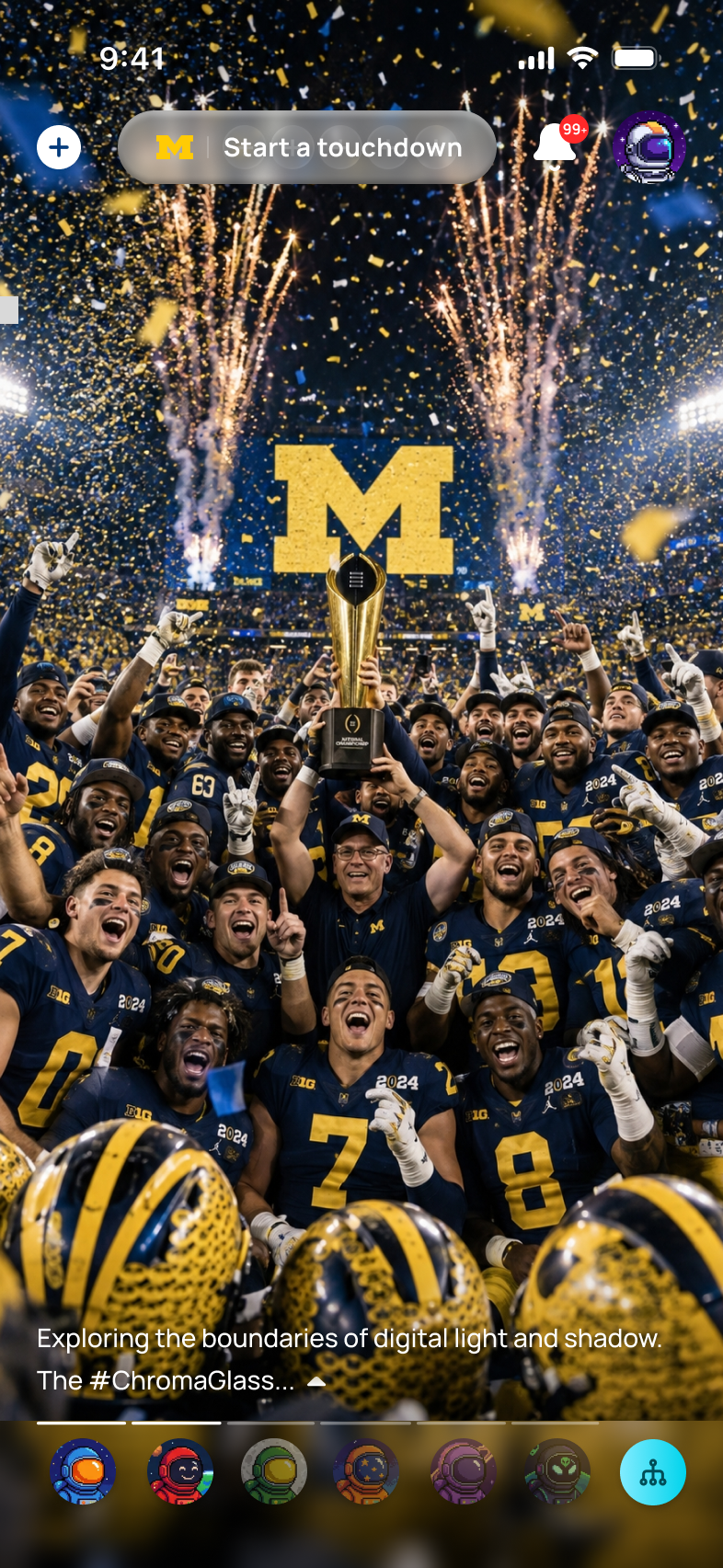
We've officially launched on campuses covered by the Big Ten athletic conference, because Big Ten is America's most influential university sports league, naturally possessing cultural soil.
-
The US market also provides a structural advantage that China lacks: WeChat is too dominant in China.
-
American teenagers' communication behavior is actually fragmented across 6-7 apps.
-
Two people are good friends. Early morning, I'm changing clothes and realize I look good today, so I post a selfie on Snapchat. My bro sees it, sends back a smiley face. Then I go play basketball, see a car accident on the way, film it and post to Instagram. My bro sees it and urgently asks if I'm okay. After school, I see an interesting travel video on TikTok, send it to my bro, tell him I hope I'm living there in ten years. Back at the dorm at night, I realize I forgot my key, so I spam my bro on iMessage asking when he's coming back.
-
Instagram carries public life, TikTok carries entertainment, iMessage handles daily事务, Snapchat belongs to the close friends circle.
-
Fragmentation means: American users are culturally ready to adopt a new container for a specific social function.
-
BeReal also proved that a single-purpose app can reach tens of millions DAU without touching Facebook's existing social chain.
-
If Wapoo takes "playable" to the extreme, it can absolutely occupy a place in American teenagers' social products.
-
Three months after product launch, my understanding of online product versus offline relationships underwent fundamental correction.
-
Initially I viewed offline as purely a user acquisition channel. But testing revealed that offline is itself the product, a complete social mechanism field.
-
Especially in America, offline culture is a crucial social component. Presidential elections are watched in groups. Sports games are watched in groups. America also has parking lot culture — weekends people chat and drink in parking lots.
-
More crucially, unlike ephemeral products like Snapchat, Wapoo can be constantly remixed, forming a content loop from online to offline and back.
-
Here's a user example: Friday night, a group watches the Michigan vs. Ohio State football game in their dorm. During halftime, someone films a video — a fraternity bro John (pseudonym) fell asleep on the couch, mouth open, half a pizza still in hand.
-
This video gets posted on Wapoo. First roommate has a football fly in from off-screen,精准 hitting John's face. Second roommate amps it up: photoshops John into Ohio State University gear, surrounded by Michigan fans booing him. Third roommate makes it superhero version: John levitates from the couch, one-handed catches the football, explosion effects added behind him.
-
By day five, the bros meet offline. The funny videos from the past three days online become offline social currency. Everyone starts roasting John.
-
Content goes online, gets remixed by others, returns to offline discussion of online content — this loop was verified during testing as a positive content cycle.
-
Test data shows: when videos include friends, classmates, or shared experiences, users'主动 editing and modifying behavior is 20x higher than with non-friend content.
-
Relationships provide context for creation, and motivation for creation.
-
Many Wapoo videos have been edited over 100 times. Currently, edits per video is our core metric.
-
Fraternity-preferred content is pranking friends. Like making two guys kiss, or fighter jets flying over a roommate's head and bombing — typical cringe straight-guy humor,偏向恶搞.
-
Sororities偏向串联 popular foreign IP to create stories. Like combining virtual IP "Tung Tung Tung Sahur" with "fruit dating show" creations, or模仿 Game of Thrones intro to mechanically build up a dorm like a castle — women偏 creative narrative.
-
Wapoo won't set up traditional content category operations like TikTok. Old methods don't suit the new era. We only care about whether it's friends' shared experiences.
-
Yiming Zhang didn't understand entertainment, but TikTok emerged in an era of content undersupply. A/B testing and algorithmic distribution were enough. Zheng Huang built Pinduoduo when goods were oversupplied, requiring deep e-commerce understanding to disrupt Taobao.
-
Video has reached the same inflection point — content supply is already oversupplied. Stronger models and algorithms aren't enough anymore. Only product people with a feel for "play" and understanding of containers can build the next national-level app.
- Product home page
"Get Him"
-
Another core metric at this stage: social density, not individual user registration count.
-
Within a defined geography or community — say a 30,000-person campus, if 10,000 are using it, that's 30% social density. Facebook's social density was only about that.
-
High density creates ubiquitous social pressure and identity recognition. This is also the path by which era-defining products like Facebook, Snapchat, and BeReal scaled from campus.
-
We've done精细化 control on user demographics. Early stage is mainstream American public campus population. Nothing else.
-
Early product culture is a matter of life and death. If users see people or styles they don't like, they'll leave immediately.
-
American young people's phones have far more apps than I imagined. The threshold for downloading new products is extremely high. This means products without cultural认同 cannot penetrate.
-
Product is brand, brand is product. Only young people who认同 your product's transmitted culture will download — wanting to be cool people, cultural认同 is the sole driver of downloads.
-
Paid user acquisition is seen as extremely low behavior in American young people's eyes, equivalent to begging. Wapoo absolutely does not do paid acquisition. It would severely damage the brand.
-
Our current growth model is绑定 schools, finding offline key nodes.
-
Strict social鄙视链 exists in American campuses. Lock onto the people at the pyramid's peak, make them love your product, and they'll promote it for free.
-
In传播话术, our keyword is Twist. "You wanna twist your bro?" Users get it instantly.
-
Twist precisely fits young people's "恶搞 friends" social need — "get him" is universal language on American campuses. Meme culture is an extension of恶搞 culture.
-
One weird thing about promoting in America: young people treat "anti-AI" as political correctness,理由是 data centers pollute the environment. But privately everyone's using AI products. So in传播, if a product over-promotes AI, it's seen as uncool. We need some balance so they can enjoy AI while maintaining a cool attitude.
-
The most effective acquisition method now is integration — like playing soccer, boxing, attending their parties with these people. I'm better at sports than them, and fun, so I naturally gain认同. Then my product must be cool, they'll definitely want to try it. This is also social context I'm very familiar with. I went through college exactly this way.
-
My typical day in America: morning meetings with China team to handle事务; noon to student-gathering spots like bubble tea shops, beaches, sports fields to接触 users — bubble tea shops are American students' hottest打工 spots; evening meetings to discuss product iteration, same-day discovered链路 issues get same-day fixes.
-
The team also recruits people who love to play, who can quickly integrate into unfamiliar groups. We have someone who's great at poker, someone who's crazy at clubbing.
-
There were also very failed promotion cases. During the 2026 World Cup we did promotion in Los Angeles, wanting to ride World Cup traffic. But on-site observation revealed it was completely wrong: American young people have limited interest in "soccer." Young people's favorite sport is still football.
-
Also this World Cup's tickets were extremely expensive. People who could afford to go "were basically quite old." So I immediately terminated the promotion.
- Wapoo's promotion methods
3.3 Billion DAU Deduction
-
My recent thinking: Wapoo's落脚点 is always people — friends拉近 relationships through co-creation.
-
AI era content generation costs keep dropping. Content no longer constitutes a moat. What's truly valuable long-term is: who made this content, who made it with whom.
-
This returns to common sense: relationship chains are the core moat of all social products. In America, even with TikTok's massive traffic, it's hard to make users leave BeReal where their friends gather.
-
Now the boundaries between content, social, and community are fusing. It's hard to define which are social products, which are community products. Wapoo's positioning is definitely social — we value relationship chain sedimentation more.
-
Maybe should move toward a more precise positioning: "video co-creation social platform," a new form of content social. At least globally, I haven't seen products similar to us.
-
As a typical Chinese founder "going global" project, sharing some feelings dealing with VCs on both sides: social has always been a highly watched track in Silicon Valley. Especially starting 2026, top funds like a16z, Khosla Ventures are seriously searching for next-generation social products again. Some Silicon Valley VCs came knocking immediately after seeing Wapoo launch.
-
Some Silicon Valley VCs shared that what they're looking for isn't another Instagram or TikTok, but whether AI's emergence will create new ways for people to connect.
-
This shift hasn't been fully perceived in China's primary market. Past two years, domestic AI investment attention has been mainly occupied by foundation models, Agents, and Embodied Artificial Intelligence. AI-native consumer and social products targeting American young people remain in non-consensus territory.
-
Chinese VCs' favorite question to me: are you the AI era's XX? Wapoo's goal is to replace video products on the market, not to be AI era's TikTok or WeChat. We want to define entirely new interaction paradigms based on the AI era.
-
Therefore, Wapoo's scarcity comes not just from product form, but also from the cognitive time gap it occupies.
-
My ambition is definitely to build a 3.3 billion DAU product. Why not? Facebook DAU is 2.1 billion, WeChat is 1.2 billion. Add them, that's 3.3 billion. AI-native containers can theoretically support user bases at this scale.
-
Wapoo isn't competing for the video generation tools market, but for getting everyone to use video to learn to communicate with each other.
-
The text era produced WhatsApp and WeChat, the image era produced Instagram and Snapchat. If AI makes video an instantly usable communication language for everyone for the first time, then a completely new, globally-based social container should be born.
—Fin—
AI Nao is seeking independent writers If you're curious about people and things in the AI wave, and skilled at writing
Please contact: shizao1123@hotmail.com
Email should include: 1. Personal introduction; 2. Relevant articles; 3. Your favorite AI Nao article Competitive compensation, professional editorial guidance
Looking forward to making noise with you