Hillhouse Made an Investment in a Hug

A PhD student who loves love built a robot that gives you hugs late at night

Embrace | Soft Embodiment | Prefrontal Cortex | Home Intelligence
Produced by | AI Nao

Prefrontal Overload
Qian Zheng has had anxiety disorder (he emphasizes he's fully recovered now). During his PhD, the pressure became so intense that he developed somatic symptoms — waking up at three or four in the morning, paralyzed, unable to do anything. "Prefrontal cortex overload. Overthinking." His solution was calling his mom. "She didn't really understand me, but she could listen patiently."
After that, Zheng kept thinking about it: the worst part of anxiety is insomnia. When someone breaks down in the middle of the night, what they really need is a person who can "steadily catch them." But here's the problem — not everyone has a number to dial. "A mother, a friend, anyone who'd pick up your call at 3 a.m. without asking why — some people never find that person their whole life."
So an insomnia-plagued PhD student set out to solve humanity's sleep problem. This was the origin of MoYa: a soft robot that can hug you tightly and purr like a cat.
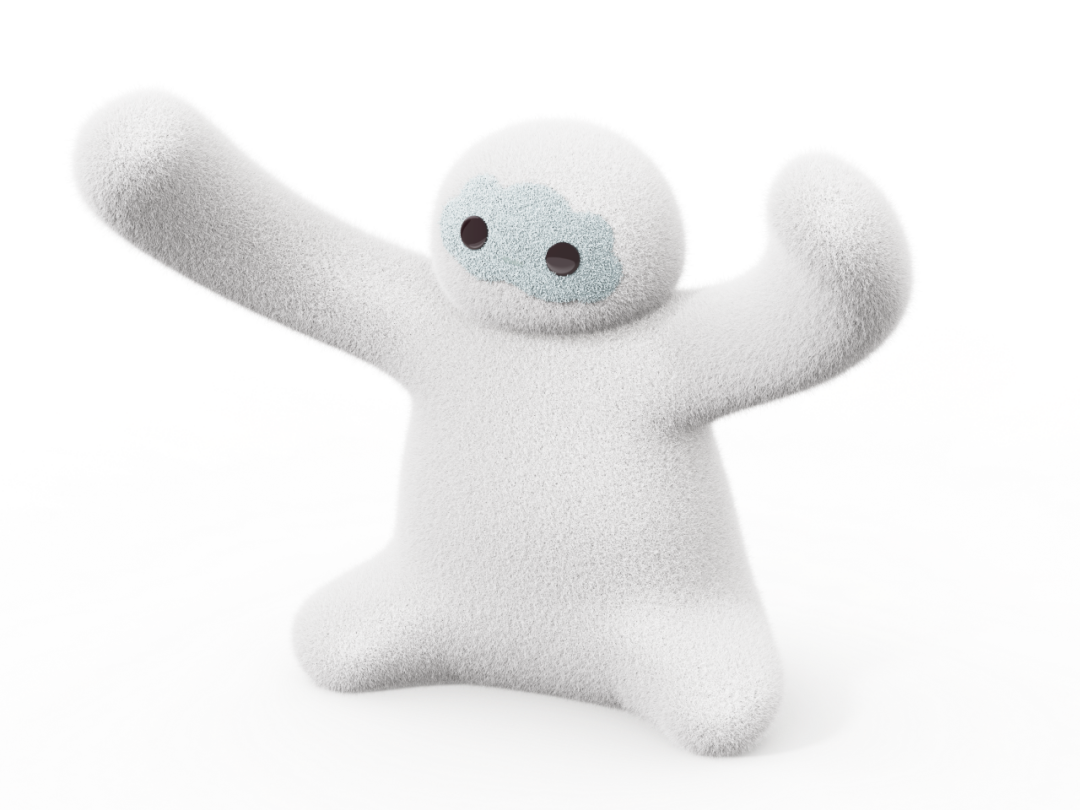
Without even a complete demo, Hillhouse quickly bet on the angel round.
MoYa's product form came from Zheng's extensive dating experience — coincidentally, his girlfriends almost all loved cats and sleeping with them. Then Zheng discovered that products like white noise machines, bedtime story devices, and patting dolls actually had scientific backing. During testing, he first launched a breathing pillow, but users feedback was clear: they just wanted "something to hold while sleeping."
So he found "embrace" — an ingenious entry point for embodiment.
Why do humans love hugs? Because "embracing" activates a pathway called the vagus nerve; the brain releases oxytocin, creating feelings of safety and calm. Hugs also reduce cortisol and improve HRV (heart rate variability), indicating better cardiac and emotional states.
I forgot to mention — Zheng studied robotics as an undergraduate at Harbin Institute of Technology and was part of building an exoskeleton robotics company from 0 to 1. To fulfill his dream of building robots, he went to Zhejiang University for a PhD specializing in mathematics and signal theory.
Of course, no description beats hugging MoYa yourself. At the recently concluded BEYOND Expo in Macau, it received the most hugs from humans.
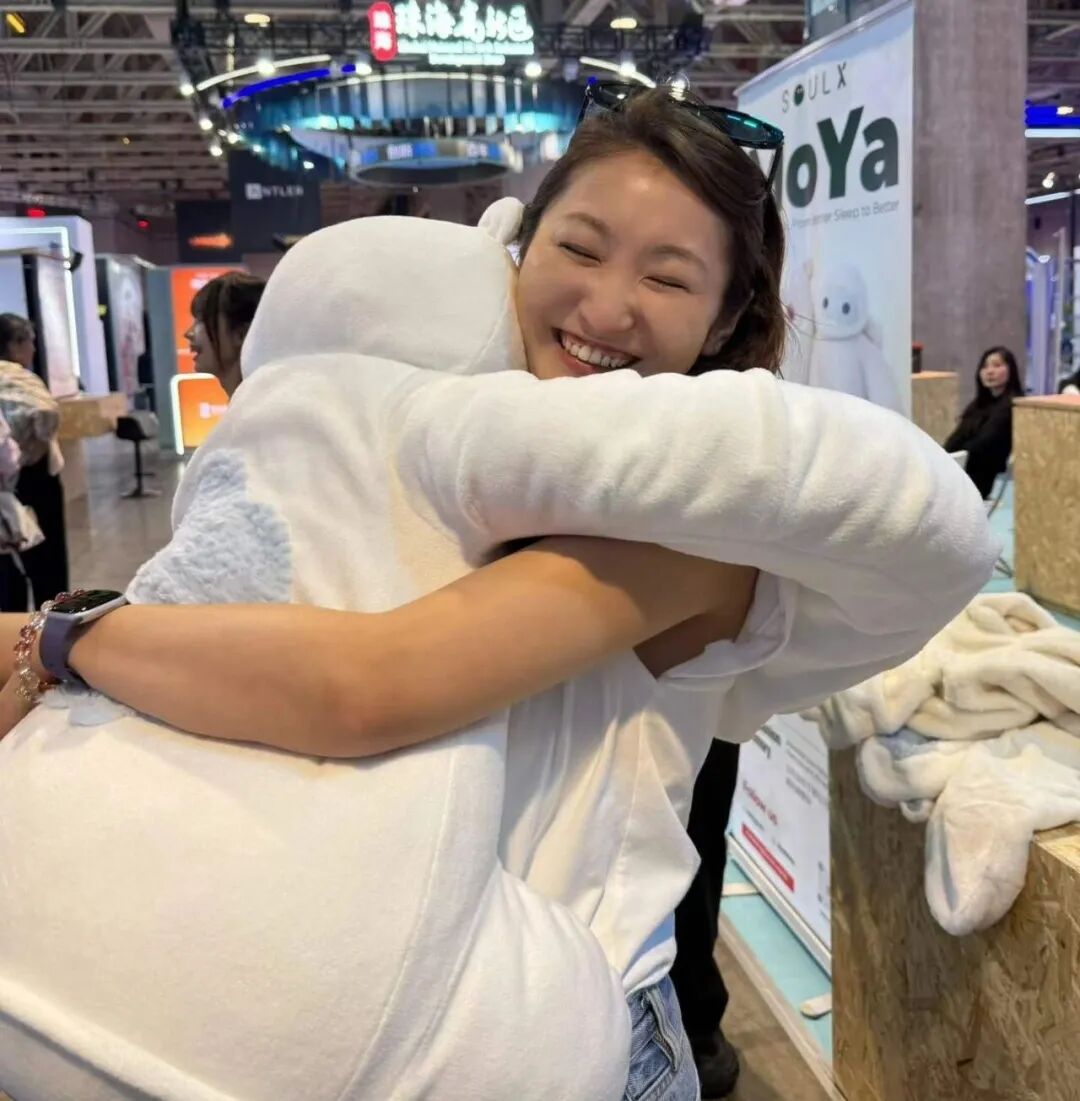
- Macau Expo user
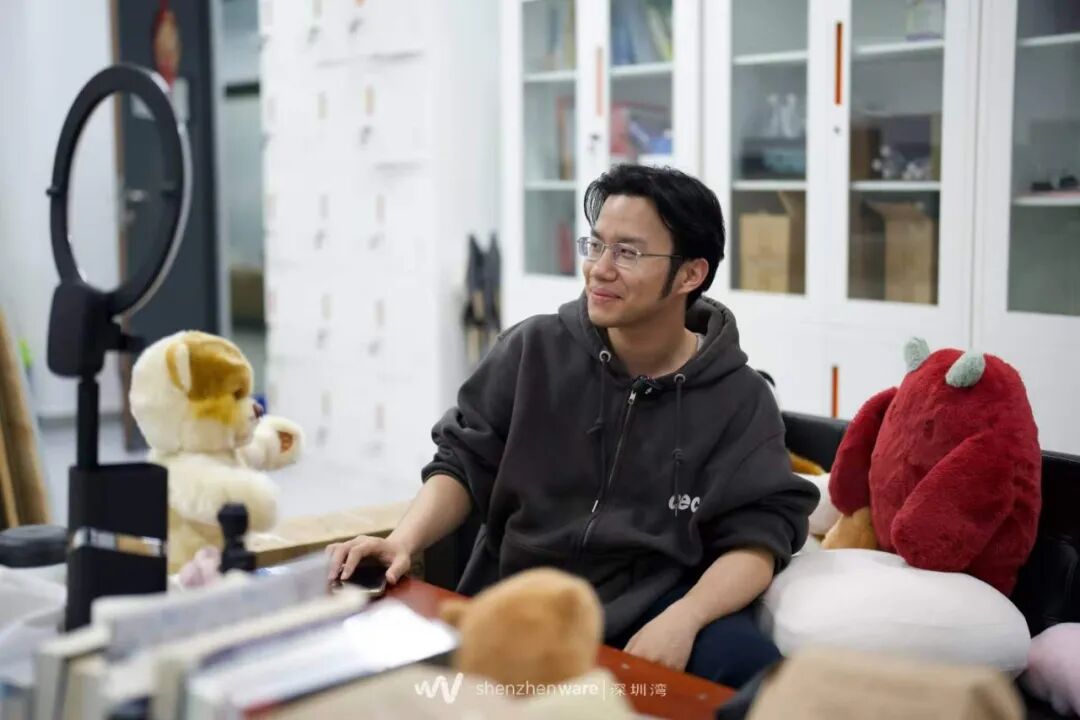
- Zheng repeatedly testing hugs
The Embrace
Who could refuse a fluffy Baymax主动拥抱你呢?
But teaching MoYa to hug was far harder than imagined.
When humans embrace, countless tiny things happen without conscious awareness. We hold someone, and our hands instinctively make imperceptible pressure adjustments — this variation itself is a kind of language. But robots treat hugging as a task to execute: hold the person, and then what? They don't know what to do next.
The answer to this problem was "breathing."
MoYa has a breathing module in its chest cavity. After it hugs you, it rises and falls rhythmically. Why specifically the chest? Because the chest is where the vagus nerve is most densely distributed — essentially the body's relaxation switch. "The exhale needs to start the moment of the hug. Too fast feels like panting, too slow and you can't feel it. Behind this is an entire coordinated standard of hugging, breathing, and patting — internally debugged for a long time."
Creating a hugging motion that most people find acceptable requires quantifying everything first: how long are the arms? How much pressure on the back when holding? MoYa's arms use an inflatable, expanding soft structure with no joints — the hugging motion is simulated through airbag inflation and deflation. The arm design required repeated prototyping. Unlike rigid robots, soft robots are highly nonlinear.
All of this constitutes a complete "hug engineering." If it doesn't make much sense, don't worry — the conclusion is that Zheng and his team spent two years defining a "hugging standard" for robots.
During testing, user feedback was "safe, satisfying, like being in mom's arms." We can all imagine that feeling.
We asked Zheng why no one on the market had made a hugging robot before.
Zheng said it's because soft robotics people love hiding in labs sculpting Baymax out of silicone; industrial robots mostly choose rigid structures with larger funding rounds; and most robotics students are men who rarely find "hugging" interesting. "You need to understand a bit of neuroscience, a bit of materials science, have a robotics background, and have the obsession to turn it into a consumer product."
This interdisciplinary gap happened to become his calling: standing at a previously unnoticed intersection. "I may not come up with a product form as good as MoYa again in my lifetime."
And this generation of AI entrepreneurs is genuinely lucky — China's supply chain has recently developed the capability to manufacture high-end airbags, with premium car cabins in new energy vehicles maturing airbag technology.

- Zheng presenting the product in Macau
Kevin Tsai
MoYa can hug you, breathe, have deep conversations, and tell sleep stories — this is what Zheng insists on achieving, treating it seriously as an embodied robot. "Vision isn't on the roadmap for now, because in sleep scenarios, it's scary — uncanny valley effect, plus privacy concerns."
MoYa's memory agent doesn't remember everything either. It only retains clues related to sleep and stress. If you mentioned recently having problems with your boyfriend, next time you talk about waking up at night, it might ask: could it be related to your boyfriend?
The questioning is guided, not pressuring — like when we're meditating or writing in a feelings journal. MoYa serves a soothing function, its personality modeled on Kevin Tsai: understanding the art of conversation, gently persuasive.
Zheng repeatedly emphasizes one word: convergence. At this stage, convergence in embodiment matters more than model parameter count.
If you cram too many sensors and physical interaction commands into the body, excessive information flooding into the context will pollute the model, and MoYa's responses become strange. This is also the problem with many general-purpose robots: "the data is too dirty, hard to iterate."
A robot that can only properly hug you in bed is far closer to true intelligence than a general-purpose robot that does everything poorly. MoYa's world is small; the information it processes is minimal. In a small world, it can achieve the extreme.
This view has echoes in academia — robotics research at MIT and Stanford also emphasizes "task specialization" and "environmental constraints."
Zheng has another bold claim: soft robots will enter households before rigid robots, for simple reasons: soft is safer, more adaptable, and 70% of household needs aren't housework but "home care" — which soft robots happen to suit.
MoYa's vision is "A soft home care robot designed to support everyday life, starting with sleep" — a soft home care robot that starts with sleep and supports daily living.
Let's translate that into plain language: when parents fight, a 3-4 year old child gives each parent a hug; when a couple is in a cold war, the cat comes over and rubs against them. "MoYa will play this role in the future."
All of this is the plan. The long journey begins with sleep.
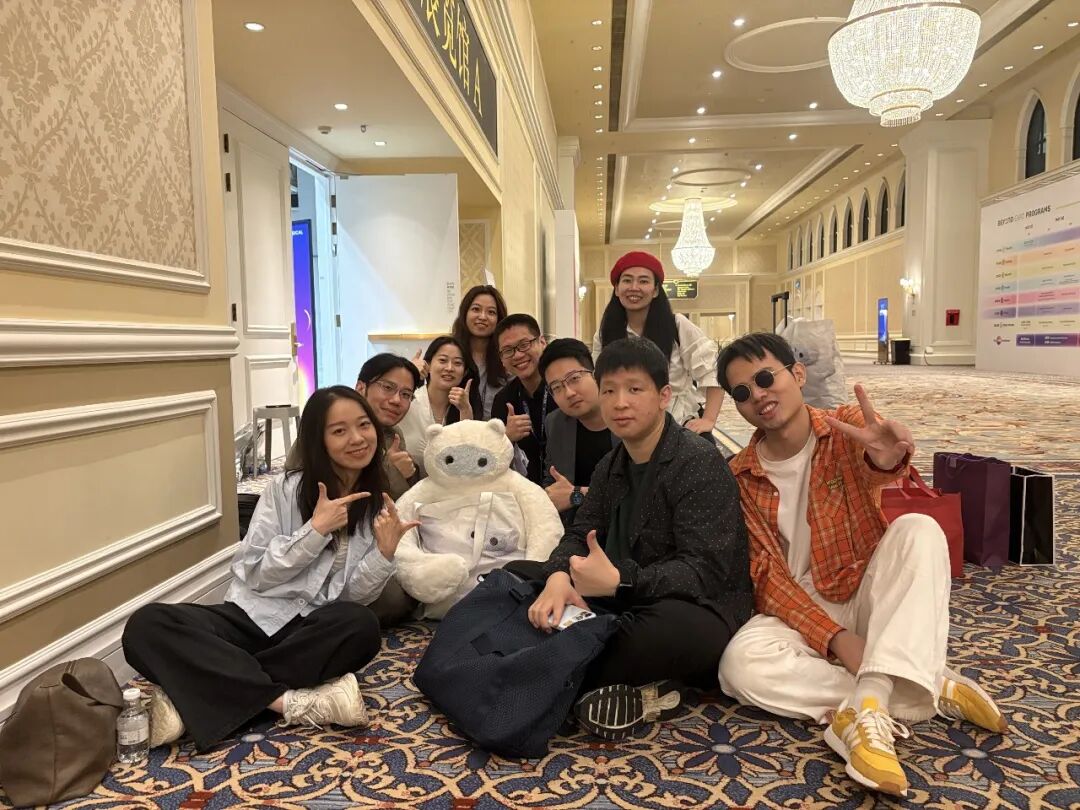
- Receiving much love at the Macau expo
The Romance-Obsessed PhD
MoYa is planned for launch in September, about to face the cruelest market test: pricing around one thousand RMB.
One investor put it bluntly: "China has 1.4 billion people. During testing, you'll always find a few hundred people who like you and say they'll buy. But whether you can mass-produce is another matter entirely. Founders shouldn't deceive themselves."
Zheng considers himself a relatively rational founder. He started a company before his PhD — brain-computer interfaces, hard tech — and lived through one bubble cycle. "Grand narratives, vague and hollow. Capital markets good one moment, bad the next — too much uncertainty." This time he wants to do something he's more confident about. Sleep is a large market that's already been validated.
He applies the Bayesian principle from machine learning to business logic: you can't create something completely disconnected from market cognition, or "new learning function × existing cognition = 0" — users won't understand, and startups don't have money for market education.
An investor who knows him well evaluates him as "someone who wants to get things done, and someone who knows very well what he wants. Doesn't change easily, doesn't follow trends. But capital markets are direct now — rigid embodiment is high-profile and high-stakes. His choice of an indirect approach isn't easy, and selling isn't what technical people are good at."
Many people suggested he ride the brain-computer interface wave — valuation could instantly hit several hundred million dollars. He refused. Others suggested starting from wearable devices, since MoYa is after all a new category. "Pure data-driven approaches don't change behavior, but an intimate relationship can change life behavior."
Something depressing: recently many people have come asking Zheng, what's the difference between MoYa and Yiwu small toys?
"Just hug it and you'll know." Zheng explains tirelessly. As an ENFP, the happy puppy is about to cry. "Hugging — that's what Yiwu small toys can't do."
Someone with more愿力 than most men to give robots "hugging" — probably because he learned from his long romantic history that "hugging" genuinely brings people value and meaning.
Dating since fifth grade, nearly 20 years now. If he remembers only one thing, it's that most girlfriends loved "being hugged."
"Do guys like it?"
"Yes, but we always feel ashamed to say it out loud, so we get used to thinking 'sex' is what soothes emotions."
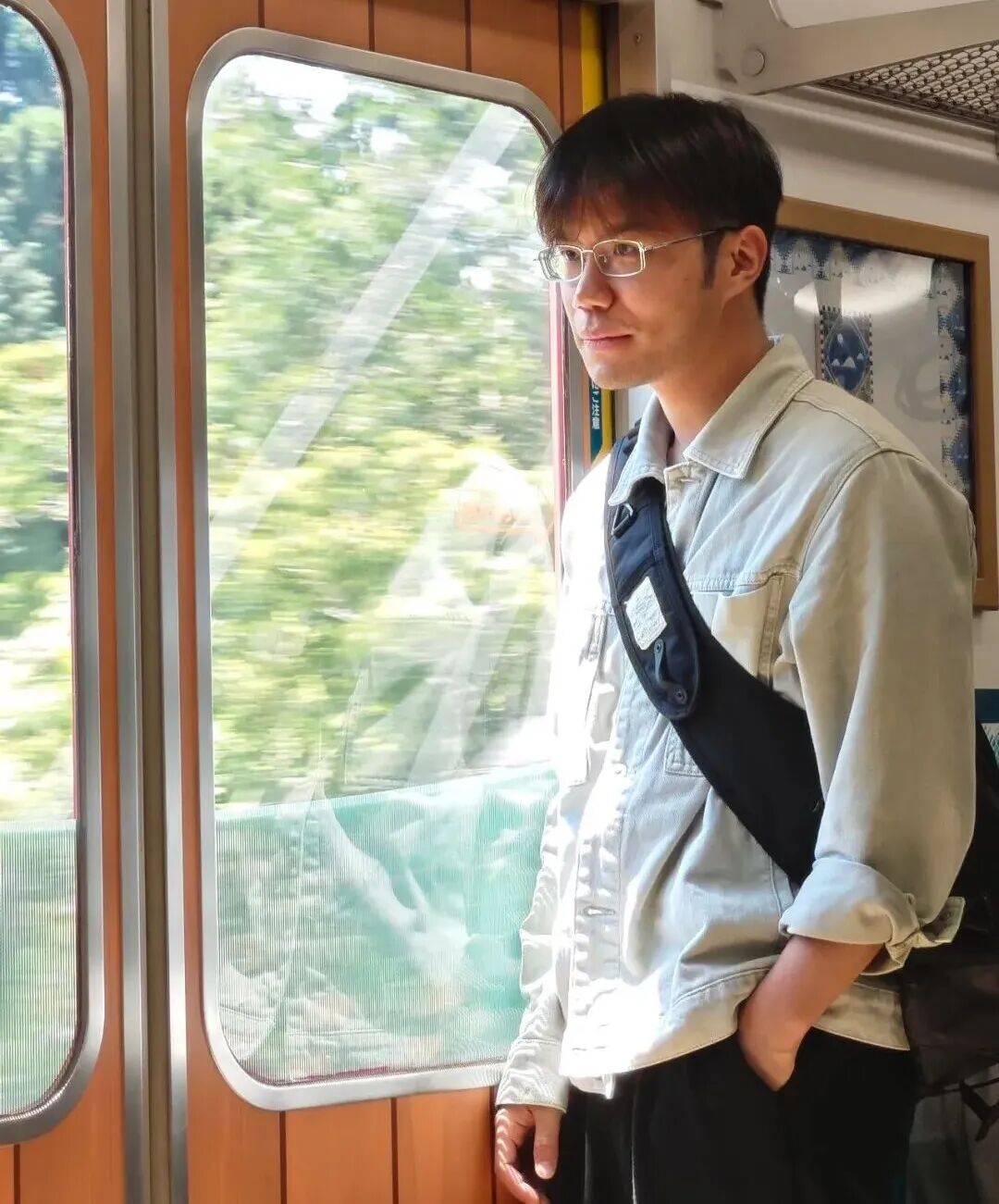
- Zheng during travels
Image source | Interviewee
Join the Community