After Unitree's IPO, How Should Embodied Artificial Intelligence Be Priced? | Keyframe

"Companies ranked near the top today might not even make the top ten in the end."

Embodied AI Pricing | Labor Force | Commercial Inflection Point | Cost
Produced by | AI Nao

Intro
Data is the frame sequence of an era — objective, yet also subjective. Everything depends on the angle from which we choose to look. The AI age makes this especially true: it reflects how the market prices "the new," and tests our ability to recognize when "change" actually begins.
Which is why AI Nao is launching a new column: "Key Frames," using data visualizations to explain pivotal shifts in the AI era.
Why "Key Frames"? In visual language, a key frame defines where a motion starts and ends — it's not the entire picture, but without it, movement loses direction.
Big data shows us how large the world is; key frames tell us which frame is where acceleration, pivot, or stagnation begins.
Each issue, we'll start from one chart, one metric, or one outlier — calibrating to a scale the general public can feel, through the most accessible data visualizations possible.
For our first issue, we train our lens on a company that's been in the spotlight lately: Unitree.
Setting aside short-term market performance, Unitree's IPO actually offered the humanoid robot industry a valuation calibration — within five days, its market cap nearly halved from a peak of 440 billion yuan. Before this, the global market lacked a publicly listed company whose primary business was humanoid robot manufacturing, with real profits and fulfilled order records to show for it.
Most peers have reached billion-yuan valuations with barely any genuine orders, largely representing the market's premature discounting of the future. Meanwhile, after pouring hundreds of billions of yuan into the primary market, pricing embodied AI companies remains one of venture capital's biggest challenges in 2026.
One embodied AI founder predicted to us that once robots solve household labor, the market could reach ten times the size of new energy vehicles.
On the opposite side sits Bain Capital Ventures partner Ajay Agarwal, who believes humanoid robots may be nothing more than "expensive party tricks."
The two judgments appear contradictory, but they point to different sides of the same reality.
Even Unitree isn't a standard answer. Its current product scenarios concentrate on research, education, and performance — still distant from the truly promising markets of industrial and home service applications.
Embodied AI companies also can't be lumped together. Body manufacturers, brain companies, and potential robot labor platforms represent fundamentally different business models.
"We're still navigating by old maps to find new continents," one embodied AI investor said.
Below is the first installment of this column, woven together through five data visualizations.
The 100 Billion Yuan Divide
Take Unitree itself. Lead underwriter CITIC Securities gave a fair market cap of 50.6–55.9 billion yuan for the next 6–12 months. CCB International offered a more bullish answer: 269 yuan per share in 2026, corresponding to 109 billion yuan market cap. Nomura, meanwhile, set a 2027 target price of 370 yuan, implying 149.6 billion yuan.
The three institutions' valuation ranges span 50–150 billion yuan — all below Unitree's current market cap.
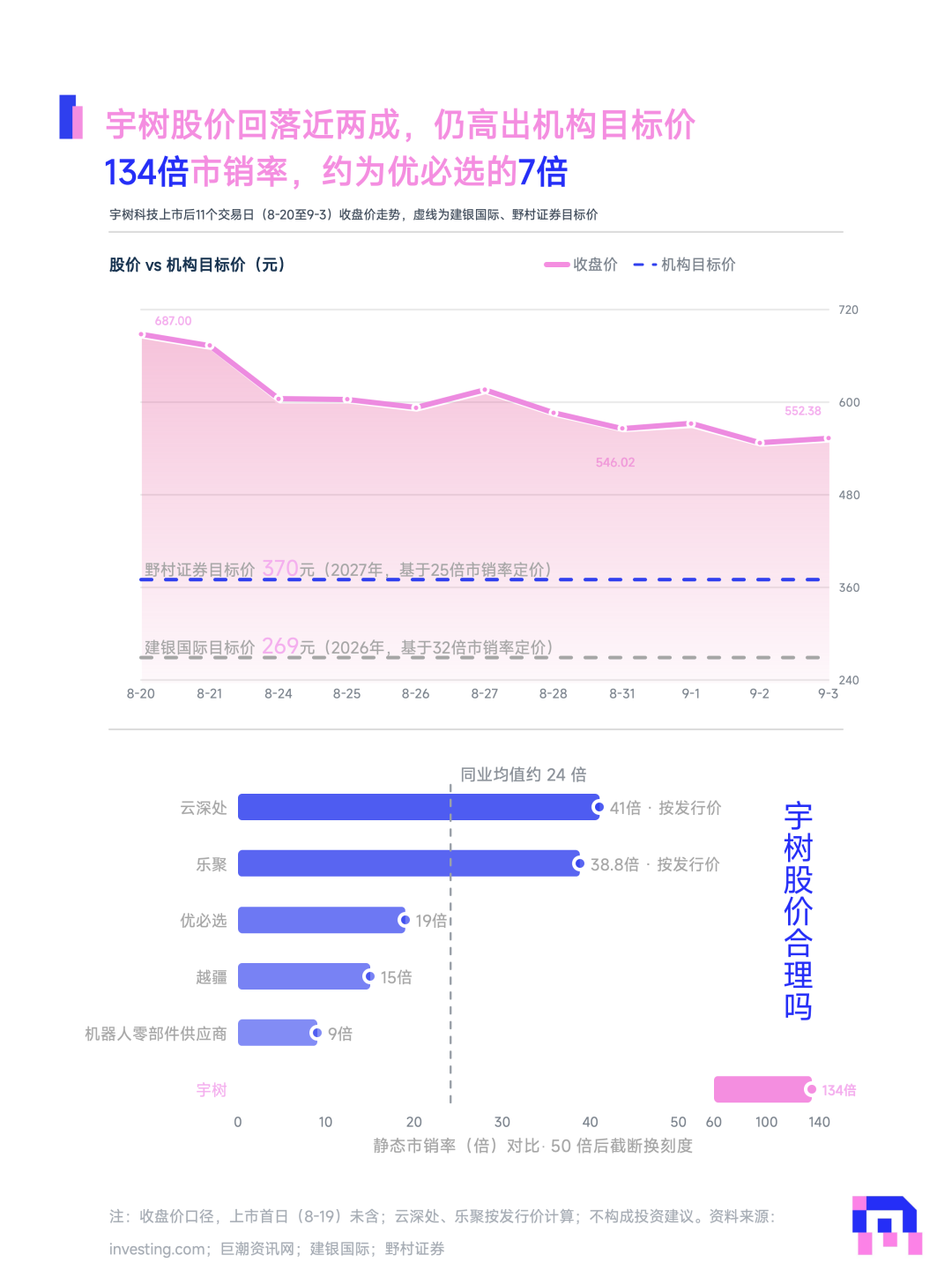
A secondary market analyst told us that Unitree's stock price hasn't stabilized yet. Behind the violent market cap fluctuations lies, in part, the embodied AI industry's failure to find a consensus framework.
Once listed, a company's valuation returns to the most basic logic: all concepts and stories must eventually land as revenue through "shipment volume," then convert to profit through "profitability." Any valuation that can't be delivered on these two points will be corrected by the market.
For a company like Unitree still in its "growth phase," the market allows some margin of error — Unitree is in a profitability trough during reinvestment; and revenue is growing rapidly. Both CCB International and Nomura calculated Unitree's stock price based on price-to-sales ratio.
Nomura predicts Unitree's fiscal 2027 revenue at 5.4 billion yuan, applying roughly 25x P/S to 404 million post-IPO shares, yielding approximately 150 billion yuan market cap. CCB International used 32x P/S for 2026.
25x or 32x P/S is not low. UBTECH currently trades at 19x P/S. Additionally, according to Nomura's data, Chinese robot component suppliers trade at only 9x.
The premium above these reflects categorizing Unitree as a technology company rather than a simple manufacturing firm, incorporating upside from future AI technology developments transforming the embodied AI industry.
"Scarcity" is another pillar supporting the valuation.
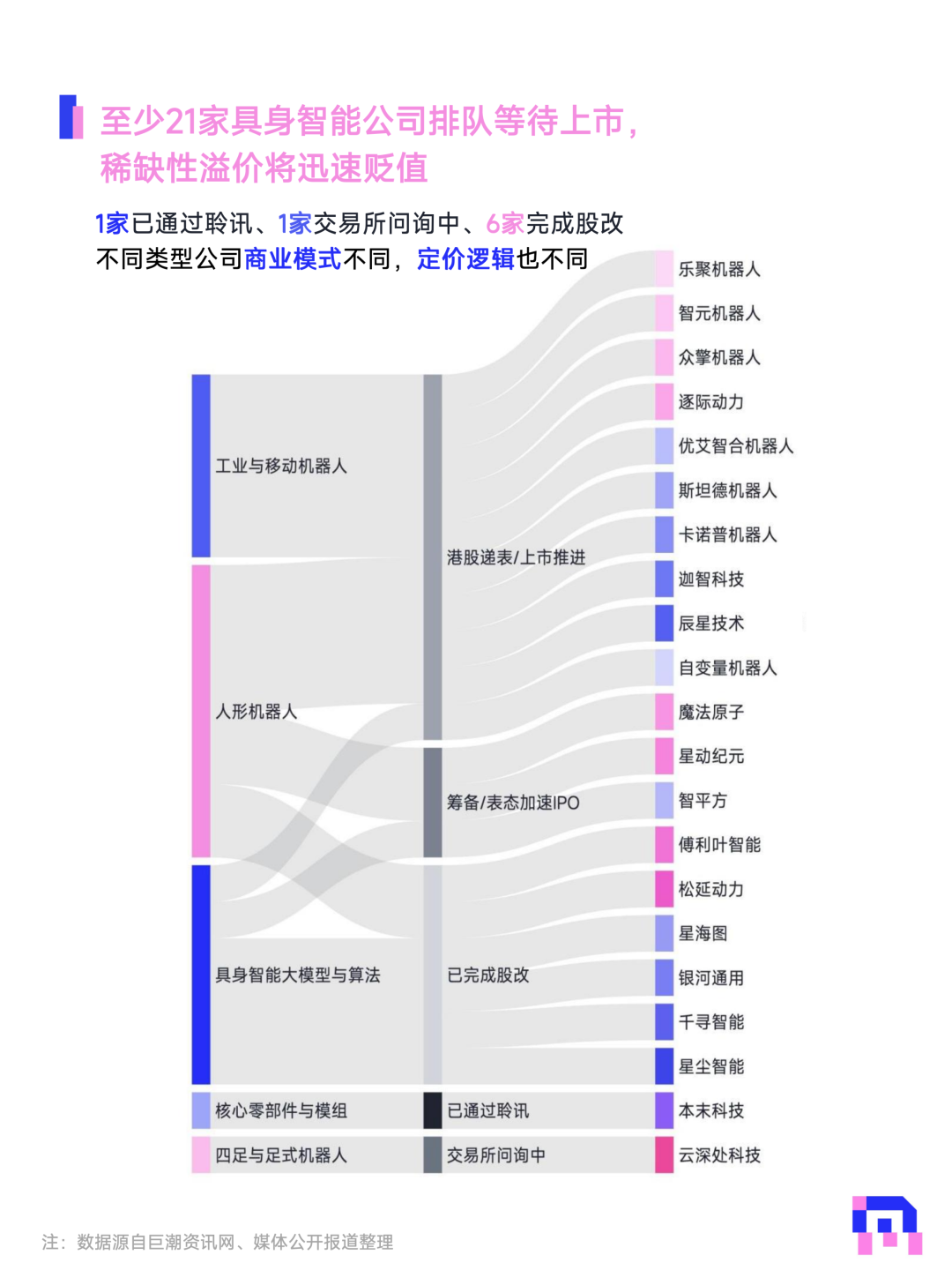
Over the past two and a half years, UBTECH was virtually the only investable humanoid robot manufacturer in secondary markets. Despite cumulative losses exceeding 5 billion yuan over six years, it still commanded a premium. However, with Unitree's IPO and at least 20+ related companies queuing for listing this year, this scarcity is depreciating rapidly. JPMorgan Chase has consequently cut UBTECH's target price to 118 HKD; the stock closed at 79 HKD on September 3.
The Two-Year Payback Threshold
One investor said the truly worth-asking question is: where is the inflection point for humanoid robots moving from prototypes to scaled deployment?
This depends on when supply and demand converge: the labor substitution value that humanoid robots represent, and the scalable commercial scenarios where they can land.
Compared to distant market size projections, a more realistic metric is whether unit costs approach labor costs.
Multiple research reports note that through Chinese supply chain adoption, plus cost dilution from scaled production and technological efficiency gains, manufacturing cost declines for humanoid robots are a deterministic trend.
A Morgan Stanley research report predicts total costs falling from $131,800 (approximately 886,000 yuan) to $16,300 (approximately 109,000 yuan), an 88% decrease. Actuators and dexterous hands will be the main drivers of cost reduction.
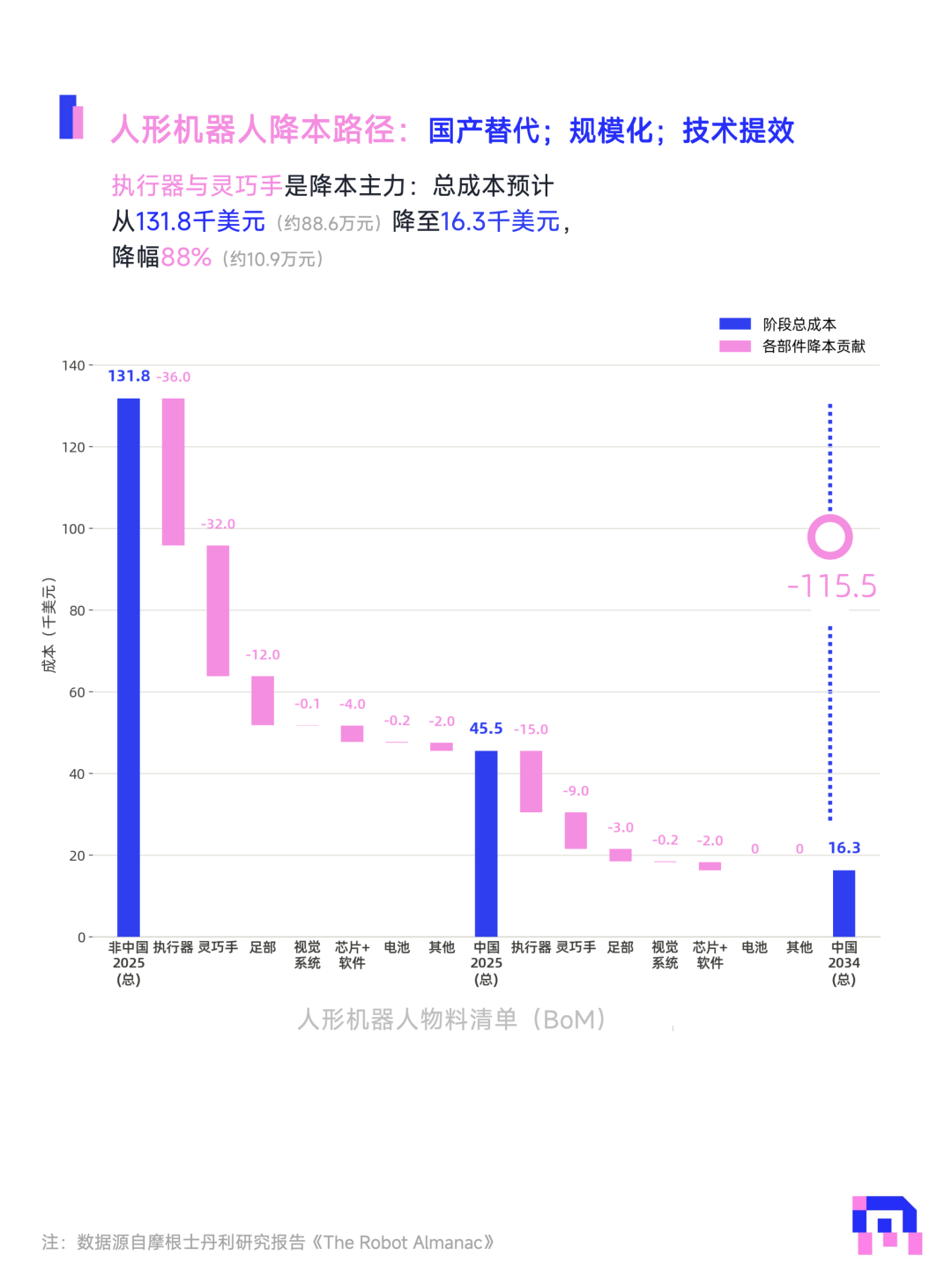
This price lands right in the range where business models can work. Unitree's G1 base version sells for 85,000–99,000 yuan, but cannot be used in industrial scenarios. Current humanoid robots for industrial use mostly fall in the 300,000–500,000 yuan range.
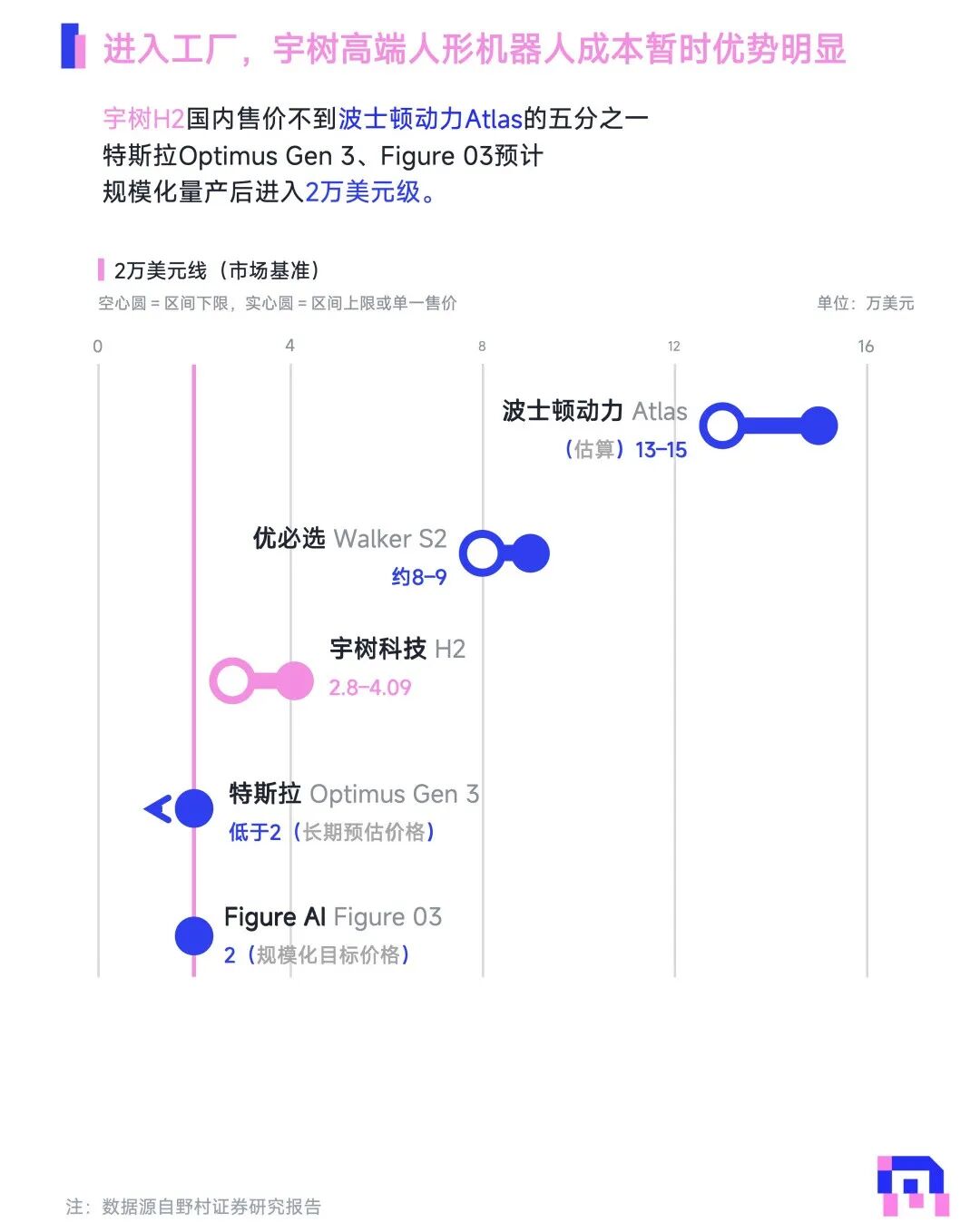
One early-stage hard tech investor believes that in supply chain cost reduction, humanoid robots are quite similar to new energy vehicles. The main difference lies in the degree of "intelligence" required.
Another early investor who backed Tesla said, "Compared to the United States, China's embodied AI advantage in supply chains benefits from the spillover of new energy vehicle manufacturing capabilities."
According to Guotai Haitong Securities research, assuming annual labor costs of 80,000 yuan, as long as robot costs (including maintenance) are 160,000 yuan, payback comes in two years.
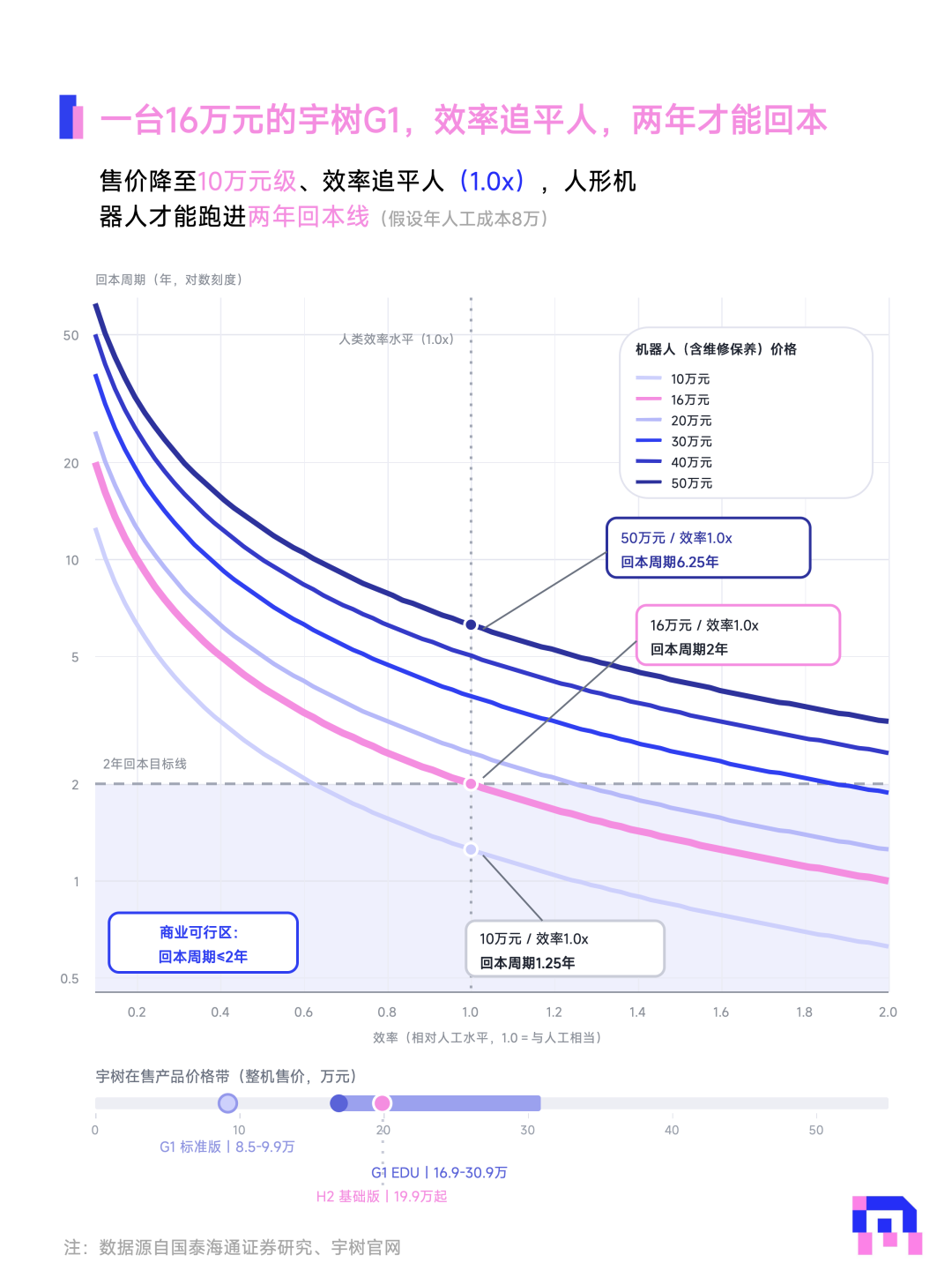
This is also embodied AI's greatest uncertainty.
A research report by Brazilian philosopher and economist Euclides Mance predicts that in 2026, one humanoid robot's efficiency will be roughly 50% of human labor, only reaching 104% by 2034.
But this too is merely a prediction.
"For predictions too far out, just treat them as if they don't exist," said one major tech company strategy executive.
In the real world, Unitree's robots can currently do simple assembly work in factories, but efficiency remains lower than humans. Additionally, each new task requires retraining the robot model specifically for that task — inefficient.
Unitree founder Xingxing Wang stated that current humanoid robots lack sufficient generalization capability; AI models have a "last few millimeters" of deviation from the real world, causing success rates to plummet.
He predicts that in as fast as two to three years, or as slow as five to ten, when robots can complete 80% of tasks in any unfamiliar environment, the industry inflection point will arrive.
A Goldman Sachs research report predicts that because environments are relatively enclosed and tasks more standardized, "logistics scenarios" will become the first large-scale application. Using Amazon as a case study, if automation fully rolls out, it could deliver approximately 5.6% leverage on service costs by 2030, saving roughly $72 billion. Next comes automotive manufacturing — final assembly, wiring harness connection, complex parts assembly, and quality inspection, scenarios still heavily dependent on human labor.
The above represents only an ideal state. Even in the most optimistic scenario, as market size expands, competitors will multiply — automakers are foreseeable potential entrants.
So the health of the humanoid robot business also depends on whether it descends into price wars, and whether gross margins on complete units come under pressure.
Additionally, we've underestimated robots' potential in "creating new demand." In education and companionship, entertainment and performance, hazardous environment operations, and other fields, robots can satisfy needs previously unmet or prohibitively expensive. The pricing logic for these "incremental markets" is completely different from "replacement cost."
Three Business Models
AgiBot and Unitree rank first and second globally in shipment volume. Compared to some "brain-building" companies, their real orders are at least quantifiable metrics — but even among these orders, there's considerable foam.
When we posed the question "how to price embodied AI brain companies," one early-stage hard tech investor's response was: that question is already outdated.
In the past, primary market enthusiasm for embodied AI wasn't精密 commercial论证, but more emotional hype. Analyzed with rigorous financial logic, embodied companies are simply "outrageously expensive."
In secondary markets, UBTECH's stock price over the past two and a half years spent most of its time below analysts' target price expectations. When analysts were telling stories with "forward P/S multiples + shipment guidance," reality was brutal.
At a moment when technology hasn't converged and mature analytical frameworks are difficult to apply for commercial judgment, when people discuss embodied AI companies, they're likely not even talking about the same type of company.
Current embodied AI companies can be simply categorized into at least three types: body manufacturers, brain companies, and robot labor platforms — corresponding to three different ways of running the numbers.
Body manufacturers represented by Unitree and AgiBot have core capabilities in hardware manufacturing and cost control. Their commercial logic more closely resembles traditional manufacturing — competing on supply chain integration capability and mass production efficiency. Valuation anchors for these companies are shipment volume and gross margin; the market measures them with manufacturing or consumer electronics frameworks (P/S, P/E). Their ceilings are relatively clear, but this also means limited valuation elasticity, unless they can gradually extend into service or operation segments.
Robot "brain" companies license their capabilities, charge SaaS fees, or bill by usage volume to multiple body manufacturers — this is the commercial logic the US embodied industry favors more, closer to software and AI companies. Their valuation anchor is the generality of model capabilities and breadth of integration — whether capabilities can be reused across different bodies and different scenarios determines their ceiling. Once a brain model becomes an industry standard, it could command valuation premiums similar to operating system vendors. But the industry is far from forming such consensus standards, and these companies' valuation volatility is the highest.
"Robot labor platforms" come closest to the distant imagination space, but are currently also the most immature model — not selling robots themselves, but charging customers by the hour, by task, or by output, with robots merely as delivery vehicles. These companies value sustained, predictable recurring revenue (ARR) over one-time hardware sales.
However, the entire industry remains in a fuzzy stage. Brain companies are often also building bodies; body manufacturers are investing in brain R&D too. Everyone is telling bigger stories.
For example, Unitree is also developing brains and pushing into industrial scenarios. In the US, Figure AI and Physical Intelligence (Pi) haven't chosen pure software licensing routes either, instead beginning deep binding with specific bodies (or scenarios) for end-to-end optimization.
So the boundaries among these three business models may not be so clear in the embodied industry.
Every technology wave sees value migrate along the chain: PCs from hardware to software, phones from complete units to ecosystems. Currently bodies are being commoditized, with barriers in manufacturing yield and supply chain relationships; brains lack pricing standards, with cores in data flywheels and model iteration.
What the market lacks isn't frameworks, but methods for pricing uncertainty — though this is also the enormous opportunity across primary and secondary markets.
One investor half-joked that the companies ranked at the front today might not even make the top ten in the end.
Data visualization | AI Nao
References
-
Nomura Securities: Initiating coverage on China's embodied-AI leader: Profitable humanoid maker at scale with cost leadership, faster iteration, and matrix breadth
-
Morgan Stanley: The Robot Almanac
-
Goldman Sachs: Global Physical AI: Framing the Forward Progress of Humanoids (with a Studied Focus on the Logistics Landscape)
-
Guotai Haitong Securities: 2025's New Generation of "Blue Collars": How Humanoid Robots Stand on Factory Assembly Lines — Embodied AI Industry Deep Dive (VII)
AI Nao is seeking independent contributors
If you're curious about the people and stories in the AI wave, and skilled at writing
Please contact: shizao1123@hotmail.com
Email should include: 1) Personal introduction; 2) Relevant articles; 3) Your favorite AI Nao article
Competitive compensation offered, with professional editorial guidance
Looking forward to making noise with you