Lark Conference Live: Why Do Smart People Make Organizations Dumber? They're Using AI to Fix That

The question is no longer whether we want to be more efficient, but rather: whether we can be, to some degree, liberated within an organization.
Produced by | AI NOW!
Intro
People tend to think of "organization" as a concentration of force — something more powerful and potent than any individual.
But in reality, we often see the opposite: bring enough smart people together, and they somehow form a clumsy system.
This isn't an anomaly. It's our daily experience.
In countless organizations, processes rely on word-of-mouth, knowledge capture depends on whoever happens to remember to document it, meetings become pre-meetings for future meetings, and the same decisions get rehashed again and again.
Why do intelligent individuals so often produce sluggish organizations?
What AI NOW! witnessed at the 2025 Lark Future Unlimited Conference was precisely this paradox being confronted head-on.
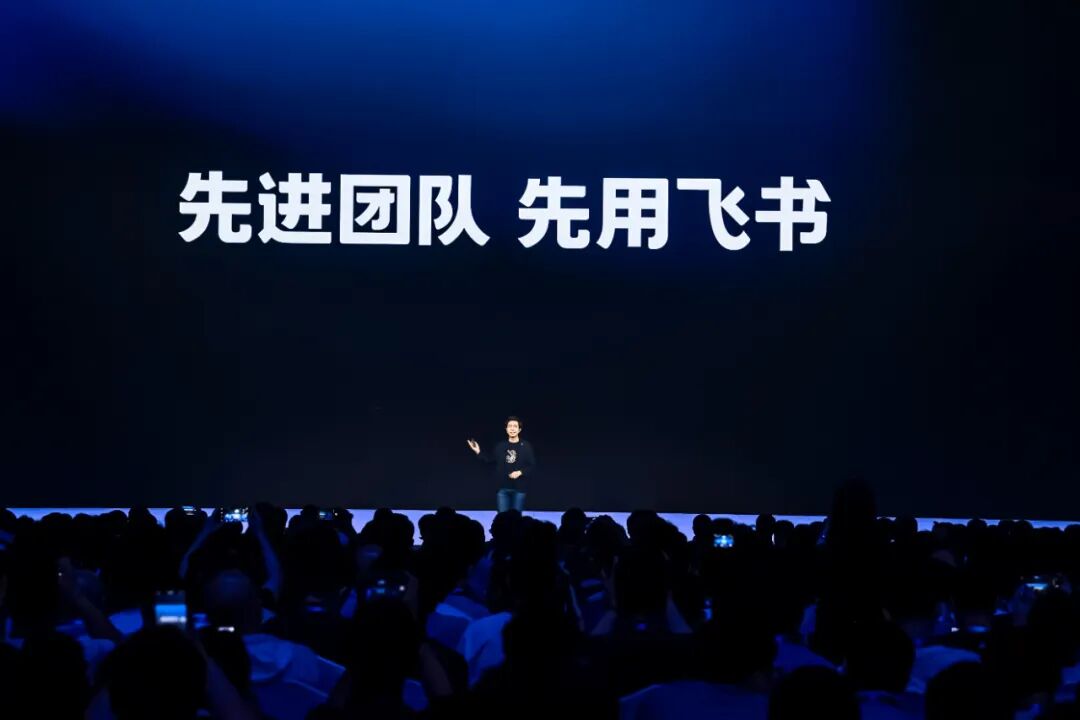
When He Xiaopeng, chairman of Xpeng Motors, took the stage to describe how his company had become one "grown on Lark" — replacing PowerPoints with collaborative documents, eliminating useless meetings (He Xiaopeng Sends Another All-Staff Letter: Say Goodbye to PPT, Use AI to Clean Up Ineffective Meetings) — the audience burst into knowing laughter.
The scenarios He Xiaopeng described are painfully familiar: frantically preparing pre-meeting materials, then distilling meeting notes afterward, with time spent on "internal alignment and reporting" far exceeding time spent on actual business.
If a company truly grew entirely on Lark, could it approach some prototype of极限协作 — no longer accumulating tools, but using one unified system to integrate an organization's knowledge, judgment, action, and evolutionary capacity?
Not merely efficiency gains, but a response to a more fundamental question:
Can an organization possess intelligence the way an individual does?
Rather than the standard tech conference formula of "product walkthrough + customer testimonial," Lark's event unfolded more like an experimental theater of organizational intelligence.
Behind each collaboration tool update lay the same underlying proposition:
If individuals can be smart, organizations need not be dumb.

Feishu Aily: The Intelligent Entity's Front Desk
Keywords: intelligent entry point, Agent container, organizational language interface, system dispatch hub
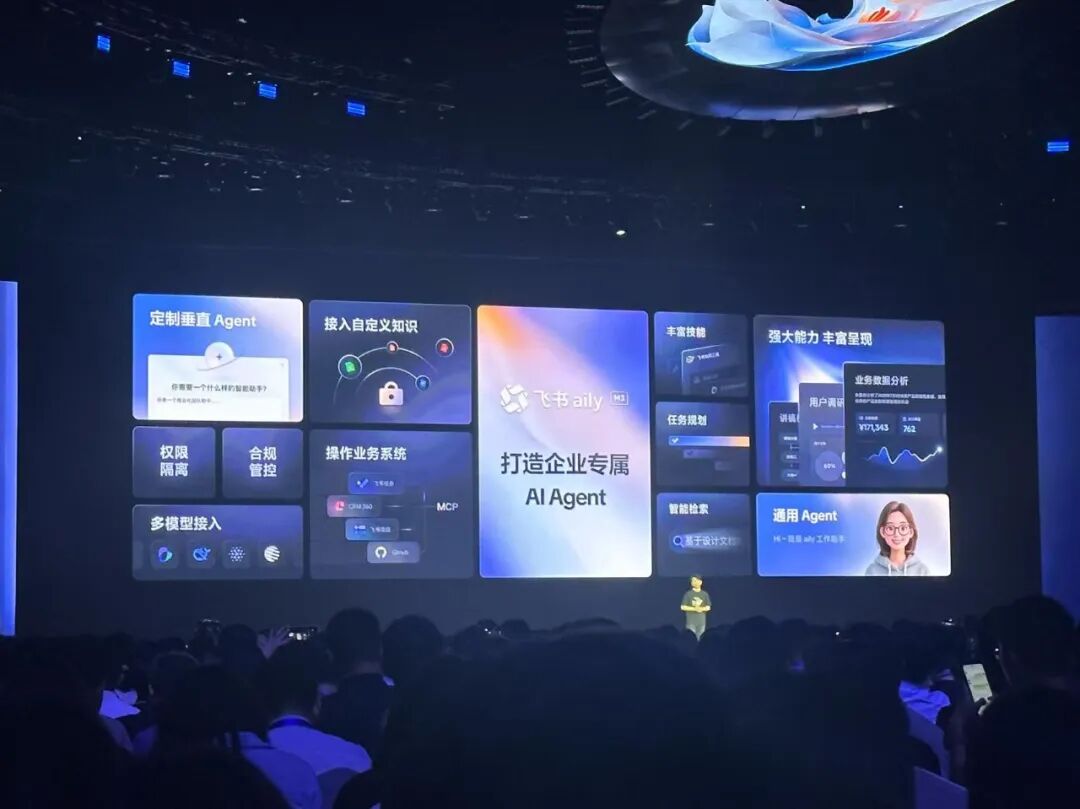
We've tended to imagine AI Agents as clever substitutes for human workers. But at Lark, Aily is fundamentally not a standalone Agent — it's the frontmost interactive organ of the organization as an "intelligent entity."
Every conversation with Aily, every response, doesn't merely retrieve answers from a language model. It threads through knowledge Q&A, cloud documents, multidimensional tables, and even deep integrations with business systems, aPaaS applications, and workflow engines — calling upon cognition and judgment that was previously scattered across the organization.
At the Aily demo booth, a Lark employee walked me through a case study. Take Vero Moda — a fashion brand targeting young women — which recently used Aily and aPaaS to build an AI coaching system that directly trains store sales staff.
For headquarters, the pain point is obvious: hundreds of stores nationwide, thousands of frontline sales associates, all selling the same garments, yet performance varies wildly. The root cause isn't attitude — it's inconsistent knowledge: How do you read different customers' style preferences? How should your pitch adapt to different personality types? Do associates even know which selling points actually matter?
Traditional training can't provide one-on-one guidance. Aily can.
Vero Moda used Lark's aPaaS to drag-and-drop together a practice portal for associates. Employees click in and enter a simulated scenario:
- The AI plays customers of various personalities, throwing out different questions and reactions
- The associate speaks with it, attempting to close a sale
- The system gives real-time feedback on pacing, emotional control, whether key selling points were hit
- Associates can even record a video self-assessment, with AI scoring it point by point
This isn't just a "chatbot companion" — it's transforming previously tacit knowledge and techniques into a replicable sales coaching system. Frontline stores, once beyond the reach of human resources, now offer employees private-tutor-style guidance and support.
And for headquarters, this system doubles as a "data window": Which associate pitches prove most effective? At which moments do customers most often drop off?
Without relying on reports or edited documents, the organization gains immediate, direct perception of frontline execution capability.
Is this the embryonic form of an "AI-native organization"?
Not merely introducing AI tools, but having AI participate in perception, feedback, and judgment — becoming an extension of the organizational consciousness layer.
Feishu Miaoda: Everyone Can Build Products
Keywords: system generation, role transformation, everyone is a Builder
At today's Lark conference, what made me want to try something immediately wasn't how powerful some AI feature was — it was hearing an operations person stand on stage and say: "I built a business system with one sentence."
"Defining processes, building systems" — inside companies, this has historically been the privilege of product managers and engineers. You had to write requirements documents, draw flowcharts, break down logic modules before a system would run the way you wanted.
But now, in Feishu Miaoda, this can become one person saying to AI: "I want a tool that can filter KOLs and auto-generate quotes."
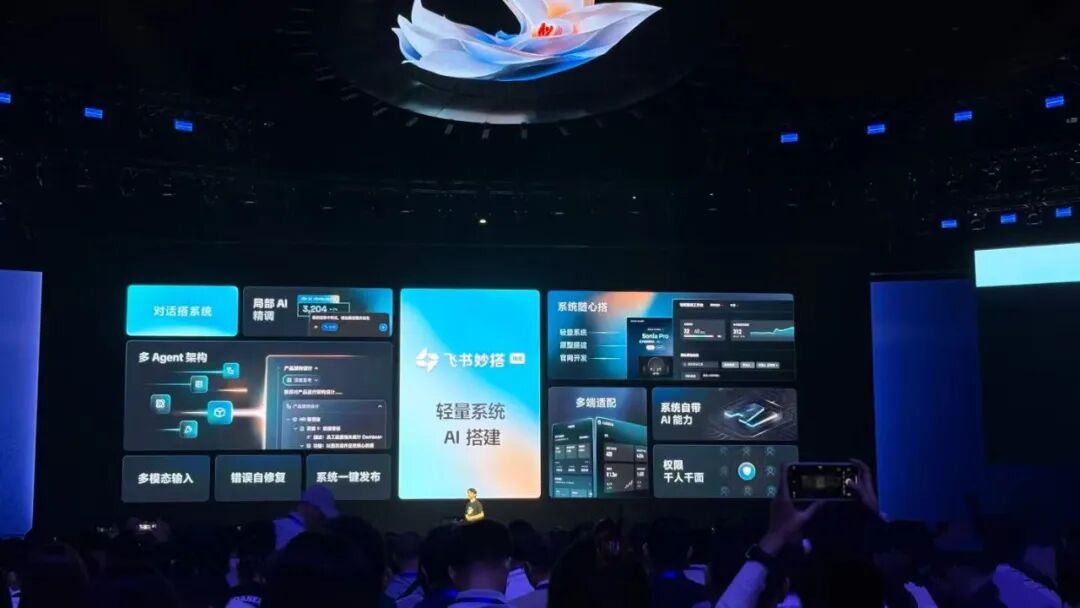
This is, of course, first and foremost a cost-cutting, efficiency tool.
But as someone without a technical background, I couldn't help feeling a quiet thrill at this signal of loosening technical power structures inside organizations.
Technology no longer needs to carry its natural barrier to entry. People who understand the business can now possess the power to define systems.
It means that within organizations, we can reposition "who I am."
I'm no longer just an operations person, a finance person, a marketer. Everyone can co-create a product with AI, can turn an idea into reality without writing a single line of code.
This is the democratization of system capability.
And the most foundational infrastructure of an AI-native organization: when everyone is a Builder, the organization can evolve into a true intelligent agent.
Multidimensional Tables: Knowledge Becomes Product
Keywords: structured expression, permission flow, productized organizational knowledge
Lark's new application mode for multidimensional tables answers one question: How can organizational knowledge not merely sit in storage, but grow into systems that can be called upon?
Many companies face similar predicaments. Documents go unread, processes exist but go unused, collaboration feels like stacking blocks that collapse with each rebuild. Tables are mere containers, knowledge mere attachments — organizational capability never accumulates, let alone invites AI participation.
With this update, multidimensional tables can be assembled into "systems" like building websites: you can set navigation, permissions, interaction flows; determine who sees what, who changes what, and what happens after a change. Clear structure, explicit rules, reusable behaviors.
This enables a shift: organizations no longer rely on "people remembering processes," but transform processes into things "that can be expressed, called upon, and executed by AI." Like translating company "conventions" into code, then handing them to systems or agents to handle.
This also changes how people work. Individuals are no longer mere form-fillers, but "designers" of knowledge products:
Turning experience into templates, judgment into trigger conditions, collaboration logic into page navigation.
It sounds complex, but it's quite grounded: this is the process of "knowledge transforming from static text into executable language," the starting point for truly escaping repetitive labor and focusing on high-value thinking.

In Closing
At the Lark conference, what you saw on the surface was clearly collaboration tool upgrades. But what's genuinely interesting is how these tools are blurring the boundary between organization and intelligent agent.
The "organization" we know typically relies on structure, process, and hierarchy to coordinate masses of "low-intelligence units" — even when those units are actually individuals endowed with judgment and creativity.
But once inside the system, each person seems required to "format" themselves before they can participate in collaboration.
In this sense, "corporate beast of burden" was never mere slang — it was reality.
The intelligent-entity organization proposes another possibility: if judgment can be shared, experience can be structured, and collaboration can be called upon, then perhaps the organization no longer merely "onboards people into processes," but can absorb human intelligence, express human intent, and feedback on human behavior.
This isn't to say Lark achieves all of this today. But it shows us that the future vision of organization as intelligent agent, human as intelligent agent operator is not unimaginable.
As tools grow smarter, the question is no longer whether we want to be more efficient, but: Can we, within an organization, be liberated enough to remain intelligent?
If the answer is yes, then the term "corporate beast of burden" will one day become a historical label, not humanity's final destiny.
Image source | Unsplash