World's First Multiplayer Agent: Two Users, Three Members — Talking AI Social with Twoo Founder Xi Chen

There are only two levels of relationship: extremely close people and complete strangers.

Social | Group Chat | Non-Convergent | Relationship Enhancement
Intro
Over the past year, AI media has covered plenty of social and community products, mostly framed around using AI to improve distribution and matching efficiency. But one persistent problem remains unsolved: the trust chain.
The basic unit of a social network is a line connecting person A to person B. Yet trust doesn't depend on the "intelligence" of either person — it depends on whether that "line" can access genuine context. In the first half of this year, AI companions and avatars saw a wave of shutdowns, driven by exactly this failure: without real context, social interaction becomes hollow.
In the past six months, a different branch of AI social has emerged: "multiplayer AI" — bringing AI into shared conversations between two people or a group. Eugenia Kuyda, founder of the AI companion app Replika, launched Wabi with this premise: multiple people sharing one AI assistant, with threads opened to partners, family, or friends, where the AI handles scheduling and life logistics.
We recently spoke with the team behind a new product called "Twoo," also exploring group-chat AI. "But globally, no product matches our form factor," said Xi Chen, Twoo's founder. "It qualifies as the world's first multiplayer agent."
Twoo's typical scenario: two people — say, a couple — enter the same chat window. Besides the two of them, there's an AI character: a little octopus. It helps the pair set daily reminders: change the water filter this weekend, take the cat for vaccines, have property management fix the toilet light. When seasons change, they can discuss which day to pack away winter clothes. Before picking up the kid from school, they can quickly sync schedules.
None of these tasks are complex. But they require constant information exchange, confirmation, and mutual prompting. Information used to scatter across different people, conversations, and timelines, with one person ultimately absorbing the coordination cost.
"What we're doing is enhancing existing relationships," Chen said. In his view, past social products solved the problem of finding someone to connect with, but not the problem of how to actually get along after connecting.
Chen is from Guangdong. He graduated from Sun Yat-sen University's mathematics department, then earned a master's in math at the University of Chicago. After graduating in late 2010, he spent five years in New York doing quantitative trading: ADR statistical arbitrage, "roughly two to three hundred million USD in daily volume." But he quickly realized he didn't love finance. He preferred games that were "sufficiently challenging, with outcomes that just cleared the excitement threshold."
Riding the mobile wave, he returned to China and founded Chuiyi, a men's subscription e-commerce platform that curated complete outfits, solving the pain point of male shopping indecision. Someone skilled at studying system mechanics and quickly finding exploitable bugs, Chen believed new e-commerce platforms could "collect personalized feedback to optimize upstream supply chain structure, then use subscription plans to flatten inventory tides and demand fluctuations in apparel."
But the game soon turned mediocre. As e-commerce infrastructure improved, platforms like Taobao and JD.com made returns and fulfillment increasingly convenient. "When I saw myself getting killed by a more infrastructure-level macro variable, I understood what dimensional reduction strike meant." He decided to leave the company — "If I wanted to make money, I could always go back to quant trading."
He began thinking about what would genuinely excite him: sufficiently large (just past the threshold) × difficult × fair and inclusive (the weak benefit). "Purely doing a business doesn't really motivate me."
Twoo is his second venture. The challenge: using AI to build an entirely new social platform. "This time I absorbed the lesson from Chuiyi — absolutely no productivity tools. The big platforms will definitely do those. User loyalty is paper-thin. I don't want to fight another unwinnable war."
When AI Nao met Chen last year, Twoo was targeting the companionship space. After a period of testing, the team found their most engaged users were parents and children. They pivoted to "using AI to enhance relationships between people." "After switching to the shared-by-two scenario, our customer acquisition cost dropped by half," Chen said.
(Chen previously won AI Nao's Shanghai Hunting Night with an early prototype of Twoo called "Lipu." The World Belongs to the Cute: 7 Unserious Projects and 3 Global Premieres | AI Nao Hunting Night Shanghai)
Twoo officially launched recently. During testing, users averaged over 40 minutes of daily usage, with 68% next-day retention. The company has secured early funding from IDG and other institutions.
Twoo plans to add convenience-oriented daily service skills and a data ecosystem built on user context. For example, it recently integrated Amap, creating seamless handoff between couples discussing "where to eat" and "let's go now."
Currently, three possible paths are emerging for AI entering social spaces. First: AI becomes a foundational feature of existing social platforms, like WeChat + AI. Second: AI joins as a new character, like Shapes in the United States, where AI characters enter conversations — essentially Weibo with AI personas. Third: Twoo, which takes a specific, defined relationship as its unit, organized around shared memory, interaction, and tasks, solving the problem of making existing relationships easier to maintain.
Which route becomes mainstream remains unclear — it involves questions of moat, experience, and business model. For Twoo, the biggest challenge isn't whether it can help users complete chores, but whether users will still want to stay after the novelty wears off.
Below are Chen's reflections on the multiplayer agent.

- Xi Chen during his quant trading days in New York

- Xi Chen at AI Nao Hunting Night in May this year
"Eight Questions for Xi Chen"
AI Nao How do you define Twoo? Is it a social product, or an AI tool embedded within a two-person relationship?
Xi Chen To be precise and accessible: we're "Doubao for two" — that's actual user feedback. Through extensive user research during testing, we found Twoo is actually displacing users' Doubao time, not WeChat time.
Previously, users would chat on WeChat, then switch to Doubao to look something up, then paste the result back into WeChat. Now on Twoo it's one-stop: the two people chat naturally, and the little octopus (third member) handles the AI part. Sending messages and querying AI become a single action.
Many users don't even realize we're an AI product after using Twoo — and we're happy about that.
AI Nao Twoo still requires downloading, then inviting another person in? Some critics argue this is a pseudo-need: the extra maintenance effort exceeds the product's benefit.
Xi Chen I've seen those comments. My first reaction wasn't to debate right or wrong, but to note what kind of discussions I enjoy. Quality discussion requires sufficient shared information foundation on the same subject (e.g., actually spending time using a product before discussing it), then debating the non-consensus parts (positioning, feature design details).
To the question itself, the crux is "extra effort." The users we're "capturing" actually save effort by using Twoo, because "chatting with the other person" and "using AI" become one action. So people naturally move certain conversations to Twoo.
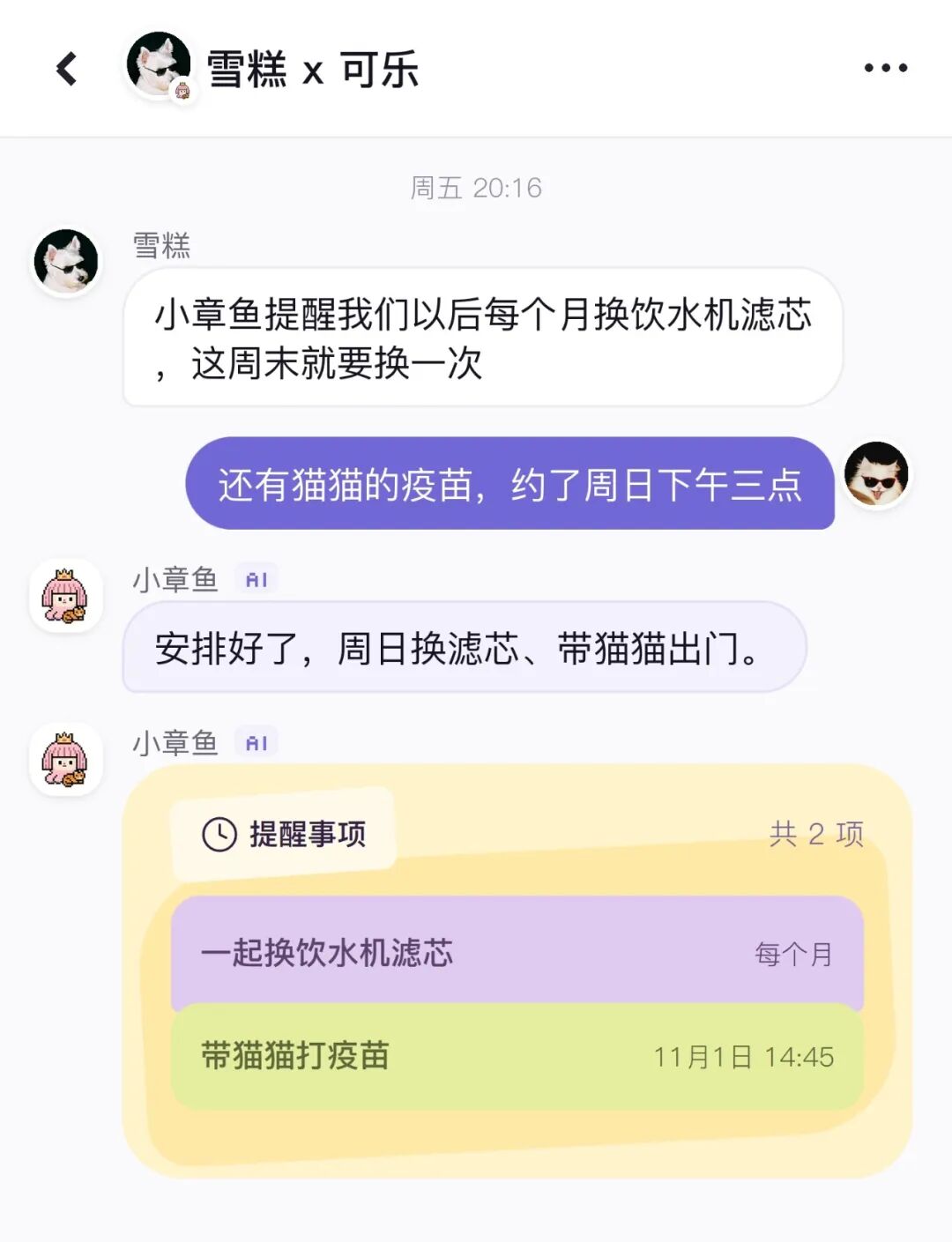
AI Nao Two people plus one AI (the little octopus) — what new experience does this actually create?
Xi Chen The two-people-plus-AI form couldn't exist before AI. It's an entirely new product category, because it's neither private chat nor group chat.
It's not private chat because the AI adds externality. Relationships need externality — external information. Even just for conversation, when topics run dry, you need things to talk about.
It's also not group chat. Traditional group chats with more than two people have safety concerns. But adding one AI that only serves this specific relationship, with context existing only in this chat window — that's different.
This is where we diverge from all other AI social products: nowhere in the world has there been intelligence that serves the "relationship" within a social network.
Serving "people" pure and simple — today's base models can't do it. Because social interaction is an open proposition without goals; the agent doesn't know what problem to solve, so it can't simulate a complete, believable "person."
Serving specific relationships — father-daughter, mother-son, romantic partners — AI can do well now precisely because the goal is convergent. Asked to serve only one relationship, within limited, genuine contextual dialogue scenarios, it won't socialize on your behalf or make other decisions for you.
AI Nao Why do users keep using Twoo? What have you observed?
Xi Chen First, we have some tool-type skills. The most used is reminders. No product before let you set a reminder for someone else. Reminders are tool-like, but once you set one for the other person, it becomes a social interaction.
An interesting observation: 30-day retention for users who use the reminder function is 2–3x higher than for those who don't.
Another skill is tarot cards. Solves the problem of running out of things to say — draw a tarot card. Because it has context, the reading is accurate. After drawing, the two people have something new to discuss, generating fresh contextual information.
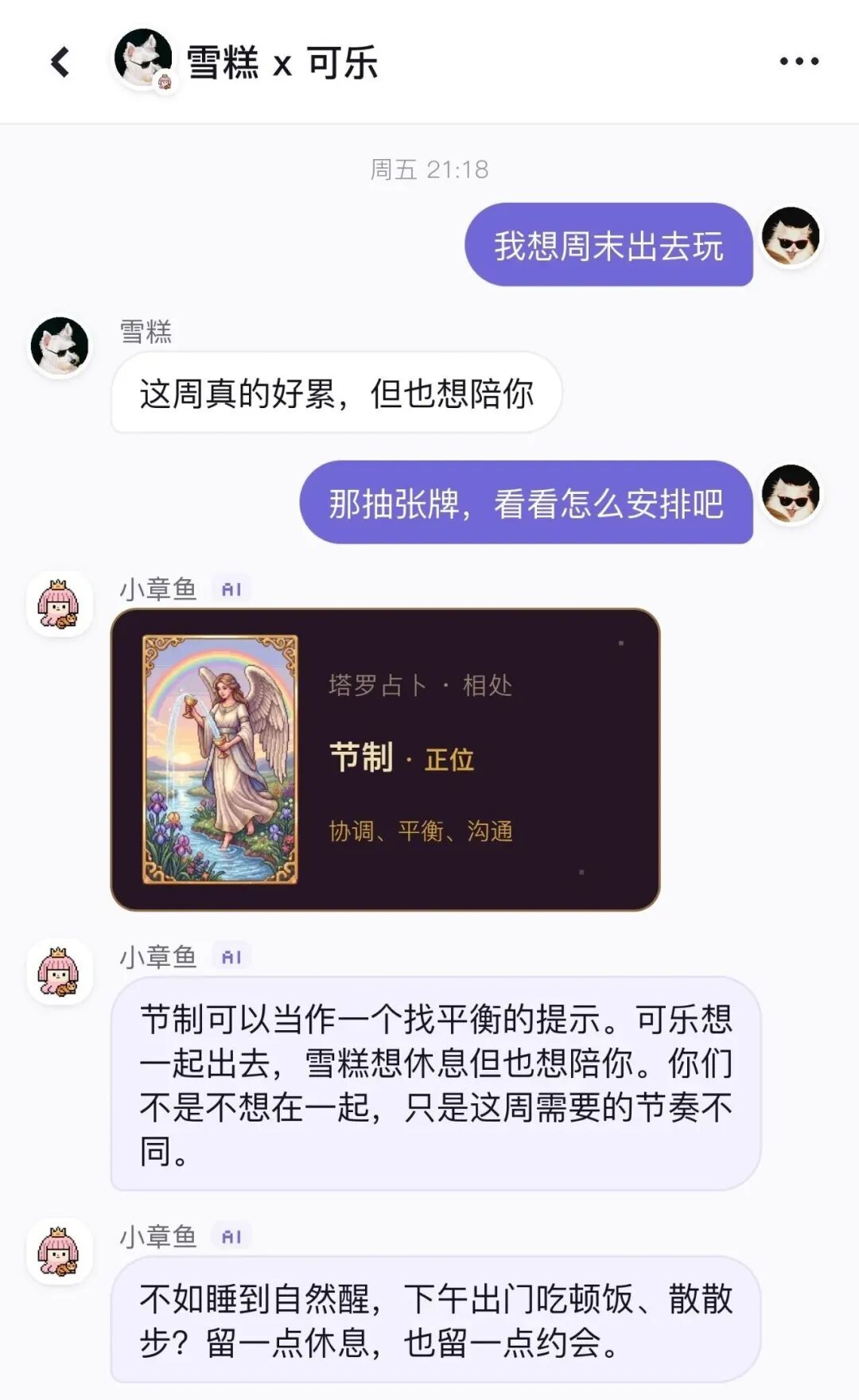
So-called personal agents are all trying to get permissions. We get them directly through conversation.
Here's a real scenario: a woman tells a man "I got my period." The AI first messages the woman: stay warm. Then cues the man: remember to bring her brown sugar water on your way home from work. The woman's emotional needs are greatly satisfied; the man feels relieved too.
The AI's role must be both functional and emotionally supportive.
AI Nao Which relationship types dominate on Twoo now?
Xi Chen 60% are real relationships — couples, family, friends. 30% are stranger relationships with "buddy" needs: prepping for CET-4 together, losing weight together. These needs have no suitable product to serve them — not even Xiaohongshu — only Twoo can fulfill them.
Interactions on Twoo are actually more pure: either relationships you deeply value, or highly purposeful collaborative relationships.
You won't find that old friend you barely talk to. Twoo fully exhibits the polarization of social relationships.
AI Nao The problems Twoo hopes to solve partially overlap with emerging Silicon Valley products like Sharp and Wabi, but your product form is very different. Is it possible you've chosen a direction that others have noticed but deemed not worth pursuing?
Xi Chen The global solution to AI social has been giving everyone an AI and having it socialize for them. Our solution is generating an AI only when users create a relationship on Twoo.
This approach solves two problems.
Loyalty is indivisible: Person B knows this is Person A's AI. So B won't tell it the truth → so it never gets B's genuine context → so it can't serve the relationship, only A.
A's AI contains everything about A: work, health, money, family, emotions. But with different people, A only shares parts. This forces A into permission management, and permission management is the classic death of social products — users won't configure permissions for every relationship.
Others haven't seen this because most are still holding hammers looking for nails. I've met many entrepreneurs who think about AI social from "how do I get my personal agent into social scenarios" — naturally leading to building a personal agent first, then figuring out how to deploy it socially. We observed from real user scenarios: where does users' social interaction actually happen? Then we asked how an agent could participate.
AI Nao Two industry doubts about "multiplayer shared AI": first, data boundaries; second, how to make money?
Xi Chen We treat anything users put in the chat window as authorized context, and users accept this naturally. Because this is a new agent, serving only this relationship, and this agent won't visit other users' chats.
Current core revenue is skins — users buying skins already covers 40% of token costs. Next is subscription, launching soon, serving heavy users, similar to a membership system. Members get access to more complex tools, letting the agent complete more tasks, including transactions: helping restock household supplies, booking flights and hotels.
AI Nao If WeChat adds AI, will Twoo still have a chance?
Xi Chen That's not how to think about it — you need a broader view. First, AI as new productive force will transform production relations.
Before WeChat, people could only maintain weak ties. Texts and calls cost money. Before phones, long-distance families barely existed. Stretching further: condoms decoupled "sexual relations" from "having children." All these point to productivity changes altering cost structures of certain things. Human relationships will certainly follow.
That's one.
Second, industry consensus holds that coding and reasoning are the paths to AGI — everything can become a program, self-iterating, self-evolving. But my question is: are all problems convergent?
Social interaction certainly can't converge — it has no goal, it's an open scenario.
Many things in the world can't converge. "Beauty," for instance — previously unmodeled because no clear payoff. But as models develop, might it become worth doing next?
That's also a huge opportunity.
At minimum, we believe social needs remain insufficiently met. WeChat solved connection, not communication. So even with someone's contact, you don't know how to start, how to maintain, how to deepen, how to get along.
We're exploring what help AI can provide on that front.
Image source | Provided by interviewee