Former CapCut China Lead Kiki Zhang Starts OJO: Which ByteDance Genes to Keep and Which to Discard

"Work backwards from the answer"
ByteDance Alum | Judgment | Middle Layer | Industry Disruption
Intro
To understand the startup predicament of 2026, you need to understand how technology evolves in the AI era.
The mobile internet had a relatively clear battle map.
Around 2011, 3G networks and smartphones made information mobile, giving rise to Weibo and WeChat. Around 2014, infrastructure like 4G and mobile payments matured, enabling real-time matching of services to people — DiDi and Meituan exploded. Only later did Douyin emerge.
AI-era technological evolution happens in leaps. 2023–2024 was infrastructure-building (GPT-4, Claude, Gemini). By 2025–2026, the first wave of applications had already appeared, and entrepreneurs found themselves building trains on moving trains.
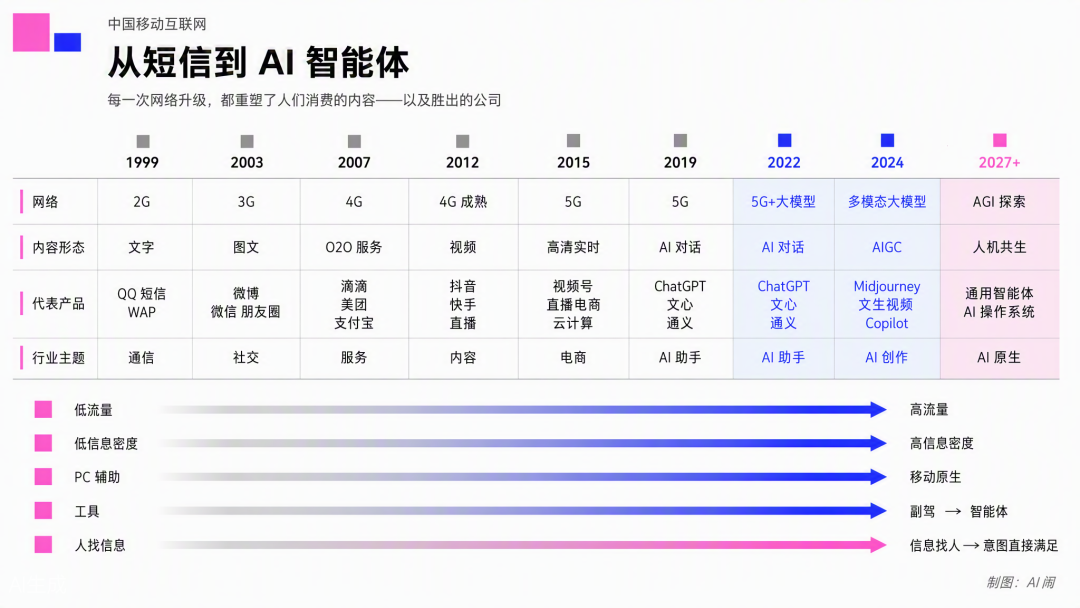
- Chart: AI Nao
There's another difference. Mobile internet solved the "last mile." AI solves "capability democratization." The moat for the former was traffic and scale; for the latter, it's a founder's cognitive barrier — depth of understanding of vertical scenarios.
When mapped to the ByteDance alumni most favored by capital markets, their advantage is that they were already riding one of the world's fastest-growing trains. They defined products and executed large-scale growth. From 2025 to now, roughly 100-plus entrepreneurs have emerged from the ByteDance ecosystem.
"When the market was good last year, ByteDance alumni could raise $2 million at angel stage. But this year applications have cooled, and valuations have been cut in half," one investor told us. After a year of market testing, a common weakness has emerged among ByteDance alumni: the company believed in overwhelming force to create miracles, but AI-era applications serve super-individuals, not two-sided markets. "You can't find new continents with old maps. Their first step after leaving to start companies needs to be self-amputation."
Zhang Qizhi (hereafter "Kiki") has a kind of "anti-inertia" — perhaps a deliberate resistance against ByteDance muscle memory. She spent eight years at ByteDance, one of the few product people to witness CapCut's complete journey from zero to over 100 million global users. Before founding her company in 2026, she was head of CapCut China, reporting directly to Kelly Zhang.
Her startup, OJO — rather than choosing the video赛道 that CapCut alumni know best and that's hottest right now — is a design decision platform.
Simply put: it lets people without professional design backgrounds have a design team at their disposal, delivering products, web pages, creative work, and design proposals. Summon "Steve Jobs" to distill product essence. Summon "Van Gogh" to set the aesthetic tone. Summon "Donald Trump" to write marketing copy.
Unlike the vast majority of "one-sentence direct output" products on the market, OJO emphasizes human thinking in the decision process. It presses users with questions: Who does this product serve? Why do they need it? And it has a built-in challenge mechanism.
Kiki believes that in an era where general models have broadly achieved capability democratization, "judgment" will be the scarcest resource. "Design isn't a high-efficiency scenario to begin with. What truly affects design outcomes is the judgment made upstream in the chain."
The efficiency gains that the industry constantly emphasizes, in her view, may just be an "intermediate state." The value large models can deliver goes far beyond efficiency. "If you only optimize around traditional workflows for efficiency, the moment models upgrade, your product instantly loses value."
A deeper layer of thinking: in the past, aesthetics were a class marker — brands that could afford big-name designers looked premium; those that couldn't were stuck with templates. Between industrialized templates and personalized design lay a gap. This is precisely what OJO aims to solve: letting ordinary people consistently produce aesthetically sound results — personal websites, creator visuals, all externalizations of taste.
OJO launched in August as a global product. Its first funding round raised nearly 100 million RMB, co-led by Shunwei Capital and Lenovo Capital and Incubator Group.
We selected eight questions.
One interesting point: on key decisions like "why start a company" and "why choose the design scenario," Kiki still retains ByteDance muscle memory.

- Kiki
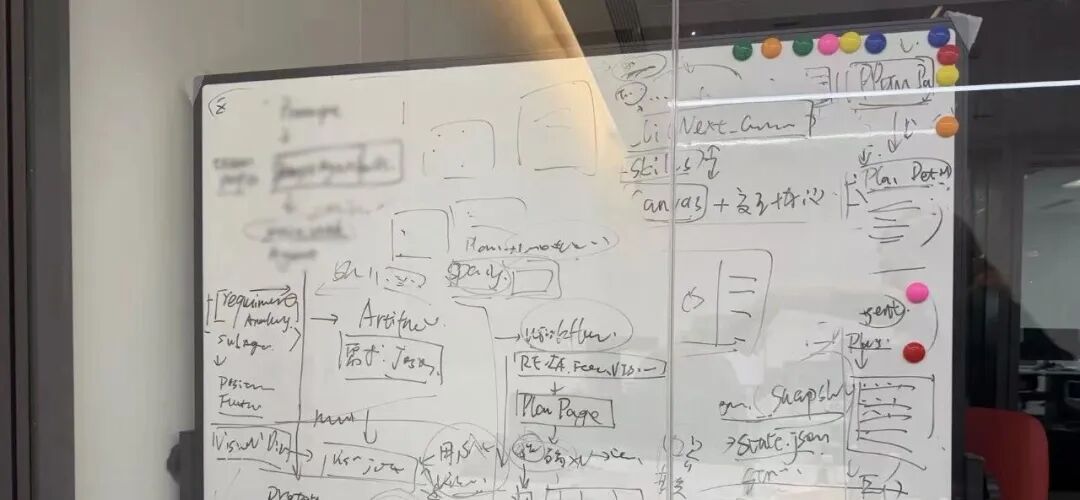
- Product derivation diagram
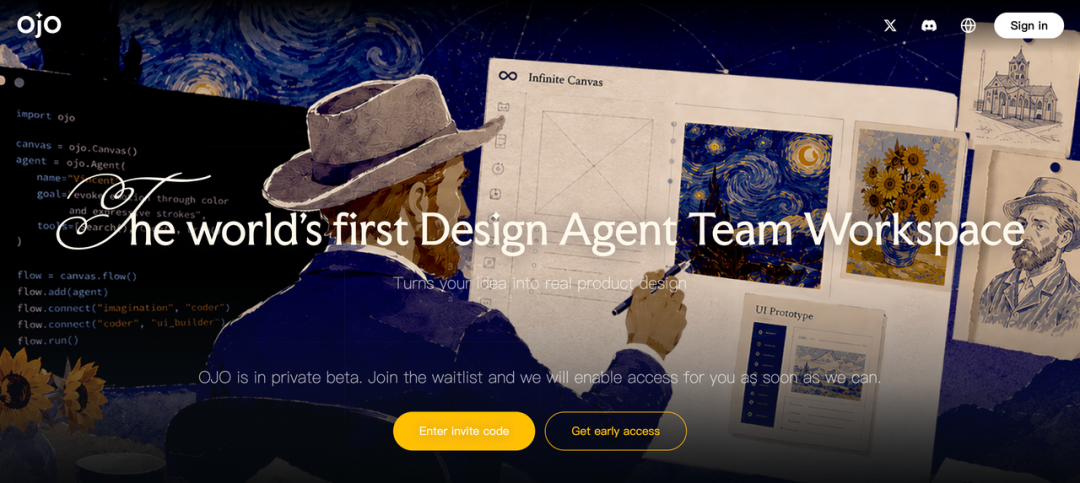
- OJO homepage
"Eight Questions for Kiki"
AI Nao Let's start with what outsiders are most curious about. In 2026, when capital markets have turned negative on "applications," you decided to start a company. What was your thinking, and what problem do you want to solve?
Kiki I actually think 2026 is a fresh starting point for entrepreneurs. In the first two years, you could explain away a lot of immaturity with "the models are still very new and early." But in 2025, you could clearly feel that model progress, especially in multimodality, was exponential. Many ideas could be realized immediately, without being constrained by technology.
So this year's entrepreneurs need to answer a new question clearly: What is your application's value on top of the model? Are you just wrapping a layer of interface and earning an efficiency arbitrage, or are you genuinely changing the original production method in a specific industry?
My experience at CapCut gave me strong intuition. CapCut's success wasn't because it had more features than Adobe. It was because the production structure of video creation changed. What used to require professional teams, professional equipment, and professional workflows could now be done by ordinary people at low cost for expression and distribution.
What truly changed was who creators were, where money came from, how teams were organized, and how work was delivered.
Looking at AI applications today, it's the same logic: applications and models aren't in simple competition. An application's real value is putting model capabilities into a specific scenario and reconstructing the delivery relationship.
This also explains why I started a company in 2026. Model capabilities reached a stage where you must answer: When capabilities are democratized by AI, what scarce value does the product provide?
For me, the answer is judgment, aesthetics, and delivery.
OJO doesn't provide "let AI generate a page faster." It helps users turn ideas into structured, aesthetic, deliverable product outcomes.
AI Nao So your starting point for solving this is: AI application entrepreneurs need to first think about what opportunities emerge after industrial structure is disrupted?
Kiki Right. If the old process itself will disappear, optimizing the old process isn't a startup opportunity — it's a trap.
The hardest part of AI application entrepreneurship isn't judging today's demand. It's judging which relationships in an industry will be broken, and how the production relationships among producers, decision-makers, and deliverers will change — that's where new product opportunities lie.
If you just stare at today's pain points, you easily end up building "intermediate state" products. For example, a niche scenario that big companies haven't served well has real demand, but it doesn't necessarily represent the future.
You avoid going deeper and deeper on a local problem, only to find the problem itself gets swallowed by model capabilities or big company entry.
I'm more accustomed to working backward from endgame. First ask: If model capabilities continue improving in three, five years, what will the industry's production structure look like? Then come back to today and find the earliest breakpoints that haven't yet been well productized.
AI Nao Was OJO derived this way?
Kiki Yes. We didn't start from "Can AI generate UI faster?" but from a more fundamental question: When professional capabilities like code, design, and content all have their barriers lowered by AI, what becomes truly scarce in product production?
Work backward from the endpoint for the answer.
Also, OJO originally came from several specific intuitions of mine.
The first was a technology signal. The starting point was last October, when we were incubating a new product inside CapCut. A colleague's prototype using Gemini made me feel it was already faster and better than some designers — this represented a major breakthrough in models' aesthetic capabilities.
The second was changes in work methods. Within our small incubation team, the boundaries between product managers, designers, and engineers were already loosening. Product managers could generate prototypes themselves. Designers could directly make interactive proposals. Engineers could participate in product expression earlier.
Design used to be a relatively downstream环节, but after AI emerged, design judgment started moving upstream, even becoming something everyone who wants to build products must participate in.
The third was my realization that many tools on the market actually conflate several things: UI/UX isn't frontend, and design isn't vibe coding. Code that runs doesn't mean it feels like a real product. A generated page doesn't mean it has clear product structure, interaction logic, and aesthetic judgment.
The recent release of our 1.0 beta version has gotten some validation. In the comments under our X announcement, overseas users directly asked if OJO could "rescue them from Figma" — they were already tired of using a drawing tool.
Users vote with their wallets. Within hours of launch, we saw clear user payments on Stripe.
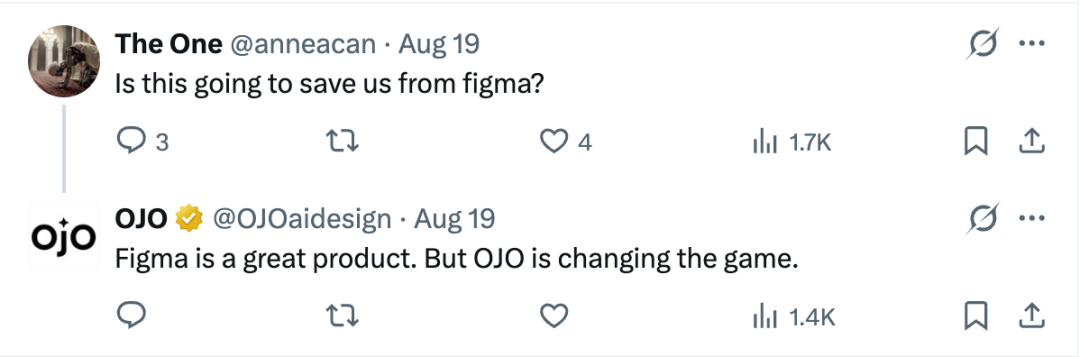
AI Nao Speaking of Figma — already the world's most successful design tool, and also undergoing AI transformation. Many people see you as an AI company challenging Figma. How does David beat Goliath?
Kiki I don't really frame this as how to beat Figma on Figma's battlefield. To build something big, you need to focus on incremental markets, not fighting over existing ones.
Figma is a tremendously great product. Much of its value comes from complex design workflows, multi-person collaboration,规范 management, and delivery alignment inside large companies. What's really paying is the organization behind it.
But people newly entering this industry today won't necessarily start by opening a complex drawing tool and learning layers, components, and interaction connections bit by bit. Just as CapCut's AI features work very well, but when users want to make AI videos, CapCut isn't necessarily the first thing they think of.
Figma solves "how professional design teams collaborate." Claude Code, Codex solve "how to implement." What OJO solves is the gap in between: how a non-professional design user turns fuzzy ideas into structured, aesthetic, deliverable product designs.
Directly put: OJO is a design decision workbench, closer to upstream — product ideas — and also closer to the layer before Coding Agents.
AI Nao How do you avoid becoming a token relay station?
Kiki The root reason many AI applications' business logic doesn't hold is that they couple cost units with value units. For example,接入 Coding product APIs with high consumption is a very heavy cost unit, but it's not actually your value unit.
This also means users can't perceive your value unit, and the business model becomes fragile: model price cuts, model upgrades, platform capability溢出 all directly冲击 your value.
So from day one, we made it clear: OJO doesn't sell tokens, and doesn't act as a model relay station.
Coding is a cost, not our value. Users can connect Codex, Claude Code for the code环节, or any stronger model that emerges later.
What we sell is design judgment before coding: why an idea holds, how product structure should be built, how aesthetic direction is chosen, how interaction logic converges, and what kind of result can be developed and delivered.
That's why we put so much effort into Agent Team, Skills, context management, and editable canvas. They're not for making models run more times, but for making models run on the right problems.
AI Nao "Design decision" is a relatively subjective thing. How do you make it into product value that users can perceive and are willing to pay for?
Kiki Aesthetics are subjective, but the results aesthetics produce are very objective. Aesthetic quality in commercial products isn't unjudgeable.
Whether a design is truly good depends on whether users are willing to adopt it, modify it, hand it to developers, and ultimately ship it.
The problem with general models is they can generate something that "looks like design," but going deeper reveals many issues: wrong structure, unclear information hierarchy, broken interaction logic, style mismatched to business scenario.
OJO doesn't help users define aesthetics. It breaks aesthetics down into more concrete processes: product positioning, user understanding, information structure, visual direction, interaction logic, motion details, industry style, regional preference.
The above is organized through Agent Team and Skills, and can be continuously modified and calibrated on canvas.
When users see what OJO produces, they'll feel in their gut: this is exactly the design I originally wanted, and the quality is better than what I'd get from one-sentence generation in a large model — sometimes cheaper too.
AI Nao What from your CapCut experience translates to OJO, and what doesn't?
Kiki First, we don't have ByteDance's deep pockets. Many things require resource consideration.
Especially when building AI products today, every user session has real model costs. Ad spend can be calculated clearly; what's hard is the "unclear" costs — the more users, the more free tokens consumed.
The growth logic for AI products is different from the past. In the mobile internet era, you might first widen the funnel, chase scale, then figure out monetization. But now you must answer earlier: Will the cost burned by users today convert to payment and retention tomorrow?
If that signal isn't clear, faster growth may mean faster losses.
OJO isn't doing large-scale投放 at this stage, nor will we do pure paid-promotion-style推广. Our strategy is to find sufficiently precise audiences, explain the product clearly, help them understand what problem OJO solves, then see if they're willing to keep using it and paying for it.
What translates from CapCut to OJO is going deep among users. CapCut's early days heavily emphasized user feedback. Many specific problems were seen and responded to. OJO's beta period is the same — we've done extensive user interviews, including domestic users, North American users, Indian users, etc. Sometimes to accommodate users' schedules, we'd have several interviews in a single weekend.

- Roughly 100+ one-on-one user interviews conducted
AI Nao The most important thing your 8 years at ByteDance taught you?
Kiki Think极致, act务实. At ByteDance, business leaders make three-year plans — we call them three-year BPs, updated every half year at a very fast pace.
As a business leader, you can't just look at today's demands, nor can you just talk about a distant vision. You must do two things simultaneously: think far enough ahead about what this industry might become in three, five years; and break that judgment back into what needs to happen in half a year, three months, today.
This methodology kept CapCut from falling behind through every market shift. These eight characters are already etched in my DNA, and they're also my entrepreneurship methodology.
Image sources | Provided by interviewee
AI Nao is looking for independent writers
If you're curious about the people and stories in the AI wave, and skilled at writing
Please contact: shizao1123@hotmail.com
Email should include: 1. Personal introduction; 2. Relevant articles; 3. Your favorite AI Nao article
Competitive compensation, professional editorial guidance
Looking forward to making noise with you