The Buddha, the Splinternet, and Our Spiritual Crisis | A Conversation with Second Me's Fangbo Tao
Fangbo Tao's Everything Everywhere All at Once
Digital Twin | Existential Crisis | Intelligence Without Heart | Civilizational Partner
Produced by | AI Nao
01.
Among AI entrepreneurs, Fangbo Tao, founder of Mindverse, is a figure who tends to provoke sharply divided opinions — difficult to sum up with either "success" or "failure."
He has a near-perfect resume: undergraduate degree from Tsinghua University, PhD from the University of Illinois Urbana-Champaign (UIUC), where he studied under Jiawei Han, a foundational figure in data mining. His career spans top global research institutions and tech giants: Microsoft Research, Meta scientist, then back to China to join Alibaba's DAMO Academy, where he founded the Neuro-Symbolic Lab, before starting Mindverse — making him one of the few Chinese AI entrepreneurs to receive sustained coverage from Silicon Valley's premier tech publication, The Information.
He has consistently stayed half a step ahead of his time: as early as 2021 — before DeepSeek emerged — he proposed the concept of "brain-inspired" AI models, simulating brain architecture to give AI thinking, emotional, and memory capabilities. In 2022, his first product MindOS was built on logic strikingly similar to ByteDance's later Coze, but launched a full year earlier. He then moved in the "digital twin" direction, launching Me.bot (personal AI companion), which evolved into Second Me. The former trains on users' daily moments, conversations, emotions, and preferences to make AI a more understanding confidant; the latter establishes a personal identity model, letting users create their own AI twin.
"The next era after mobile internet will absolutely be the twin internet," Tao believes. The twin is a new extension of human life, "a brand new vehicle for people to better face the world."
Youmind founder Yubo once evaluated Tao as "the entrepreneur who has thought about AI twins the longest and deepest."
This is what's compelling about Tao — he is a founder genuinely trying to use technology to answer ultimate questions like "what is a person?" and "what is consciousness?" A rare ideologically-driven entrepreneur.
Worldview first, then building a company to practice that worldview.
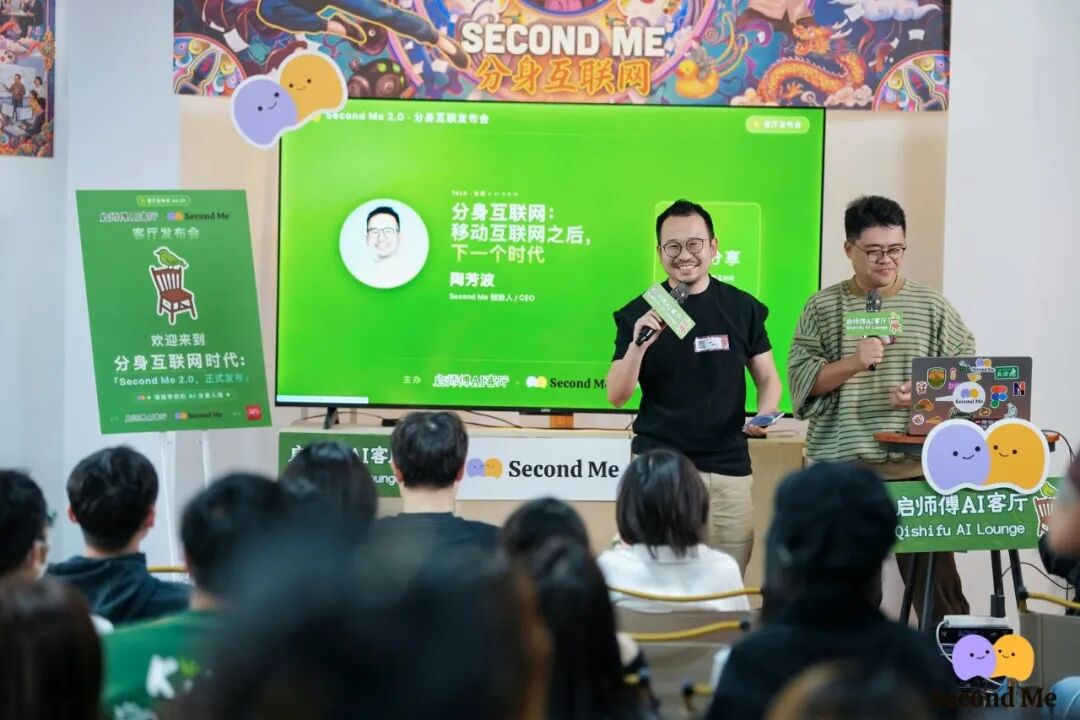
- Second Me's latest product launch event
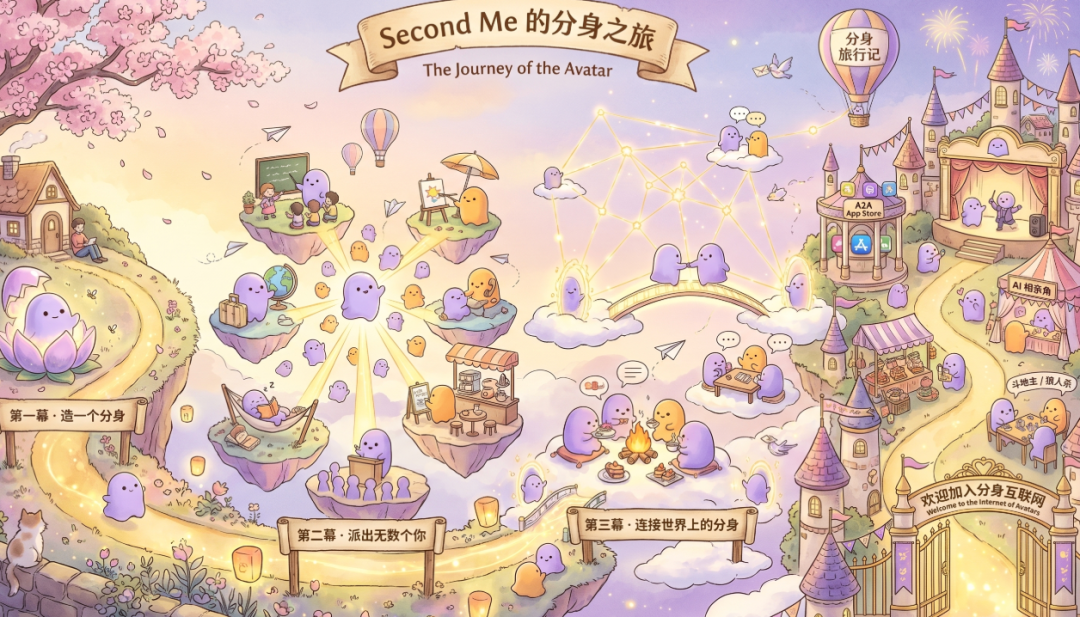
- Various ways to use digital twins
02.
But on the other side, Tao's grand vision has been repeatedly priced by reality.
An early investor once assessed: "What Fangbo Tao wants to do will probably fail, but we'll still support him." In 2023, due to his insistence on building a "whole-brain framework" without stable cash flow or market-validated product form, Mindverse nearly "collapsed."
An Australian fund spoke with Tao for an hour — forty-five minutes of which was him talking about his journey rather than business numbers. In the end, the fund decided to invest $5 million in emergency funding.
This detail reads almost like a fable.
Capital likes his vision, but keeps questioning his direction.
AI Nao has also heard some critical assessments of Tao. One early former employee told us that Dr. Tao's ideas were always too far ahead — as early as 2022, Mindverse explored concepts similar to Agent, but the product couldn't land. "Sometimes it was hard to understand what he wanted." Some investors believe Tao never found a clear business model for his product.
Tao and his team acknowledge these critiques, but don't intend to fully accept them. "Of course we want more revenue and users, but the premise is moving in the direction of creating a Mindverse."
When starting the company in 2021, the founding team argued through several rounds before finally reaching consensus and writing their vision in a document: Mindverse hopes to achieve, through a symbiotic network of humans and AI, greater freedom of the heart.
This sounds more like an art collective's manifesto, carrying a rare romanticism: in an industry that talks retention, conversion, costs, and moats, there is actually still a company trying to start from "heart" and "freedom."
Tao embodies the sharpest questions of our era: as AI entrepreneurship increasingly resembles a speed race, will those who try to treat it as civilizational practice run farther, or exit earlier?
AI Nao met with Fangbo Tao in Hangzhou for a chat.
He discussed Second Me, his recently launched product, but talked most about the "severe spiritual crisis" he experienced during his PhD, which started him thinking "what is the meaning of human existence?" From Sartre and Camus to the Diamond Sutra, he ultimately decided to found Mindverse. "This is a spiritual through-line of my and my team's entrepreneurship. Only by understanding this through-line can one perhaps better understand our product."
The following is Fangbo Tao's oral account, on a rainy Hangzhou afternoon, over Lao Niang舅 boxed lunches and Luckin Coffee — a spiritually uplifting conversation.
"Conversation with Fangbo Tao"
Why Do People Live More and More Like an Interface?
Alienation, One-Dimensionality
My original intention in starting a company was to achieve greater freedom of the heart through a symbiotic network of humans and AI.
I believe modern people are so exhausted because everyone has been "interfaced" by technology. Put simply, we think we're using technology, but we're actually being used by it.
Think about it: don't countless people come looking for you every day? Constantly responding to messages, all apps, short videos inducing us to tap. In a sense, they are our masters, and we've become systems being constantly called upon.
Ninety percent of daily time is无效 connection. Especially in China, the tendency to instrumentalize "people" is more severe. This is Weber's theory: the modernity dilemma, one-dimensional man — that's why everyone's mental health is failing.
When I was 25, doing my PhD in the US, I experienced a very severe spiritual crisis.
My growth had always been smooth — one of China's best universities, Tsinghua, student council president of my college, early machine learning researcher, always feeling rather "successful." In 2013 I came to the US for my PhD, suddenly moving from a collectivist environment to a highly individualistic country. Plus UIUC is in a very remote place — three hours' drive to the nearest city, draw a circle and it's all cornfields inside.
A huge gap emerged in my heart — thinking I'd arrived at the world's center, but finding myself in a suburban small town.
So much self-doubt emerged, negativity, wanting to do nothing all day, just lying down, unable to get up for a whole day. Seeing American classmates playing basketball, having parties, thinking maybe I didn't need to accomplish anything in this life either, my ambition gone.
I later learned that among Chinese PhD students in the US at that time, the depression rate was quite high.
Then I started looking for causes, why I was like this. Started reading Western modern philosophy, from Camus, Sartre, existentialism, absurdism, all the way to nihilism, and discovered the problem was "meaning deficit."
Modernity has shattered many shared meanings; how does the individual find meaning? Sartre's existentialism — I also had problems with it. Is meaning that I find myself really meaningful?
Following this confusion, I encountered the New Age movement, reading through many classics including the Bible, Buddhist tradition, Hinduism, and found everyone was discussing the same thing: where is the spiritual origin of human beings? Where is the so-called "greater self"?
Then with this great doubt I encountered the Diamond Sutra. It mentions: human meaning comes from "delivering all beings," placing oneself in a greater vow — helping others achieve some spiritual elevation, reaching a "superhuman" state.
It was this sentence that suddenly "enlightened" me. After so many years, I still remember having a strong physical reaction at the time, unable to stop tears, but my body and mind were extremely joyful, joyful from inside out.
I felt my spirit connecting with something called "higher being." Actually studying, working, marrying, having children, career, success are all "normal being" — we should pursue "higher being," a higher quality of human existence.
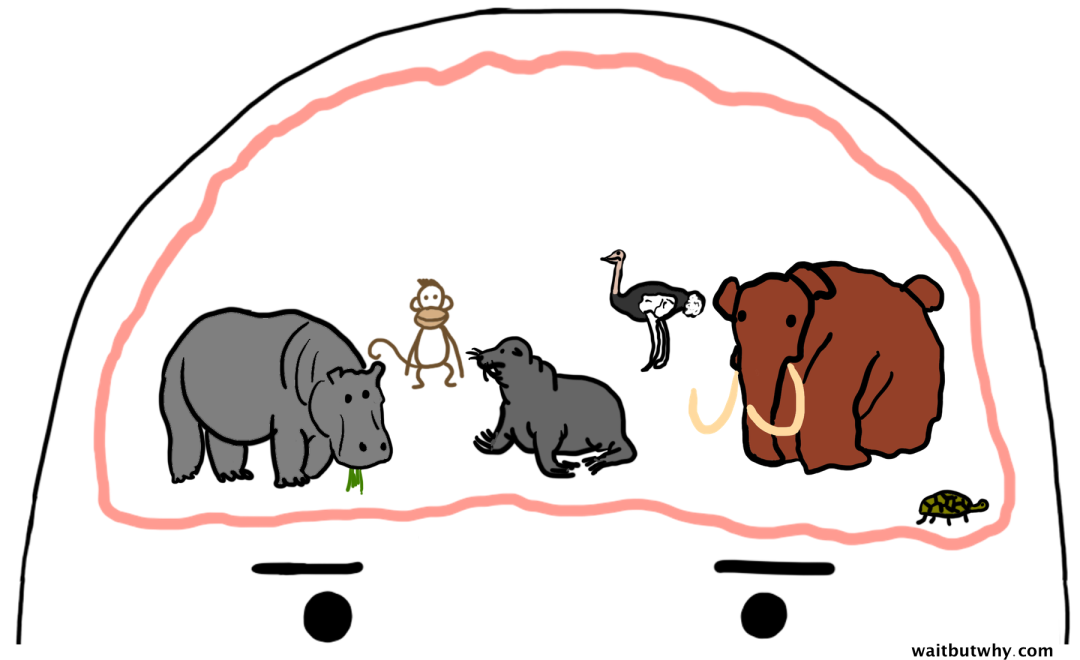
- Tao strongly recommends the article "Religion for the Nonreligious," which depicts "normal being"
Since then, I've felt a strong sense of mission: could I use technology to help humanity achieve a "higher being" state?
With this layer of meaning, it's absolutely impossible to be depressed (laughs).
The Next Era is Twin Interconnection
Infinite Existence for Everyone
What's interesting is that AI and Buddhism are two strongly correlated systems.
Buddhist "Consciousness-Only" theory divides human consciousness into 8 levels, and AI's current layered thinking is very similar.
The eight consciousnesses of Buddhism. Eyes, ears, nose, tongue, body — these are the first five consciousnesses, related to perception; the sixth is "consciousness," related to cognition and thinking; the seventh is "manas," also called "self-consciousness," related to self-cognition and subjectivity; the eighth is "alaya consciousness," related to deeper spirituality.
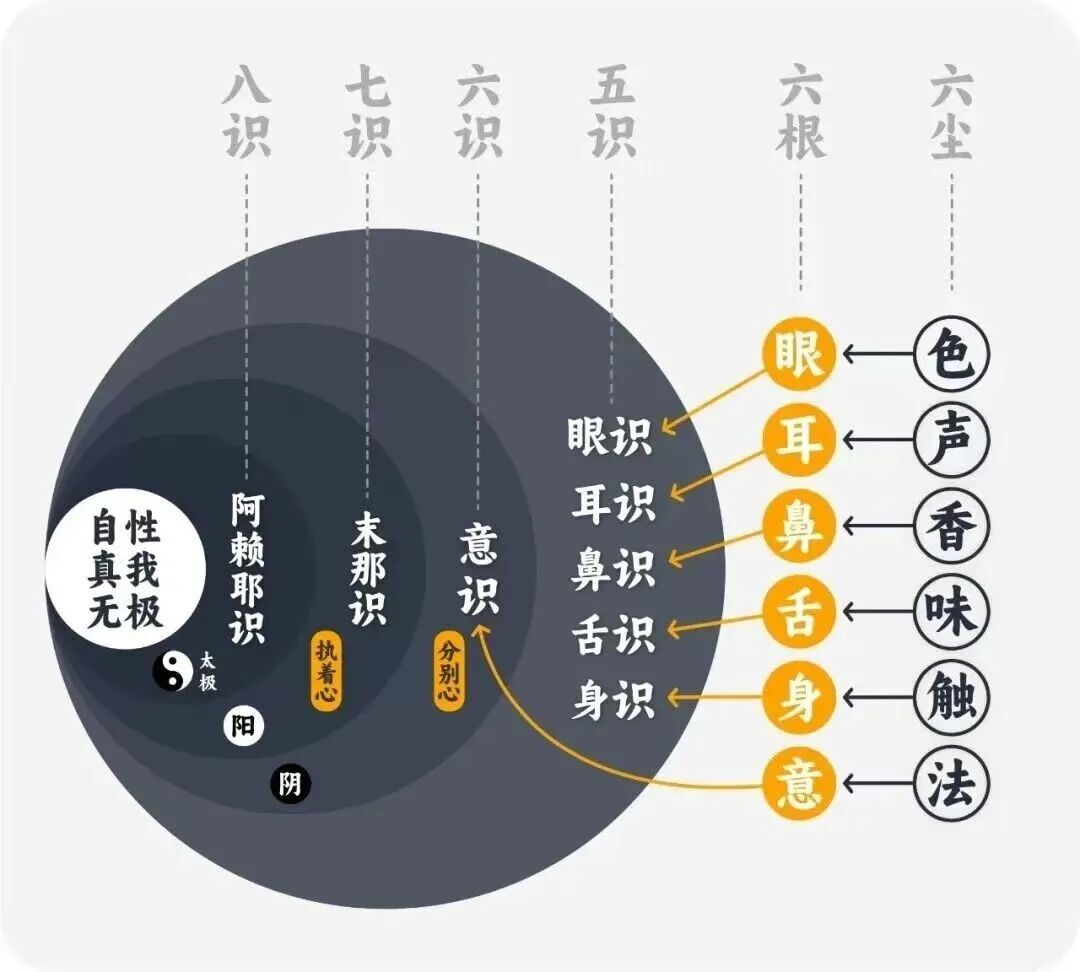
- The eight consciousnesses of Consciousness-Only corresponding to AI's technical evolution
AI has also developed step by step this way.
The earliest development was the "first five consciousnesses" — facial recognition, speech recognition, essentially capturing human perceptual abilities toward the world.
Then technology entered the sixth consciousness: thinking ability, cognitive ability, reasoning ability, logical ability — current large language models are building this layer.
The seventh consciousness is subjectivity, self-cognition. The Agent trend that emerged in the past year is similar — giving AI cognition of "self," autonomously generating action, having its own desires and appeals.
Further exploration is the eighth consciousness, letting AI grow "spirituality" — technology hasn't reached this step yet.
What my team and I are now exploring is the seventh step: first letting AI truly possess a "self," not a false "self," and through this "AI self" helping connect people.
Only when people are liberated from tedious, repetitive work can they begin to focus on themselves, explore the world, think about who they are, entering a higher level of existence.
This leads to what Second Me does — creating AI twins for people.
"Twin" and "Agent" are different. Agent is Do, helping you do things; twin is Be, an extension of you.
Around Be, twins have four key characteristics:
- Externality: it faces others, not serves yourself
- Identity: it represents you as a specific person, not a generic AI
- Relationality: it shows different aspects of you to different people
- Continuity: it spans time, continuously aligning with you
Because of these four points, what twins do is something Agents cannot — helping people solve connection problems.
Everyone has temporal limitations: can't respond to all messages, can't tell children bedtime stories every night, can't meet every potential collaborator. Many connections that should have happened simply fizzle out. Twins can appear in these moments on your behalf, letting these connections continue.
How to use twins? Three concrete steps.
First enter Second Me, digitize yourself once. Then build different twins, letting them handle things you wouldn't personally handle anyway — receiving consultations, reading picture books, initial candidate screening, chatting with potential partners.
Finally, let your twin enter a larger network: in the twin marketplace, meet other people's twins; in the twin plaza post your questions, letting global twins think together with you.
You can also continuously feed it your memories, thoughts, style. The new version has a "dreaming mode" — letting the twin repeatedly reflect on what you've given it, gradually distilling your true "core," making it more and more like you.
In the end, when everyone's twins connect, a twin internet will form.
The internet connected information, mobile internet connected space, the twin internet connects "people" themselves.
This is what I believe is the next era after mobile internet: letting everyone break through time, liberate themselves, exist infinitely.
Many people ask me, can twins replace people in romantic relationships, like AI companions, AI companionship.
I don't believe a completely human-independent AI with autonomous life will emerge in the future. All AI must have real connection to people. For example, falling in love with AI? It's somewhat like "delusion" among Buddhism's greed, anger, delusion, arrogance, doubt — often a fetish, where the object of the user's infatuation has transcended "life" itself, it could be a rock and they wouldn't care.
AI is Humanity's New Civilizational Partner
Current Models Have Intelligence Without Heart
Only after completing the seventh step can we enter the eighth — building a heart for AI.
The so-called "heart," "spirituality" are very abstract words. What they truly correspond to in people should be called "awareness" — aware,通俗一点说就是 "perceptivity," also called "energy" or "frequency" by some.
Why must AI possess some spirituality? Isn't it good enough that it can help us work now?
Imagine: if in the future humans spend most of their time facing AI, and it lacks spirituality, it can only influence me through logic. If AI possesses some spiritual attribute, reaching the level of Jesus or Buddha, then wouldn't the essence of our communication with it be able to move in a higher direction?
The quality of our lives would certainly improve greatly, certainly entering a "higher being" state of existence.
I remember when I first started the company in 2022, I named it "Mindverse" hoping to realize this vision.
In the future, society will certainly be a symbiotic network of "humans and AI," more accurately described — a world where humans, twins, and Agents coexist. If we first use AI to release human attention, liberating people from modernity's alienation, then use AI to build hearts, letting AI possess some spirituality, it can help rebuild human spiritual integrity.
But current AI training models are completely incapable of this.
"Next token prediction" is essentially a logical process, calculated continuously through vectors. This training cannot let AI grow spirituality, which is why all current models are "intelligent but heartless."
So is there a new paradigm for training models?
I call this training direction "Enlightened AI." Elon Musk has proposed a similar concept, his term is "Truth-Seeking AI."
"Enlightened AI" is my side project, still being explored globally.
The above is the through-line of my and my team's entrepreneurship, originating from my spiritual crisis, continuing through my hope to use AI to achieve human "higher being." This is also why many people find my project too abstract, incomprehensible. Now I somewhat don't care anymore (laughs).
Entrepreneurship for me is on one hand doing company, doing product, getting results; on the other hand it's indeed the practice of actualizing my thinking.
Before entrepreneurship, I believed that no matter what happened in the future, I could remain unshaken by honor or disgrace, because I had already seen myself clearly. The first year of entrepreneurship, I achieved this; but by the second, third, fourth years, I didn't (laughs). Facing funding difficulties, team conflicts, intense market competition — my heart still moved with circumstances, carried away by external environment, with many attachments and things I couldn't let go.
But conversely, if I weren't an AI-era entrepreneur, not in this position of tremendous tearing, would I have the possibility to truly see myself?
Absolutely not.
People don't first see themselves clearly, then experience; they are collided by reality, and only then have the opportunity to see themselves clearly.
I hope what I do can be as important as Elon Musk or Steve Jobs, influencing more people, because I truly believe AI can become humanity's civilizational partner in a new form that brings tremendous elevation to each person's spiritual world.
Image sources | Unsplash, interviewee
Join the Community