Exclusive | The Entrepreneur Qi Lu Praised for Having the Most "Silicon Valley Product Sense" Wants to Redefine the World Microsoft Built

At the 72-hour mark of MiraclePlus's Fall 2025 Demo Day, AI Nao secured this star project's first public exposure.

By Zhang Zhuo | Produced by AI Nao
Intro
When someone says they want to disrupt Microsoft, you think they're talking big.
When this same person tells you they dropped out of college and later taught themselves to become a product manager and developer, you figure they're delusional.
And when they add that the reason they left school was "loving street dance too much — needed to run my own dance crew" — you're certain something is wrong with this person's head.
This is the basic profile of Zhang Haoran: an atypical founder background, two startups, both backed by MiraclePlus. Qi Lu has praised him internally on multiple occasions as the founder with "the most Silicon Valley product sense."
He broke into the industry through product interaction design, spent over a decade building productivity tools, lived through the full arc of the mobile internet boom, started his first company in 2020 focused on MarTech SaaS, sold that business, then joined Lark in 2023 to lead no-code and workflow engine development.
In the winter of 2024, driven by "not wanting to miss AI," he jumped back to the front lines, serving more than ten companies going global with AI implementation, and helped design several Agent applications including the Fellou AI browser.
In the summer of 2025, he launched his second startup: an enterprise-grade Agentic productivity tool called Agencize.ai.
He previously shared on AI Nao's AI Practitioners how he evolved from traditional RAG and workflow orchestration to personally architecting complex Agent ecosystems in the AI era — the lessons and war stories along the way. The Founder Qi Lu Called "Most Silicon Valley Product-Minded" Shares: Four Foundational Product Capabilities Every AI Native Needs | AI Practitioners
Having built full-stack from the ground up, Zhang holds many unconventional views on product.
When chatting with AI Nao, the words he mentions most are "different" and "obsession." He believes what's most scarce in the AI era is "making products that stand apart from everything else."
Taste comes partly from "long-term input," partly from inner obsession — "you need a fire inside, an absolute must to build something different from everyone else." For his second startup, a vertical Agent isn't the goal. His ambition is to "create the next AI-native way of working, the way Microsoft created Excel and kicked off the software era."
AI Nao secured the first exclusive on this star project, 72 hours before MiraclePlus's Fall 2025 Demo Day. This is Zhang Haoran's first detailed public walkthrough of his new product "Agencize."
The Agencize beta launches December 7 — MiraclePlus Fall 2025 Demo Day — with the official release planned for April 2026. Zhang's target is hitting $1 million ARR in 2026, and regardless of subsequent growth, keeping the team at three people.
We've distilled nine of Zhang's sharpest perspectives, including his thinking process, non-consensus explorations, and predictions for what's ahead.
Small easter egg: After the interview, Zhang talked about convincing his parents to let him quit college because of his passion for street dance. At the time, he thought: "If anything could make me give up dancing, I'd absolutely become top-tier at it." — meaning he couldn't imagine anything that could make him quit. Obsessive personality. "Turns out I soon got obsessed with building products, and that's lasted to this day. Street dance is just how I decompress from startup stress now.")

- Still a street dance kid in 2013
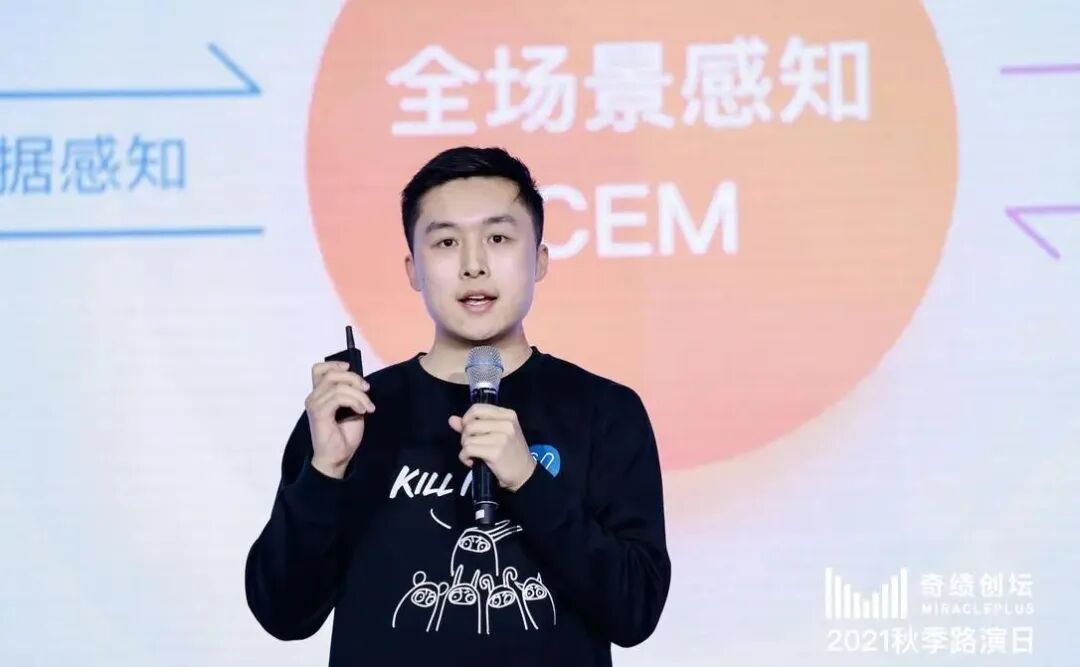
- First startup pitch at MiraclePlus in 2021
Key Perspectives — NOW!
1. All Agents with pre-built workflows are wrong.
Zhang Haoran: In October 2024, while helping a client implement AI in Shenzhen, a question suddenly hit me: if reasoning is already dynamic, why are products and processes still fixed? That was the first time I had the idea for "living software" — software that adapts and evolves based on demand.
I immediately reached out to Xie Yang at Fellou. Turns out we were thinking along similar lines, and he was already executing on it. Then I rushed to validate against real client scenarios — it worked.
An important validation came out of this process: many organizations have been suffering under pre-built workflow models for a long time.
From this I hold an extreme view: every Agent built in advance through hyper-complex orchestration and rigid frameworks on the market today is wrong. Unfortunately, I barely see any peer building an Agent that can grow organically during the process itself.
So after six months of thinking and case validation, I started my second company in June this year — an enterprise-grade Agentic productivity tool called "Agencize.ai."
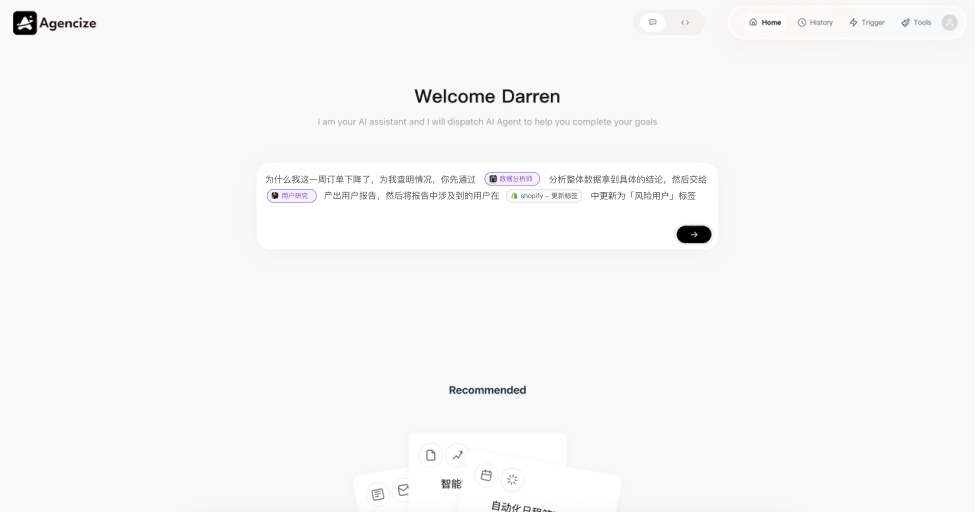
- The new product Agencize uses natural language to directly drive task completion
2. Software should be "alive" — growing organically through the work itself.
Zhang Haoran: The first principle of enterprise SaaS procurement: either deliver end-to-end completion, or fix SOPs so junior employees can use at scale.
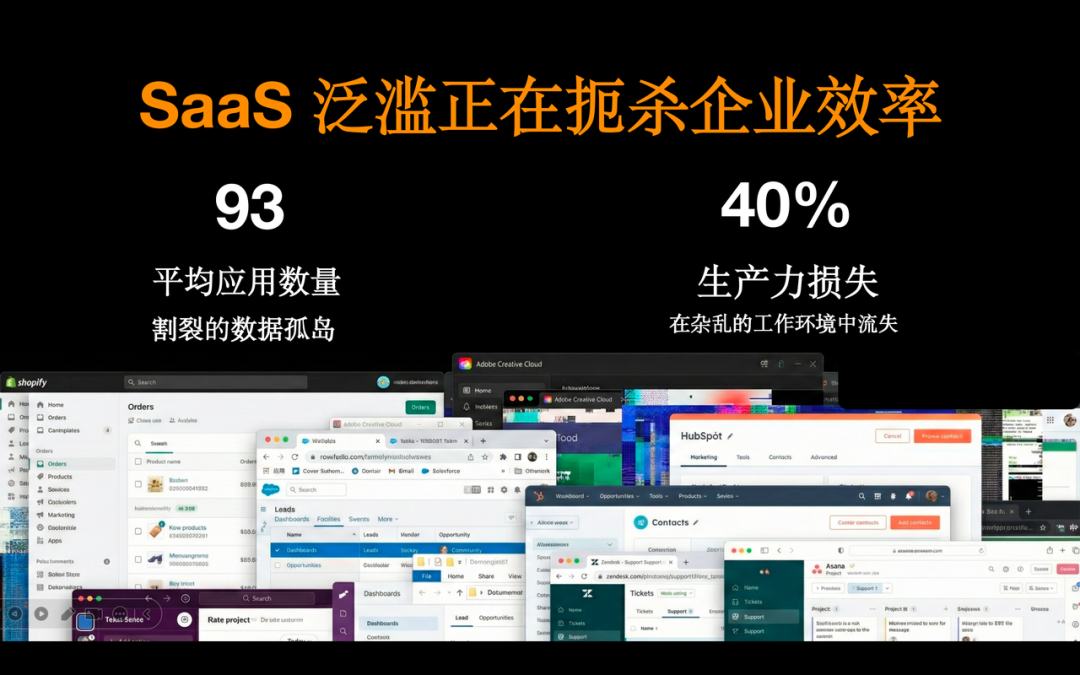
In the United States, the average enterprise buys 90+ SaaS products; each employee uses 10+ applications. Efficiency gains come with a counterproblem I call application fatigue from digital office work. Employees constantly switch between apps, moving data around, acting as human routers.
The deeper pain: companies have never truly converted the know-how in someone's head into knowledge assets. SaaS is just a static data recorder.
Based on this, I believe software shouldn't be pre-configured — it should "grow" from your actual work process.
So in designing Agencize, my build logic is intent-driven task completion.
For simple tasks, the Agent mobilizes existing internal enterprise software. For complex tasks, the Agent generates an entirely new, personalized piece of software based on your scenario.
- Zhang Haoran presenting at MiraclePlus
3. SaaS will inevitably be downgraded to data infrastructure.
Zhang Haoran: Entering the AI era, I'll put this more aggressively: all SaaS software gets downgraded to enterprise data infrastructure. I'm taking an AI-native perspective to let AI deliver more valuable outcomes.
E-commerce is a complex scenario: orders in Shopify, email marketing in Klaviyo, user behavior in GA, consumer data in CDP or CRM, logistics in ERP.
Say a global home appliance brand has plug conversion issues worldwide, and a user's shipping address, receiving address, and actual usage location may all differ. An ops person wants to email a user about plug usage — previously they'd switch between multiple apps querying information. For ten users, loop ten times. A day's work, gone.
Now, they just state their intent to Agencize, and it auto-generates a personalized software suite. The AI proactively asks: do you do this daily? Around what time?
Then their "personalized software" runs autonomously.
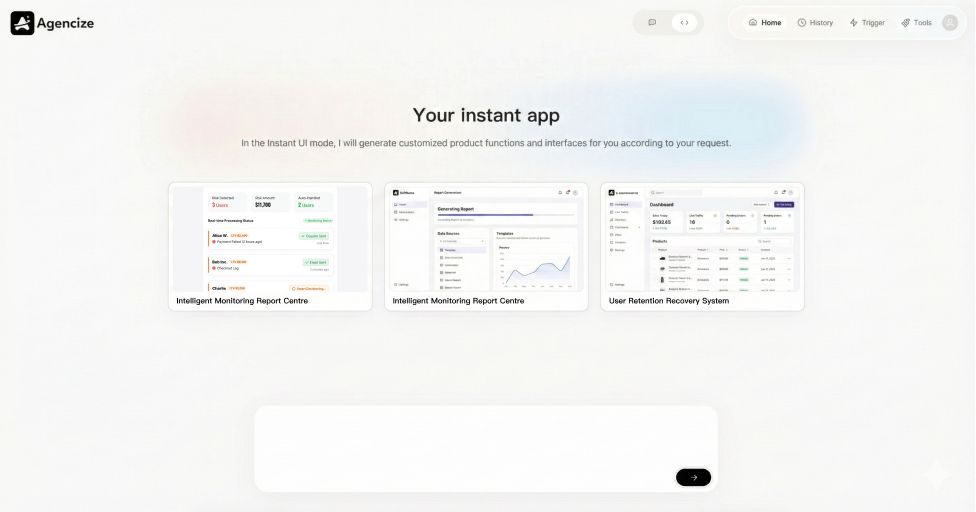
- Users describe needs and instantly generate personalized software
4. This is the first time enterprise know-how gets structurally captured.
Zhang Haoran: Because this Agent design needs to call numerous internal enterprise tools, we've done extensive testing and optimization, building out a reasoning architecture for it — how to understand business, use tools well and accurately, self-correct, etc. Unlike other Agent reasoning strategies, ours doesn't pre-generate any so-called to-do list planning. This is a truly adaptive reasoning architecture that continuously aligns with user intent.
As large model capabilities improve, this reasoning framework's accuracy, speed, and cost are all improving. Our own evaluation system's boundaries keep expanding.
Another hard problem: how does enterprise know-how get infused into the Agent? I believe enterprise know-how is process data — what AI learns about human work preferences and methods through collaboration with people.
This is also why I fundamentally reject pre-orchestrated Agent construction. It looks like converting human know-how into an Agent, but the orchestration process involves massive loss, and requires extremely high-level talent to map a truly complete, lossless workflow into AI's operating system — and you can't possibly cover all edge cases.
Know that many people inside companies simply lack this construction capability. Technical people don't understand the business; most who could build it are non-technical business people who can't orchestrate it.
The solution: we need to understand the Agent as an employee's digital twin, learning how real people work, what tools they use in decisions, studying "how real people actually get things done" through working alongside them.
This redefines organizational memory, and enables enterprise know-how to be structurally captured for the first time.
Going forward, we'll build a self-training pipeline from "process data" that can update model weights in real-time, giving the Agent true evolutionary capability.
5. Why must Agents deliver results through "conversation"?
Zhang Haoran: Most Agent products use "conversation" to deliver results. But as someone from an interaction design background, I've been thinking: conversation shouldn't be the only interaction pattern for Agents.
Essentially, the delivered result should manifest in a form appropriate to your intent — so "living" software is the best presentation form for Agents.
Planning "interface information hierarchy" is crucial in interaction design — using emphasis and other techniques to make different information influence user behavior differently. Imagine rich information flattened into linear language inside a dialogue box — massive loss.
But why is interface interaction now generally considered terrible? I think it's simply because 99% of software-era practitioners were so bad at it that people came to believe "interface" itself is bad, so we "need conversation."
Wrong. In today's attention economy, users shouldn't need to care how software works. The most efficient path: user expresses intent, product immediately assembles a perfectly adapted interface with appropriate presentation — nothing extraneous.
I believe this is far better than "conversation" interaction.
Agencize's ultimate delivery is an interface — possibly containing an app, something like WeChat mini-programs, possibly a workflow, possibly conversation. Whatever's most convenient for the user. Supporting this dynamic interface is an Agent generated in the backend, serving as the software's backend logic.
6. Build wide first, then narrow.
Zhang Haoran: This perspective came from Qi Lu.
At the time I was纠结 whether to build generalized scenarios or narrow down.
The advantage of specific vertical scenarios: I have client resources, can commercialize earlier. But in a one-on-one conversation, Qi Lu directly told me that for this product type, before finding strong product-market fit, theoretically the product shouldn't be made too narrow — because that turns signal into noise.
He was absolutely right. Once you build from a vertical perspective, future generalization requires rebuilding ~80%.
In early product stage, we should be foolish — naively洞察ing all kinds of needs, seriously researching every group's needs, building with high abstraction.
After the foolish period, when you launch Go-to-Market, that's when you lock onto very specific populations within vertical scenarios to penetrate.
AI product definition needs high abstraction (this is hard), but GTM still needs to follow business logic in finding specific early core groups and core scenarios.
7. Betting on 1 billion global knowledge workers.
Zhang Haoran: During private beta, our user profile is clear: professional individual users and SMBs.
The reason we don't touch large enterprises: many of their processes are already fixed, their employee systems are rigidly compartmentalized. Only smaller customers can't trade people for growth, so they need us more.
Returning to the origin of entrepreneurship: what's the first principle? Essentially, today you've selected a group of people — perhaps currently niche, but who will become the mainstream way of working.
I'm betting on the future 1 billion knowledge workers, because as AI develops, one-person economies and micro-economies will only multiply. When my product grows alongside these people, I gain rule-definition rights.
8. Keep the team at three people, long-term.
Zhang Haoran: The team is just two people — me and my co-founder.
We've already pushed every AI tool on the market to its limits. We're direct beneficiaries of AI productivity gains.
I handle demand through commercialization and product definition, write some code; he handles core product code and AI architecture. Going forward, we might hire one more person to accelerate growth, and the three-person structure stays permanent.
I'm using an extreme constraint — "3-person team, $5 million ARR" — to force myself to focus on product, to prioritize using our own product to run our own company, ensuring my product can better help customers.
9. We deserve to become the next Microsoft.
Zhang Haoran: The earliest knowledge workers' way of working was defined by Excel. Entering the mobile internet era, SaaS led by Salesforce defined workflows. I believe in the AI era, products like Agencize that切入 through intent + personalization will become the new paradigm.
We deserve to become the next Microsoft.
The first time I thought this, it scared me too (laughs) — genuinely got goosebumps.
But breaking down the product modules I want to build: if through our efforts we achieve them all, then we actually deserve to become the next Microsoft.
Future work may no longer be between people, but between Agent and Agent, workflow and workflow, machines running 24/7, humans retreating behind the scenes, appearing at fixed times to unblock key bottlenecks and make key decisions.
The "eight-hour workday" will likely disappear.
Image sources | Provided by interview subject, Unsplash
Recommended Reading



Join the Community