Shandong Rebel, a King Who Won't Kneel

Young people who "haven't accomplished a single thing of note, yet have already figured out how they'll be remembered as great."

Video Canvas | '97 Founder | The Table | New Paradigm

Stray Dog
In 1965, Frank Herbert wrote Dune. On a planet ruled by sandstorms and giant worms, a sisterhood called the Bene Gesserit wielded power for centuries through storytelling. They propagated the prophecy that a "Chosen One" would arrive to lead the suffering masses to paradise, while behind the scenes they manipulated noble bloodlines, breeding humanity like prize livestock.
Then one mother rewrote the logic. She convinced those around her that her son was this "Chosen One," and eventually, her son became king.
More than 50 years later, Denis Villeneuve adapted it for the screen, aiming to convey Herbert's true intention — "a warning about charismatic leaders" — rather than letting the protagonist be mistaken for a hero.
Ding Zhiyuan, born in 1997 (hereafter Julian), is obsessed with this story. But he sees its other side: how to turn oneself into a god through self-narrative. "Greatness is never discovered. It's spoken into existence."
In Julian's self-narrative: he is a small-town exam grinder from Zibo, Shandong, who fell in love before the gaokao, became emotionally unstable, failed to get into Tsinghua University, and settled for the mechanical engineering department at Shanghai Jiao Tong University. His early days in Shanghai were "like a stray dog," "every skyscraper felt like it was bullying me." The turning point came when he happened to read Chai Jing's Seeing and "cried his eyes out," deciding to become a reporter at The Paper. Later, a female colleague working in VC took notice of him and brought him into an investment firm for an internship. "Only then did I feel Lujiazui was no longer bullying me."
What follows is a story of highs and lows: there's the Mark Zuckerberg-style decisive dropout (graduating top of his class, then dropping out of Guanghua School of Management at Peking University), and the brutal gatekeeping of the old guard (being rejected for a full-time position by a partner at one firm on the grounds that he "wasn't a US returnee") — the genius narrative and the pedigree narrative running in parallel.
He knows full well that people love to hear tales of past suffering — friends who've met him in the past two years have all heard the above — and has cast himself as a rebellious, repeatedly bruised sad boy. Failing the gaokao — "the consequence of not making a careful choice against fate." Early career setbacks — "I just despised having no agency in the torrent of the era."
Talking to Julian, you always sense the shadow of Justin Sun.
He frankly admits he rather likes Justin Sun. "An evil little imp, pretty fun. He's definitely not decent, definitely got crushed by plenty of old geezers too."
To add dimension to his character, he volunteers a detail: when he graduated from university, his father, a civil servant, asked when he would take the civil service exam. He sent back a close-up of his arm: "Dad, don't you think tattoos look cool?"
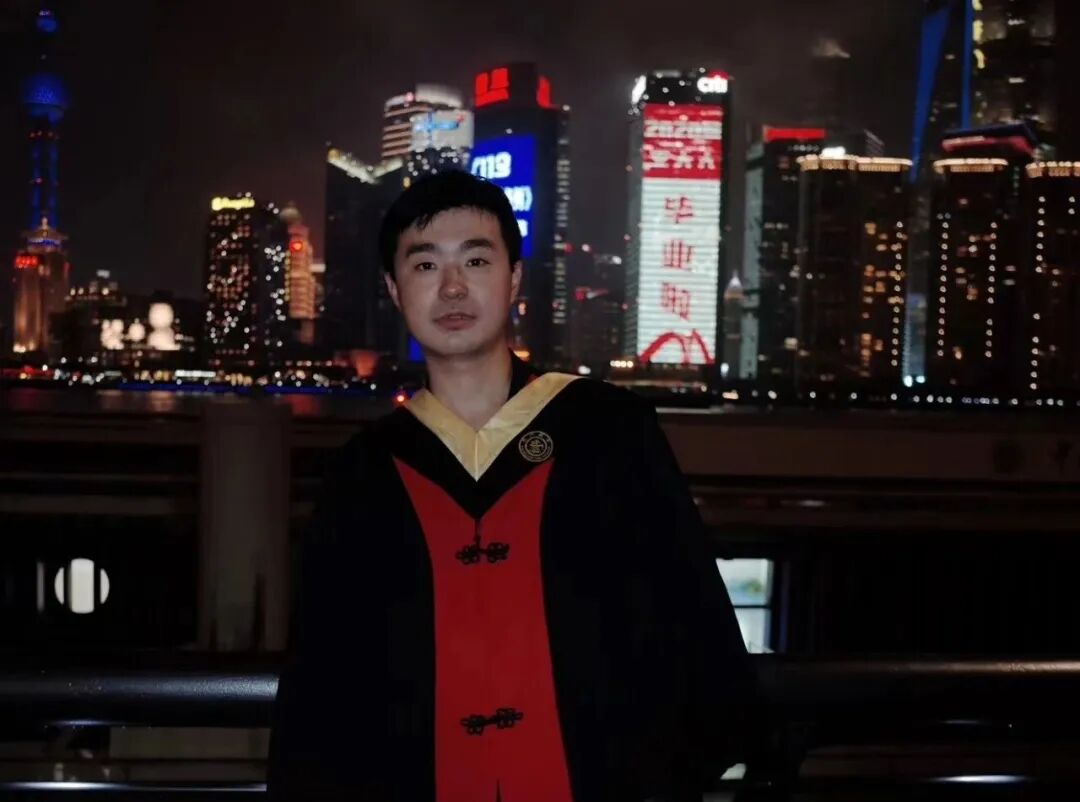
- Julian refused to take the civil service exam after graduation

- Julian went to volunteer teach in rural China. He says he rarely takes photos since starting his company, because he's gained weight
Fox
Julian has liked putting his Chinese name, "Zhiyuan," into translation software since he was young. The word it always spits out: Ambition.
By the usual logic, we'd be writing about Julian because he changed the world, or because he landed a major investment from a top-tier dollar fund — but actually, none of the above. He is simply a young man who "hasn't accomplished a single proper big thing yet, but has already figured out how to be great."
What he currently possesses is merely: six years of investment manager experience (including internships); an AI social product long declared a failure, "like an otaku boy's wet dream"; an AI chat product targeting white men in middle America, "earning eighty or ninety thousand dollars, enough to keep me alive"; and a video canvas product preparing for launch, with uncertain fate, "this one will definitely work."
In the small circle of venture capital, he happily projects a personality everyone likes: smart, passionate, sincere (or at least appearing so), ambitious. But on the other hand, he presents a sense of "not fitting in" — angry, caustic, sharp. "Because I'm sick of the utilitarian, preachy stuff. Too ugly."
His university classmate and former colleague at Meituan Longzhu, Kouki, analyzes this contradiction: as a Shandong man deeply poisoned by Confucianism and small-farmer thinking, he has the exam-grinding and mansplaining side; but he also has the Fujian side, possessing the pioneering temperament of a maritime civilization. "He can grasp opportunities for big outcomes again and again, but every time he puts on a show and throws them on the ground, with a 'I don't fucking want it.'"
"His rebelliousness does draw people's attention." Jinshi, a personal investor in Julian's first startup project, says. Her day job is primary market investing. For a time, Julian was frantically sharing his startup reflections on Jike, along with critiques and introspection about the VC circle, which resonated with her.
After brief interactions on Jike, Julian proactively DM'd her to meet, wanting to start an M&A fund with her. He also mentioned his startup project at the time. "Later, the M&A fund went nowhere, but I invested in his project. I was genuinely attracted by his 'written expression.' To be frank, I wasn't very optimistic about that social product, didn't really get it either. But early-stage investing is betting on people. A person's expression represents their cognition and experience. I was willing to vote for this person with my money."
After meeting Julian just once, in mid-2025, Jinshi decided to back his startup. "It wasn't a lot of money, wired directly to his personal account. At that time, he hadn't even incorporated a company."
There are eight such individual investors in total.
Julian believes that to accomplish great things, one must have a "reality distortion field." This ability came from working with Yutong Zhang at GSR Ventures. "She elevated my intuitive side, my perception of people, to a completely different level." Yutong Zhang is the most important boss in his life. "Sometimes when facing something, I often extract myself and channel her."
He still remembers two things about Yutong Zhang to this day.
The first interview, he was 30 minutes late. "After walking out of that conference room's glass door, she pressed the elevator button for me downstairs, rode down with me to the first floor, walked out of the Guomao building with me, and kept standing there until I got in the car."
He recalled interviewing at another VC firm, where the male partner said: "You're from Shandong, I'm from Shandong too. Work with me, and in ten years you'll become me." "I scrolled through his Moments. I thought, forget it, I definitely don't want to become you."
Another thing: "Back then, for anyone at Alibaba at P10 level and above, Yutong would note their birthday and send gifts on their birthday, even if she'd only met them once."
Yutong Zhang often reminded everyone: details determine success or failure.
So why not join Moonshot AI? In two years, his former boss has risen to become the most powerful woman in AI. "There was a period when I really wanted to prove to my former boss that I was far more outstanding. But now, I no longer care. Today, there are very few people who can still instill values in me, play daddy or mommy to me. The principle of equivalent exchange — I'm all too clear on that now."
It should be noted: everything about Yutong Zhang above is Julian's subjective narrative. His assessment of her: "Extraordinarily unique, like a fox."
The logo of one product at his previous company was a cunning fox.

Curvature Drive
Now, Julian has enthusiastically launched his third startup.
Synvas is an AI video canvas product. It aims to solve a fracture in AI video creation: generation and editing are two separate workflows, because the vast majority of products on the market are built on web frontends, essentially "frontend stores" for models. Synvas uses a game engine tech stack (WebGPU plus WebCodecs), capable of directly tapping local GPU to generate and edit simultaneously.
Julian is convinced that Synvas will definitely be a great product.
His reasoning: first, the transformation of video production methods is an era-level opportunity; second, Synvas is difficult for large models to swallow, just as no matter how powerful AI becomes, game development still can't do without Unity and Unreal Engine. "You can't just add a module to CapCut, you'd have to tear it down and rebuild"; third, he is physiologically drawn to "making friends with artists."
His plan is to move to the United States in 2027, with headquarters in Los Angeles, and eventually train his own models. "We serve the A24 of the AI era."
Synvas has opened its first funding round. "Only planning to raise one round in Asia, the second round will be in the US."
Jinshi's second meeting with Julian was about this product. "His first startup's social product didn't really meet expectations. He later made various B2B attempts. Early this year he told me on WeChat he was starting a new project, proactively offering that my investment would carry over to the new project, and said he would send me a memo reviewing the past. After some time I asked where the memo was, and he changed the subject. He told me about the new product, seeming reluctant to talk much about the past, kept telling me the new product would definitely be better. Later meetings were also mostly about envisioning the new product, with only a small amount of reflection on the past."
Jinshi says he's "definitely not a fraud, but perhaps somewhat unable to face failure head-on."
"Looking back, I invested in him last year not because he was an investor and therefore better at hustling, but because his deconstruction of VC and the venture world at that time, his understanding of entrepreneurship, resonated deeply with my mindset then. Now, if you asked me to invest in him, I probably wouldn't. Not because of his changes, but because of mine. But at that time, I was truly all-in, very emotional."
Regarding Julian's globalization plans, his co-founder WZ said over the phone, nonchalantly, "He's talking shit again, isn't he?"
WZ is a designer by training, having worked at multiple companies, born in 1989, an otaku. "I don't have a concept of 'day.' When I wake up it's daytime, when I'm sleepy it's night, when I'm hungry I eat." Synvas was originally a personal project he launched alone. After Julian saw the demo, he "showed tremendous enthusiasm."
So the two decided to partner. Julian is CEO, with slightly more equity. "I have zero interest in operations, management, or hiring. I'm only interested in building the product." WZ and Julian are completely different types. "He's a social terrorist. I also don't agree with his love of boasting, but boasting isn't necessarily bad in this era. I don't like him running around blustering either, but it attracts necessary attention, which isn't necessarily bad either."
Most of Julian's friends — more precisely, mostly Jike mutuals — think Synvas might just be a small but beautiful business. "I think the direction he chose will give him a pretty suffering phase early on," says Kaiyi, a former Manus employee. "But don't let his constant bluster fool you, he actually can't do anything too outrageous. After all, he's Shandongese."
As for what kind of person he ultimately wants to become, Julian decided to answer after a bathroom break — he'd drunk too much red bean and barley water that day.
When he returned, he said solemnly: "I want to become a great person, and this greatness is defined by me, and this greatness is accepted by many people." What does he define as greatness? "Sitting at the same table as Mark Zuckerberg, Sam Altman, and Yiming Zhang."
At this point, a new contradiction emerges in the narrative: he has transplanted his critique of the old table wholesale onto the new table. He knows this, and has no intention of pretending otherwise. "Isn't history just such cycles? Of course I accept that the world is unfair. My resentment simply comes from being in the lower position."
He talks about his generation of entrepreneurs — the post-'95 generation — born in the golden age of Mobile Internet, graduating straight into the pandemic, wanting a seat at the table but finding it packed.
He uses the curvature drive spacecraft from The Three-Body Problem as metaphor: young people today get a seat at the table through gravity (being chosen by powerful figures), while someone like him is far from all galaxies. The only option is to compress the air in front of him and blast it backward — using pressure differential to propel himself forward.
This is yet another almost perfect narrative. There's just one small problem: the curvature drive is a technology that doesn't exist in the real world.
AINao is looking for writers and interns
If you're curious about the people and stories in the AI wave, and skilled at writing
Please contact: shizao1123@hotmail.com
Email should include: 1. Personal introduction; 2. Relevant articles; 3. Your favorite AINao article
Competitive compensation offered
Looking forward to making noise with you