StepFun Closes New 5 Billion Yuan Funding Round: Racing for Endpoints, Crunching Numbers, and the Ultra-Marathon Ahead

StepFun has raised 5 billion yuan in fresh funding, setting a new single-round record for the sector over the past 12 months, as the battle for end-user devices heats up.

Produced by | AI Nao
Intro
The hottest industry news today:
StepFun (hereinafter referred to as "StepFun") announced that Qi Yin has officially assumed the position of Chairman of the Board, joining CEO Daxin Jiang, Chief Scientist Xiangyu Zhang, and CTO Yibo Zhu to form the core management team.
Additionally, we have learned that StepFun has completed a Series B+ funding round exceeding RMB 5 billion, setting a new record for the largest single financing round in China's large model track over the past 12 months. Participants in this round include industrial investors such as Shanghai SDIC Pioneer Fund, China Life Private Equity Investment Company Limited, and Pudong Venture Capital, with existing shareholders Tencent and Qiming Venture Partners making additional investments. This round continues to bet on the strategic implementation of "AI + Endpoints."

- Qi Yin
Looking at the recent wave of news — Zhipu AI and MiniMax filing for Hong Kong IPOs, Moonshot AI announcing the completion of a $500 million Series C funding round, Baichuan CEO Chuan Wang giving interviews emphasizing RMB 3 billion in cash on hand, and now StepFun officially announcing Qi Yin's appointment to accelerate "AI + Endpoints" — AI Nao believes that the capital market's evaluation logic for large models is undergoing a fundamental shift in 2026.
When models become commoditized utilities like water, electricity, and coal, the premium on foundational capabilities will inevitably be eroded by pricing. Profits will necessarily migrate toward the far end of the distribution chain — the "endpoint entry point."
The industry battle will shift from "model parameters" to "endpoints": entry points, data, and distribution.
As newly appointed StepFun Chairman Qi Yin defined two goals for the company: first, to become a top-tier foundational model company, and second, to establish clear commercial logic with a "closed business loop."
The market is starting to "do the math."
At the recently concluded CES, Dell's pivot also corroborates that tech giants are thinking rationally about AI's value. They announced the revival of their XPS hardware line (which directly competes with Apple's MacBook Pro), with technical lead Tom Petersen reflecting that over the past two years, they had placed too much emphasis on AI's technology narrative, while ordinary users still didn't understand why they should pay for "AI." "Pure concepts don't do much for actual business." Dell will increase its coverage of endpoint entry points: "The coming competition will depend on which company has the ability to turn AI into a consumer experience."
Setting aside the big-company battle — after all, ByteDance's investment in models reached a staggering RMB 200 billion in 2025 — China's "Six Little Dragons" of model companies, based on different understandings of AI's endgame and different resource positions, have gradually diverged into four paths.
The first is ToB/API type, selling capabilities, with revenue closer to an order-based model and a clear scaling path. The risk is that when giants engage in price wars, margins will inevitably be squeezed. Zhipu AI and 01.AI fall into this camp.
The second is ToC/APP type, selling products. The advantage is faster growth and more substantial data, represented by Moonshot AI and MiniMax. But the risks are equally brutal: high customer acquisition costs, high cash burn, and inevitable dependence on platform distribution.
The third is selling industry solutions. The advantage is fast implementation and direct cash recovery. The risk is difficulty in scaling. Baichuan is stuck in this position — this approach is more like turning the model into an industry productivity tool.
The fourth is endpoint/system type, shifting from selling capabilities to selling relationships. The advantage is that once strongly bound to endpoint ecosystems, new distribution models can form with long-term revenue. But the risk is also the greatest: model companies must be highly dependent on industrial collaboration, and progress is slow.
StepFun is betting on this position. Among all large model startups, StepFun is the one most deeply bound to mobile phones and automobiles, with the most mass production cases.
The Radical Path
The choice of different positions also reflects different understandings of how to achieve AGI.
Among the Six Little Dragons, StepFun's chosen technical route is relatively radical: building end-to-end native multimodality.
The reason for this choice is their belief that achieving AGI should reference evolutionary theory — reptiles becoming humans must learn language, locomotion, tool use, and gradually accomplish complex tasks.
StepFun CEO Daxin Jiang said in an interview: If you only want a model to pass the Turing test, language is sufficient; but if it is to be comparable to human intelligence, it must have vision, perception, and spatial understanding.
Simply put: StepFun's defined native multimodality is more like "a person's brain" — able to speak, read, write, and run.
In fact, few model startups choose to train such models, because the costs are too high and the model too heavy. Currently, besides StepFun, only ByteDance and DeepSeek are making deep investments in this direction. The mainstream market approach is to pre-train a large language model (LLM), then mount a visual encoder like a plug-in. This method enables quick deployment, but the drawbacks are obvious: fragile architecture, and when improving the model's visual capabilities, language reasoning logic often regresses.
Additionally, the error rate in information transfer between visual and language models is too high, likely leading to task failure.
StepFun skipped the common "language model + visual plug-in" assembly approach. They believe: human intelligence does not have "mounted" vision; perception and action are inseparable.
To use an analogy: when a person paints, they don't look, then think, then move the brush — they look, think, and paint simultaneously.
Another example: real-world tasks in the human world are inherently multimodal. A designer takes a messy living room photo and performs spatial renovation and modification. This requires AI to complete physical space reconstruction in its "mind" while "seeing" — recognizing furniture depth, understanding light and shadow occlusion, and synchronously "generating" a logically coherent new layout the instant instructions are given.
To support this "world model" vision, StepFun made radical investments in underlying technology, introducing full-modal data from day one of training, avoiding the "capability seesaw" phenomenon caused by later remediation. Additionally, through their proprietary multimodal encoder distancing technology, they improved multimodal training efficiency to over 95% of pure text models.
So among the Six Little Dragons, StepFun is also known as the "multimodal king," having released 30 multimodal models covering vision, voice, 3D, music, and other modalities. It is also one of the few Chinese companies with trillion-parameter MoE models.
The Difficulty of Endpoints
Renowned VC and Founder Space Chairman Steve Hoffman predicted at the WAIC conference held in Hong Kong that the main battlefield will be endpoints. "All the big companies in Silicon Valley are fighting for AI + endpoints."
StepFun's newly appointed Chairman Qi Yin has made similar judgments: relying solely on cloud-based models makes true AGI difficult to achieve; the ability to understand users' physical needs must enter endpoints.
Around February 21, 2025, StepFun revealed this narrative logic at the Step UP Ecosystem Open Day: strong models + strong endpoints. The core challenge is solving three hard problems for AI entering the real world: latency, power consumption, and cost.
First, it must run.
The real world has latency, power consumption, network fluctuations, even disconnection. Any architecture that only works in the cloud will easily have problems when entering endpoints. StepFun writes endpoint constraints into the architecture upfront, rather than remediating after product launch.
They released the Step-GUI series, open-sourcing the edge-deployable endpoint model Step-GUI Edge for mobile devices, using edge-cloud collaboration to make privacy boundaries knowable and controllable.
For example, you take a photo of your refrigerator. StepFun's Step-GUI Edge completes the full closed loop of scanning ingredients, comparing recipes, and calculating calories directly on the device side, without uploading to the cloud, protecting privacy with zero latency.
Some endpoint circle technical discussions suggest that while Step-GUI Edge's real effects still need long-term testing across different apps, it has at least shown the embryonic form of endpoint system capability: being able to do things on device.
Second, it must deliver.
StepFun is deeply bound to mobile phones and automobiles.
In the mobile phone domain, StepFun has already partnered with 60% of top-tier phone brands, with nearly 50 million model installations. Features co-developed with OPPO such as one-tap screen query and one-tap universal search enable users to directly complete photo Q&A, document Q&A, screen recognition Q&A, and other operations.
The automotive domain landing case involves Qianli Technology, jointly launching the "Qianli Intelligent Driving RLM Large Model." Essentially, this pushes VLA thinking into the vehicle-side system, making autonomous driving no longer pure code logic — AI can understand the trajectory of a stray cat suddenly crossing the road ahead.
Finally, it must be affordable.
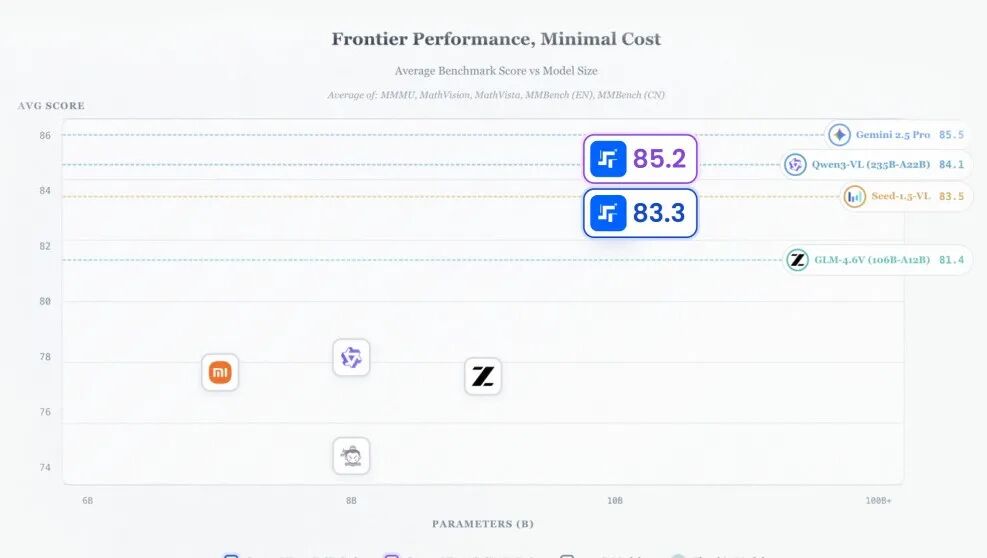
Model affordability is essentially a game between performance and operating cost. StepFun's open-sourced Step3-VL-10B achieves higher intelligence based on a smaller model — reaching performance levels comparable to 100B to 200B scale models in benchmarks for perception, math competitions, and logical reasoning.
This means that for some already-aligned key tasks, equivalent intelligence can now be obtained with fewer parameters and lower compute costs. Developers don't have to bear high costs.
OpenAI founding member Andrej Karpathy once pointed out that the future trend is "small and beautiful" models — using extremely high-quality data and reinforcement learning to enable models to release deeper intelligence in smaller physical footprints.
Essentially, this transforms AI from "raw material" into plug-and-play "components."
The Long Marathon
Andrej Karpathy also publicly questioned non-native approaches: he believes large language models have only a "secondhand understanding" of the physical world, because they lack the ability to directly perceive photons. They must enter the physical world to realize model value.
It is known that Sam Altman has reversed his position that models "don't need new hardware," and has begun secretly developing an AI-specific device that can perceive its surroundings.
StepFun Chairman Qi Yin also believes that StepFun's strategy is the integration of AI with endpoints, with three core scenarios now: individual, mobility, and home. "The individual is centered on phones and wearable devices; mobility is clearly centered on vehicles; for home scenarios, people previously focused more on consumer IoT, but in the future the home will be the core scenario for embodied intelligence."
We believe that the 2026 endpoint battle will likely catalyze three trends.
First, model companies will increasingly resemble system integrators or ecosystem companies.
Google is deeply integrating Gemini across its entire suite, hoping to transform from a "search tool" into an ecosystem company.
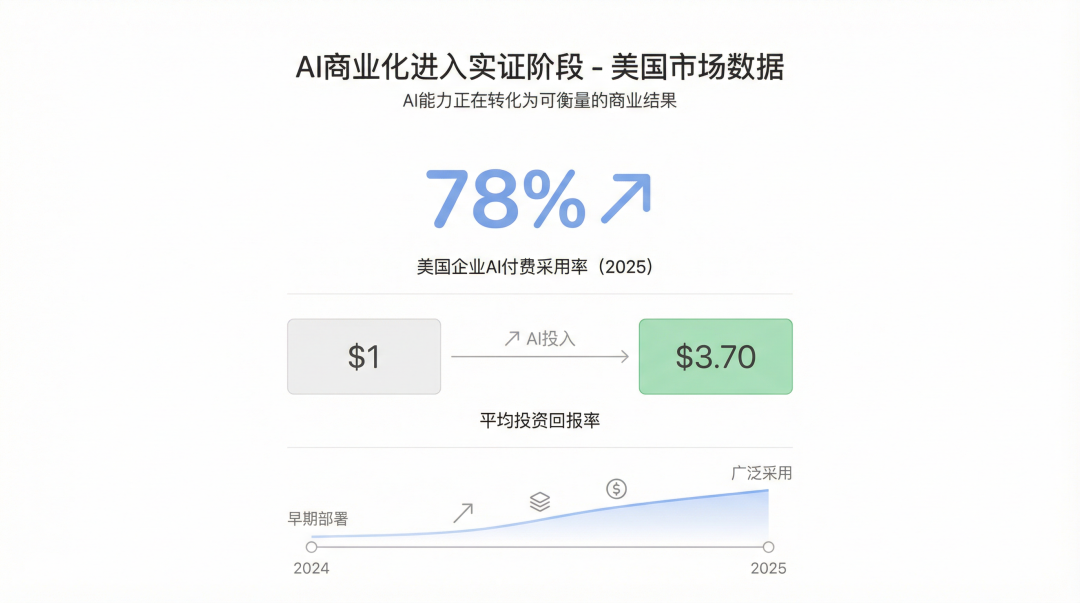
Second, competition will have concrete metrics such as installations, retention, and payment structures. AI capability will truly become business results.
One measurable standard: according to the latest 2025 United States statistics, AI adoption among paying enterprises has risen to 78%, with clear accounting that every $1 invested in AI budget delivers $3.70 in ROI.
Third: the new moat will be permissions, ecosystem partnerships, and edge-cloud collaboration engineering capabilities.
A16z's Marc Andrusko proposed the concept of a "permission economy." Large models can only access public data, but more complex scenarios lack data. Whoever gains access to more data permissions possesses an unreplicable moat.
At the WAIC conference held in Hong Kong, someone asked Founder Space Chairman Steve Hoffman: Who will win?
"The winning companies will be those that build the richest, deepest ecosystems — not just large language models, but encompassing platforms, industry integration, developers, and connections with consumers."
Technology history repeatedly proves: whoever owns the endpoints owns distribution rights and data reflux rights. The Android camp has long been mired in hardware commoditization and homogenized brand and channel competition; Apple relied on iOS + App Store + ecosystem services to rise from behind, now commanding higher market share.
Clearly, StepFun has chosen a technically promising winning path — betting on edge-cloud collaboration, advancing GUI Agent, and terminal ecosystem partnerships.
But having chosen the difficult but correct track, what faces them is an ultra-long marathon.
On one hand, numerous competitors; on the other, rapidly changing technology. This demands a startup without weak points — between radical technical paths and market feedback, they cannot easily make mistakes, must have sustained delivery capability, and also depend on capital's patience.
Images | Unsplash, Youmind